
How to Maximize Conversions with AI Automation in Insurance



Insurance didn’t suddenly become harder to sell. People simply became harder to convince. Customers today read more, compare more, and pause more often. They open a quote on their phone while waiting for coffee. They half-finish it between meetings. Then life steps in, and the moment passes.
Most of the time, they don’t come back. That’s not because insurance products are bad. It’s because the experience around them feels slow, heavy, and strangely outdated compared to everything else people use every day.
This is where AI automation in insurance starts to matter. Not as a flashy upgrade. Not as a trend. But as a quiet way to keep customers moving forward instead of drifting away. And when that happens, conversions follow.
The Conversion Challenge Facing Modern Insurance Companies
On the surface, many insurance businesses look healthy. Traffic is coming in. Campaigns are running. Lead forms are active. Yet when teams look closely at outcomes, something feels off.
Quotes are started but not finished. Follow-ups happen too late. Agents spend time chasing leads that were never serious in the first place. And genuinely interested customers sometimes wait too long for an answer. The problem isn’t a single broken step. It’s the space between steps.
Insurance journeys are long. They require attention, trust, and patience. The moment momentum breaks, intent fades. And intent, once lost, is hard to recover.
Traditional automation helped speed up tasks. It reduced manual work. But it didn’t solve decision delays. It didn’t adapt to customer behavior. And it didn’t know when to act quickly versus when to step back. That’s the gap AI automation fills.
Understanding AI Automation in Insurance
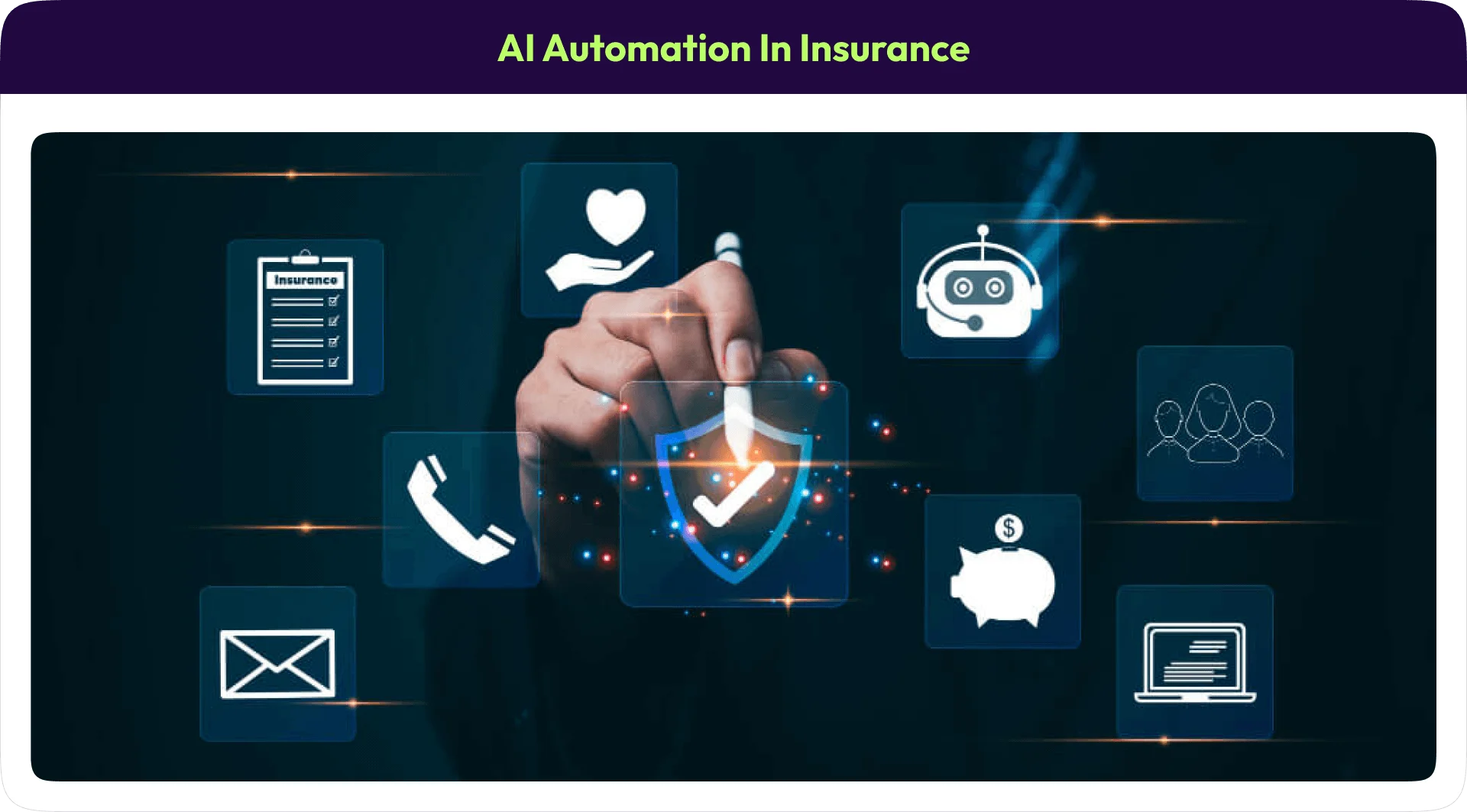
At its core, the idea is simple. Automation follows instructions. AI learns from behavior. Rule-based systems do exactly what they’re told. AI-powered automation watches patterns, notices signals, and adjusts actions based on what’s actually happening.
In insurance, that means systems can sense when someone is engaged, when they’re hesitating, or when they’re about to drop off. It can change the timing of a follow-up, surface the right information, or move a case forward without waiting for human input.
AI in insurance isn’t about replacing people. It’s about removing unnecessary pauses. Those pauses are often invisible, but they’re expensive. Once you see it that way, the value becomes very practical.
Why Conversion Optimization Matters More Than Traffic
Getting people to your site isn’t the hard part anymore. Keeping them moving is. Insurance buyers don’t behave like they used to. They don’t sit down with a single provider and patiently go through the process. They jump between tabs. They leave and return. They compare quietly.
If the journey underneath is slow or confusing, more traffic just means more people slipping away.
AI automation helps by responding in real time. It keeps progress visible. It reduces uncertainty. Sometimes it simply reminds someone where they left off, at the right moment, without sounding pushy. This isn’t persuasion. It’s momentum management. And in insurance, momentum is everything.
How AI Automation Improves Insurance Conversions at Every Stage
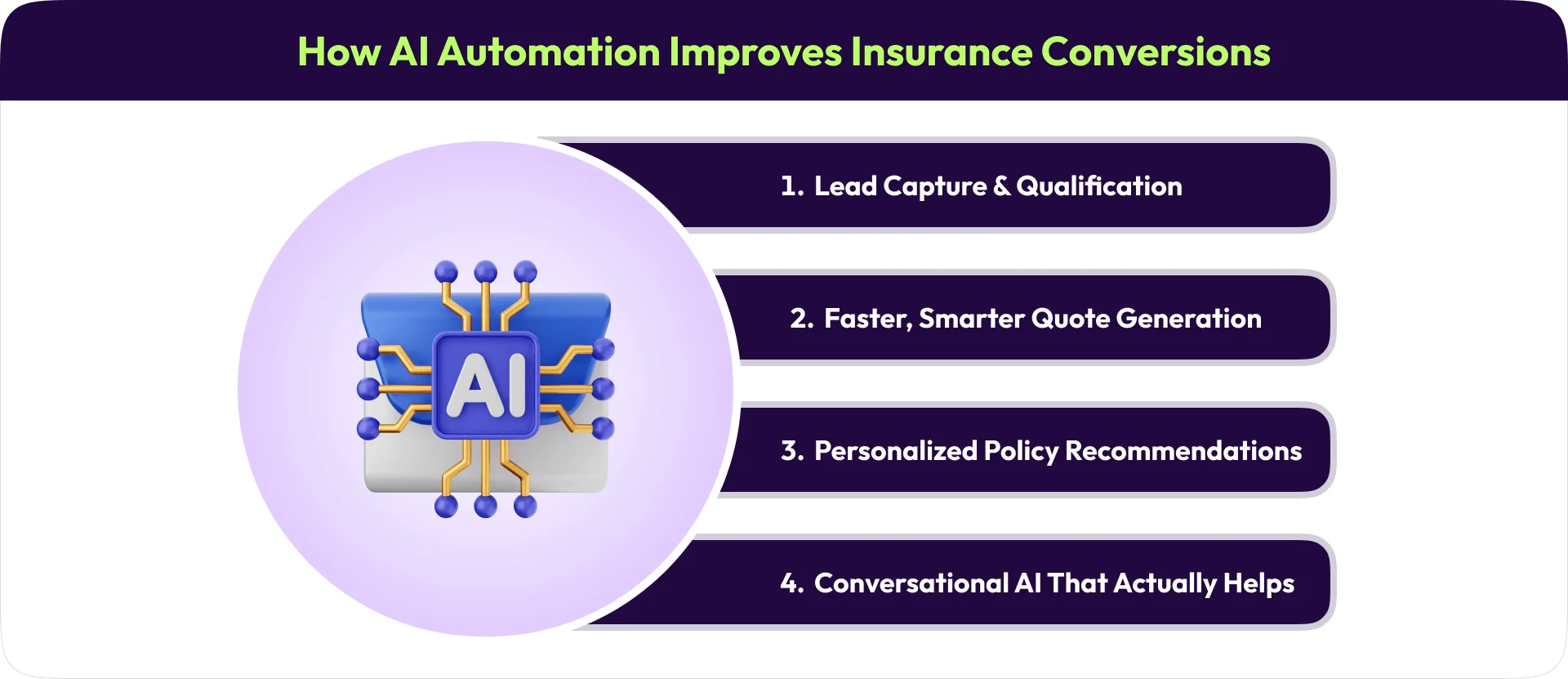
Lead Capture & Qualification
One of the quiet problems in insurance is that all leads are often treated the same. High-intent prospects wait just as long as casual browsers. Agents don’t always know who’s worth prioritizing until time has already been spent.
AI automation changes that dynamic. By observing behavior rather than just form submissions, systems can tell when someone is serious. How deeply they engage. How quickly they move. Where they pause.
This allows teams to respond faster to the right people and avoid burning energy on low-intent leads. Over time, conversion rates improve simply because effort is focused where it matters.
Faster, Smarter Quote Generation
Speed shapes perception, whether we like it or not. When quotes take too long, customers assume the process will stay slow. When quotes arrive quickly, the experience feels modern and trustworthy.
AI-powered automation pulls data from multiple sources at once, evaluates risk instantly, and produces accurate pricing without unnecessary delays. What used to take hours can now happen while the customer is still paying attention. This doesn’t just reduce abandonment. It changes how customers feel about the brand before a single policy is issued.
Personalized Policy Recommendations
Most people don’t enjoy choosing insurance. They want reassurance more than options. AI in insurance builds a picture of the customer based on data and behavior. It understands coverage needs, risk profiles, and context. Instead of presenting a long list of choices, it guides people toward what fits.
That guidance reduces doubt. Doubt is often what stalls decisions. When customers feel understood, they move forward with more confidence.
Conversational AI That Actually Helps
Everyone has had a bad chatbot experience. The kind that loops, misunderstands, or answers questions nobody asked. Modern conversational AI is different. When done right, it feels less like a bot and more like a helpful assistant who knows when to step aside.
These systems answer questions, guide users through quotes, and assist with onboarding. They’re available when humans aren’t. And when a situation needs a real person, they hand it off smoothly. Customers appreciate that balance. And they remember it.
Real-World Conversion Use Cases of AI in Insurance
Across the industry, similar patterns are emerging. Health insurers reduce drop-offs by guiding users gently through long forms instead of overwhelming them all at once. Auto insurers recover abandoned quotes by reaching out at the right time with relevant context. Life insurers simplify onboarding by automating document checks that used to slow everything down.
Claims teams use AI automation to keep customers informed, not with vague updates, but with clear, timely messages that reduce anxiety. None of these changes is dramatic on its own. Together, they quietly improve conversion, retention, and trust.
Where Insurance Companies Lose Conversions Without AI Automation
Loss in insurance rarely looks like failure. It looks like silence.
A quote that arrives too late.
A follow-up that never quite happens.
A generic message that doesn’t land.
Customers don’t complain. They just choose someone else. Without AI automation, teams rely heavily on manual effort and memory. And no matter how skilled people are, things slip through when volume grows. That’s not a talent issue. It’s a system issue.
AI Automation Across the Insurance Value Chain
AI automation in insurance isn’t confined to one department. It stretches across the entire journey. Marketing teams see better lead handling. Sales teams gain context. Underwriting becomes faster without sacrificing accuracy. Claims communication improves. Renewals feel timely instead of reactive.
When systems work together, customers feel less friction. They may not know why the experience feels smoother, but they notice the difference.
Implementing AI Automation in Insurance: A Practical Roadmap
The biggest mistake is trying to automate everything at once. The smarter approach is to start where friction hurts most. Often, that’s quoting, follow-ups, or onboarding. Improve one area. Measure the impact. Then expand. AI automation works best when it grows alongside the business. Not when it’s forced in everywhere overnight. Patience here pays off.
Common Concerns Around AI Automation in Insurance
Some hesitation is healthy. Cost is a common concern, but so is the cost of losing qualified leads every day. Fear of replacing agents comes up often too, even though most implementations reduce burnout rather than jobs.
Compliance and data security matter, especially in insurance. Today’s AI systems are designed with these realities in mind. This isn’t experimental tech anymore. Caution is reasonable. Avoidance is expensive.
Why Custom AI Automation Delivers Better Conversion Results
Generic tools are built for averages. Insurance workflows rarely are. Custom AI automation adapts to specific processes, regulations, and markets. It integrates more cleanly with existing systems and scales without forcing teams into awkward workarounds.
Over time, that flexibility shows up in the numbers. Conversions stabilize. Operations feel calmer. Growth becomes easier to sustain.
Choosing the Right AI Automation Partner for Insurance
Technology alone won’t fix conversion issues. The right AI Automation partner understands insurance logic, not just code. They ask uncomfortable questions early. They think about post-launch optimization, not just deployment.
That upfront thinking often makes the difference between a system that works and one that quietly gets ignored.
Conclusion: Turning AI Automation into a Conversion Engine
AI automation in insurance doesn’t force people to buy. It removes reasons not to. Less waiting. Less confusion. Less friction. When customers move easily through the journey, decisions follow naturally. That’s how conversions improve without pressure.
Frequently Asked Questions (FAQs)
1. What is AI automation in insurance, and how does it help conversions?
AI automation in insurance uses intelligent systems to speed up quotes, prioritize high-intent leads, and personalize customer interactions. By reducing delays and friction across the journey, insurers can convert more leads into policies. Alris helps design AI automation focused specifically on improving conversion outcomes.
2. Will AI replace insurance agents?
AI does not replace insurance agents. It supports them by handling repetitive tasks like data checks and basic queries. This allows agents to focus on complex cases and relationship building. Alris builds AI automation that works alongside agents, keeping the sales process human-led.
3. How quickly can AI increase conversion rates in insurance?
Conversion improvements can appear within a few months when AI automation is applied to high-impact areas like quote generation or lead routing. Faster responses often lead to fewer drop-offs. Alris AI typically starts with focused pilots to deliver measurable conversion gains before scaling.
4. What compliance and risk issues should insurers watch for when using AI?
Insurers must ensure data privacy, transparency, and fair decision-making when using AI. Human oversight and auditability are also important. We design AI automation solutions with compliance, security, and explainability built in to reduce regulatory and operational risks.
5. How much does it cost to implement AI automation in insurance?
Costs depend on the scope and level of customization. Small pilots are more affordable, while enterprise solutions require higher investment but offer stronger ROI. We help insurers prioritize use cases and build phased AI automation strategies aligned with business goals and budgets.
6. What are the best use cases of AI automation in insurance to improve conversions?
High-impact use cases include instant quote generation, intelligent lead scoring, automated follow-ups, and conversational AI. These directly reduce friction during the buying process. We focus on implementing conversion-driven use cases rather than spreading automation across low-impact areas.
7. How can Alris AI help insurance companies adopt AI automation successfully?
Alris supports insurers through strategy, custom AI automation development, system integration, and ongoing optimization. Their approach focuses on solving real conversion challenges, improving customer journeys, and building scalable AI solutions that align with insurance workflows and compliance needs.
Shravan Rajpurohit
CEO & Co-Founder
Shravan Rajpurohit is the Co-Founder & CEO of The Intellify, a leading Custom Software Development company that empowers startups, product development teams, and Fortune 500 companies. With over 10 years of experience in marketing, sales, and customer success, Shravan has been driving digital innovation since 2018, leading a team of 50+ creative professionals. His mission is to bridge the gap between business ideas and reality through advanced tech solutions, aiming to make The Intellify a global leader. He focuses on delivering excellence, solving real-world problems, and pushing the limits of digital transformation.

Stay Updated
with AI Insights
Get the latest articles on AI, automation, and enterprise technology delivered to your inbox weekly.

500+ people have already subsribed!
No spam. Unsubscribe anytime.