
10 Insurance Workflow Automation Opportunities You Should Implement in 2026



Insurance companies are under pressure right now. Claims are increasing. Regulations keep changing. Customers expect quick answers, sometimes instantly. But most insurers still rely on manual processes buried inside emails, spreadsheets, and disconnected systems. Teams spend hours moving data from one screen to another. Mistakes happen. Work slows down. Customers wait.
This is exactly why insurance workflow automation is becoming a serious priority for insurers heading into 2026.
Automation is no longer just about reducing paperwork. It’s about connecting data, systems, and decisions so operations move faster and smarter. When implemented correctly, it helps insurers handle claims more quickly, reduce operational costs, and improve the experience for both employees and policyholders.
In this guide, we’ll explore 10 practical insurance workflow automation opportunities that insurers should consider implementing in 2026.
Why Insurance Workflow Automation Is Becoming a Priority in 2026
Insurance operations are becoming more complex every year. What worked a decade ago… honestly, it’s starting to break. Let’s look at why automation is moving from “nice to have” to essential.
Growing operational complexity
Insurance companies manage thousands of processes across underwriting, claims, policy servicing, compliance, and customer support. Each step involves documents, approvals, and validations. Without workflow automation, these processes easily become slow and fragmented.
Rising customer expectations
Customers no longer accept long waiting periods for claims decisions or policy updates. They expect the same speed they experience with online banking or e-commerce. Automation helps insurers respond faster and keep customers informed.
Pressure to reduce operational costs
Manual processes require large teams and still lead to errors. Automating repetitive tasks allows insurers to reduce operational costs while maintaining service quality.
AI is reshaping insurance processes
Artificial intelligence is enabling smarter automation. Systems can now extract data from documents, identify patterns in claims, and support decision-making workflows.
Distributed teams require scalable systems
Many insurance teams now work across different locations or even countries. Automated workflows ensure everyone follows the same process, no matter where they operate.
From reactive to proactive operations
Traditional insurance operations react after problems occur. Automation allows insurers to monitor processes in real time and respond earlier before delays or issues escalate.
Challenges of Manual Insurance Workflows Today
Despite technology improvements, many insurers still rely on manual processes. And the problems show up quickly.
Delays from repetitive tasks
Employees spend hours copying information between systems or verifying documents manually.
High risk of data entry errors
Manual input increases the risk of incorrect policy data, claim details, or financial information.
Limited process visibility
Managers often struggle to track where a claim or application currently sits.
Large claim volumes
During events like natural disasters, manual systems quickly become overwhelmed.
Disconnected systems
When tools do not communicate with each other, teams end up duplicating work.
Compliance risks
Incomplete documentation or missing audit trails can create regulatory risks.
Slower customer response
Customers may wait days or weeks for updates. And honestly, that frustration shows up quickly in reviews.
Key Areas Where AI Is Transforming Insurance Operations
Before we dive into the specific automation opportunities, it helps to look at the areas where AI is already reshaping insurance. These include:
Claims handling
Underwriting
Policy lifecycle management
Customer communication
Regulatory compliance
Within these areas, workflow automation can significantly improve efficiency.
10 Insurance Workflow Automation Opportunities
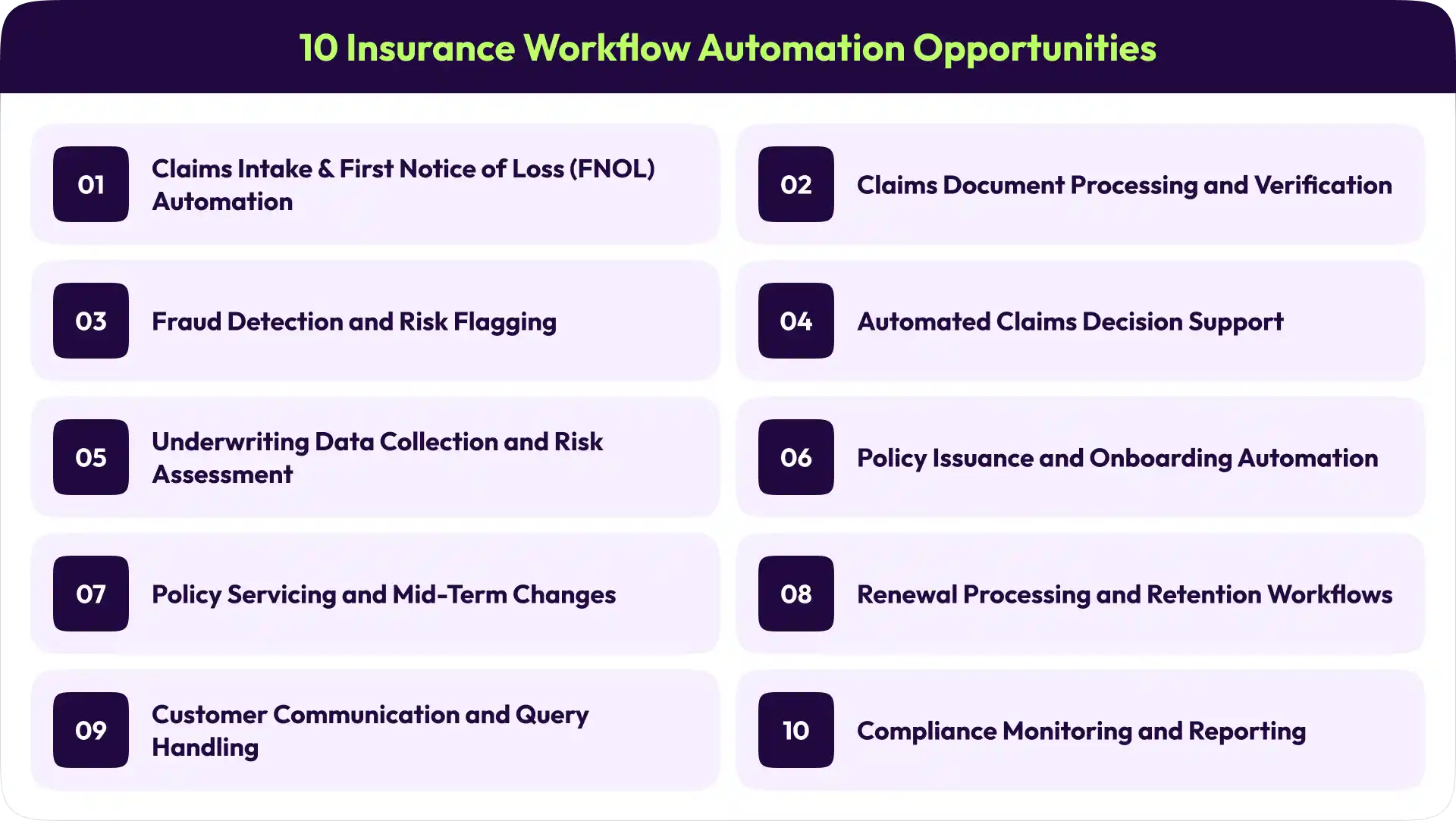
1. Claims Intake and First Notice of Loss (FNOL) Automation
Claims processing begins when a customer reports an incident. This step is called First Notice of Loss (FNOL). Traditionally, this information is collected manually through forms or customer service calls. Automation can streamline this process by:
Capturing claim details from digital forms, emails, or mobile apps
Extracting information from uploaded documents or photos
Automatically registering claims in internal systems
Validating policy information instantly
This reduces data entry errors and allows insurers to respond to policyholders much faster.
2. Claims Document Processing and Verification
Claims often involve multiple documents:
Medical reports
Repair invoices
Accident reports
Police documents
Photos
Processing these manually takes time. Automation tools can classify, verify, and extract information from documents automatically.
Benefits include:
Faster claim assessments
Improved document accuracy
Detection of missing information
Better audit readiness
For insurers managing thousands of claims each month, this can save significant operational effort.
3. Fraud Detection and Risk Flagging
Insurance fraud is a major challenge for the industry. Automation combined with AI can analyze patterns across claims data to detect suspicious activity early. These systems can:
Identify unusual claim behavior
Compare claims with historical data
Flag high-risk cases for review
Trigger investigation workflows
Instead of reviewing every claim manually, teams can focus only on potentially fraudulent cases.
4. Automated Claims Decision Support
Not every claim requires manual review. Many routine claims follow predictable patterns. Automation systems can evaluate claim eligibility using predefined rules and historical data. They may recommend:
Claim approval
Claim rejection
Escalation for manual review
This improves consistency and reduces claim processing time. Adjusters can then focus on complex cases instead of routine ones.
5. Underwriting Data Collection and Risk Assessment
Underwriting often involves gathering data from multiple sources. This includes:
Application forms
Financial documents
Medical records
Risk assessments
Automation tools can extract and validate this data automatically. This helps insurers:
Reduce underwriting cycle time
Improve data accuracy
Provide faster policy decisions
Underwriters can focus on complex risk evaluations rather than data entry.
6. Policy Issuance and Onboarding Automation
Once underwriting is complete, policies must be generated and delivered. This stage still involves several manual steps in many organizations. Workflow automation can handle tasks like:
Generating policy documents
Validating customer information
Sending documents to policyholders
Updating internal systems
This creates a smoother enrollment onboarding experience for customers while reducing administrative work.
7. Policy Servicing and Mid-Term Changes
Customers frequently request updates to their policies. These may include:
Address changes
Coverage adjustments
Beneficiary updates
Policy corrections
Automated workflows can process these requests quickly. Changes can be validated and updated across systems in real time. The result is faster service and fewer manual errors.
8. Renewal Processing and Retention Workflows
Policy renewals represent a critical revenue opportunity for insurers. Automation helps identify policies approaching renewal and trigger workflows automatically. These workflows may include:
Risk re-evaluation
Renewal quote generation
Customer notifications
Retention offers for high-value clients
Instead of reacting at the last minute, insurers can proactively manage renewals.
9. Customer Communication and Query Handling
Insurance customers often contact companies to check claim status or policy details. Customer support automation can handle many routine interactions.
Examples include:
Automated claim status updates
Policy reminders
Response to common inquiries
Omnichannel messaging (email, chat, SMS)
This reduces the workload on call center teams while improving response speed.
10. Compliance Monitoring and Reporting
Insurance companies operate under strict regulatory requirements. Manual compliance tracking increases risk. Workflow automation can help by:
Maintaining audit trails automatically
Tracking regulatory requirements
Generating compliance reports
Ensuring documentation completeness
This reduces compliance risks and simplifies reporting processes.
A Practical Roadmap to Start Automation in Insurance
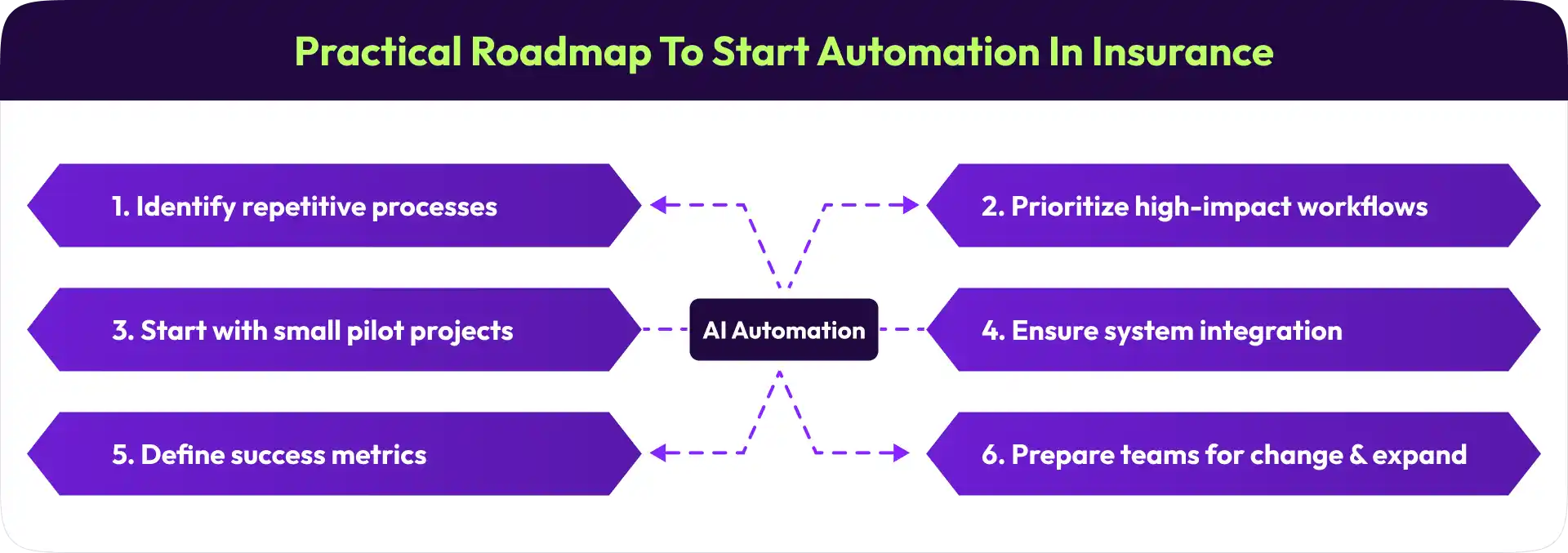
Implementing automation doesn’t require replacing every system overnight. A gradual approach works better. Here’s a simple roadmap insurers can follow.
Identify repetitive processes: Start with processes that involve heavy manual effort.
Prioritize high-impact workflows: Focus on areas where automation can improve speed or reduce errors. Claims processing is often a good starting point.
Start with small pilot projects: Testing automation on smaller workflows helps teams learn and refine processes.
Ensure system integration: Automation platforms should connect with existing systems rather than replace them immediately.
Define success metrics: Track measurable outcomes such as Processing time, error reduction, and customer response time.
Prepare teams for change: Automation changes workflows. Employees should understand how their roles evolve.
Expand gradually: Once the first projects succeed, automation can expand across departments.
Key Factors Before Implementing AI in Insurance Workflows
Not every automation tool is designed for insurance operations. When evaluating solutions, insurers should consider several factors.
Ability to process unstructured documents
Insurance processes depend heavily on documents. The solution should extract data from PDFs, images, and scanned forms accurately.
AI model reliability
Automation tools must produce consistent and reliable results. Poor accuracy creates more work instead of reducing it.
Integration with legacy systems
Many insurers rely on legacy platforms. Automation tools must connect with existing systems without major disruptions.
Scalability
As organizations grow, automation should support increasing workloads across departments.
Security and compliance readiness
Insurance data includes sensitive personal information. Solutions must meet strict security and compliance requirements.
End-to-end workflow orchestration
The best platforms manage the entire workflow from document intake to final decision.
The Business Impact of Intelligent Workflow Automation
When implemented correctly, insurance workflow automation delivers measurable results.
Faster processing times: Claims, policy updates, and underwriting decisions happen much quicker.
Lower operational costs: Automation reduces manual work and operational overhead.
Improved accuracy: Automated workflows reduce human errors in data processing.
Higher employee productivity: Employees can focus on higher-value tasks instead of repetitive work.
Better customer experience: Customers receive faster responses and more transparency.
Stronger competitive position: Insurers that automate operations can adapt faster to market changes.

Final Thought
Insurance companies are entering a period of rapid operational change. Customer expectations are rising. Regulations are evolving. And claim volumes continue to grow. In this environment, insurance workflow automation is no longer optional. Organizations that continue relying on manual processes will struggle to keep up. The smarter approach is to begin gradually identifying key processes, implement automation in stages, and scale based on results.
Companies that start early gain a significant advantage. Their operations become faster, more reliable, and better prepared for future challenges. The goal isn’t just efficiency. It’s building resilient insurance operations ready for 2026 and beyond.
Frequently Asked Questions (FAQs)
1. What is insurance workflow automation, and how is it different from basic automation?
Insurance workflow automation connects multiple steps across claims, underwriting, and policy processes so work moves forward automatically without constant manual intervention. Unlike basic automation that handles single tasks, workflow automation manages the entire process from data intake to final decision while keeping teams informed along the way.
2. How does AI improve insurance claims processing?
AI can quickly extract information from documents, images, and forms, classify claim types, and flag missing details. This reduces manual review time and helps adjusters focus on complex cases rather than routine tasks. It also improves consistency in how claims are handled.
3. Is workflow automation suitable for both large insurers and mid-size companies?
Yes. While large insurers use automation to manage scale, mid-size companies often benefit even more because it helps them compete without dramatically increasing staff. Modern solutions are designed to integrate with existing systems and can be implemented gradually.
4. Will automation replace human roles in insurance operations?
Automation is meant to handle repetitive administrative work, not replace expertise. Underwriters, claims specialists, and service teams still make critical decisions, especially in complex situations. In most cases, automation actually frees employees to focus on higher-value work.
5. How long does it typically take to implement insurance workflow automation?
It depends on the scope, but many organizations start seeing results within a few months when they begin with targeted workflows such as claims intake or document processing. A phased approach is usually more effective than trying to automate everything at once.
6. How should insurers prioritize which workflows to automate first?
Start with processes that are high-volume, rule-based, and prone to errors. Areas where delays directly affect customers, such as claims handling or policy servicing, usually deliver the fastest and most visible improvements.
Shravan Rajpurohit
CEO & Co-Founder
Shravan Rajpurohit is the Co-Founder & CEO of The Intellify, a leading Custom Software Development company that empowers startups, product development teams, and Fortune 500 companies. With over 10 years of experience in marketing, sales, and customer success, Shravan has been driving digital innovation since 2018, leading a team of 50+ creative professionals. His mission is to bridge the gap between business ideas and reality through advanced tech solutions, aiming to make The Intellify a global leader. He focuses on delivering excellence, solving real-world problems, and pushing the limits of digital transformation.

Stay Updated
with AI Insights
Get the latest articles on AI, automation, and enterprise technology delivered to your inbox weekly.

500+ people have already subsribed!
No spam. Unsubscribe anytime.