

10 Healthcare Workflow Automation for Faster and Smarter Operations
Healthcare workflow automation helps hospitals and clinics reduce manual work, improve efficiency, and deliver better patient experiences. This blog explains why automation is essential in 2026 and highlights 10 key healthcare workflows worth automating, from appointment scheduling to billing and patient communication. It also covers real-world benefits, common implementation challenges, and practical steps to get started with AI automation in healthcare without overwhelming teams or disrupting day-to-day operations.

Table of Contents
Healthcare teams are busy. Not just busy, overloaded. Front desk staff handle calls nonstop. Nurses juggle admin work with patient care. Billing teams chase paperwork that never seems to end. And somehow, things still slip through: missed calls, delayed appointments, and incorrect entries. It is frustrating, honestly.
This is where healthcare workflow automation starts to make sense. Not as a trend, but as something practical. Something that actually fixes day-to-day operational chaos.
In 2026, automation in healthcare is not just about saving time. It is about making systems work without constant human intervention. Whether it is answering patient calls at midnight or verifying insurance in seconds, AI automation in healthcare is quietly changing how hospitals and clinics run.
And the question is no longer if you should automate. It is what should you automate first?
What Is Healthcare Workflow Automation?
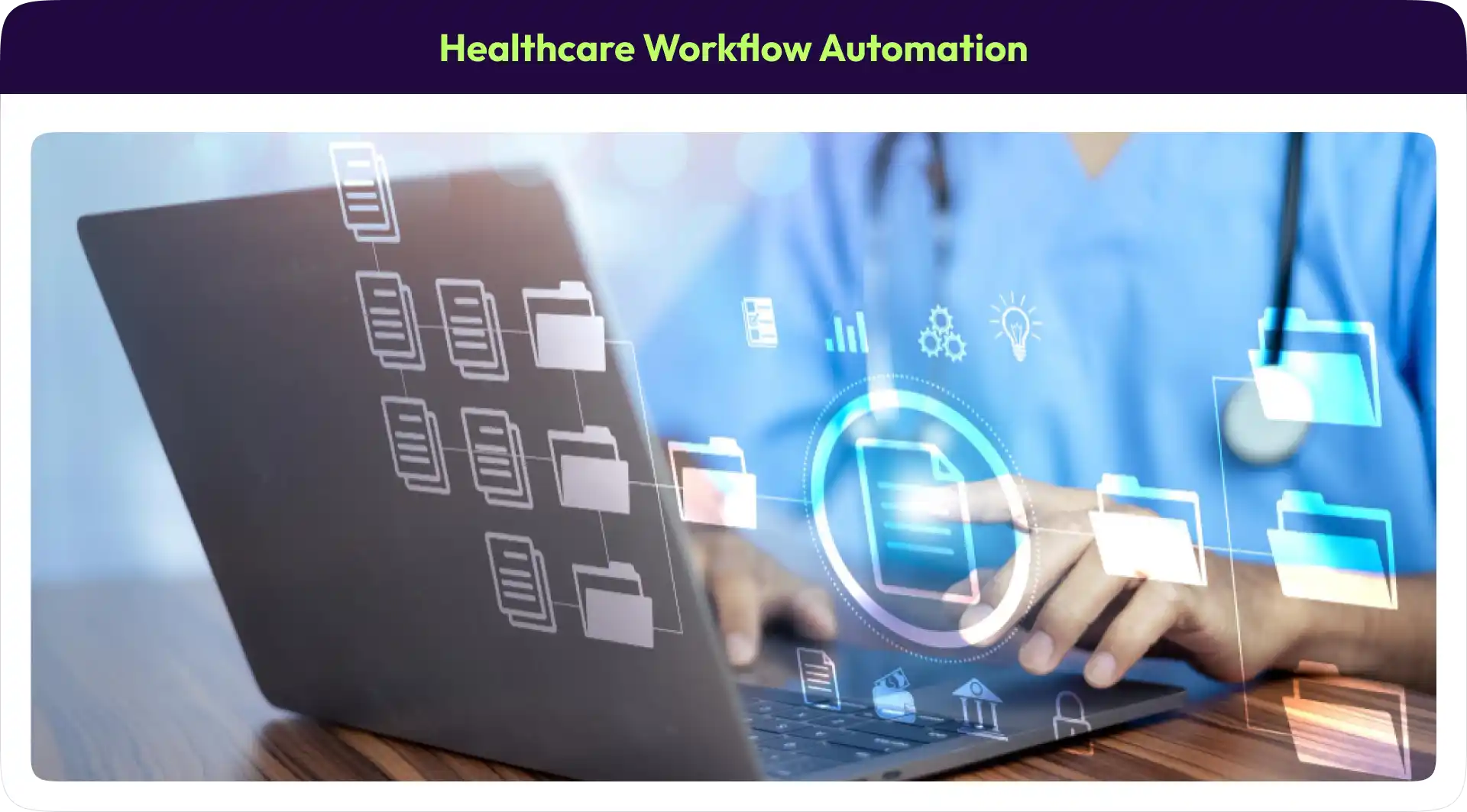
In simple terms, healthcare workflow automation means using software, often powered by AI, to handle routine tasks without manual effort.
Instead of a receptionist scheduling appointments manually, a system does it. Instead of staff calling patients for reminders, automated messages go out. Instead of someone checking insurance details line by line, AI tools can handle it in seconds.
It is not about replacing people. It is about removing repetitive work so teams can focus on patient care and higher-value decisions.
A few everyday examples include:
Appointment booking systems
Automated patient intake forms
Billing and claim processing tools
AI voice agents handling incoming calls
When done right, healthcare automation reduces friction. Things move faster. Staff get breathing room. Patients do not feel ignored.
Why Healthcare Automation Is No Longer Optional in 2026
Healthcare systems are under pressure. Patient expectations have changed. People want quick responses, and no one wants to stay on hold for ten minutes just to book an appointment. If that happens, many patients simply hang up or go somewhere else.
At the same time, staff shortages remain a serious problem. Many clinics and hospitals do not have enough people to handle growing demand, so the workload keeps piling up. There is also the accuracy factor. Manual processes lead to errors, and in healthcare even small mistakes can create big issues.
This is why healthcare AI automation is becoming a baseline, not a luxury.
Patients expect 24/7 availability
Staff need relief from repetitive tasks
Operations need to be faster and cleaner
Compliance requires better documentation
Healthcare organizations cannot solve all of this simply by hiring more people. That approach does not scale well, but automation does.
Benefits of Healthcare Workflow Automation
When you automate even a few workflows, the impact starts showing up quickly. Not in a dramatic everything-changed-overnight way, but in small and visible improvements that add up across the organization.
Faster operations
Tasks that used to take hours, like verifying insurance or processing forms, can happen in minutes or even seconds. Patients move through the system faster, and staff do not get stuck waiting on basic administrative tasks.
Reduced manual workload
A lot of administrative work in healthcare is repetitive. Entering data, calling patients, and checking details takes time. Automation takes over much of this work so staff can focus more on actual patient care.
Better patient experience
Patients do not like waiting, whether it is on a call or at the front desk. Automation helps organizations respond instantly by booking appointments, sending reminders, and sharing updates in a smoother way.
Cost control without cutting corners
Instead of continually adding more administrative staff to manage rising demand, healthcare teams can use automation to handle more volume efficiently. It is not about replacing people. It is about scaling operations more sustainably.
Fewer errors
Manual work naturally leads to mistakes such as typos, missed entries, and incorrect details. Automated systems follow defined rules consistently, so error rates usually drop.
24/7 availability
Patients do not always reach out during working hours. AI-powered systems can handle common requests late at night, early in the morning, and over weekends without interruption.
Better coordination across teams
When workflows are automated, tasks do not get lost between departments. Teams have better visibility into what needs to be done and when.
Scalability without chaos
As patient volumes grow, operations do not have to break down. Automation helps healthcare systems absorb more demand without everything becoming messy.
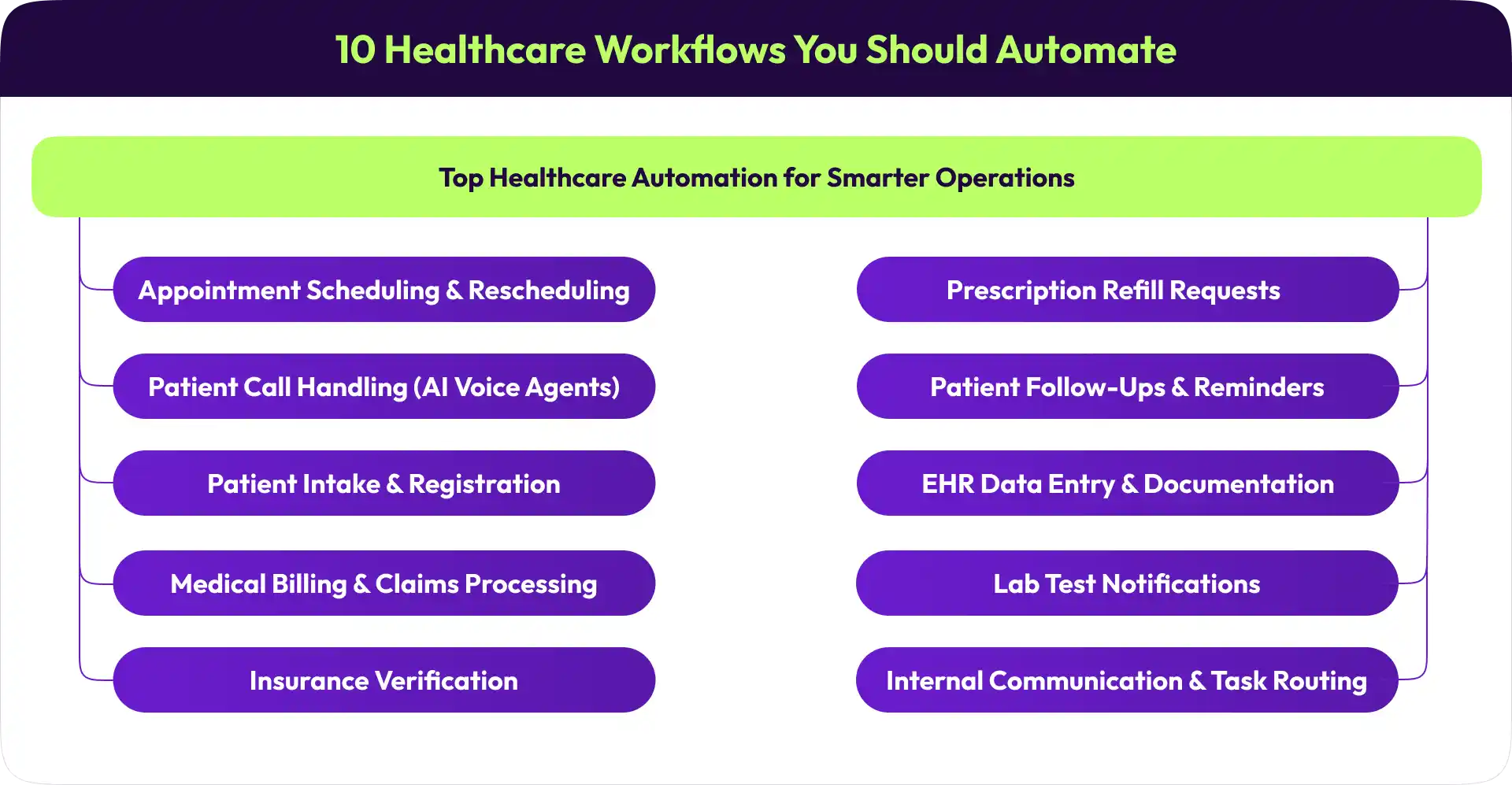
10 Healthcare Workflows You Should Automate in 2026
1. Appointment Scheduling and Rescheduling
Scheduling sounds simple, but it rarely is. Patients call, cancel, reschedule, or miss appointments altogether. Automation allows patients to book appointments online or through voice systems and reschedule without calling the front desk.
Outcome: Fewer empty slots, less back-and-forth communication, and more organized schedules.
2. Patient Call Handling with AI Voice Agents
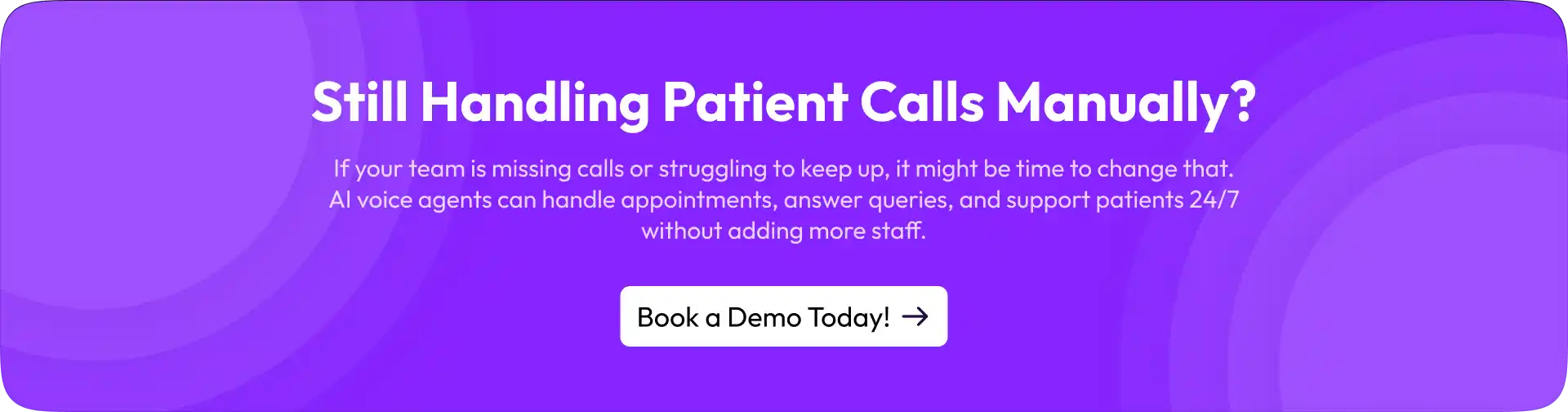
Front desk teams can only answer so many calls at once. The rest are missed. AI voice agents can answer every incoming call and support common requests automatically.
These systems can:
Book appointments
Answer common questions
Route urgent cases to the right team
Outcome: Fewer missed calls and better response times for patients.
3. Patient Intake and Registration
Patients filling out forms at reception slows things down, and staff often have to re-enter the same information again. With automation, patients complete forms online before arriving and the data flows directly into the system.
Outcome: Faster check-ins and less duplicated work.
4. Medical Billing and Claims Processing
Billing is one of those areas where small errors create major delays. Automation helps validate patient and insurance details, generate bills, and submit claims more efficiently.
Outcome: Faster payments and fewer rejected claims.
5. Insurance Verification
Verifying insurance manually takes time, and important details sometimes get missed. Automated systems can check coverage instantly through integrated data sources.
Outcome: More accurate information and less waiting for both patients and staff.
6. Prescription Refill Requests
Patients often call or visit just to request prescription refills. Staff write the request down and pass it along to doctors. Automation lets patients submit refill requests digitally so clinicians can review and approve them within the workflow.
Outcome: Faster processing and less phone traffic.
7. Patient Follow-Ups and Reminders
No-shows are frustrating for both staff and patients. Automated reminders through SMS, email, or voice can reduce missed appointments, and follow-up messages after visits can be scheduled automatically.
Outcome: Better attendance and more consistent care.
8. EHR Data Entry and Documentation
Entering patient data manually into EHR systems is time-consuming and exhausting. AI tools can support this by capturing data from forms, organizing records, and updating systems automatically.
Outcome: More accurate data and less manual effort for staff.
9. Lab Test Notifications
Patients often call repeatedly to ask whether results are ready. Automation can send notifications as soon as reports are available so patients do not need to keep calling.
Outcome: Lower call volume and better communication.
10. Internal Staff Communication and Task Routing
Sometimes delays happen simply because tasks are not assigned clearly. Automation tools can assign work automatically, send reminders, and track progress across teams.
Outcome: Clearer responsibility and faster execution.
Real-World Example: How Automation Transforms Healthcare Operations
Let’s take a realistic scenario. A clinic handling around 300 to 400 calls a day. That may sound manageable, but it often is not.
Before automation:
Around 25% of calls go unanswered
Patients wait on hold
Staff feel constantly rushed
Appointment slots get mismanaged
After introducing healthcare workflow automation:
AI voice agents answer incoming calls instantly
Patients can book appointments without speaking to staff
Automated reminders reduce no-shows
Intake forms are completed before visits
After a few months, missed calls drop significantly, staff have more time for in-person patients, scheduling becomes more predictable, and patients complain less about delays. It is not always a dramatic overnight change, but the system feels calmer and more controlled.
Challenges in Implementing Healthcare Automation
It is not always smooth. There are a few common challenges healthcare organizations usually run into while adopting automation.
Legacy systems do not always cooperate
Many hospitals still use older software. Integrating automation tools with these systems can take more effort than expected.
Data privacy concerns
Healthcare data is sensitive, so any automation platform needs to follow strict security and compliance requirements. This can slow down implementation, but it is necessary.
Staff hesitation
Some team members worry automation may replace their roles. Others simply do not want to change familiar workflows. That resistance is common.
Initial setup effort
Setting up workflows takes time. Teams need to define processes clearly before automating them. Otherwise, they end up automating confusion.
Cost concerns
There is usually an upfront investment. Even when the long-term return is clear, the initial cost can still feel like a barrier.
Still, most of these challenges are temporary. Once systems are in place and teams adjust, operations tend to get much easier.
How to Get Started with Healthcare Workflow Automation
If you try to automate everything at once, it usually fails. Too many changes happening at the same time create confusion. A better approach is to start small and expand gradually.
Pick one or two workflows
Start with high-impact areas such as appointment scheduling or call handling. These usually show quick results.
Choose tools that integrate easily
Avoid solutions that require rebuilding your entire system. Look for tools that work with the systems you already use.
Focus on patient-facing workflows first
Improvements here are visible immediately. Patients notice quicker responses and smoother interactions.
Train your team properly
Even simple systems need basic training. If staff do not understand how to use the workflow, adoption will suffer.
Track results
Measure metrics such as missed calls, no-show rates, response times, and processing time to see what is improving.
Expand gradually
Once the first few workflows are working well, move to the next areas step by step. That is how most healthcare organizations build automation successfully.
Why Choosing the Right Healthcare Automation Partner Matters
Choosing the right partner matters more than the tool itself. Healthcare is not like other industries. There are compliance requirements, patient expectations, and complex systems involved. A generic automation tool may not fit those realities well.
That is where a platform like Alris AI can fit better by focusing on practical healthcare use cases instead of trying to do everything at once.
Examples include:
AI voice agents for handling patient calls
Workflow automation across departments
Integration with existing healthcare systems
What often stands out is simplicity. Healthcare teams usually do not want a massive transformation project just to see basic results. They want a solution that fits into daily operations without making work harder.
Support matters too. When something does not work, organizations need a team that understands healthcare workflows, not just software.
Conclusion
Healthcare systems cannot keep running on manual processes at this scale. Healthcare workflow automation helps reduce pressure, improve efficiency, and create better patient experiences. It is not about replacing people. It is about helping them do their jobs without constant overload.
If your organization is still relying on manual workflows for core operations, it may be time to rethink the way those systems work.
Frequently Asked Questions (FAQs)
1. What is Healthcare Workflow Automation, and how does it work?
Healthcare workflow automation uses AI and software to handle routine tasks like scheduling, billing, and patient communication automatically. Solutions like Alris AI manage these workflows in the background, reducing manual effort and improving efficiency.
2. Why is Healthcare Workflow Automation important in 2026?
Healthcare demand is growing, but staff capacity remains limited. Automation helps hospitals and clinics manage more patients, respond faster, and reduce errors. Platforms like Alris AI support 24/7 operations without increasing team workload.
3. What are the best workflows to automate in healthcare?
The most valuable workflows to automate usually include appointment scheduling, patient calls, billing, insurance verification, and follow-ups. These are high-volume processes where automation can improve speed, accuracy, and consistency.
4. How does AI automation improve patient experience?
AI automation reduces wait times and improves access to care. Patients can book appointments, get answers, and receive reminders instantly. Alris AI helps healthcare organizations support patients anytime, even outside regular working hours.
5. Can Healthcare Workflow Automation reduce missed patient calls?
Yes. AI voice agents can answer every call and handle basic queries or bookings automatically. This helps clinics avoid missed calls, improve response rates, and offer more consistent patient support.
Share This Article
If you found this article helpful, share it with your network
Shravan Rajpurohit
CEO & Co-Founder
Shravan Rajpurohit is the Co-Founder & CEO of The Intellify, a leading Custom Software Development company that empowers startups, product development teams, and Fortune 500 companies. With over 10 years of experience in marketing, sales, and customer success, Shravan has been driving digital innovation since 2018, leading a team of 50+ creative professionals. His mission is to bridge the gap between business ideas and reality through advanced tech solutions, aiming to make The Intellify a global leader. He focuses on delivering excellence, solving real-world problems, and pushing the limits of digital transformation.
Stay Updated with AI Insights
Get the latest articles on AI, automation, and enterprise technology delivered to your inbox weekly.
No spam. Unsubscribe anytime.
Ready to Transform Your Workflows?
Join thousands of businesses already using Alris to automate their operations and boost productivity.