
How AI Agents Help Restaurants Run Smarter With Less Staff



Summary: AI agents for restaurants are software systems that can understand customer requests and complete tasks such as answering calls, taking orders, booking reservations, sending reminders, and handling follow-ups. For US restaurants, they can help reduce communication workload, capture after-hours enquiries, support direct ordering, and give staff more time to focus on guests.
Running a restaurant with a lean team can get difficult fast. During a busy Friday night, the same few employees may be serving tables, handling takeout orders, answering questions, managing reservations, and picking up the phone. When several things happen at once, something gets missed.
Usually, it's the phone. A customer calls about a reservation. Nobody answers. They call another restaurant. Another customer wants to change their booking. The host is too busy. Someone calls after closing to place an order. They get voicemail.
These aren't huge problems individually. But across hundreds of calls and reservations, they can add up.
This is where AI agents for restaurants can help. Instead of simply automating one task, an AI agent can understand a customer's request, respond naturally, and take an action such as booking a table, taking an order, answering a question, or sending a confirmation.
This guide looks specifically at communication AI agents and how US restaurants can use them in 2026 to handle more customer communication without constantly adding more work to an already busy team.
What Are AI Agents for Restaurants?
An AI agent for restaurants is software that can understand what a customer is asking and take the appropriate action. That's different from a basic chatbot or phone menu.
A traditional phone system might say: "Press 1 for reservations. Press 2 for orders."
An AI voice agent can understand: "I'd like to move my reservation from Saturday to Sunday, preferably around 7." It can then check availability, offer available times, confirm the customer's choice, and send a confirmation.
This is the important part: the agent doesn't just respond. It can complete a workflow.
Restaurant voice AI can handle tasks such as:
Answering inbound calls
Taking phone orders
Booking reservations
Rescheduling or cancelling bookings
Answering common questions
Sending SMS confirmations
Running reminder campaigns
Following up with customers
Re-engaging customers who haven't visited recently
The exact capabilities depend on the platform and its integrations.
Why communication AI agents specifically
Communication is one of the areas where restaurant staffing pressure becomes obvious. Calls often arrive when employees are already busy serving customers.
Full-service restaurant labor costs were reported at a median of 36.5% of sales, while the National Restaurant Association reported that 42% of restaurant operators were not profitable in 2025.
Adding another employee just to answer routine calls isn't always practical.
Communication AI agents offer another option: handle repetitive customer conversations while employees stay focused on the guests already inside the restaurant.
The Communication Problems AI Agents Solve for US Restaurants
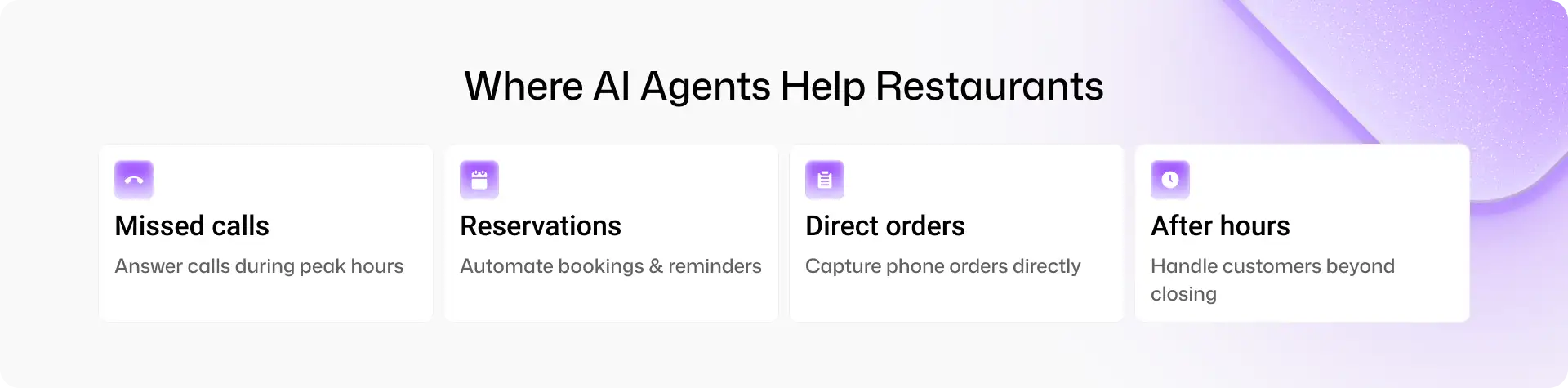
The phone coverage gap during service
The restaurant phone always seems to ring at the worst possible moment. A server is carrying food. The host is seating a large party. The manager is dealing with a kitchen issue. And the phone keeps ringing.
The problem is structural. Peak service hours are also often peak communication hours. If an employee answers the phone, they're pulled away from another task. If nobody answers, the restaurant risks losing the customer.
An AI voice agent can answer these calls without requiring someone on the floor to stop what they're doing.
After-hours: the silent revenue gap
Customers don't stop searching for restaurants when the restaurant closes. They may want to make a reservation, ask about catering, place an order, or check the menu at 9 or 10 p.m.
The National Restaurant Association has reported that nearly 75% of restaurant traffic is now off-premises, including takeout and delivery.
That makes after-hours communication worth paying attention to. Instead of sending customers straight to voicemail, an AI agent can continue handling supported requests. The customer gets an answer. The restaurant gets another opportunity to capture the business.
The no-show problem
No-shows are frustrating because the restaurant has already allocated the table, staff, and operating capacity.
OpenTable and YouGov reported that 28% of Americans surveyed had missed a restaurant reservation in the previous year. OpenTable has also reported that deposits reduced no-shows by an average of 57% on its platform.
Manual confirmation can help, but it depends on staff remembering to do it consistently.
AI agents can automate confirmation and reminder messages for every reservation.
They don't get busy and forget the 8:30 p.m. booking.
The third-party commission drain
Third-party delivery platforms can take a meaningful percentage of an order.
The provided research notes commission rates of roughly 15-30% across major US delivery platforms, while TouchBistro/Harris Poll research found that 29% of direct takeout diners in the US usually order by phone.
That makes direct phone ordering an interesting channel.
If an AI agent can answer the call, take the order accurately, and send it into the restaurant's ordering system, the restaurant can potentially keep more direct business instead of sending every customer through a marketplace.
How Communication AI Agents Work in a Restaurant
The end-to-end communication workflow
A typical workflow can look like this:
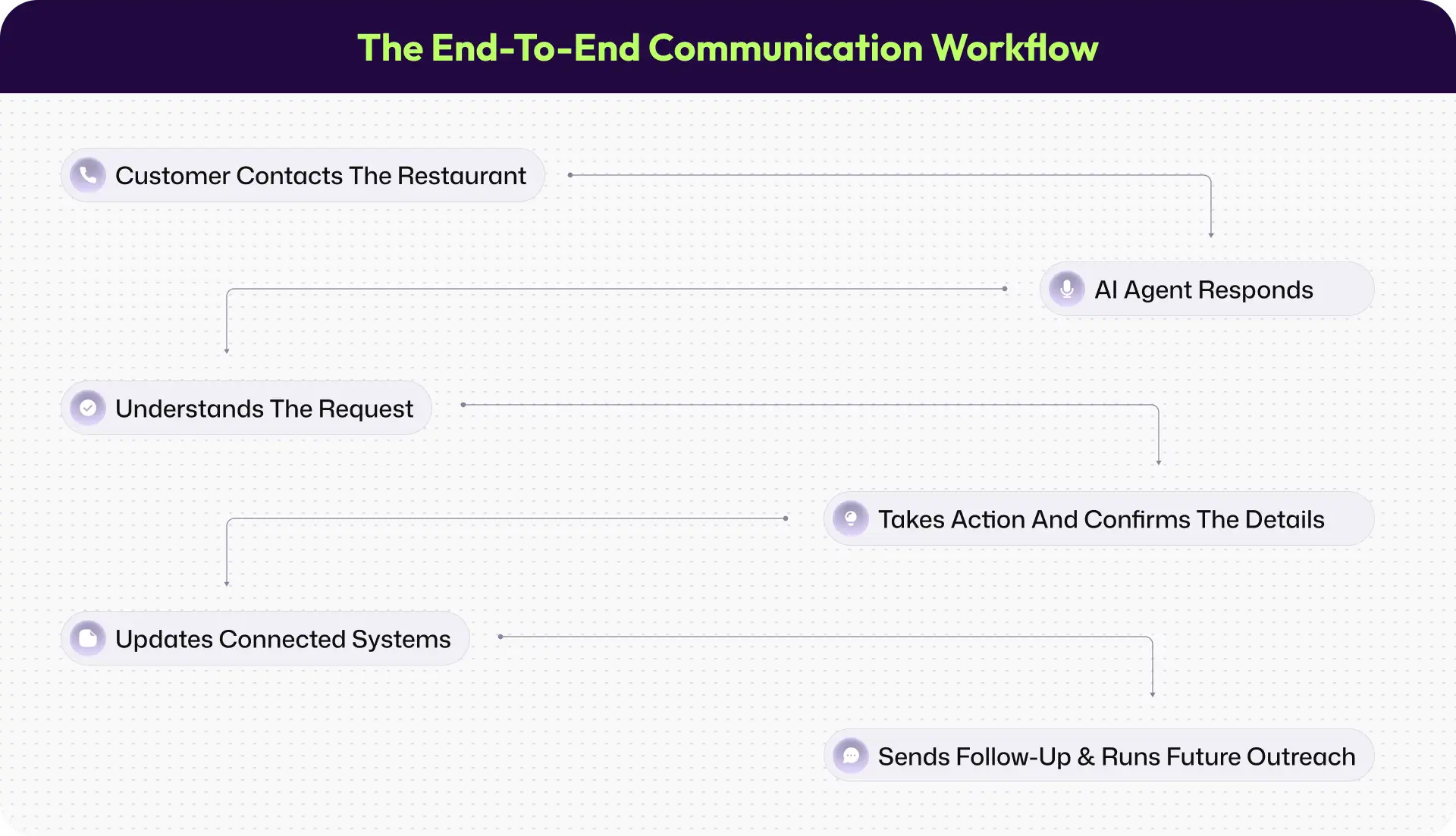
For example, a customer calls to book a table. The agent can check availability, make the reservation, repeat the date and time, send an SMS confirmation, and later trigger a reminder. The call is only the beginning of the workflow.
How AI agents handle simultaneous communication during peak US service hours
Humans have a very obvious limitation: one person can normally handle one phone conversation at a time. AI systems can handle multiple conversations simultaneously, depending on the platform's capacity.
So if five customers call during a Saturday dinner rush, the restaurant doesn't necessarily have to put four callers on hold. Each conversation can be handled independently.
For restaurants with heavy lunch, dinner, or weekend call volumes, this can reduce the pressure on the front-of-house team.
The omnichannel difference
Customers don't communicate through only one channel. A customer might call to make a reservation, receive an SMS confirmation, and later respond to that message.
If every channel is handled separately, the customer experience can become fragmented. An omnichannel AI system connects channels such as:
Voice
SMS
Email
Other supported messaging channels
The goal is simple: the conversation should continue instead of starting from scratch every time the customer switches channels.
What Communication AI Agents Do for US Restaurants
1. Handling inbound calls - orders, reservations, and enquiries
AI agents can answer common restaurant calls without staff intervention. Typical requests include:
Reservations
Takeout orders
Order modifications
Opening hours
Menu questions
Location information
Catering enquiries
Large-party requests
For orders, the agent can repeat the details before completing the transaction. That matters because a misunderstood order can create another problem for the kitchen and the customer.
2. Automating reservation management and no-show reduction
An AI agent can manage several parts of the reservation process:
Check availability
Book tables
Reschedule bookings
Handle cancellations
Send confirmations
Send reminders
Manage waitlist notifications
This removes a lot of repetitive communication from the front desk. It also makes the process more consistent.
3. Capturing and converting after-hours communication
A restaurant might close at 9 p.m., but customers can still call afterward. An AI agent can continue handling supported tasks such as:
Reservations
Orders
Catering enquiries
Large-party requests
Common questions
Instead of collecting a voicemail and hoping someone follows up the next morning, the restaurant can potentially resolve the request immediately.
4. Outbound communication - reminders, recall, and reactivation
AI agents aren't limited to inbound calls. They can also start conversations.
For example:
Reminders: "Just a reminder about your reservation tomorrow at 7 p.m."
Recall: "We haven't seen you in a while. Would you like to book your next visit?"
Post-visit follow-up: "How was your experience?"
Reactivation: Reach customers who haven't visited in 60, 90, or 120 days.
These are simple tasks, but doing them consistently can be difficult when staff has dozens of other things to handle.
5. Protecting direct order revenue from third-party platforms
Direct orders can help restaurants reduce their reliance on third-party marketplaces. AI agents can make phone ordering easier by answering immediately, understanding modifications, confirming the order, and sending it into the connected ordering workflow.
The basic calculation is: Direct order volume × applicable commission rate = potential commission avoided
The actual result depends on the restaurant's current ordering mix, average order value, and platform agreements.
Communication AI Agents Across US Restaurant Types
Full-Service and Fine Dining
For full-service restaurants, reservation management is often the biggest communication use case. AI agents can help with:
Reservations
Large-party enquiries
Changes and cancellations
Waitlists
Confirmation messages
Post-visit communication
For fine dining, conversation quality matters just as much as automation. Customers expect clear and polite communication. A system that sounds awkward or struggles with basic requests can create more work instead of reducing it.
Quick Service and Fast Casual Chains
For QSRs and fast-casual restaurants, phone ordering and peak-hour call handling can be more important. AI agents can:
Take phone orders
Handle modifications
Answer menu questions
Capture direct orders
Handle multiple calls during busy periods
The 29% phone-ordering figure in the provided research highlights why this channel still matters for US takeout businesses.
Pizza and High-Volume Takeout
Pizza ordering can become surprisingly complicated. A customer might order multiple sizes, toppings, crusts, combinations, and modifications in one call.
A good AI agent needs to understand the order structure and confirm it before submitting. For high-volume pizza restaurants, simultaneous call handling can also be useful during Friday and Saturday rushes.
Multi-Location Restaurant Groups
Multi-location restaurants have another challenge: consistency. One location may answer every call quickly.
Another may regularly send customers to voicemail. A centralized AI communication system can help standardize:
Call handling
Restaurant information
Booking workflows
Customer follow-up
Reporting
This also gives restaurant groups a central view of communication performance across locations.
Ghost Kitchens and Delivery-First Concepts
Ghost kitchens and delivery-first restaurants may have fewer front-of-house employees, but customers still need answers.
AI agents can handle questions about orders, pickup, delivery, menus, and operating hours.
They can also support direct phone ordering for restaurants that want another channel outside third-party delivery marketplaces.
The Business Case for Communication AI Agents at US Restaurants
The labor efficiency argument
The value isn't necessarily about replacing employees. It's about reducing the amount of repetitive communication employees have to handle.
The National Restaurant Association reported that 74% of operators said technology would augment rather than replace human labor.
If a host spends 30 minutes during a busy shift answering routine calls, that's 30 minutes they're not spending on guests. AI can take some of that work off their plate.
The revenue recovery calculation
Restaurants can estimate potential value using their own numbers.
Missed calls: Call volume × missed call rate × average order/booking value
No-show recovery: Reservation volume × no-show rate × recoverable bookings × average check
Commission avoidance: Direct order volume × applicable commission
After-hours revenue: After-hours calls × conversion rate × average order/booking value
Using actual restaurant data is much more useful than relying on a generic ROI claim.
The AI adoption context
AI adoption among US restaurant operators is growing. The provided Toast survey found that 86% of respondents were comfortable using AI and 81% planned to increase their AI use. The National Restaurant Association also reported that only a small share of operators were currently using AI for customer orders.
That leaves room for restaurants to test specific use cases without trying to automate the entire operation at once.
How to Choose the Best AI Agents for Restaurant Operations
What separates communication AI agents from automation tools
Ask vendors what the AI actually does.
Give them a real example: "A customer wants to move their Saturday reservation to Sunday. What happens?"
Then ask whether the system understands the request, checks availability, makes the change, confirms it, and sends the customer a message.
This tells you much more than simply asking whether the platform is "AI-powered."
Key features to evaluate
Look for:
Omnichannel capability - voice, SMS, and email
Natural conversation quality - test real restaurant scenarios
POS integration - especially for phone ordering
After-hours capability - actual resolution, not just message capture
Outbound communication - reminders and reactivation
US compliance controls - including consent and DNC management where applicable
Real-time analytics - calls, conversions and outcomes
Scalable pricing - understand usage and location limits
Red flags when evaluating platforms
Be cautious if an "AI agent":
Only handles one channel
Cannot connect to relevant restaurant systems
Only collects messages after hours
Has no outbound capability
Requires manual order entry
Has weak human handoff
Becomes difficult to price as call volume increases
Test the platform with your actual restaurant scenarios before committing.
Why Alris AI fits the communication AI agent category
Alris AI is positioned around voice, SMS, and email communication, with automated workflows for customer interactions.
For restaurant use cases, the platform focuses on calls, reservations, ordering, customer questions, and follow-up workflows.
Its restaurant offering also addresses after-hours communication and simultaneous call handling.
For a restaurant evaluating Alris or any similar platform, the important step is to confirm the integrations, supported workflows, pricing, and capabilities required for its specific operation.
How to Implement Communication AI Agents at Your US Restaurant
Step 1: Identify your highest-cost communication gaps
Start with your data. Look at:
Missed calls
Peak call times
After-hours calls
No-show rates
Phone orders
Third-party order volume
Reservation workload
Then choose the problem that creates the clearest operational or revenue impact.
Step 2: Choose the right platform for your restaurant type
A single-location fine dining restaurant may need reservation automation.
A QSR may need phone ordering.
A multi-location group may need centralized communication and reporting.
Don't choose features just because they're available. Choose based on the actual workflow.
Step 3: Start with the highest-ROI communication use case
Start small.
For full-service restaurants, reservation management may make sense.
For QSRs, phone ordering could be the starting point.
For restaurant groups, consistent call handling across locations may be the priority.
Prove the first use case before expanding.
Step 4: Integrate with existing systems
Depending on your workflow, connect the AI agent with:
POS
Reservation platform
CRM
Ordering system
SMS
Calendar
The fewer manual steps employees have to perform after the AI interaction, the more useful the system becomes.
Step 5: Configure and test before going live
Test real situations. Try:
Menu modifications
Sold-out items
Reservation changes
Large-party bookings
Allergy questions
After-hours calls
Unusual requests
Human escalation
Also test live transactions before customers start using the system.
Step 6: Monitor and expand
Track performance during the first few weeks. Useful metrics include:
Missed call rate
Booking conversion
Order conversion
No-show rate
Direct order volume
After-hours conversion
Human handoff rate
Customer feedback
Once the first workflow is working properly, expand into additional use cases.
Conclusion
Restaurants don't necessarily need more technology. They need technology that solves a problem they already have.
For many US restaurants, communication is one of those problems. Calls arrive during peak service. Customers call after hours. Reservations need reminders. Orders need to be captured accurately. Staff is already busy.
AI agents for restaurants can take on some of that communication workload. They can answer calls, manage reservations, take orders, send reminders, handle after-hours requests, and support direct customer communication.
The sensible way to approach it is to start with one clear problem. Measure how much it currently costs in staff time, missed opportunities, or lost revenue. Deploy the AI agent around that workflow. Track the results. Then decide where it makes sense to expand.
The goal isn't to make a restaurant feel automated. It's to let the team spend less time chasing phones and repetitive messages and more time taking care of the people actually in the restaurant.
Frequently Asked Questions (FAQs)
1. What communication tasks can AI agents handle at a US restaurant?
They can handle calls for reservations, orders, FAQs, catering enquiries, cancellations, changes, reminders, follow-ups, recall campaigns, and customer reactivation, depending on the platform and integrations.
2. How do AI agents reduce no-shows at US restaurants?
They can automate reservation confirmations and reminders so customers receive consistent communication before their booking.
3. Do AI agents work for small independent US restaurants?
Yes. A small restaurant can start with a limited use case such as answering calls, managing reservations, or handling after-hours enquiries and expand later.
4. How do AI agents handle communication across multiple restaurant locations?
They can centralize communication while maintaining location-specific information such as menus, hours, reservations, and phone numbers. Reporting can then provide a broader view across locations.
5. What should I look for when choosing AI agents for restaurant operations?
Evaluate conversation quality, omnichannel support, POS and reservation integrations, after-hours functionality, outbound communication, compliance controls, analytics, human handoff, and pricing.
6. How quickly can a US restaurant implement AI Voice agents?
A straightforward single-location implementation can potentially be completed within one to two weeks, while more complex multi-location deployments can take longer depending on integrations and configuration.
Shravan Rajpurohit
CEO & Co-Founder
Shravan Rajpurohit is the Co-Founder & CEO of The Intellify, a leading Custom Software Development company that empowers startups, product development teams, and Fortune 500 companies. With over 10 years of experience in marketing, sales, and customer success, Shravan has been driving digital innovation since 2018, leading a team of 50+ creative professionals. His mission is to bridge the gap between business ideas and reality through advanced tech solutions, aiming to make The Intellify a global leader. He focuses on delivering excellence, solving real-world problems, and pushing the limits of digital transformation.

Stay Updated
with AI Insights
Get the latest articles on AI, automation, and enterprise technology delivered to your inbox weekly.

500+ people have already subsribed!
No spam. Unsubscribe anytime.