
AI Agents for Healthcare Operations: Automating Calls and Administrative Workflows



Healthcare today isn’t just about treating patients, it’s also about managing an overwhelming amount of administrative work behind the scenes.
From handling hundreds of patient calls daily to scheduling appointments, verifying insurance, and managing follow-ups, front-desk teams are constantly stretched. In many clinics and hospitals, staff spend more time on operational tasks than on actual patient care. And honestly, that’s where things start to break down: missed calls, long wait times, and frustrated patients.
This is exactly where AI Agents in healthcare are starting to make a real difference.
In simple terms, AI agents are intelligent systems that can handle routine tasks automatically, like answering calls, booking appointments, sending reminders, and updating systems. They work 24/7, don’t get tired, and can integrate with existing healthcare software.
In this blog, we’ll break down what AI agents are, how they work in real healthcare settings, where they add the most value, and what you should consider before implementing them.
What Are AI Agents in Healthcare?
AI agents are software systems designed to understand requests, make decisions, and complete tasks without needing constant human involvement.
Now, it’s important not to confuse them with basic chatbots. Traditional chatbots mostly follow scripts. They answer simple FAQs and often get stuck when things get even slightly complex. AI agents, on the other hand, are action-oriented. They don’t just respond, they actually do the work.
In healthcare operations, AI Agents for healthcare can:
Answer patient phone calls in real-time
Schedule, reschedule, or cancel appointments
Send reminders and follow-ups
Collect patient details before visits
Verify insurance eligibility
Update practice management systems
Think of them less as a chatbot and more like a digital front-desk assistant that never takes a break.
Why Healthcare Operations Are Ideal for Automation
If you look closely, most administrative tasks in healthcare follow predictable patterns.
A patient calls → asks for an appointment → provides details → confirms availability → gets a reminder.
This flow repeats hundreds of times every day. Yet, many organizations still rely heavily on manual processes. That leads to:
Missed calls during peak hours
Long hold times
High no-show rates
Staff burnout
Delayed patient responses
Endless manual data entry
The reality is, these aren’t complex problems, they’re repetitive ones.
That’s why AI Automation for healthcare operations works so well. It takes over structured, repetitive workflows and executes them faster and more consistently. And to be clear, this isn’t about replacing staff. It’s about supporting them. When AI handles routine tasks, your team can focus on what actually matters: patient care.
How AI Agents Work in Healthcare Operations

Let’s walk through a simple example to understand how these systems function.
1. A patient reaches out, this could be via phone, website chat, or even text.
2. The AI voice agent understands the request using natural language processing. It doesn’t rely on rigid scripts; it understands intent.
3. Then:
It identifies the patient (or collects necessary details)
Connects with scheduling or EHR systems
Checks availability
Books or updates the appointment
Sends a confirmation instantly
4. If the request is complex, say a medical query or an emergency, the system transfers it to a human staff member. This balance is important. AI handles the routine. Humans handle the critical.
Automating Patient Calls with AI Voice Agents
One of the biggest pain points in healthcare operations is call handling. Patients call for everything like appointments, rescheduling, test results, and general queries. And during peak hours, even well-staffed clinics struggle to keep up.
AI voice agents solve this by acting as a first line of response. They can:
Handle incoming calls 24/7
Answer common patient questions
Route urgent cases appropriately
Capture after-hours inquiries
Manage high call volumes without delays
Reduce missed and abandoned calls
Instead of patients waiting on hold, they get immediate responses. And that alone improves the overall experience significantly.
Appointment Scheduling and Rescheduling Without Manual Effort
Scheduling might sound simple, but in practice, it’s one of the most time-consuming tasks. Back-and-forth calls, availability conflicts, and last-minute cancellations all add up.
With AI Agents for Healthcare Operations, this becomes much smoother. These systems can:
Book appointments based on real-time availability
Handle rescheduling and cancellations instantly
Manage waitlists automatically
Send confirmations and reminders
Work across channels like phone, SMS, or web
The result? Fewer errors, faster bookings, and better time utilization for providers.

Administrative Workflows AI Agents Can Automate
Beyond calls and scheduling, there’s a long list of backend tasks that AI agents can handle quietly in the background. Some of the most impactful ones include:
Patient intake and registration: AI agents can collect patient details before the visit, such as demographics, medical history, and symptoms, so staff don’t have to start from scratch at the front desk.
Insurance verification and eligibility checks: Instead of manually calling insurers or logging into portals, AI agents can instantly verify coverage, reducing delays and billing errors.
Referral management: Coordinating between providers, tracking referrals, and ensuring documentation is complete can be handled automatically, which is especially useful for specialty clinics.
Prescription refill requests: Patients can request refills through voice or chat, and the AI agent can validate basic criteria before routing it for approval.
Follow-up coordination: Whether it’s post-treatment check-ins or routine follow-ups, AI agents can schedule and remind patients without staff involvement.
Payment reminders and billing communication: Automated reminders for pending payments help improve collections without awkward manual follow-ups.
Updating patient records: Information collected during interactions can be directly updated in systems, reducing duplicate data entry.
These are tasks that usually take up hours of staff time every day. Automating them doesn’t just save time, but it also reduces errors and improves consistency.
Real-World Use Cases Across Healthcare Organizations
One of the reasons AI Agents in healthcare are gaining traction so quickly is their flexibility. They’re not limited to one type of provider; they adapt across different healthcare environments.
Here’s how different organizations are actually using them:
Hospitals
Large hospitals deal with extremely high call volumes. AI agents help manage incoming calls, route patients correctly, and reduce pressure on call centers—especially during peak hours.
Specialty clinics
Clinics that rely heavily on referrals use AI agents to coordinate between providers, track patient journeys, and ensure no referral falls through the cracks.
Diagnostic centers
Scheduling lab tests or scans often involves back-and-forth communication. AI agents simplify this by handling bookings, sending prep instructions, and managing reminders.
Dental practices
With recurring appointments and routine check-ups, dental clinics benefit from automated scheduling, confirmations, and recall reminders.
Telehealth providers
AI agents support virtual care by managing appointment bookings, patient onboarding, and even basic pre-consultation queries.
Multi-location healthcare groups
For organizations with multiple branches, maintaining consistency in operations is a challenge. AI agents standardize workflows across locations, ensuring patients get the same experience everywhere.
What stands out across these use cases is simple: AI isn’t replacing systems. It’s making them work better together.
Key Benefits of AI Agents in Healthcare Operations
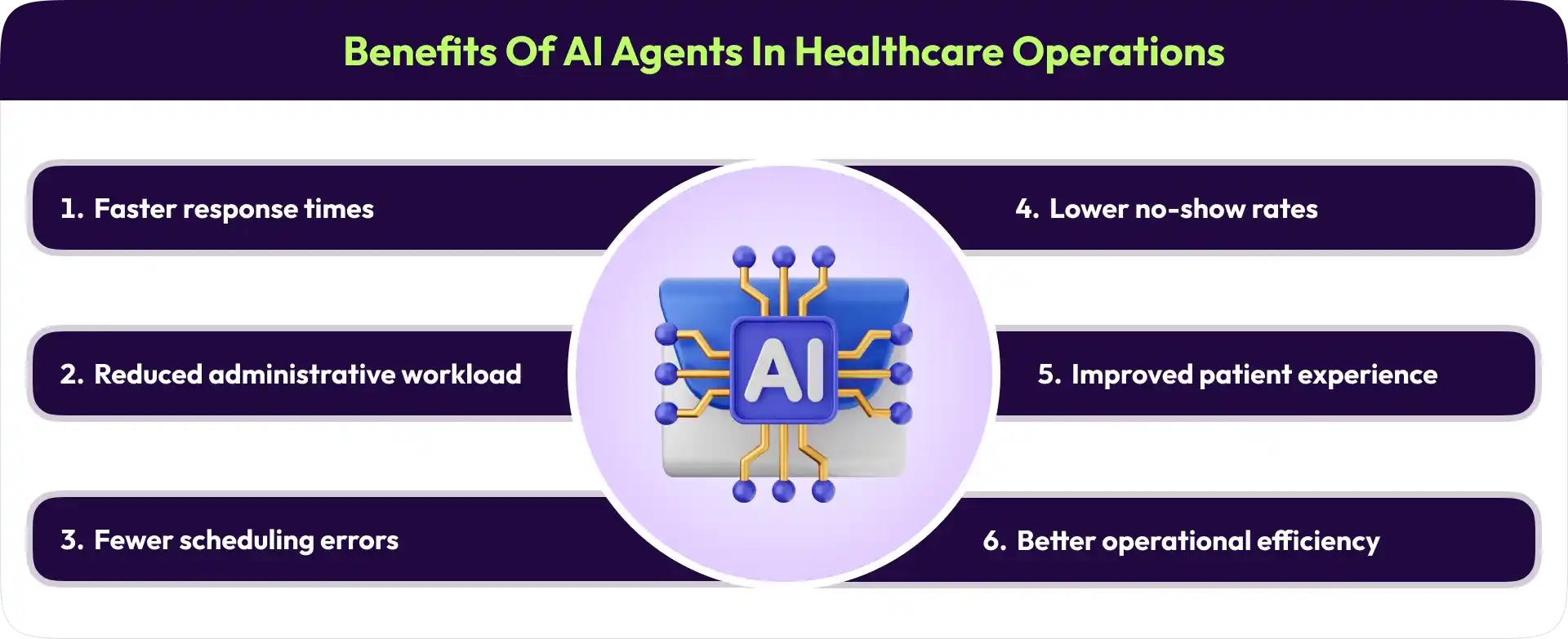
When implemented thoughtfully, the benefits of AI Automation for healthcare operations go beyond just saving time. You’ll start to notice improvements across multiple levels:
Faster response times: Patients don’t have to wait on hold or wait for callbacks. They get immediate answers, even outside working hours.
Reduced administrative workload: Routine tasks are handled automatically, giving staff breathing room during busy hours.
Fewer scheduling errors: Automated systems reduce double bookings, missed entries, or incorrect slot allocations.
Lower no-show rates: Timely reminders and easy rescheduling options encourage patients to show up or inform in advance.
Improved patient experience: Faster interactions, fewer delays, and smoother communication make a noticeable difference in satisfaction.
Better operational efficiency: Workflows move faster, systems stay updated, and processes become more predictable.
Scalable support without increasing headcount: As patient volume grows, AI agents can handle the increase without requiring proportional staff expansion.
What to Consider Before Implementing AI Agents
Adopting AI Agents in healthcare can deliver strong results, but only if implemented the right way. It’s not just about adding a tool, it’s about making it work smoothly within your existing operations.
Integration with existing systems: The AI agent should connect seamlessly with your EHR, scheduling, and CRM systems to avoid workflow disruptions.
HIPAA compliance and data security: Patient data must be handled securely, with proper encryption and compliance standards in place.
Escalation to human staff: There should always be a clear handoff to human teams for complex or sensitive cases.
Custom workflow design: The solution should adapt to your processes, not force you to change how you work.
Accuracy and ongoing monitoring: Regular testing and improvements ensure the system stays reliable over time.
Staff training and adoption: Teams should understand how AI supports their work, making adoption easier and more effective.
When these basics are in place, AI agents can deliver real, long-term value without adding complexity.
Why AI Voice Agents Are Becoming Essential for Modern Healthcare Operations
Healthcare is changing, and patient expectations are changing even faster. People don’t want to wait on hold anymore. They expect quick responses, flexible scheduling, and seamless communication.
At the same time, healthcare providers are dealing with staffing shortages and increasing operational pressure. This creates a gap. AI voice agents help bridge that gap by offering:
24/7 availability
Instant responses
Consistent service quality
Reduced dependency on manual processes
Organizations that adopt early aren’t just improving efficiency, they’re gaining a competitive advantage.
How Alris AI Helps Healthcare Organizations Automate Operations
This is where platforms like Alris AI come into the picture. Alris AI is designed specifically to help healthcare organizations automate calls and administrative workflows without disrupting existing systems.
With Alris AI, you can:
Deploy AI voice agents that handle patient calls automatically
Automate appointment scheduling, rescheduling, and follow-ups
Integrate seamlessly with your current systems
Ensure HIPAA-ready deployment for secure operations
Customize workflows based on your organization’s needs
Scale operations across clinics, hospitals, or networks
Instead of adding more staff to manage growing demand, you can build a system that scales with you.
If you’re exploring how to reduce operational burden while improving patient experience, it might be worth taking a closer look at what Alris AI can do for your healthcare operations.
Final Thought
Healthcare operations are becoming more complex, but they don’t have to become more difficult. AI Agents in healthcare are already transforming how clinics and hospitals manage calls, appointments, and administrative workflows. By automating repetitive tasks, they reduce staff workload while improving responsiveness and efficiency.
More importantly, they allow healthcare teams to refocus on what truly matters: patient care. If you’re running a healthcare organization today, it’s a good time to step back and ask: Which of your workflows are still manual and could be automated?
Because the shift toward AI-powered operations isn’t coming. It’s already here. And solutions like Alris AI are making that transition not just possible, but practical.
Frequently Asked Questions (FAQs)
1. How do AI agents help healthcare organizations manage patient calls?
AI agents can answer calls, understand patient requests, share information, and complete tasks such as booking appointments or routing urgent cases. This helps reduce missed calls and improves response times.
2. Can AI agents schedule and reschedule appointments automatically?
Yes. They can check provider availability, book appointments, process cancellations, and send confirmations and reminders without manual effort.
3. What healthcare administrative tasks can AI agents automate?
AI agents can handle patient intake, insurance verification, referral coordination, follow-up reminders, prescription refill requests, and payment notifications.
4. How do AI agents help reduce appointment no-shows?
They send reminders, allow patients to confirm or reschedule easily, and help fill canceled slots more quickly.
5. Can AI agents integrate with existing healthcare systems?
Yes. They can connect with scheduling platforms, EHR systems, CRM tools, and communication software to automate workflows.
6. Are AI agents secure for handling patient information?
Yes, when implemented with proper safeguards. Healthcare AI solutions should follow HIPAA-compliant processes and strong security practices.
Shravan Rajpurohit
CEO & Co-Founder
Shravan Rajpurohit is the Co-Founder & CEO of The Intellify, a leading Custom Software Development company that empowers startups, product development teams, and Fortune 500 companies. With over 10 years of experience in marketing, sales, and customer success, Shravan has been driving digital innovation since 2018, leading a team of 50+ creative professionals. His mission is to bridge the gap between business ideas and reality through advanced tech solutions, aiming to make The Intellify a global leader. He focuses on delivering excellence, solving real-world problems, and pushing the limits of digital transformation.

Stay Updated
with AI Insights
Get the latest articles on AI, automation, and enterprise technology delivered to your inbox weekly.

500+ people have already subsribed!
No spam. Unsubscribe anytime.