
AI Answering Service for Growing Businesses: Key Benefits & Why It Matters



There's a particular stage in a business's growth where the phone becomes a problem. Not because calls are bad; they're not. But because the volume starts outpacing the team's ability to handle them properly.
At ten customers, answering the phone is fine. Someone picks up, deals with it, moves on. At a hundred customers, it's a rotation. At five hundred, it's a job. And somewhere in that scaling curve, things start slipping: calls go unanswered, response times slow down, customers who expected to speak to someone get voicemail instead.
That's the gap AI answering services are designed to fill. Not as a replacement for good customer service, but as the infrastructure that keeps it functioning as the business grows.
This guide is for business owners and operators who are hitting that wall. It covers what AI answering services actually do, the specific problems they solve for growing businesses, how to choose the right one, and why Alris AI is worth looking at seriously.
The Communication Problems Growing Businesses Face
Every Missed Call Is a Missed Opportunity
Call volume doesn't grow linearly with the business. It spikes during launches, promotions, busy seasons, and the team isn't always ready. During those spikes, calls get missed. Not because anyone's slacking, but because there are simply more calls than people to answer them.
The revenue cost is real and usually underestimated. A missed call from a new customer is a lead that goes nowhere. Research consistently shows that most customers who don't get through on the first try don't call back; they move on.
Customer Support Becomes a Bottleneck
In the early days, founders handle support personally. The volume is manageable. Then growth happens, and the volume isn't manageable anymore, but the founder is still picking up the phone between meetings, or it falls to whoever's nearest. The result is inconsistent, slow, and a bit chaotic.
Inconsistent Customer Experience
When multiple people handle calls, the experience varies. One person gives full information. Another says "let me check and call you back" and forgets. Customers notice. For a growing business trying to build a reputation, variable first impressions are a problem that gets harder to manage as the team grows.
After-Hours Gaps Hurt Growth
A meaningful share of enquiries arrive outside business hours. People call when they have a moment, not when it's convenient for the business. If every after-hours call goes to voicemail, those customers either wait (and many won't) or they find an available competitor.
Hiring More Staff Isn't Always the Answer
A full-time receptionist or support agent costs $30,000-$45,000 in salary before benefits, training, and management overhead. They cover one channel. They're available roughly eight hours a day. When they leave, and turnover in support roles is high, you start again. For most growing businesses, the call volume doesn't justify a full hire, but it's too high to handle informally.
What Is an AI Phone Answering Service?
An AI phone answering service is software that answers inbound calls, understands what the caller is asking, and handles the request by booking an appointment, answering a question, or qualifying a lead in a natural, conversational way. No phone trees. No button presses. Just a direct response to what the caller actually says.
Unlike a traditional answering service that takes messages and passes them on, an AI phone answering service resolves the interaction during the call. Unlike IVR, it holds a real conversation instead of routing through menus. And unlike a virtual receptionist, it doesn't have shift hours, breaks, or a capacity limit.
Automated Answering Service vs Traditional Answering Service
Worth laying this out clearly because businesses evaluating options often conflate the two.
A traditional answering service uses human operators, often offshore or outsourced, to pick up calls on your behalf. They follow a script, take a message, and pass it on. They generally don't resolve anything in real time.
An automated answering service, specifically AI-powered, handles the interaction end to end. No message-taking. No callback required. The caller gets what they called for.
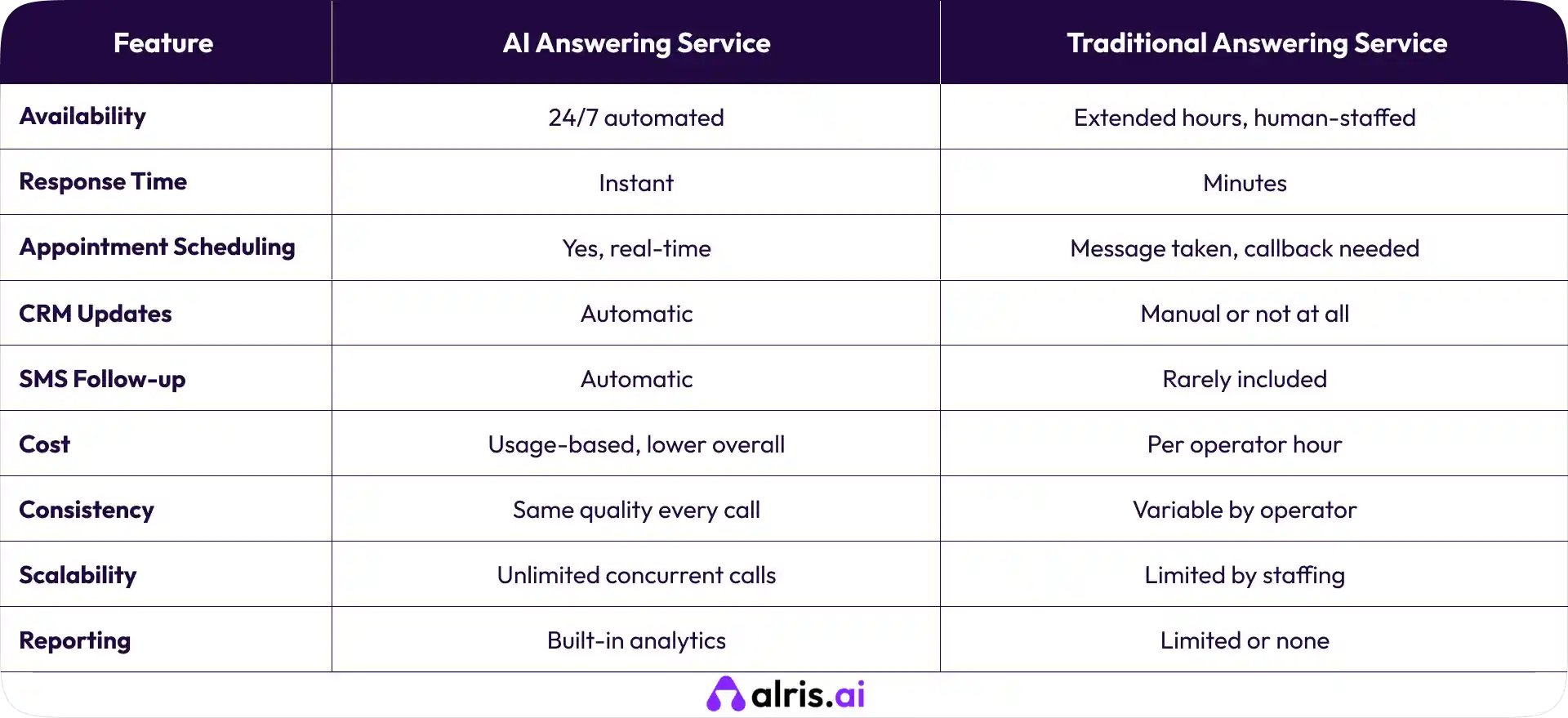
For growing businesses evaluating both, the practical question is: do you want someone to take a message, or do you want the problem solved during the call?
Benefits of Using an AI Answering Service
1. Never Miss a Call - Day or Night
Every inbound call gets answered immediately, regardless of what the team is doing or what time it is. Peak periods, lunch hours, evenings, weekends the system handles them all. For growing businesses where missed calls have a direct revenue impact, this is usually the most immediate benefit.
2. Deliver Consistent Responses Every Interaction
Same accuracy, same tone, same information, every call, every time. No variation between team members, no gaps when someone's off sick, no wrong information given because a new hire hadn't been fully briefed.
3. Scale Without Scaling Headcount
Ten calls a day or five hundred the system handles both without any change in cost or quality. As call volume grows, the infrastructure scales with it automatically. No hiring cycle, no training period, no capacity ceiling.
4. Reduce Operational Costs
The cost per interaction through an AI answering service is significantly lower than through a human agent. Factor in the true cost of a hire: salary, benefits, training, turnover, and the maths strongly favours AI for most growing businesses.
5. Automate Repetitive Customer Queries
Every business gets the same questions repeatedly. What are your hours? How much does it cost? Can I change my appointment? These are important to answer well but don't require a skilled person to handle them. Automating this layer frees the team for interactions that genuinely need them.
6. Improve Response Times Across Every Channel
Instant responses on voice, SMS, and email. No hold music, no callback queues, no "we'll get back to you within two business days." Customers in 2026 expect fast answers; businesses that provide them consistently have a measurable advantage.
7. Support Multi-Channel Communication
Customers don't stick to one channel. They call, follow up by text, and check email for a confirmation. A platform that handles voice, SMS, and email from one system keeps the experience consistent regardless of how the customer reaches out.
8. Free Up Your Team for High-Value Work
A lot of what occupies customer-facing staff at growing businesses doesn't require their skills. When it gets automated, the team focuses on what actually moves the needle: building customer relationships, handling complex problems, doing work that's hard to systematise.
Why Automated Answering Service Matters at Growth Stage
The scaling inflection point
Every business that grows past a certain point hits the same wall. The informal systems that worked when the team was small start breaking down as volume increases. This inflection point usually comes earlier than expected, and when it hits, the options are: hire quickly (expensive and slow), let service quality slip (damaging), or put systems in place that handle the volume automatically.
AI automation bridges the gap between "small enough to manage manually" and "large enough to justify a full support team," which is exactly where most growing businesses spend a significant stretch of their journey.
Speed of response as a competitive advantage
In most industries, the first business to respond to an enquiry wins a disproportionate share of conversions. An AI answering service responds in seconds, not hours. For growing businesses competing against larger, better-resourced competitors, that speed is a genuine differentiator.
First impressions at scale
At ten customers, the founder ensures every first interaction is excellent. At a hundred, that's not possible. AI automation standardises the first impression not in a robotic way, but in a "the customer always gets a prompt, accurate, professional response" way.
After-hours as a growth lever
Most growing businesses treat after-hours as a gap they can't fill. AI answering services turn it into an advantage. Enquiries at 9 pm get handled at 9 pm. Businesses available when competitors aren't capture the customers those competitors miss.
Use Cases: AI Customer Support Agent in Action
Inbound Call Handling and Routing
Every call gets answered, the request gets understood, and the caller gets routed appropriately, whether that's a direct resolution, a booking, or a transfer to a human with context already gathered. No queues, no voicemail, no lost calls during busy periods.
Appointment Scheduling and Booking Management
Real-time availability checks, instant booking confirmation, automated reminders, and self-service rescheduling, all handled during or immediately after the call. For service businesses, this is often the single biggest operational win from implementing an AI answering service.
Lead Qualification and Follow-Up
When a new lead calls in, the AI captures the relevant information, asks qualifying questions, and routes hot leads to the sales team with context already prepared. Cold leads get an appropriate response without tying up a human. No lead sits uncontacted for hours because the team was busy.
FAQ and Product Query Handling
Pricing, availability, product details, policies, turnaround times the questions every business answers dozens of times a day. Automating these removes a significant volume from the team's workload and gives customers a faster answer than waiting for a human to be available.
After-Hours and Overflow Coverage
Calls that arrive outside business hours get handled immediately rather than going to voicemail. Call spikes during busy periods get absorbed without quality dropping. The system doesn't have a capacity ceiling.
Smart Escalation to Human Staff
When a call is complex, sensitive, or specifically requests a human, the AI transfers it cleanly with a summary of the conversation so the staff member isn't starting from scratch. The handoff should be seamless. In a well-configured system, it is.
Industries Where AI Answering Drives the Most Value
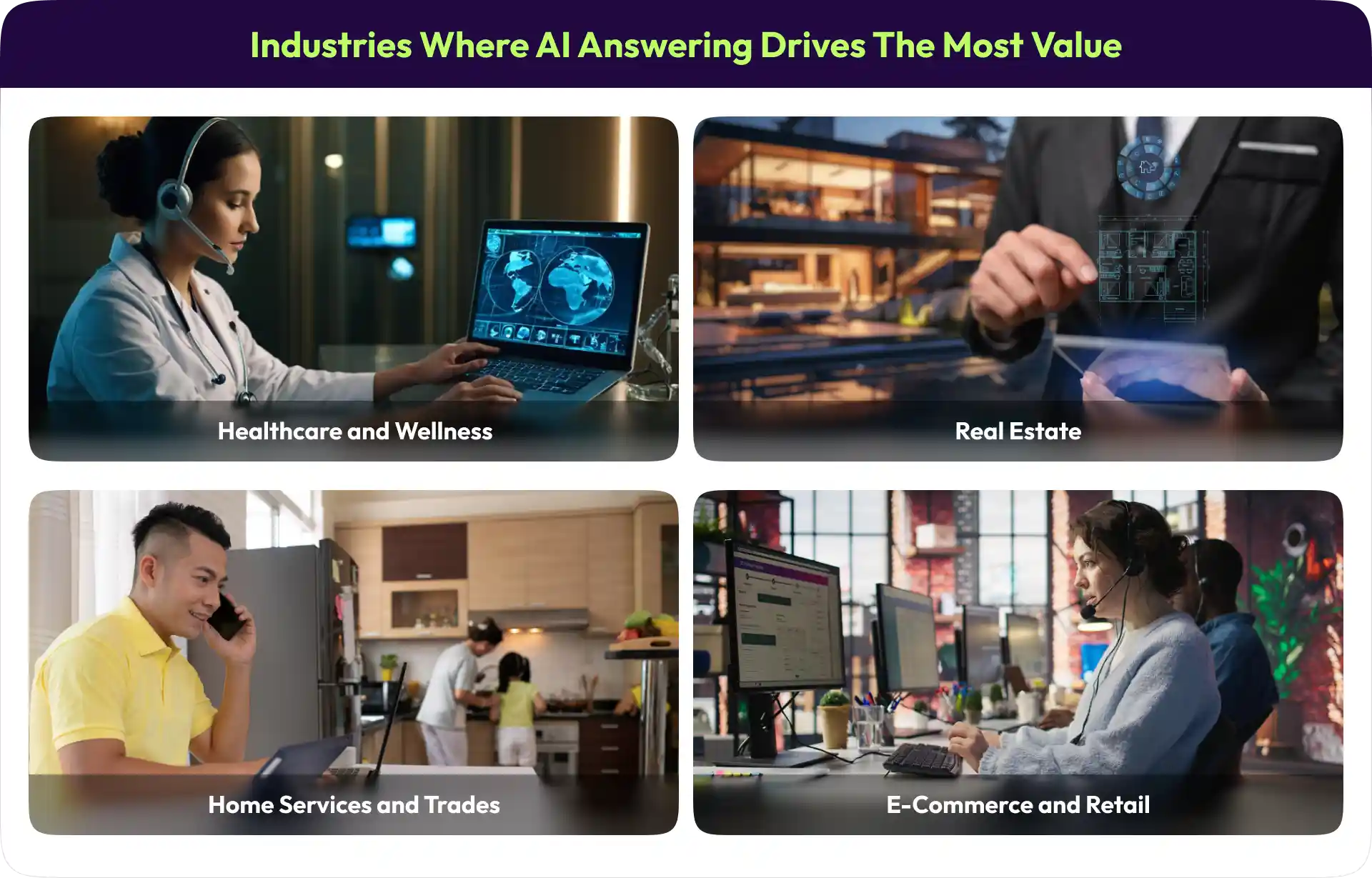
1. Healthcare and Wellness
Appointment scheduling, patient queries, after-hours coverage, and no-show-reducing reminders handled without front desk staff involvement.
2. Real Estate
Speed of response is a direct conversion factor. AI answers every property enquiry immediately and books viewings before the lead goes cold.
3. Home Services and Trades
Tradespeople on the job can't answer calls. AI picks up, captures the job details, and books the appointment while they work.
4. E-Commerce and Retail
Order queries, return requests, product support, shipping questions - AI handles these at any volume without additional staff.
How to Choose an AI Answering Service?
Conversation quality: Does it sound natural?
Test with real call scenarios, not a polished demo. Include unusual requests and see how the system handles them. If it sounds robotic, customers will hang up
Omnichannel capability
Confirm that voice, SMS, and email are all handled from one platform. Single-channel tools leave gaps that someone still has to fill manually.
CRM and tool integration
Ask specifically about the systems you use. "Integrates with CRMs" and "has a native integration with your specific CRM" are different things.
Appointment scheduling capability
Confirm bookings happen in real time during the call, not via a message processed later. Check how cancellations and rescheduling work.
Post-call workflow automation
Confirmation texts, follow-up emails, CRM updates. These should run automatically. If they don't, the team is still doing the admin the tool was supposed to handle.
Analytics and reporting
Call volumes, resolution rates, peak hour patterns at minimum. You need visibility to know whether the system is working.
Pricing and scalability
Understand the full cost at your actual call volume, including setup fees, integration fees, and per-feature charges not visible in the headline price.
Why Use Alris AI as Your AI Phone Answering Service
Most AI communication tools solve one problem well and leave the rest to other tools. A voice platform that doesn't handle SMS. An SMS tool with no call capability. A chatbot that doesn't connect to the phone. For a growing business, this means managing multiple platforms, multiple integrations, and multiple places where things can break.
Alris AI is built as an omnichannel AI agent platform: voice, SMS, email, and system updates all from one system. From day one, it answers every inbound call, books appointments in real time, handles FAQs, qualifies leads, and manages after-hours calls automatically. Outbound reminders and follow-ups run without anyone on the team initiating them.
How Alris AI connects your communication stack
It integrates with existing CRM, helpdesk, and scheduling tools so data flows automatically: no manual entry, no gaps between channels, no separate systems to reconcile.
Balancing AI and human agents
When a call needs a human, Alris transfers it with full context. The agent picks up knowing what was said and what was needed; no repetition required from the customer.
Analytics and continuous improvement
The reporting gives visibility into what's actually happening: call volumes, resolution rates, peak periods, sentiment trends. The system improves over time as it processes more interactions and as the configuration gets refined based on what the data shows.
Final Thought
There's a predictable point in every growing business's journey where communication starts to break. Not catastrophically, just quietly. Calls get missed. Responses slow down. The team ends up handling things that don't need them, and the things that do get less attention.
An AI answering service fixes the structural problem: it handles the call volume outpacing the team, maintains consistent quality as the business scales, and keeps the business accessible when competitors go dark.
The businesses that grow most efficiently put the right systems in place early not to replace people, but to make sure people spend their time on work that actually needs them.
Frequently Asked Questions (FAQs)
1. What is an AI answering service?
An AI answering service is software that answers inbound phone calls, understands what the caller is asking, and handles the request booking, query, and lead qualification automatically, in natural conversation, without a human operator.
2. How much does an AI answering service cost vs a human one?
A human receptionist typically costs $30,000-$45,000 per year in salary alone, covering one channel during business hours. AI answering services typically cost a fraction of that, covering 24/7, unlimited concurrent calls, across multiple channels. For most growing businesses, the cost comparison strongly favours AI.
3. Is an AI answering service available 24/7, including after hours?
Yes. It doesn't have shift hours, breaks, or holidays. Every call gets answered at 2 pm on a Tuesday or 11 pm on a Sunday.
4. Which businesses should use an AI answering service?
Any business receiving regular inbound calls that struggles to answer all of them consistently, particularly during busy periods or outside business hours. Professional services, healthcare, real estate, home services, e-commerce, and SaaS businesses all see strong results.
5. Can AI handle complex customer queries?
It handles a wide range of queries accurately when configured properly. Genuinely complex situations get escalated to a human agent with full context passed along. A well-configured system knows its limits and hands off cleanly.
Shravan Rajpurohit
CEO & Co-Founder
Shravan Rajpurohit is the Co-Founder & CEO of The Intellify, a leading Custom Software Development company that empowers startups, product development teams, and Fortune 500 companies. With over 10 years of experience in marketing, sales, and customer success, Shravan has been driving digital innovation since 2018, leading a team of 50+ creative professionals. His mission is to bridge the gap between business ideas and reality through advanced tech solutions, aiming to make The Intellify a global leader. He focuses on delivering excellence, solving real-world problems, and pushing the limits of digital transformation.

Stay Updated
with AI Insights
Get the latest articles on AI, automation, and enterprise technology delivered to your inbox weekly.

500+ people have already subsribed!
No spam. Unsubscribe anytime.