
AI Answering Service vs Call Center: Which Is Right for Your Business?



Summary: An AI answering service uses conversational AI to answer calls, schedule appointments, qualify leads, and handle customer inquiries automatically. A traditional call center relies on human agents to manage these interactions. While both help businesses respond to customers, they differ significantly in cost, availability, scalability, and efficiency. This guide compares both AI answering solutions and call centers to help you choose the right option for your business.
Every missed call is a missed opportunity. Could be a new lead, a booking, a customer who needed help and didn't get it. For a lot of businesses, that's happening more than they'd like to admit.
The question isn't whether you need to handle calls better; it's how. Two options come up most often: an answering service or a call center. And now, with AI-powered answering services becoming genuinely good, there's a third path worth understanding before you decide.
This guide breaks down how each option works, where they differ, what they cost, and which one actually makes sense depending on your business size, call volume, and budget. Whether you're a solo operator drowning in calls or a growing company evaluating your options, this should help.
What Is an Answering Service?
An answering service handles incoming calls on behalf of a business. Instead of calls going to voicemail or ringing out, they get answered either by a human operator or, increasingly, by an AI system and dealt with accordingly.
How traditional answering services work
Traditional answering services use a team of remote operators who answer calls using a script or set of instructions provided by the business. They take messages, transfer calls, or handle basic queries, then relay information back to the business.
The shift from human-staffed to AI-powered answering services
For years, "answering service" meant a person picking up the phone on your behalf. That's changing fast. AI-powered answering services now handle the same tasks and often more without needing a human on the other end at all. More on that in a minute.
What businesses typically use answering services for
Mostly: handling overflow calls, after-hours coverage, appointment scheduling, basic customer queries, and making sure no call goes unanswered during busy periods.
What Is a Traditional Call Center?
A call center is a centralized operation, either in-house or outsourced, where a team of agents handles a high volume of calls. It can be purely inbound (receiving calls), purely outbound (making calls), or a mix of both.
How call centers operate
Calls come in, get queued, and are routed to available agents. Agents work from scripts, knowledge bases, and CRM systems to handle queries, complaints, sales, or support. Supervisors monitor quality and performance.
Inbound vs outbound call centers
Inbound call centers focus on handling customer calls, support requests, billing questions, and order issues. Outbound call centers make calls for sales outreach, follow-ups, surveys, and reminders.
What businesses typically use call centers for
Enterprises and larger businesses use call centers for complex support, sales operations, and high-volume customer interactions that require trained agents and structured workflows.
What Is an AI Phone Answering Service?

How AI answering services differ from traditional answering services
Traditional answering services rely on human operators following a script. AI answering services use technology to understand what a caller is saying and respond in real time, in natural language, without a human involved. The result? Faster responses, no hold times, and availability around the clock.
Technologies powering AI phone answering services
Natural Language Processing and conversational AI
This is what lets the system understand what someone is actually saying, not just a keyword or menu selection, but the intent behind the words. "I need to move my appointment" gets understood the same way "can I reschedule?" does.
Automated call handling and routing
Based on what the caller says, the AI either handles the request directly or routes the call to the right person with context already captured, so nothing has to be repeated.
CRM and business tool integration
AI answering services connect with your calendar, CRM, or scheduling software, so they're not just collecting information; they're actually doing things. Booking appointments, pulling up account details, logging calls.
How AI answering services work end-to-end
A call comes in. The AI picks up, greets the caller, figures out what they need, and either resolves it on the spot or passes it along with full context. The whole thing happens in seconds, and the caller usually can't tell the difference.
AI Answering Service vs Call Center: Key Differences
1. Setup and operational complexity
Setting up a call center takes time, hiring, training, building workflows, and configuring systems. An AI answering service can typically be live in days, sometimes hours.
2. Cost structure and pricing models
Call centers charge per agent, per hour, or per month, and costs scale with headcount. AI answering services usually charge per minute or per call, with no staffing overhead.
3. Availability and scalability
A call center is limited by how many agents are working at a given time. An AI answering service handles any number of simultaneous calls without performance dropping.
4. Quality and consistency of customer interactions
Human agents have good days, bad days; high turnover means constant retraining. AI delivers the same quality on every single call.
5. Human touch vs automated efficiency
Call centers win when a call genuinely needs empathy, judgment, or complex problem-solving. AI wins when the goal is speed, accuracy, and volume.
6. Speed of deployment
A call center takes weeks or months to stand up properly. An AI answering service is measured in days.
7. Data, reporting, and analytics capabilities
AI systems log everything automatically: call transcripts, resolution rates, common queries. Getting that level of data from a traditional call center takes additional tooling and effort.
When an AI Answering Service Makes More Sense
Small to mid-sized businesses with high call volumes
If you're a small team getting more calls than you can handle, an AI answering service covers the gap without the overhead of hiring.
Businesses needing 24/7 coverage without staffing costs
Running a 24/7 call center is expensive. An AI answering service gives you round-the-clock coverage at a fraction of the cost.
After-hours and overflow call handling
Calls that come in after hours or when the team is tied up don't have to go to voicemail anymore.
Appointment scheduling and booking management
This is where AI answering services genuinely shine. Booking, rescheduling, and cancellations are handled automatically, integrated with your calendar.
Repetitive, high-volume inbound queries
Business hours, pricing, directions, order status, the same questions over and over. AI handles these without breaking a sweat, freeing your team for the calls that actually need them.
Businesses prioritizing fast deployment and low overhead
If you need something working quickly without a big implementation project, an AI answering service is the faster, leaner option.
Key Benefits of an AI Phone Answering Service
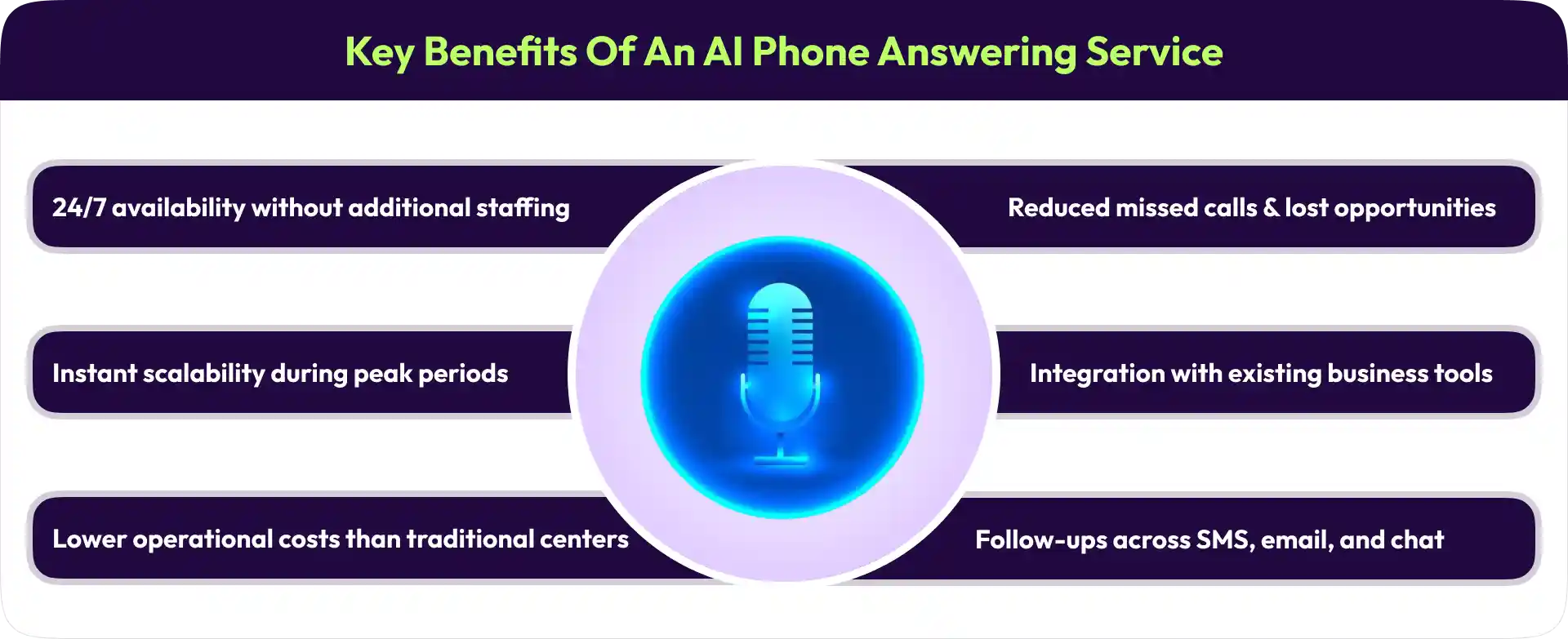
1. 24/7 availability without additional staffing
Every call gets answered, day or night, weekend or holiday, without anyone working overtime.
2. Instant scalability during peak periods
Ten calls or a thousand, the system handles them the same way.
3. Reduced missed calls and lost opportunities
Missed calls often mean missed revenue, especially for service businesses and medical practices where a caller who doesn't get through will just call the next provider on their list.
4. Lower operational costs than traditional call centers
The math usually works out clearly in favor of AI for businesses that don't need complex, relationship-driven call handling.
5. Seamless integration with existing business tools
Good AI answering services plug into what you're already using: CRM, scheduling software, helpdesk, so there's no manual data entry or disconnected workflow.
6. Omnichannel follow-up across SMS, email, and chat
The best platforms don't stop at voice. A call handled by AI can automatically trigger a follow-up text, a confirmation email, or a chat message, keeping the customer informed across channels.
AI Answering Service vs Call Center: Cost Comparison
Typical cost of running an in-house call center
Factoring in salaries, benefits, training, management, office space, and technology, an in-house call center agent typically costs a business anywhere from $25,000 to $45,000+ per year. Multiply that by headcount, and the numbers get significant fast.
Typical pricing models for AI answering services
Most AI answering services charge per minute of call time or per call handled, often ranging from a few cents to a dollar or more per minute depending on features and volume. Monthly subscription plans with usage tiers are also common.
Hidden costs of call centers: staffing, training, turnover, infrastructure
Turnover in call centers is notoriously high, and every time someone leaves, training costs go with them. Add in the technology stack, floor space, and management overhead, and the real cost is often higher than the headline number suggests.
Total cost of ownership comparison
For most small and mid-sized businesses, an AI answering service costs significantly less over 12 months than even a part-time human answering team, especially when you factor in 24/7 availability.
ROI considerations for small and mid-sized businesses
The ROI calculation is usually straightforward: fewer missed calls, more bookings, lower overhead. For appointment-driven businesses, especially capturing one or two extra bookings per day from calls that would have gone to voicemail can cover the entire cost of the service.
AI Answering Service Across Industries
Medical and healthcare practices
For medical offices, unanswered calls mean patients who can't book, can't get information, or give up and call a competitor. AI answering services handle appointment scheduling, after-hours queries, and basic patient questions while keeping things HIPAA compliant.
Dental clinics
Dental practices deal with a high volume of routine calls, bookings, rescheduling, and insurance questions. An AI answering service handles most of this automatically, so front desk staff can focus on patients in the office rather than on the phone.
Property management companies
Property managers get calls at all hours: maintenance requests, lease questions, move-in queries. An AI answering service captures and routes these without requiring someone on call around the clock.
Real estate agencies
Missed calls in real estate cost leads. AI answering services ensure every inquiry gets picked up, with the ability to qualify callers and route serious buyers or renters to the right agent.
Small businesses and startups
Small teams can't always be available. An AI answering service levels the playing field, giving a small business the same phone coverage as a much larger operation.
Legal and professional services
Law firms and professional services businesses often deal with sensitive, time-sensitive calls. An AI answering service handles intake, schedules consultations, and routes urgent calls appropriately.
Home services and plumbing businesses
Plumbers, electricians, and HVAC techs are often on the job and can't answer the phone. An AI answering service picks up, captures the job details, and routes urgent calls or schedules bookings automatically.
Hospitality and travel
Hotels and travel agencies handle a constant flow of booking calls, cancellations, and queries. AI answering services manage this volume smoothly, even during peak seasons when call volumes spike.
How AI Answering Services Handle Specific Call Types
Appointment scheduling and booking
The caller says when they'd like to come in. The AI checks availability, confirms the slot, and sends a confirmation, all without any staff involvement.
After-hours and emergency call handling
After hours, the AI handles what it can and routes genuinely urgent calls to an on-call person, with context already captured.
Lead qualification and intake
New inquiry calls get answered, basic qualifying questions get asked, and the information gets passed to the right team member, so no lead sits uncontacted overnight.
Billing and payment inquiries
Balance questions, invoice queries, payment confirmations, standard stuff that doesn't need a human but does need a timely answer.
Frequently asked questions
Hours, location, pricing, and services: the AI handles these without tying up anyone's time.
Call routing and escalation to human staff
When a call genuinely needs a person, the AI hands it off cleanly with a summary of the conversation so the staff member isn't starting from scratch.
Key Features to Look for in an AI Answering Service
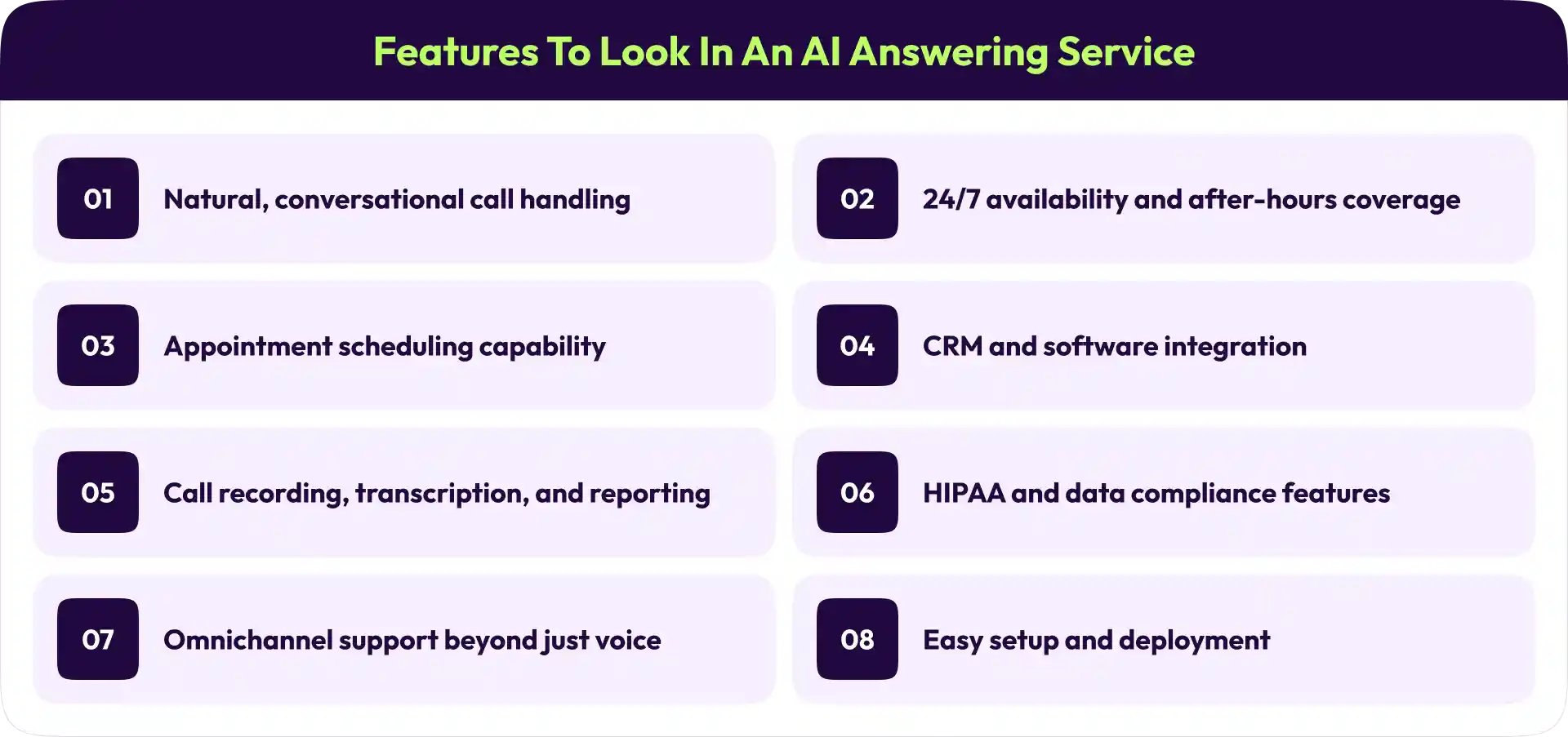
1. Natural, conversational call handling
If the AI sounds robotic or forces callers through a rigid script, it's going to frustrate people. The best systems hold a genuine, flowing conversation.
2. 24/7 availability and after-hours coverage
Non-negotiable for most businesses. Every call should get answered regardless of the time.
3. Appointment scheduling capability
Direct calendar integration so bookings actually get made during the call, not just noted for someone to follow up on later.
4. CRM and software integration
The platform should connect with your existing tools so data flows automatically and nothing needs to be entered manually.
5. Call recording, transcription, and reporting
You need visibility into what's happening on calls, both for quality control and for spotting patterns in what customers are asking.
6. HIPAA and data compliance features
For healthcare and legal businesses especially, this is a hard requirement.
7. Omnichannel support beyond just voice
The strongest platforms extend beyond the phone, connecting voice with SMS, chat, and email for a complete customer communication picture.
8. Easy setup and deployment
If it takes three months and a developer to get it working, the ROI timeline gets a lot longer. Look for platforms designed to go live quickly.
How to Transition From a Call Center to an AI Answering Service
Step 1: Audit your current call handling workflows
Map out what types of calls you receive, how they're currently handled, where the bottlenecks are, and what's going wrong. This gives you a clear starting point.
Step 2: Identify call types suitable for automation
Not every call needs to be automated on day one. Start with the high-volume, lower-complexity call bookings, FAQs, and after-hours queries. These are the easiest wins.
Step 3: Choose the right AI answering service platform for your business
This is where the decision gets real. Alris AI, for example, is built as a full omnichannel platform, meaning it doesn't just handle voice calls; it connects them with SMS, WhatsApp, and email, so the follow-up after a call happens automatically rather than requiring someone to chase it up manually.
Step 4: Integrate with existing CRM and business tools
Get the AI connected to your calendar, CRM, or helpdesk before going live. The more it can access, the more it can actually do during a call.
Step 5: Run a parallel test before full transition
Don't switch overnight. Run the AI system alongside your existing process for a period, monitor how it handles real calls, and fix any issues before making it the primary system.
Step 6: Monitor, refine, and scale
Keep an eye on resolution rates, missed call data, and customer feedback. Adjust conversation flows where needed and expand automation as you get comfortable with what's working.
Common Myths About AI Answering Services
"It sounds robotic, and customers will hate it"
Modern conversational AI has come a long way. Most callers can't tell they're not speaking to a person, and frankly, many prefer the speed and consistency over waiting on hold for a human.
"It can't handle complex calls"
AI answering services aren't designed to replace humans on every call, just the majority that are routine. Complex calls still get escalated. That's the point.
"It's only for large businesses"
Actually, the opposite is often true. Small businesses benefit the most because they typically can't afford full-time call center staff but still need reliable call coverage.
"It will replace my entire team"
It takes the repetitive, high-volume stuff off their plate. Most businesses find that their staff can focus on more valuable work once routine call handling is automated.
"It's too expensive to set up"
Compared to what? The cost of hiring even one part-time receptionist usually exceeds the monthly cost of a capable AI answering service several times over.
Conclusion
Call centers make sense for large-scale operations where human judgment, relationship management, and complex call handling are central to the model. But for the majority of small and mid-sized businesses, an AI answering service covers the same ground at a fraction of the cost and does it around the clock without anyone clocking in or out.
Every call that gets answered is a chance to book a customer, help someone, or make a decent first impression. Every missed call is the opposite. That connection between reliable call handling and business growth is about as direct as it gets, and it shows up quickly in the numbers when you start tracking it.
The technology has matured a lot. The cost makes sense. And the gap between what AI can handle and what used to require a human keeps narrowing. For most businesses evaluating their options in 2026, AI isn't the experimental choice anymore; it's the practical one.
If your current setup means calls are being missed, going to voicemail, or eating up more staff time than they should, it's worth taking a closer look at what an AI answering service can actually do. Alris AI handles voice calls, SMS, WhatsApp, and email in one platform so every channel stays covered without stitching together a stack of separate tools. [Explore Alris AI →]
Frequently Asked Questions (FAQs)
1. What is the difference between an answering service and a call center?
An answering service handles incoming calls on behalf of a business, typically focused on message taking, call routing, or basic queries. A call center is a larger, structured operation handling high volumes of inbound and outbound calls with a team of dedicated agents. AI answering services automate much of what traditional answering services do, without human operators.
2. Is an AI answering service HIPAA compliant?
It depends on the platform. Reputable AI answering services offer HIPAA-compliant configurations, including encrypted call handling, data security controls, and Business Associate Agreements. Always confirm compliance capabilities with the provider before deploying in a healthcare setting.
3. How much does an AI phone answering service cost?
Pricing varies by provider and usage. Most platforms charge per minute of call time or offer monthly subscription tiers. For many small businesses, costs start at a few hundred dollars per month, significantly less than staffing even a part-time receptionist.
4. Can an AI answering service handle appointment scheduling?
Yes, and this is one of its strongest use cases. AI answering services with calendar integration can check availability, book appointments, send confirmations, and handle rescheduling during the call itself.
5. What is the best answering service for small businesses?
The best option depends on your call volume, industry, and what you need the service to do. For small businesses that need 24/7 coverage, appointment scheduling, and integration with their existing tools, an AI answering service is usually the most cost-effective and scalable choice.
Shravan Rajpurohit
CEO & Co-Founder
Shravan Rajpurohit is the Co-Founder & CEO of The Intellify, a leading Custom Software Development company that empowers startups, product development teams, and Fortune 500 companies. With over 10 years of experience in marketing, sales, and customer success, Shravan has been driving digital innovation since 2018, leading a team of 50+ creative professionals. His mission is to bridge the gap between business ideas and reality through advanced tech solutions, aiming to make The Intellify a global leader. He focuses on delivering excellence, solving real-world problems, and pushing the limits of digital transformation.

Stay Updated
with AI Insights
Get the latest articles on AI, automation, and enterprise technology delivered to your inbox weekly.

500+ people have already subsribed!
No spam. Unsubscribe anytime.