
How AI Call Centers Are Transforming the Customer Support Industry



Summary: AI call centers are changing customer support by automating routine conversations, reducing wait times, and helping businesses deliver consistent service across voice, SMS, chat, and email. This guide explains how AI call centers work, their key benefits, industry use cases, implementation best practices, and how platforms like Alris AI help organisations improve customer experience while lowering operational costs and scaling support more efficiently.
Think about the last time you called customer support. Chances are, you spent a few minutes waiting on hold, repeated your issue more than once, and hoped the next agent could actually help. It's frustrating, and customers are losing patience.
The problem isn't that support teams aren't working hard. They are. The challenge is that traditional call centers were built for a time when customers mainly called during business hours and accepted waiting in queues. That world no longer exists.
Today, customers expect instant responses across phone calls, SMS, live chat, email, and even messaging apps. They also expect businesses to remember previous conversations and provide consistent support every time.
This shift is driving rapid adoption of AI call centers. By combining conversational AI, voice AI, automation, and CRM integration, businesses can respond faster, reduce operational costs, and improve customer satisfaction without constantly increasing headcount.
In this guide, you'll learn how AI call centers work, why they're becoming essential in 2026, their biggest benefits, practical use cases across industries, and how platforms like Alris AI help businesses deliver smarter, always-on customer support.
Traditional Call Center Chaos
A typical day inside a traditional call center is busy from the moment agents log in.
Calls, emails, live chats, and support tickets keep arriving while agents switch between CRM systems, knowledge bases, and ticketing software. Every conversation requires looking up customer information, updating records, and often transferring calls to another department.
As customer demand increases, queues grow longer and response times slow down.
Many businesses try solving this by hiring more agents. But that approach comes with higher recruitment costs, longer training periods, and increased employee turnover. It treats the symptom rather than the actual problem.
The reality is that today's customer expectations have outgrown traditional support models. Businesses need a smarter way to manage high volumes without compromising service quality.
Major Pain Points of Traditional Call Centers Affecting Customer Satisfaction
Slow Response Times and Long Hold Times
Long wait times remain one of the biggest reasons customers abandon support calls. When call volumes exceed available agents, queues build quickly, leaving customers frustrated before the conversation even begins. Even a well-trained support team struggles to maintain fast response times during busy periods.
Agent Multitasking and Burnout
Customer service agents do far more than answer calls. They verify customer details, search multiple systems, update CRM records, write notes, schedule follow-ups, and resolve issues all while trying to keep conversations moving.
Repeating the same questions hundreds of times every week leads to fatigue, lower productivity, and eventually burnout, affecting both employee satisfaction and customer experience.
Peak Hour Chaos
Holiday sales, product launches, billing cycles, or unexpected service issues can double call volumes almost overnight.
Traditional call centers have limited capacity because every interaction depends on agent availability. Businesses often bring in temporary staff, but training new employees takes time, making it difficult to maintain consistent service when demand spikes.
Limited Call Hours and After-Hours Gaps
Customers don't stop needing support when the office closes.
Whether someone wants to confirm an appointment late at night or check an order early in the morning, unanswered calls often mean missed opportunities. Providing true 24/7 support with human agents alone is expensive, making after-hours coverage a major challenge for many businesses.
Inconsistent Customer Experience
Support quality often depends on which agent answers the phone.
Different experience levels, communication styles, and product knowledge can lead to inconsistent responses. One customer receives excellent service, while another gets conflicting information. Over time, customers associate these inconsistencies with the brand rather than individual agents.
High Operational Costs
Running a traditional call center involves much more than paying salaries.
Recruitment, onboarding, training, office infrastructure, software licences, telecom systems, quality monitoring, and employee turnover all add to operational costs. As customer expectations continue rising, simply expanding the workforce becomes increasingly difficult to justify.
What Is an AI Call Center?
An AI call center uses artificial intelligence to automate and support customer interactions across voice calls, SMS, email, live chat, and other communication channels.
Instead of relying entirely on human agents, AI handles repetitive conversations, answers common questions, qualifies requests, updates customer records, and routes complex issues to the right person when needed.
Unlike traditional call centers that depend on available staff, AI can manage thousands of conversations simultaneously while delivering consistent responses every time.
It's also very different from older IVR (Interactive Voice Response) systems. Traditional IVRs rely on fixed menus such as "Press 1 for Sales" or "Press 2 for Support." Modern AI understands natural conversations, allowing customers to speak normally without navigating endless menu options.
Rather than replacing support teams, AI works alongside them, handling routine tasks while human agents focus on situations that require empathy, judgement, or complex decision-making.
The technology powering AI call centers
Several AI technologies work together behind the scenes:
Natural Language Processing (NLP): Understands customer questions in everyday language.
Machine Learning: Improves responses over time by learning from interactions.
Voice AI and Speech Recognition: Enables natural phone conversations without scripted menus.
Omnichannel Integration: Connects voice, SMS, chat, email, and CRM platforms into one workflow.
Real-Time Analytics: Monitors conversations, customer sentiment, and performance metrics to improve support quality continuously.
Together, these technologies create a faster, more personalised, and scalable customer support experience.
How AI Call Centers Work
An AI call center doesn't simply answer calls; it manages the entire customer journey, from the first interaction to the final follow-up. Here's what a typical workflow looks like:
Customer Contacts Support (Call, Chat, SMS, or Email)
↓
AI Agent Responds Instantly
↓
Identifies Customer Intent and Retrieves CRM History
↓
Resolves the Query or Routes It to a Human Agent
↓
Updates CRM Automatically
↓
Triggers Follow-up via SMS, Email, or Callback
The process starts when a customer reaches out through their preferred channel. Instead of waiting in a queue, the AI agent responds immediately, understands the request, and checks previous interactions, account details, or order history through integrated systems.
If the query is straightforward, such as checking an order status, booking an appointment, or resetting an account, the AI resolves it independently.
When a conversation requires empathy, negotiation, or technical expertise, the AI transfers it to the most suitable human agent along with the complete conversation history. This means customers don't have to repeat themselves, and agents already have the context they need.
One of the biggest advantages is scalability. Unlike traditional call centers, AI can manage thousands of conversations simultaneously without increasing wait times or affecting response quality.
AI Call Center vs Traditional Call Center
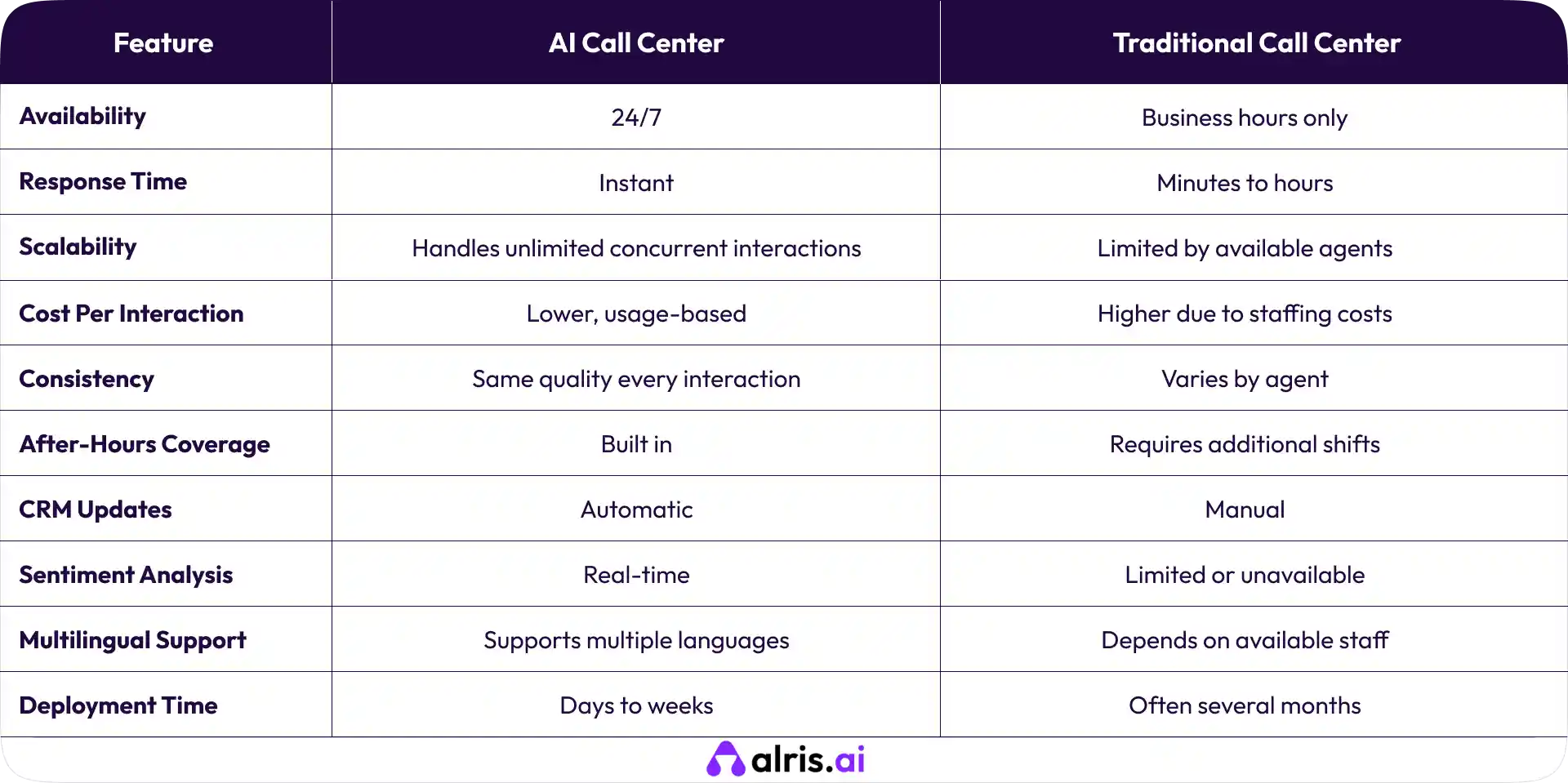
The comparison makes one thing clear: traditional call centers rely on adding more people to meet growing demand, while AI scales through automation. Businesses can improve response times, reduce costs, and maintain consistent customer experiences without continuously expanding their support teams.
Key Benefits of AI Call Centers for Modern Customer Support
24/7 Customer Support Without Extra Staffing
Customers expect support whenever they need it, not just during office hours.
AI call centers provide round-the-clock assistance without requiring overnight shifts or additional staffing. Whether it's midnight or a public holiday, customers can receive immediate help for routine enquiries, bookings, account updates, or order tracking.
Instant Response - Zero Hold Time
Nobody enjoys waiting on hold. AI answers customer enquiries within seconds, reducing frustration and improving the overall experience. Faster responses also increase the likelihood of resolving issues during the first interaction.
Consistent Quality Across Every Interaction
Human conversations naturally vary depending on experience, workload, or even how someone's day is going.
AI delivers consistent responses based on approved business rules and knowledge, ensuring every customer receives accurate and reliable information regardless of when they contact support.
Real-Time Sentiment Analysis and Smart Escalation
Modern AI doesn't just process words; it can also detect signals that indicate frustration, urgency, or dissatisfaction.
If a customer becomes upset or the issue grows more complex, the conversation can be transferred to a human agent immediately, along with all relevant context. This creates a smoother customer experience and helps prevent complaints from escalating.
Significant Reduction in Operational Costs
Hiring, training, and retaining support staff is expensive. By automating repetitive enquiries, businesses reduce the number of routine interactions handled by human agents. Teams become more productive, operating costs decrease, and support resources can be focused on higher-value conversations.
Scalability During Peak Periods
Seasonal sales, product launches, and unexpected service disruptions often create sudden spikes in customer enquiries. Unlike traditional call centers that require additional staffing, AI automatically scales to handle increased demand without affecting response times or service quality.
Omnichannel Customer Support From One System
Today's customers move between communication channels throughout their journey. Someone may start with a website chat, continue via SMS, and later call for additional assistance.
An AI customer service keeps every interaction connected, giving customers a seamless experience while ensuring support teams have complete conversation history in one place.
Continuous Learning and Improvement
One of AI's biggest strengths is that it improves over time. By analysing customer interactions, identifying common questions, and measuring performance, AI continuously refines its responses. Businesses also gain valuable insights into recurring issues, customer behaviour, and opportunities to improve products or services.

Use Cases of AI in Call Center Operations
AI is most valuable when it removes repetitive work while helping human agents deliver better service. Here are some of the most common applications.
Handling High-Volume Repetitive Queries
AI can instantly resolve routine enquiries such as order tracking, account information, appointment scheduling, FAQs, password resets, and basic troubleshooting. This reduces call volumes for human agents and improves response times.
Intelligent Call Routing
Instead of transferring customers between multiple departments, AI identifies the customer's intent and connects them directly with the right team or specialist, reducing unnecessary handoffs.
Automated Outbound Calling
AI can proactively contact customers for payment reminders, appointment confirmations, customer feedback, renewals, follow-ups, and re-engagement campaigns, ensuring important conversations aren't missed.
After-Hours Support Coverage
Rather than sending customers to voicemail, AI continues answering questions, capturing leads, booking appointments, and resolving common issues outside business hours.
Real-Time Agent Assistance
AI doesn't only help customers; it also supports agents by suggesting responses, retrieving customer information, and surfacing relevant knowledge articles during live conversations.
Customer Sentiment Monitoring
By analysing tone and language in real time, AI identifies frustrated customers early and escalates conversations before dissatisfaction grows into complaints or lost business.
Post-Call Automation
Once a conversation ends, AI automatically creates summaries, updates CRM records, schedules follow-ups, and sends customer satisfaction surveys, reducing manual administrative work.
How Different Industries Use AI Call Centers
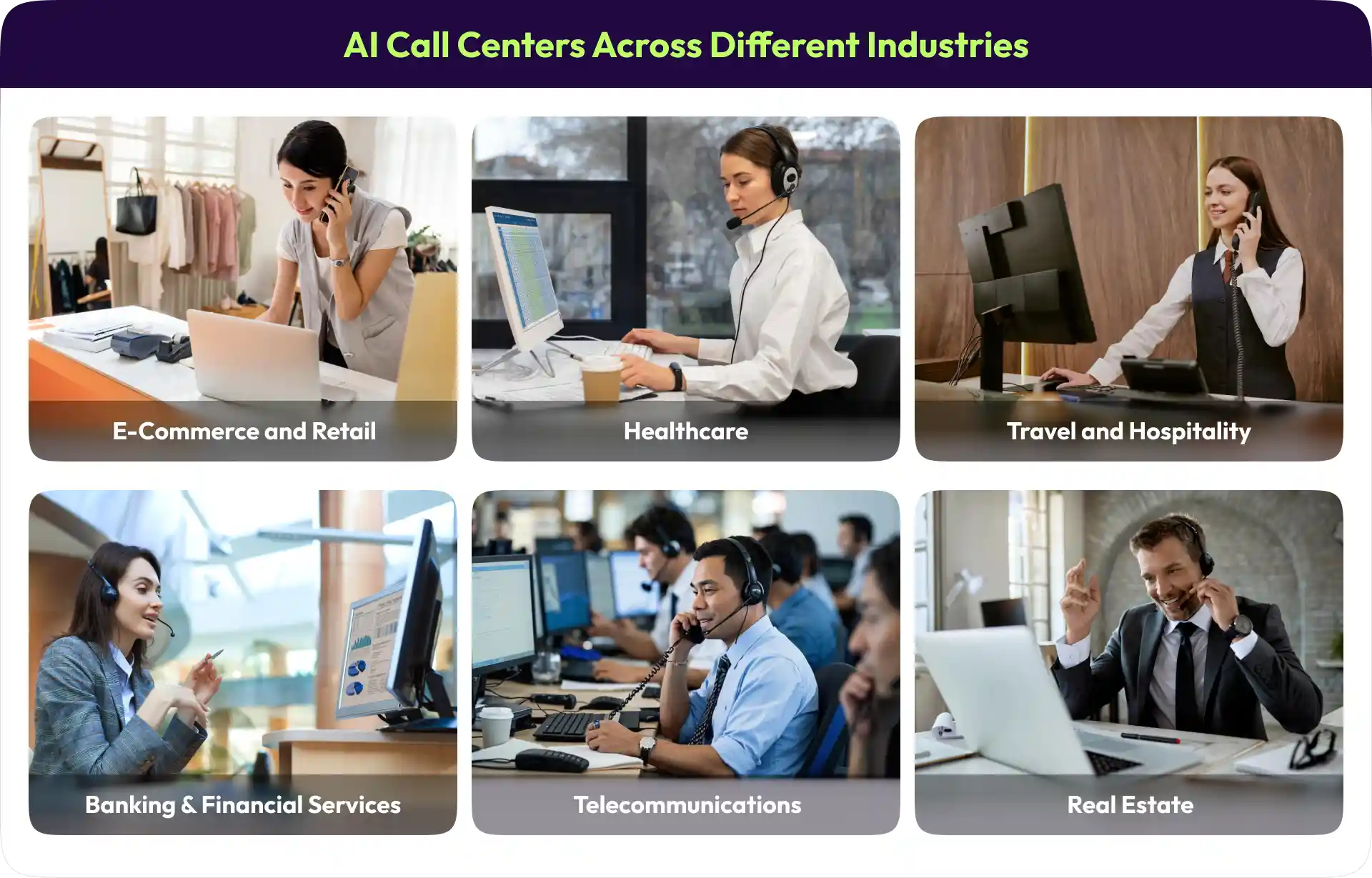
Customer support challenges may look different across industries, but the goal is always the same: respond quickly, resolve issues efficiently, and deliver a consistent experience. That's why AI call centers are being adopted across a wide range of businesses.
E-Commerce and Retail
Online shoppers expect quick answers before they make a purchase. AI call centers help retailers handle order tracking, delivery updates, return requests, refund enquiries, and product questions instantly. During high-demand periods like Black Friday or holiday sales, AI scales automatically to manage increased customer volumes without long wait times.
Healthcare
Healthcare providers manage thousands of patient interactions every day. AI can schedule appointments, answer common patient questions, send reminders, handle prescription refill requests, and route urgent cases to the appropriate staff. This reduces administrative workload while improving the patient experience.
Banking and Financial Services
Banks and financial institutions receive a constant flow of account enquiries, payment requests, fraud alerts, and loan-related questions. AI helps customers access information quickly while allowing human agents to focus on sensitive or complex financial conversations.
Telecommunications
From internet outages to billing questions and plan upgrades, telecom providers deal with high call volumes daily. AI can resolve routine issues, provide service updates, and route technical problems to specialised support teams without unnecessary transfers.
Travel and Hospitality
Travellers often need immediate assistance, especially when plans change unexpectedly. AI call centers help customers manage bookings, cancellations, itinerary updates, and hotel enquiries at any time of day, improving both customer satisfaction and operational efficiency.
Real Estate
Real estate businesses lose valuable opportunities when calls go unanswered. AI helps qualify leads, schedule property viewings, answer listing enquiries, and stay connected with buyers, sellers, tenants, and property owners even outside business hours.
How to Implement an AI Call Center
Moving to an AI call center doesn't have to happen overnight. The most successful implementations usually start small, improve gradually, and expand over time.
Step 1: Audit Your Current Call Center Workflows
Review your existing support process to identify where delays, repetitive tasks, and manual work occur. Understanding these bottlenecks helps you prioritise automation opportunities.
Step 2: Identify High-Volume, Repetitive Interaction Types
Look for conversations that follow predictable patterns, such as appointment scheduling, order tracking, FAQs, account enquiries, and payment reminders. These are usually the best candidates for AI automation.
Step 3: Choose the Right AI Call Center Platform
Not every AI platform offers the same capabilities. Look for a voice AI solution that supports natural conversations, omnichannel communication, CRM integration, analytics, and intelligent human escalation, not just basic voice automation.
Step 4: Integrate With CRM, Helpdesk, and Existing Tools
AI performs best when it has access to customer history and business data. Connecting your CRM, helpdesk, scheduling software, and communication platforms creates a seamless experience for both customers and agents.
Step 5: Configure Conversation Flows and Test Thoroughly
Before going live, test different customer scenarios, including edge cases and escalation paths. This helps ensure conversations feel natural and that complex issues reach the right human agents.
Step 6: Launch, Monitor, and Optimise Continuously
Implementation isn't the finish line. Regularly review analytics, customer feedback, automation rates, and conversation quality to identify opportunities for ongoing improvement.
Key Features to Look for in an AI Call Center Platform
Choosing the right AI call center platform is just as important as deciding to adopt AI in the first place. The best solutions don't just automate calls; they improve the entire customer support experience.
Here are the key features to look for:
Omnichannel support: Manage voice calls, SMS, live chat, and email from one platform.
Natural conversations: AI should understand and respond like a real conversation, not a scripted IVR.
Smart escalation: Complex or sensitive issues should seamlessly transfer to human agents.
CRM and helpdesk integration: Customer information should update automatically without manual work.
Outbound communication: Support appointment reminders, payment notifications, follow-ups, and customer outreach.
Security and compliance: Ensure customer data is protected and industry regulations are met.
Analytics and reporting: Access insights into call volume, response times, customer sentiment, and agent performance.
Quick deployment: A modern AI platform should be easy to configure without lengthy implementation projects.
Alris AI for Your AI Call Center
Building an AI call center shouldn't mean replacing your existing tools or completely changing how your support team works. It should make those systems work better together. That's exactly what Alris AI is designed to do.
Alris AI is an AI-powered customer communication platform that helps businesses manage voice calls, SMS, email, and chat from a single interface. Instead of treating every channel separately, it creates one connected customer journey, making conversations faster, more consistent, and easier to manage.
One Platform for Every Customer Conversation
Customers rarely stick to one communication channel. Someone may start with a website chat, respond via SMS, and later call for additional support.
Alris AI keeps every interaction connected, ensuring both AI and human agents have complete conversation history without switching between multiple systems.
Automating Repetitive Work From Day One
Support teams often spend hours answering the same questions every day. Alris AI automates tasks such as:
Answering frequently asked questions
Booking and rescheduling appointments
Lead qualification
Order and account enquiries
Payment reminders
Customer follow-ups
Call summaries and CRM updates
By reducing repetitive work, support agents can focus on conversations that genuinely require human expertise.
Seamless CRM and Helpdesk Integration
An AI call center is only as effective as the systems it connects with. Alris AI integrates with existing CRM platforms and helpdesk software, allowing customer information, conversation history, and support activities to update automatically. This reduces manual data entry while giving agents the context they need before every conversation.
Smart Escalation to Human Agents
Not every issue should be handled by AI. When a customer has a complex request or needs personalised assistance, Alris AI transfers the conversation to the right team member with the full conversation history attached. Customers don't need to repeat themselves, and agents can continue the conversation without starting from scratch.
Built-In Analytics for Continuous Improvement
Every customer interaction provides valuable insight. Alris AI tracks response times, conversation outcomes, frequently asked questions, customer sentiment, and support performance through real-time dashboards. These insights help businesses identify bottlenecks, improve workflows, and continuously optimise customer support operations.
The Future of AI Call Centers
Customer support is becoming more proactive rather than reactive. Instead of waiting for customers to contact support, AI will increasingly identify potential issues before they become problems.
For example, it can automatically notify customers about delayed deliveries, upcoming appointments, failed payments, or service interruptions before they need to ask.
Personalisation will also continue improving. As AI integrates more deeply with CRM systems and customer data, conversations will become increasingly relevant, helping businesses deliver faster and more personalised support.
Voice AI is also expected to become the preferred customer support channel for many organisations, thanks to improvements in conversational accuracy and natural language understanding.
Rather than replacing customer service teams, AI will continue evolving into a trusted assistant handling repetitive work while enabling human agents to focus on building stronger customer relationships.

Conclusion
Traditional call centers were designed for a very different era one where customers accepted long wait times, limited business hours, and inconsistent service.
Today's customers expect something different. They want quick responses, personalised conversations, and the flexibility to connect through the channel that suits them best.
AI call centers solve many of the structural challenges that traditional support teams face. They reduce repetitive work, improve response times, lower operational costs, and provide consistent customer experiences across voice, SMS, email, and chat.
The businesses delivering exceptional customer support in 2026 aren't simply hiring more agents. They're combining AI with omnichannel communication, connected CRM data, and continuous optimisation to build support operations that scale with customer expectations.
For organisations looking to improve customer experience while operating more efficiently, adopting AI customer support is no longer just an innovation; it's becoming a competitive advantage.
Frequently Asked Questions (FAQs)
1. What is an AI call center?
An AI call center uses artificial intelligence to automate customer interactions across voice, chat, SMS, and email. It can answer common questions, route enquiries, update CRM systems, and assist human agents.
2. Can AI call centers completely replace human agents?
No. AI is best used to automate repetitive tasks while human agents handle conversations requiring empathy, negotiation, or complex problem-solving.
3. How do AI call centers handle complex customer issues?
When AI detects a request beyond its capabilities, it transfers the conversation to the appropriate human agent along with the complete interaction history.
4. What industries benefit most from AI call centers?
Healthcare, retail, banking, telecommunications, travel, real estate, insurance, and professional services are among the industries seeing significant value from AI-powered customer support.
5. How does an AI call center integrate with existing systems?
Most modern AI platforms integrate with CRM software, helpdesk tools, scheduling systems, and communication platforms through APIs or built-in connectors.
6. How do AI call centers handle multiple languages?
Many AI call center platforms support multilingual conversations, allowing businesses to assist customers across different regions without hiring dedicated language specialists.
7. How do AI call centers ensure data privacy and compliance?
Leading AI platforms use encryption, secure authentication, access controls, and compliance frameworks to protect customer information and meet industry regulations.
Shravan Rajpurohit
CEO & Co-Founder
Shravan Rajpurohit is the Co-Founder & CEO of The Intellify, a leading Custom Software Development company that empowers startups, product development teams, and Fortune 500 companies. With over 10 years of experience in marketing, sales, and customer success, Shravan has been driving digital innovation since 2018, leading a team of 50+ creative professionals. His mission is to bridge the gap between business ideas and reality through advanced tech solutions, aiming to make The Intellify a global leader. He focuses on delivering excellence, solving real-world problems, and pushing the limits of digital transformation.

Stay Updated
with AI Insights
Get the latest articles on AI, automation, and enterprise technology delivered to your inbox weekly.

500+ people have already subsribed!
No spam. Unsubscribe anytime.