
How AI Is Transforming Insurance Verification for Dental Practices



Summary: Manual dental insurance verification is slow, costly, and prone to errors that lead to claim denials and staff burnout. This guide explores how AI automates eligibility verification, reduces administrative workload, improves claim accuracy, and helps dental practices streamline operations while delivering a better patient experience.
The Bottleneck That Costs Dental Practices Millions Every Year
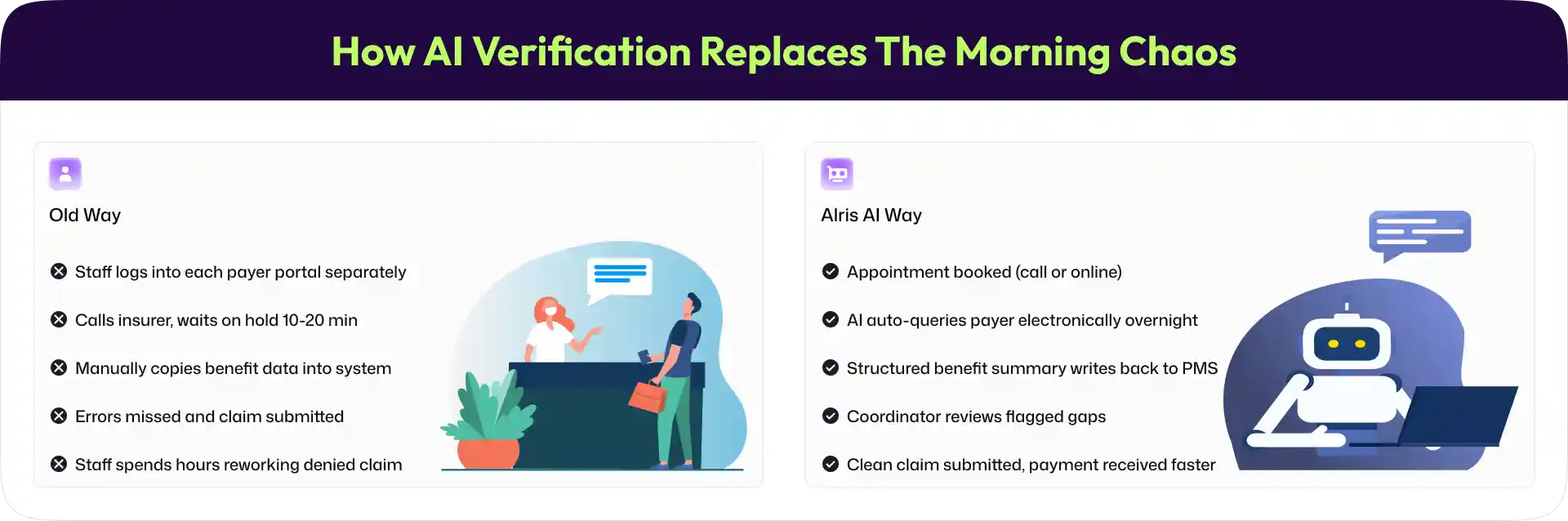
It is 7:45 a.m. in a busy Dallas dental practice. Before the first patient sits down, two front desk team members are already on hold with separate insurance companies, cross-referencing benefits in Dentrix, and manually copying coverage details into a spreadsheet that may already be out of date. By the time they are finished, the morning rush has started, the phones are ringing, and the next round of dental insurance verification for tomorrow's schedule has not even begun.
This is not a staffing problem. This is a workflow problem, and it is costing practices far more than they realize.
In 2023, the U.S. dental industry spent $2.1 billion on insurance eligibility and benefit verification, a 15% increase from the prior year, according to the 2024 CAQH Index published by the Council for Affordable Quality Healthcare. Meanwhile, nearly 70% of dental offices still rely on phone calls and portal logins to verify coverage, a process the American Dental Association has called increasingly complex, costly, and unreliable.
AI is changing that equation. In 2026, AI dental insurance verification automation tools are pulling eligibility data directly from payers, surfacing benefit summaries inside your practice management system, and flagging potential issues before the patient walks in the door, all without a single hold-music bar. This guide explains how it works, what the ROI looks like, and how practices across Texas and the rest of the U.S. are making the switch.
Why Manual Dental Insurance Verification Is Breaking Front Desks
The core problem is straightforward: every patient on tomorrow's schedule needs their insurance verified before treatment can begin. Deductibles must be confirmed. Coverage maximums must be checked. Any lapse in eligibility can mean a denied claim, a frustrated patient, and hours of staff time spent on rework. The numbers make the scale of the problem visible:
Manual verification costs $10 to $11 per check and 11 minutes of staff time per patient, according to the 2024 CAQH Index. For a practice seeing 40 patients a day, that totals $440 in daily labor and roughly 7 hours of front desk time, just for verification.
12% of dental claims billed are denied, and administrative error during the verification stage is the leading cause, according to Henry Schein One's eligibility research.
56% of dental practice managers say getting insurance claims paid is a bigger operational challenge than staff retention, per a Henry Schein One industry survey.
The dental industry could save $580 million annually by replacing manual and portal-based verification with automated electronic processes, per the CAQH Index 2024.
The underlying reason manual verification stays embedded in so many practices is that the insurance ecosystem was not designed for speed. Each payer portal has its own format, login, and navigation. Hold times during peak hours can stretch past 20 minutes per call. And because coverage details change every January when plans reset, information that was accurate last week may no longer be valid today.
Moreover, dental staffing pressures have not eased. Provider time to complete administrative transactions in the dental industry increased by 22% between 2022 and 2023, according to the CAQH Index, largely because high turnover means newer, less experienced staff are completing tasks that previously took skilled coordinators half the time. Practices that rely on institutional knowledge to navigate payer portals are increasingly exposed.
How AI-Powered Dental Insurance Verification Actually Works
AI insurance verification is not a chatbot that calls insurance companies on your behalf. It is a layer of intelligent automation that connects directly to payers via HIPAA-compliant electronic data interchange, retrieves structured eligibility and benefit data, and writes the results back into your practice management system automatically.
The workflow looks like this:
When an appointment is booked or confirmed, the AI system queries the relevant payer, pulling deductible balances, coverage percentages, frequency limitations, remaining annual maximum, and plan year dates. That data is formatted into a standardized summary, regardless of which insurer it came from, and written directly into the patient's record in Dentrix, Eaglesoft, Open Dental, or Curve Dental. No portal login. No hold music. No manual data entry.
For practices using an AI voice agent like Alris AI, this loop closes further: the same system that answers patient calls and books appointments can also trigger the verification workflow at the time of booking, so by the morning of the appointment, the eligibility check is already complete. AI verification systems also run in batch mode, checking the entire next-day or next-week schedule overnight, so the front desk team arrives to a dashboard showing which patients are confirmed, which have coverage gaps, and which need a conversation before treatment begins. Problems surface 24 to 48 hours in advance, not when the patient is already in the chair.
Six Ways AI Insurance Verification Transforms Practice Operations
1. Reclaim 4+ Hours of Front Desk Time Every Day
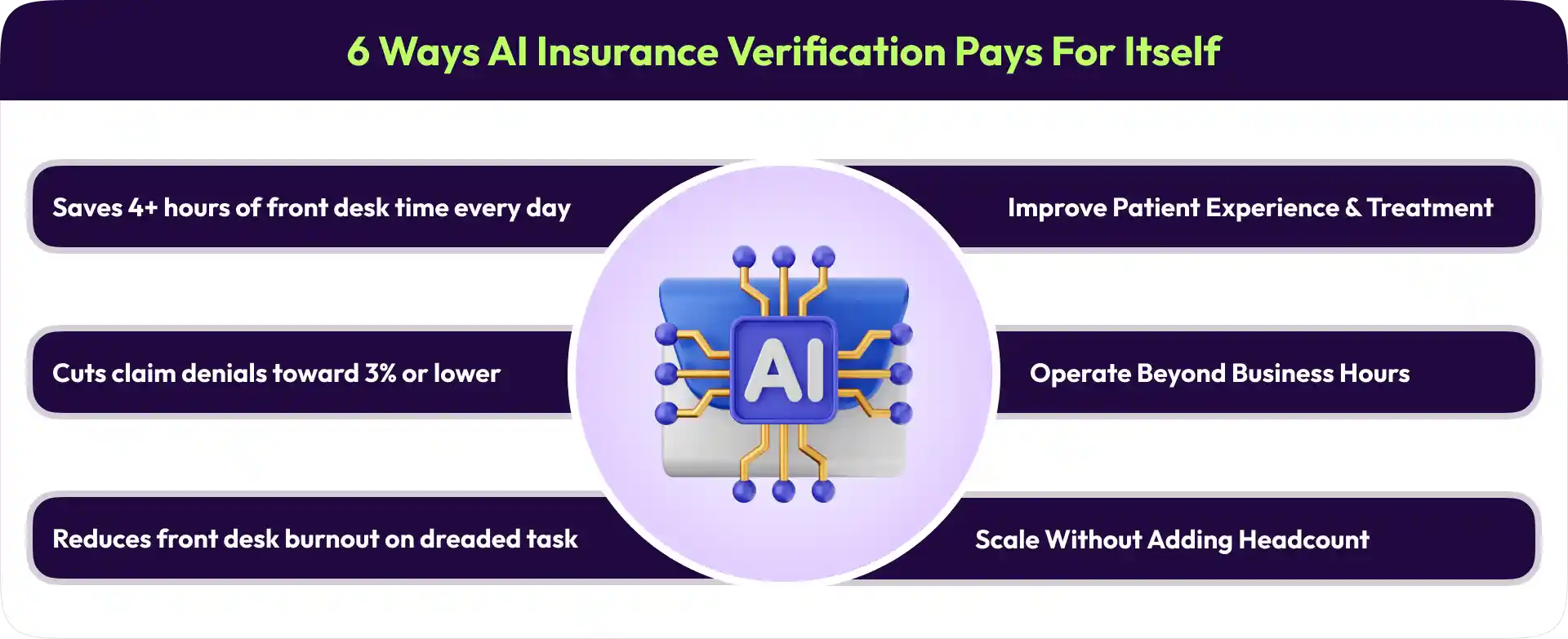
Henry Schein One data shows that practices automating eligibility verification save an average of four hours per day by eliminating phone calls and portal logins. For a practice with three or four front desk staff members, that is the equivalent of adding half an FTE to your team without hiring anyone. Those hours shift to patient communication, recall outreach, and treatment coordination, work that drives production.
2. Cut Claim Denials and Protect Revenue
When verification is accurate and complete before treatment, claim denials fall sharply. Henry Schein One reports that practices using their automated eligibility tools file 97% of claims clean on the first submission. Reducing your denial rate from the industry average of 12% toward that benchmark means thousands of dollars per month recovered without any rework. Every denied claim that does make it through rework costs staff time, delays payment, and risks the patient portion going uncollected.
3. Free Staff from the Highest-Burnout Task in the Practice
Insurance verification consistently ranks as the most dreaded task in dental administration. Staff members who spend three hours every morning on hold with payers experience higher burnout rates and are more likely to leave. Automating verification does not just save time; it changes the tone of the morning. Front desk teams that have made the switch report higher satisfaction scores and more capacity to engage meaningfully with patients.
4. Improve Patient Experience and Treatment Acceptance
When patients arrive knowing exactly what their insurance covers and what their out-of-pocket cost will be, treatment acceptance rises. Coverage surprises at checkout are one of the most common reasons patients delay or decline recommended treatment. Accurate upfront verification, confirmed and communicated before the appointment, removes that barrier. The result is a better patient experience and higher same-day production.
5. Operate Beyond Business Hours
Insurance companies are open from 8 a.m. to 5 p.m. Your practice's schedule does not always cooperate. AI verification systems run 24 hours a day, 7 days a week, checking upcoming appointments overnight and on weekends. Late-booked Friday afternoon patients can have their coverage verified before Monday morning without anyone working overtime.
6. Scale Without Adding Headcount
For group practices and DSOs managing multiple locations, manual verification requires either a centralized team or duplicated effort at every site. AI verification scales horizontally: the same system verifies 50 patients or 5,000 with the same accuracy and speed. Adding a location does not mean adding an insurance coordinator.
AI Insurance Verification in Action: Three Practice Types
Solo Practice in Dallas: Eliminating the Morning Bottleneck
A single-dentist practice in North Dallas sees 30 patients per day, all with some form of dental insurance. The solo front desk coordinator was spending the first two hours of every morning on verification calls, which meant phones went unanswered and new patient inquiries were left on voicemail. After implementing AI eligibility verification integrated with their Dentrix system, the coordinator now reviews a completed verification dashboard each morning rather than building it from scratch. The saved time went directly into answering new patient calls and reducing the practice's voicemail-to-callback gap from 4 hours to under 30 minutes.
Group Practice in Houston: Standardizing Across Three Providers
A three-provider group practice in Houston's Medical Center area was dealing with inconsistent verification workflows. Each front desk team member had a slightly different process, which meant coverage errors varied by who had worked the previous day. AI verification standardized the output: every patient record received the same structured benefit summary in the same format, regardless of payer or staff member. Claim denial rates dropped within the first 60 days, and the billing coordinator spent 40% less time on rework each week.
DSO in San Antonio: Scaling Verification Across Eight Locations
A San Antonio-based DSO with eight locations was running separate verification processes at each site, with no centralized visibility into denial patterns or coverage accuracy. Implementing a unified AI verification layer integrated across all locations gave the billing team a single dashboard showing eligibility status, pending coverage gaps, and denial trends by location. The DSO was also able to reduce the insurance verification headcount from three full-time coordinators to one, with the remaining staff redirected to accounts receivable management. Similar patterns are emerging at multi-site groups in Austin, El Paso, and Plano as DSOs consolidate their revenue cycle operations.
What to Look for When Evaluating AI Verification Tools
Not all dental insurance verification tools are built the same. Before committing to a solution, practice owners and office managers should evaluate five key areas:
Practice management system integration
The best verification tools write data directly into Dentrix, Eaglesoft, Open Dental, or Curve Dental without manual export and import steps. Confirm native integration before signing any contract. A system that delivers a PDF or email summary instead of a chart writeback creates a new manual step rather than eliminating one.
Payer coverage
Ask vendors to provide a list of the insurance plans and payers that their system queries. Most tools cover major carriers like Delta Dental, Cigna, Aetna, MetLife, and Guardian. Smaller regional plans and Medicaid programs vary by vendor. If a significant portion of your patient base carries a plan not on the vendor's list, you will still need manual backup processes for those patients.
HIPAA compliance and signed BAA
Any AI tool that accesses or transmits patient insurance data must be HIPAA-compliant. A signed Business Associate Agreement (BAA) is not optional: it is a legal requirement. Reputable vendors will provide a BAA as a standard part of onboarding. If a vendor is reluctant to sign one, that is a disqualifying signal.
Batch vs. real-time verification
The most effective systems run both: batch verification for the upcoming 1 to 3 days of appointments, and real-time queries triggered at the moment of booking for same-day or next-day patients. Ask how quickly the system flags a coverage problem and through what channel (dashboard alert, text to the coordinator, EHR flag).
Metrics and reporting
A good verification tool should give you visibility into your denial rate trends, verification completion rate, and any recurring payer issues. If a vendor cannot show you reporting dashboards during the demo, they are unlikely to help you measure ROI after go-live.
Three Trends Shaping Dental Insurance Verification Over the Next 18 Months
1. Real-Time Adjudication at the Chair
The next frontier in verification is real-time adjudication: the ability to submit a claim and receive a payment decision before the patient leaves the operatory. Major payers, including Delta Dental and several Blue Cross plans, are expanding real-time adjudication capabilities in 2026 and 2027. Practices with AI verification infrastructure already in place will be positioned to connect to these real-time feeds immediately, reducing days-in-AR from the current industry average of 30-plus days toward single digits for participating payers.
2. AI-Assisted Predetermination
For higher-cost procedures, predeterminations are still largely a manual, multi-day process. AI is beginning to automate predetermination submission and tracking, submitting the clinical documentation electronically and flagging expected approval timelines based on payer history. Practices that are already using AI for eligibility verification will have the fastest path to adding predetermination automation as the technology matures through 2026 and 2027.
3. Predictive Denial Prevention
The most sophisticated verification systems are moving beyond eligibility lookups toward predictive denial prevention: AI models that identify, based on a patient's specific plan and procedure codes, which claims are statistically likely to be denied and why. Rather than reacting to denials after the fact, these systems surface a warning before treatment so the coordinator can obtain documentation, secure a predetermination, or inform the patient of their likely out-of-pocket cost in advance. Expect this capability to become standard in enterprise-tier dental AI platforms within the next 18 months.
Dental Insurance Verification Is a Revenue Problem. AI Is the Fix.
Manual dental insurance verification was always expensive. In 2026, the data confirms what dental office managers have known for years: the phone-and-portal model costs practices $10 or more per check, generates 12% claim denial rates, and burns out the front desk team members most critical to running a productive day.
AI-powered dental insurance verification eliminates the bottleneck without adding headcount. It frees front desk teams to focus on patients. It protects revenue by improving first-pass claim accuracy. And it scales with your practice, whether you are managing one operatory or eight locations across Texas.
Practices in Dallas, Houston, San Antonio, and Austin that have already made the switch are not looking back. The question for 2026 is not whether to automate dental insurance verification. It is how soon you can start, and how much revenue you are leaving on the table in the meantime.
Frequently Asked Questions (FAQs)
1. How long does AI dental insurance verification take compared to manual verification?
Manual dental insurance verification takes 11 minutes per patient on average, according to the CAQH Index 2024. AI-powered verification typically completes the same check in under two minutes, and most systems run batch verifications overnight so results are ready before the front desk team arrives in the morning. For a 40-patient-per-day practice, this translates to four or more hours of staff time recovered daily.
2. Will AI verification work with my practice management software?
Leading AI verification tools integrate natively with Dentrix, Eaglesoft, Open Dental, and Curve Dental. Alris AI connects with all four. Before selecting any tool, confirm that the integration includes direct writeback to your coverage tables rather than just a separate report or export, since writeback is what actually eliminates the manual data entry step.
3. Is AI insurance verification HIPAA-compliant?
Any software that accesses or transmits patient insurance data must be HIPAA-compliant, and the vendor must sign a Business Associate Agreement (BAA) with your practice. Reputable AI verification tools include a signed BAA as a standard part of the onboarding process. This is a non-negotiable requirement. Always confirm BAA signing before sharing any patient data with a vendor.
4. What happens if the AI verification misses something or pulls incorrect data?
No verification system, human or AI, achieves 100% accuracy because payer data can be incomplete or delayed. The difference is that AI systems flag discrepancies and edge cases for human review rather than passing errors through silently. Best-in-class systems report accuracy rates above 95%, and they provide a dashboard view of any records that need manual follow-up, giving your team a short, focused review list rather than requiring them to process every record from scratch.
5. How quickly can a dental practice implement AI insurance verification?
For practices using supported practice management systems, implementation typically takes one to three weeks, covering system integration, payer setup, and team training. Unlike hiring a new insurance coordinator, there is no recruiting cycle, no onboarding ramp, and no institutional knowledge risk if that person eventually leaves. Alris AI practices are typically live within this window, with full verification coverage from day one.
6. Does AI insurance verification cover all dental insurance plans?
Most AI verification platforms cover major commercial carriers, including Delta Dental, Cigna, Aetna, MetLife, Guardian, Humana, and United Concordia. Coverage for smaller regional plans, Medicaid, and CHIP plans varies by vendor and state. Texas practices with a high Medicaid patient volume should ask vendors specifically about Texas Medicaid and CHIP payer connectivity before committing to a solution.
7. What is the ROI of switching to AI insurance verification?
ROI depends on your current denial rate, verification volume, and staff cost, but the math closes quickly for most practices. At $10 to $11 per manual check (CAQH data), a practice running 40 verifications per day spends $16,000 to $18,000 per month on verification labor alone. Automated systems reduce that cost by 80% or more, and the reduction in claim denials adds additional revenue recovery. Most practices see payback on verification automation within 30 to 60 days of go-live.
Sources & References:
Sources (Verified: June 2026)
1. American Dental Association (ADA)
2. Council for Affordable Quality Healthcare (CAQH)
4. Henry Schein One. Dental Insurance Billing and Collections. 2024
Shravan Rajpurohit
CEO & Co-Founder
Shravan Rajpurohit is the Co-Founder & CEO of The Intellify, a leading Custom Software Development company that empowers startups, product development teams, and Fortune 500 companies. With over 10 years of experience in marketing, sales, and customer success, Shravan has been driving digital innovation since 2018, leading a team of 50+ creative professionals. His mission is to bridge the gap between business ideas and reality through advanced tech solutions, aiming to make The Intellify a global leader. He focuses on delivering excellence, solving real-world problems, and pushing the limits of digital transformation.

Stay Updated
with AI Insights
Get the latest articles on AI, automation, and enterprise technology delivered to your inbox weekly.

500+ people have already subsribed!
No spam. Unsubscribe anytime.