
AI Patient Reactivation: How Dental Practices Win Back 1 in 3 Lapsed Patients



Summary: Patient attrition quietly drains revenue from dental practices, but AI is changing how teams win patients back. This guide explores how AI in dental clinics automates outreach through voice calls, texts, and appointment scheduling to reconnect with lapsed patients. Learn the causes of patient attrition, the business benefits of reactivation, implementation best practices, and how AI helps improve retention, increase bookings, and reduce front desk workload.
It is a Wednesday afternoon at a group practice outside Houston, and the office manager is scrolling through a Dentrix report before the last patient of the day checks out. Buried in the numbers is a column she rarely opens: patients with no appointment in the last 18 months. The count is over 600, more than a quarter of the practice's total patient base. Every one of those charts once showed up as production on the schedule, and now it does not.
This is the quiet math behind dental patient reactivation, and it quietly decides whether a practice grows or simply treads water. Practices spend heavily to bring new patients through the door while an entire second practice worth of lapsed patients sits dormant in the same database, already familiar with the office, already trusting the brand, and already easier to win back than any cold lead.
In 2026, AI voice agents are changing how practices approach this problem. Instead of front desk staff squeezing reactivation calls between patients, an AI receptionist can systematically work through the inactive list, call, text, and book, all without adding headcount. This guide explains why patients lapse, what the research says about winning them back, and how practices in Austin, Dallas, San Antonio, and beyond are turning dormant charts into a reliable revenue stream.
Why Patient Attrition Is Costing Dental Practices More Than Ever
Most dentists know they lose some patients every year. Few have measured exactly how many, and fewer still have a system built to win them back.
According to Henry Schein One's 2026 Catalyst Index, a benchmarking report covering tens of thousands of DSOs, multi-location groups, and private practices, average patient retention declined from 72% to 64% year over year. In practical terms, that means roughly one in three patients who were active a year ago are no longer showing up, a shift the report calls a growing disconnection between operational efficiency and long-term growth.
The pattern is not new, it has simply gotten worse. Dental Economics reported in an analysis of practice data that national patient attrition rates average around 17%, while Dental Intelligence's dataset of more than 4,000 offices puts the average closer to 25%, meaning one of every four patients a practice sees will be lost to attrition each year. Layer on a slower economy and rising treatment costs, and the gap between what a schedule could produce and what it actually produces keeps widening.
Average patient retention across the industry sits at 64%, down from 72% a year earlier.
National attrition averages 17% to 25% depending on practice type and market.
Cost and low perceived need remain the top reasons adults delay or skip dental visits altogether.
Meanwhile, most practices still treat reactivation as an afterthought, a stack of recall postcards or a task assigned to whichever front desk coordinator has a free hour. As a result, the lapsed patient list keeps growing while the tools to shrink it stay the same as they were a decade ago.
What Is AI Patient Reactivation?
AI patient reactivation is the use of an AI voice agent, working alongside text and email, to systematically reach out to patients who have gone quiet, remind them why they matter to the practice, and get them back on the schedule without a staff member dialing the phone.
For a busy dentist or practice manager, the idea is simple, even though the technology behind it is not. The system pulls the list of patients who have not been seen in a defined window, commonly 12 to 24 months, directly from the practice management system, whether that is Dentrix, Eaglesoft, Open Dental, or Curve Dental. It then reaches out by phone and text using natural, conversational language rather than a rigid script, and it offers real open appointment slots instead of asking the patient to call back.
If a patient answers and has questions about cost, insurance, or what has changed at the practice, the AI receptionist can address them in the moment rather than losing the patient to voicemail. In addition, if the call is not picked up, a text follows automatically with a direct booking link, so the patient can reschedule at 9 p.m. without ever speaking to anyone. For practices already using Alris AI for everyday call answering, the same system that books new patients and confirms tomorrow's schedule can run reactivation campaigns in the background, all day, every day, with no additional staff time required.
This matters because dental patient reactivation is fundamentally a volume problem. A practice with 600 lapsed patients cannot realistically have a coordinator call all 600 one by one between other duties. An AI voice agent can work through that list methodically over days or weeks, log every outcome, and flag the patients who need a human follow-up, such as someone with a complex treatment plan or an outstanding balance. The technology does not replace clinical judgment, it simply removes the bottleneck that keeps most reactivation lists untouched in the first place.
Benefits of AI Patient Reactivation for Dental Practices
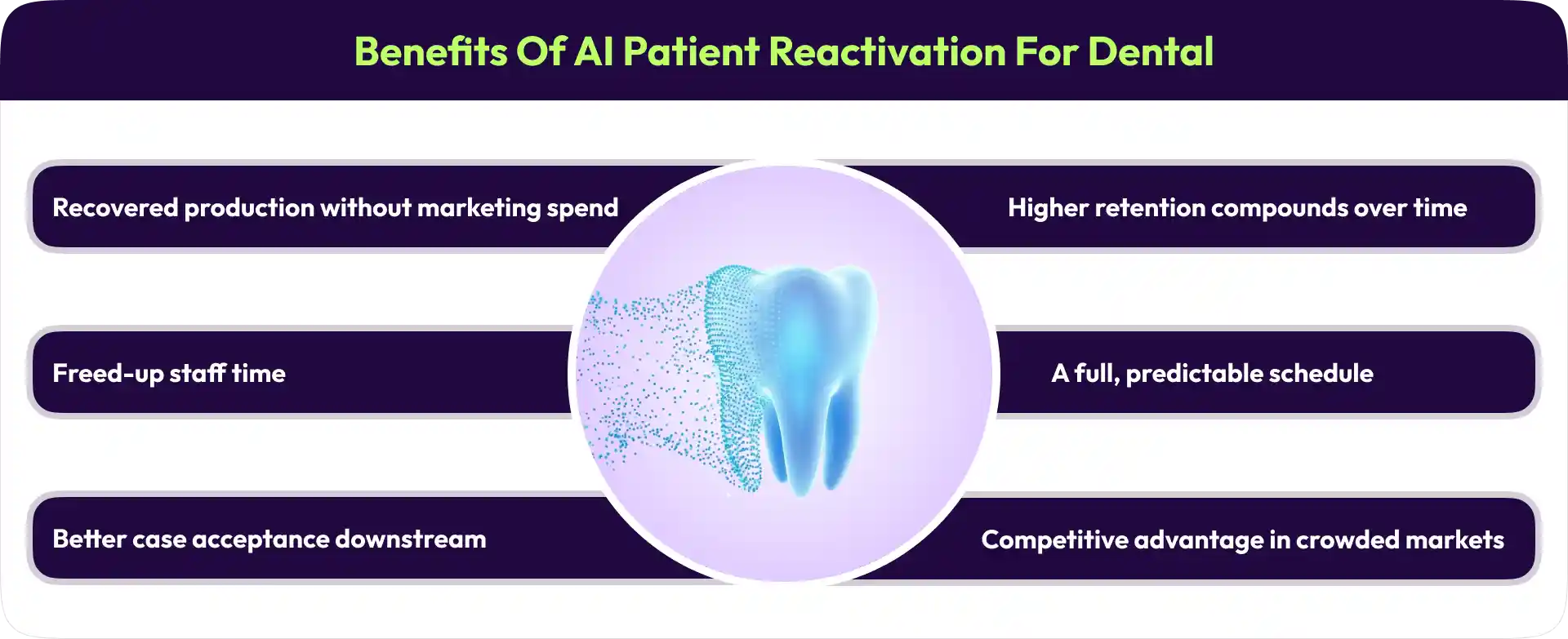
Dental patient reactivation done well changes the economics of a practice in ways that go beyond a single recovered appointment. Here is what practices typically see once an AI voice agent takes over the process.
1. Recovered production without new marketing spend
Reactivating a lapsed patient costs a fraction of acquiring a new one through paid marketing, since the practice already has their information, history, and trust on file.
2. Higher retention compounds over time
Harvard Business Review, citing research from Bain and Company's Frederick Reichheld, reports that increasing customer retention rates by just 5% can increase profits by 25% to 95%. Applied to a dental practice, even a modest improvement in how many lapsed patients return has an outsized effect on annual revenue.
3. Freed-up staff time
Front desk teams no longer need to carve out blocks of time for outbound recall calls between patients, insurance questions, and check-ins. That time goes back into the patient experience in the chair.
4. Better case acceptance downstream
The 2026 Catalyst Index found that top-performing practices achieve 75% case acceptance compared to 45% for the average practice. Patients who feel remembered and reached out to personally are more receptive to treatment recommendations once they are back in the chair.
5. A full, predictable schedule
Instead of hoping new patient inquiries fill open slots, practices can pull from a known, already-interested pool of lapsed patients to keep hygiene and treatment chairs full.
6. Competitive advantage in crowded markets
In metro markets like Austin, Dallas, and Houston, where patients have no shortage of dental options, a practice that proactively reaches out before a patient chooses a competitor keeps more of its existing base.
AI Patient Reactivation Use Cases
Solo practices:
A solo practitioner in Plano with one office manager and no dedicated marketing budget cannot spare staff hours for outbound recall calls. An AI receptionist runs reactivation campaigns overnight and on weekends, filling hygiene gaps without adding a single hour to the office manager's week.
Group practices:
A three-location group in the Dallas-Fort Worth area with a shared patient database can segment lapsed patients by location and treatment history, then let the AI voice agent run location-specific campaigns, tailoring messaging to each office's schedule and availability.
DSOs:
A DSO managing a dozen practices across San Antonio and El Paso can standardize dental patient reactivation across every location at once, giving regional managers a consistent view of recovered production and retention rates without relying on each office to run its own manual recall process.
How to Choose the Right AI Patient Reactivation Solution
Before adopting an AI patient reactivation system, practices should evaluate a few key factors.
1. Confirm the platform integrates natively with your practice management software, so lapsed patient lists and booked appointments sync automatically without manual data entry.
2. Ask how the system handles patient conversations. A true AI-powered voice agent should be able to answer basic insurance and cost questions, not just play a scripted reminder message.
3. Confirm HIPAA compliance and that the vendor will sign a Business Associate Agreement, since reactivation outreach involves protected health information.
4. Ask for visibility into results. A practice should be able to see how many lapsed patients were contacted, how many were booked, and how much production was recovered, not just a vague promise of improved retention. It is also worth asking how the vendor prioritizes outreach. A system that treats a patient inactive for 13 months the same as one inactive for three years will waste effort on the hardest cases while newer, easier wins sit further down the list.
The Future of AI Patient Reactivation
Over the next 12 to 18 months, expect dental patient reactivation to keep evolving in three directions.
1. AI systems will get better at predicting which lapsed patients are most likely to return, prioritizing outreach based on treatment history and past behavior rather than treating every inactive patient the same.
2. Reactivation and insurance verification will merge into a single workflow, so a returning patient's coverage is already confirmed before they even schedule.
3. Bilingual and Spanish-language outreach will become standard rather than optional, particularly across Texas markets with large Spanish-speaking populations in cities like San Antonio and El Paso.
Final Thought
Lapsed patients are not lost revenue, they are deferred revenue sitting in a database that most practices never systematically work. Between rising attrition rates and a shrinking margin for error in a slower economy, dental patient reactivation has moved from a nice-to-have to a core part of running a healthy practice.
AI voice agents make that work achievable without adding staff, running outreach around the clock, and booking patients back onto the schedule the moment they are ready. As practices across Texas and the rest of the country compete for the same shrinking pool of new patients, the ones who systematically reactivate the one in three patients who have already lapsed will be the ones who keep growing in 2026 and beyond.
Frequently Asked Questions (FAQs)
1. What is a lapsed dental patient?
Most practices define a lapsed patient as anyone without a completed appointment in the last 12 to 18 months. Some practices use an 18-month window specifically to account for patients who skip a single annual cleaning before returning. The exact cutoff should match your recall interval and patient base.
2. How does AI patient reactivation work?
An AI voice agent calls the patient directly using natural conversation, not a recorded script, and offers real open appointment times pulled from the practice's schedule. If the call goes unanswered, a follow-up text with a direct booking link is typically sent automatically.
3. Is AI patient reactivation HIPAA compliant?
It should be. Any reputable AI receptionist vendor working with protected health information should sign a Business Associate Agreement and use HIPAA-compliant infrastructure for storing and transmitting patient data during reactivation outreach.
4. How effective is AI patient reactivation?
Response rates vary by how long a patient has been inactive and how many outreach attempts are made, but practices that combine phone, text, and persistent multi-touch outreach consistently recover more patients than a single postcard or one phone call ever would.
5. Will an AI receptionist replace my front desk team?
No. An AI voice agent handles high-volume, repetitive outreach like reactivation calls and reminders, freeing your front desk team to focus on patients who are physically in the office and on tasks that need a human touch.
6. Does dental patient reactivation work for solo practices or only for larger groups?
It works for both. Solo practices often see the fastest relative impact since they typically have no dedicated recall system in place at all, meaning even a basic AI-driven reactivation campaign represents a significant improvement.
Sources & References:
All sources were verified in June 2026.
1. Henry Schein One. Catalyst Index, Revealing Clinical Performance as the Primary Driver of Growth
2. Wells, Brett, DDS. Dental Economics
Shravan Rajpurohit
CEO & Co-Founder
Shravan Rajpurohit is the Co-Founder & CEO of The Intellify, a leading Custom Software Development company that empowers startups, product development teams, and Fortune 500 companies. With over 10 years of experience in marketing, sales, and customer success, Shravan has been driving digital innovation since 2018, leading a team of 50+ creative professionals. His mission is to bridge the gap between business ideas and reality through advanced tech solutions, aiming to make The Intellify a global leader. He focuses on delivering excellence, solving real-world problems, and pushing the limits of digital transformation.

Stay Updated
with AI Insights
Get the latest articles on AI, automation, and enterprise technology delivered to your inbox weekly.

500+ people have already subsribed!
No spam. Unsubscribe anytime.