
How AI Dental Receptionist Reduces Call Abandonment and Missed Calls


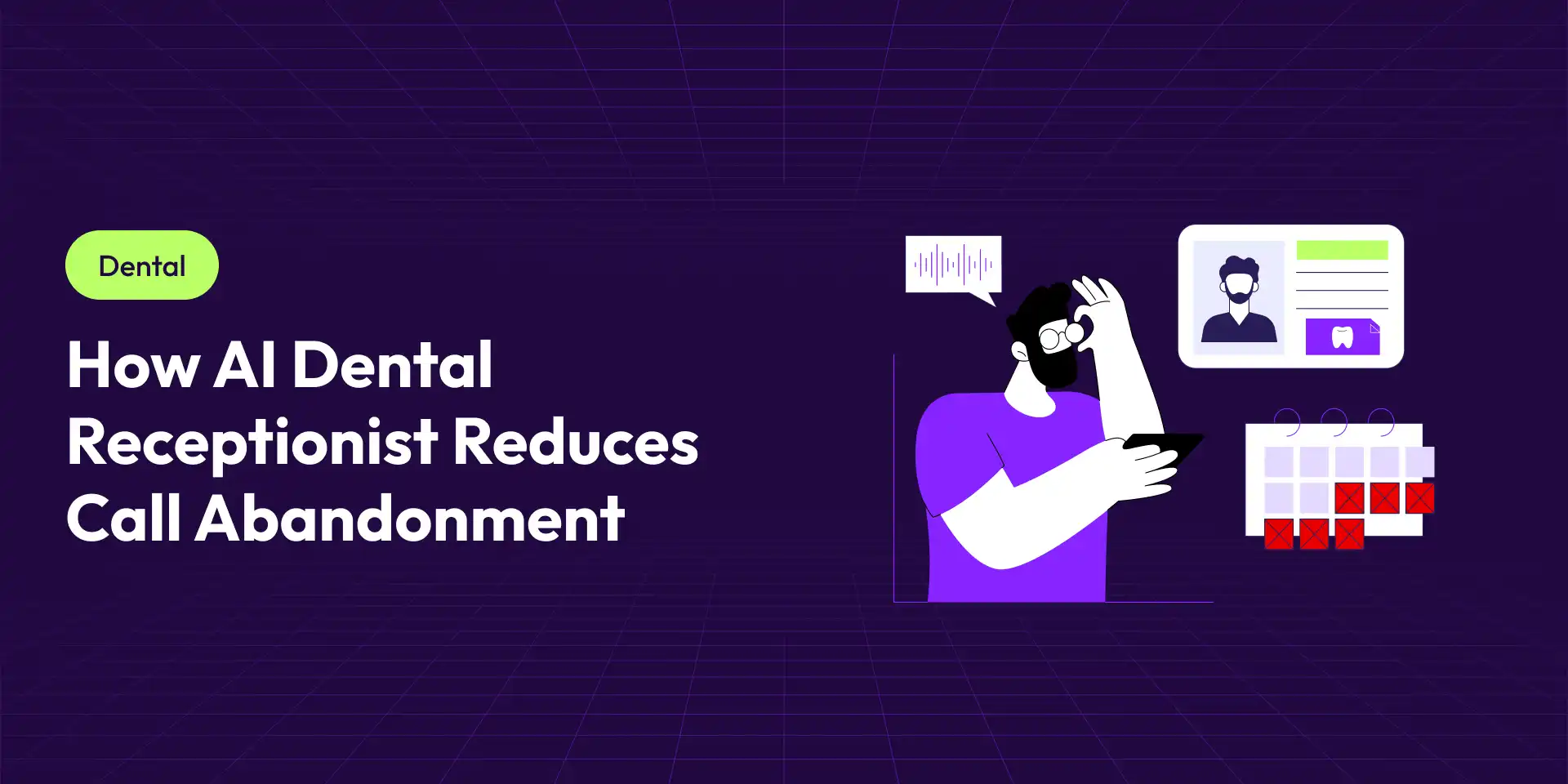
Summary: An AI dental receptionist helps US dental practices reduce missed and abandoned calls by providing 24/7 phone coverage, answering patient questions, scheduling appointments, and supporting after-hours inquiries. This guide explains how dental AI receptionist technology improves call handling, reduces front desk workload, and helps practices capture more patient opportunities.
A dental receptionist does much more than answer the phone. On a typical day, they may check patients in, manage appointments, answer billing questions, coordinate with the clinical team, and deal with a steady stream of calls at the same time.
That becomes difficult when several patients call at once.
The problem gets worse during predictable busy periods. Morning calls, lunch-hour calls, and after-hours calls can arrive when the front desk has little or no capacity to answer them. The result is missed calls, abandoned calls, delayed callbacks, and potentially lost new patients.
An AI dental receptionist adds another layer of phone coverage. It can answer calls, handle routine questions, schedule appointments, send confirmations, and support patients outside normal office hours.
This guide explains how call abandonment happens, what it can cost a US dental practice, how an AI dental receptionist works, and what practices should consider before implementing one.
What Is Call Abandonment at a Dental Practice?
A missed call is straightforward: the phone rings, but nobody answers.
An abandoned call is slightly different. The caller reaches a hold queue or voicemail but hangs up before their issue is resolved. Abandoned calls can be harder to track because the phone system may register that the caller reached the practice, even though the conversation never actually happened.
For a dental practice, both situations can hurt new patient acquisition.
Imagine someone searching for a dentist, finding your practice, and calling to schedule. If nobody answers, they have two options: try again or move on. A lot of patients will move on.
When does dental call abandonment happen most
Call abandonment tends to follow a pattern.
Morning: 8:00 a.m. to 9:30 a.m. This can be one of the busiest call windows. Patients are calling before work, before school, or at the beginning of their day. Meanwhile, the front desk is handling patients arriving at the practice.
Lunch hour: Patients may call during their own lunch breaks, while the practice has reduced front desk coverage.
After 5:00 p.m., the front desk may be closed, leaving incoming calls to voicemail or another limited coverage option.
The frustrating part is that call volume can peak precisely when the dental receptionist is least available.
What callers do after abandoning a dental call
Some callers try again. Some leave a voicemail. Others search for another dental practice and call the next option.
That last outcome is particularly important for US practices competing in local search results. If another dentist is only a few clicks away, a patient may not feel any reason to wait for a callback.
One abandoned call might not seem serious. Repeated every day, though, those lost opportunities can add up.
The Real Cost of Missed and Abandoned Calls at US Dental Practices
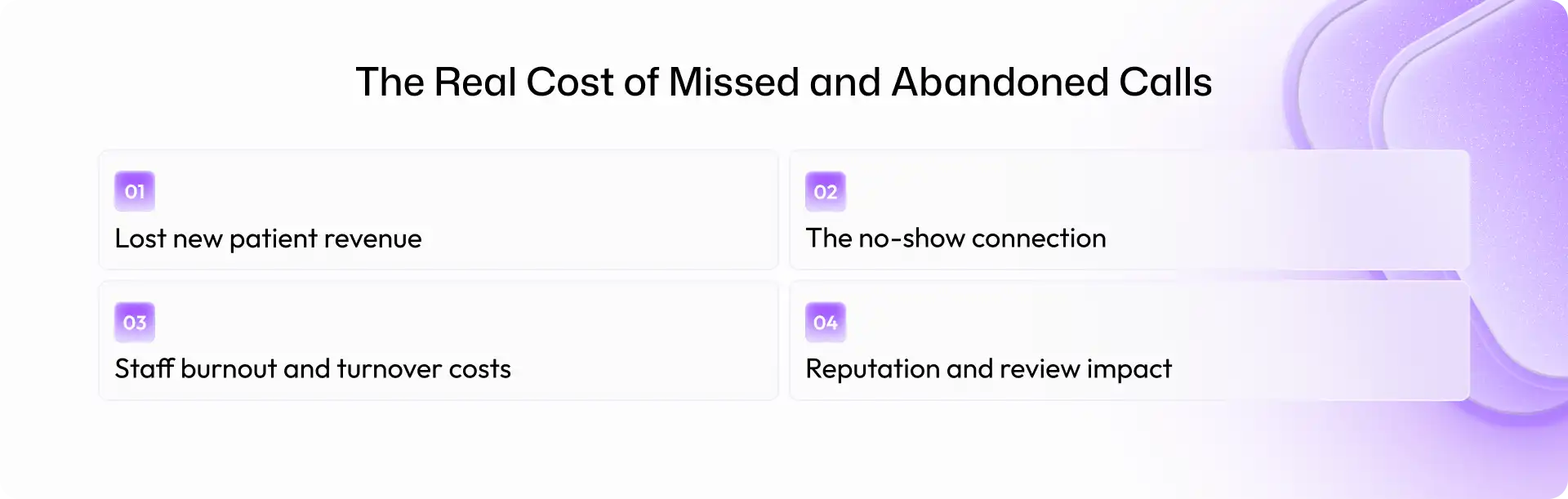
Lost new patient revenue
Not every dental call is a new patient opportunity. Some are existing patients asking questions, changing appointments, or dealing with billing.
New patient calls are different. A new patient can become a long-term patient, return for regular care, and potentially refer family members. Losing that first appointment can therefore mean losing more than one transaction.
A practice can estimate its missed-call opportunity by looking at:
Missed and abandoned calls each week
The estimated share of those calls from prospective patients
New patient booking rates
Average value of a new patient
Longer-term patient value
The exact financial impact will vary by specialty and practice. The important point is to measure what is happening at your own front desk rather than treating every missed call as an identical opportunity.
The no-show connection
Phone communication also affects what happens after an appointment is booked.
If confirmation and reminder outreach depend entirely on a busy dental receptionist, some patients may not receive timely communication. A patient might forget an appointment, realize they cannot attend, or fail to reschedule early enough for the practice to fill the slot.
That can leave an empty chair that is difficult to backfill.
Automated confirmation and reminder workflows can take some of this repetitive work away from the front desk. An AI dental receptionist can send confirmation messages, reminders, and rescheduling prompts without requiring staff to manually contact every patient.
Staff burnout and turnover costs
Phone overload is not just a patient-access problem. Reception teams already have to switch between phone calls, patients at the front desk, scheduling, payments, internal requests, and other administrative tasks. When calls keep coming in, the pressure builds. Over time, that can contribute to front desk burnout and turnover.
The cycle is pretty simple:
Understaffing → more missed calls → more workload → more burnout → more turnover → understaffing
Replacing a trained dental receptionist also takes time and money. Recruitment, onboarding, and training all add costs that aren't solved simply by hiring another person.
Reputation and review impact
Patients who struggle to reach a dental practice may mention it in a Google review. They may not use the phrase "call abandonment." Instead, they might say:
"Nobody answers the phone."
"I called multiple times."
"No one called me back."
"It's difficult to reach the office."
For a US dental practice that relies on Google reviews and local search visibility, repeated complaints about phone accessibility can affect how prospective patients view the practice.
What Is an AI Dental Receptionist?
An AI dental receptionist is software that handles routine patient conversations over the phone.
It is not simply a recording. It is not a basic phone menu that asks callers to press numbers. And it is different from a generic AI answering tool that has no understanding of dental workflows.
A dental AI receptionist can be configured around the way a practice actually operates. It can answer inbound calls, understand what the caller needs, schedule appointments, answer routine questions, capture patient information, and escalate more complex situations to staff.
The main difference from a traditional dental receptionist is capacity.
One receptionist can only have one conversation at a time. An AI system can handle multiple calls simultaneously, giving the practice another way to manage periods when call demand suddenly spikes.
What an AI dental receptionist handles
Depending on the platform and configuration, an AI dental receptionist can support:
Inbound calls: New patient inquiries, scheduling, billing questions, and routine requests.
Appointment booking: Appointments can be scheduled or rescheduled using real-time calendar availability.
SMS and email confirmations: Patients can receive automatic confirmation and reminder messages.
After-hours coverage: Calls can continue to be handled after the practice closes.
Recall outreach: Overdue patients can be contacted automatically.
Post-visit follow-up: Routine messages can be sent after appointments.
Bilingual calls: English and Spanish support can help practices serving diverse US patient populations.
Human escalation: Clinical questions and complex situations can be routed to staff.
How an AI Dental Receptionist Reduces Call Abandonment
Answering every call instantly - removing the primary abandonment trigger
The most direct way to reduce call abandonment is to make sure someone or something is available to answer.
An AI dental receptionist can provide 24/7 coverage, answering calls without relying on a single front desk employee. During a peak period, several callers can be handled in parallel rather than forcing everyone into the same queue.
That changes the experience for the patient who was about to hang up. Instead of waiting for the receptionist to finish with another patient, the caller can immediately explain what they need.
Covering the morning call spike
The 8:00 a.m. to 9:30 a.m. period can put considerable pressure on a dental front desk.
An AI dental receptionist can handle new patient inquiries, scheduling requests, and routine questions while the in-office team focuses on patients physically standing in front of them.
That means the receptionist does not have to choose between answering the phone and helping the patient at the desk. For practices with a high volume of morning calls, this can directly improve the number of new patient opportunities captured during the busiest window.
Closing the after-hours gap
After-hours calls are another obvious gap. A practice may close at 5:00 p.m., but patients don't necessarily stop looking for dental care at 5:00.
With an AI dental receptionist, after-hours callers can still receive assistance, schedule appointments, provide their information, or have urgent situations routed appropriately.
The same applies to weekends and holidays. Instead of reaching a voicemail box and deciding to try another practice, a prospective patient can continue the conversation.
Automated outbound - reducing patient-side abandonment
Not all communication needs to start with an incoming call. Automated outbound communication can reduce the number of reasons patients need to call in the first place.
For example, confirmation and reminder messages can be sent before appointments. Patients who need to reschedule can respond to the reminder rather than calling the front desk.
Recall outreach can also reconnect with overdue patients before they drift away. The result is a more proactive communication process and less repetitive phone work for the front desk.
How an AI Dental Receptionist Works: The Patient Call Journey
The workflow can look like this:
Patient Calls the Practice - any time of day
↓
AI Dental Receptionist Answers Within One Ring - natural greeting, no hold
↓
Identifies the Request - new patient inquiry, scheduling, billing question, or urgent concern
↓
Handles the Interaction - answers the question, captures details, or books the appointment
↓
Confirms with the Caller - appointment details are repeated before the call ends
↓
PMS Updated in Real Time - Dentrix, Eaglesoft, Open Dental, Curve Dental
↓
SMS Confirmation Sent Automatically
↓
Reminder Triggered - typically 24-48 hours before the appointment
↓
Follow-up Triggered - post-visit communication after the appointment
During busy periods, simultaneous calls can be handled without putting every caller into the same queue. For urgent or clinical matters, the AI can escalate the call to the appropriate staff member with the relevant context. After-hours calls can follow the same general workflow, while escalation rules can determine which situations require human involvement.
AI Dental Receptionist vs Traditional Dental Receptionist
The two approaches solve the phone-coverage problem differently.
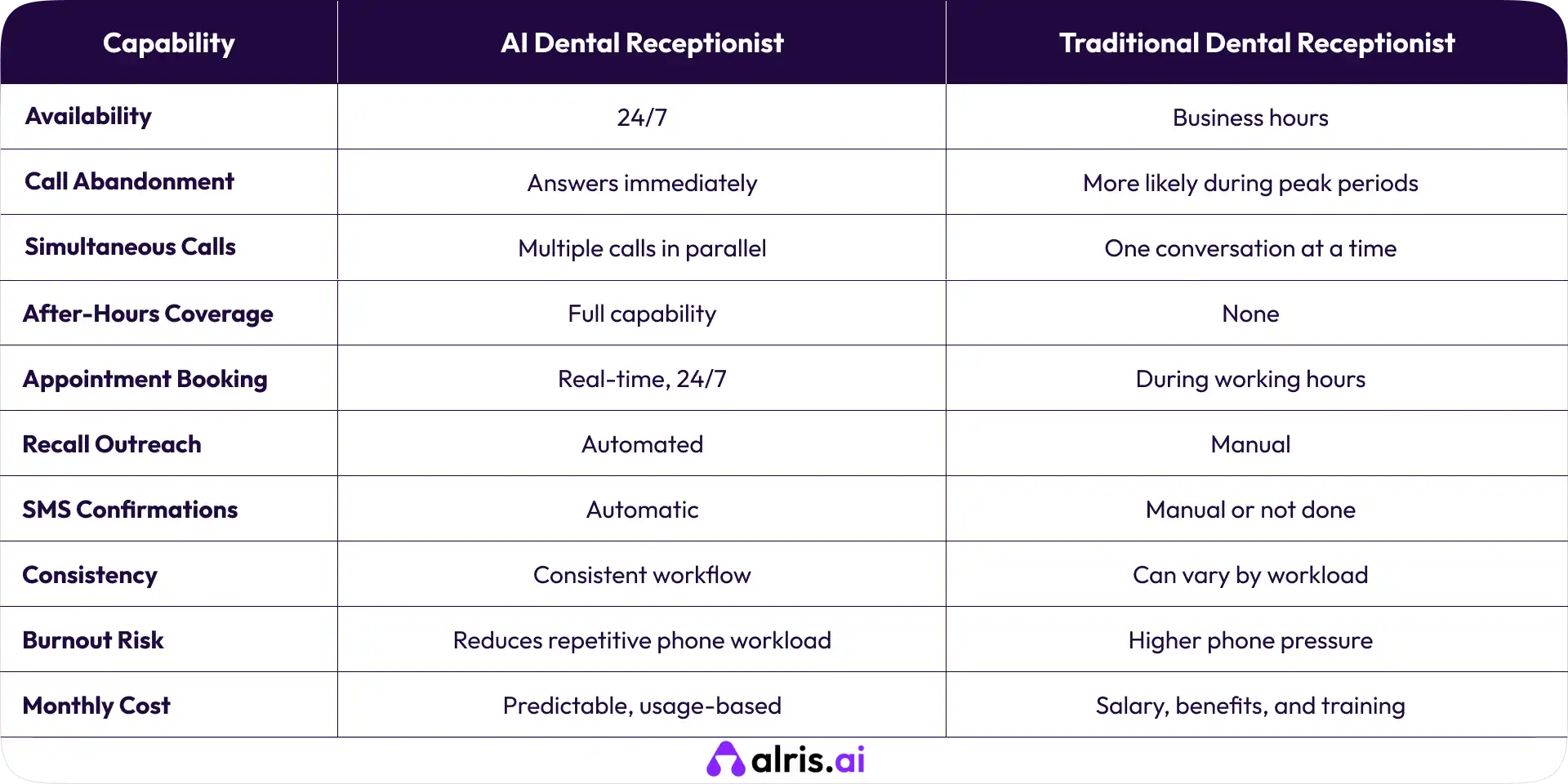
The goal isn't necessarily to choose AI instead of a receptionist. In many practices, the better approach is to use AI to cover repetitive phone interactions while the human team focuses on patients and more complex situations.
How to Implement an AI Dental Receptionist at Your US Practice
Step 1: Measure your current call abandonment and missed call rate
Start with your existing phone data. Look at:
Answered versus unanswered calls
Abandoned calls
Morning and lunch-hour patterns
After-hours call volume
New patient calls
Calls that result in appointments
This gives you a baseline to compare after implementation.
Step 2: Choose the right AI dental receptionist platform
Don't judge a platform only by how natural its demo sounds. Check whether it supports:
HIPAA compliance and a Business Associate Agreement
Real-time PMS integration
After-hours appointment booking
Natural conversations using real dental scenarios
For a US practice, these are practical requirements, not nice-to-have extras.
Step 3: Integrate with your practice management software
Connect the platform to the practice's PMS so scheduling information stays current. Before going live, test appointment booking and confirm that patient information is handled appropriately within the integration.
Step 4: Configure for your practice's call types
Every practice has its own workflows. Configure:
New patient inquiry flows
Appointment types
Scheduling rules
Availability windows
Emergency escalation
Recall outreach
Confirmation messaging
The more closely the system matches the actual practice workflow, the more useful it becomes.
Step 5: Test across your highest-abandonment scenarios
Don't just test one easy call. Test simultaneous morning calls, after-hours new patient inquiries, Spanish-language conversations, post-procedure questions, and emergency routing.
Those are the situations where a system's real-world performance matters.
Step 6: Monitor call abandonment rate post-implementation
After launch, keep measuring. Track the call abandonment rate weekly during the first month. Compare morning abandonment before and after implementation, measure new patient calls that become booked appointments, and monitor changes in front desk workload.
What to Look for in an AI Dental Receptionist Platform
Before choosing a platform, look for these capabilities:
HIPAA compliance with BAA
Instant call answering
Real-time PMS integration
Full after-hours appointment capability
Natural dental conversation
Automated SMS and email confirmations
Recall outreach automation
English and Spanish support
Call analytics
Omnichannel communication across voice, SMS, and email
One point deserves extra attention: PMS integration.
If the system can answer a call but cannot see real-time appointment availability or actually book the patient, the practice may still need to call the patient back. That doesn't fully solve the problem.
Conclusion
Call abandonment at a US dental practice is rarely a completely random problem.
Calls tend to increase during predictable periods: morning rushes, lunch hours, evenings, weekends, and holidays, when the front desk may have limited capacity or no coverage at all.
That creates a frustrating situation. A prospective patient finds the practice, makes the call, and then disappears because nobody answers.
An AI dental receptionist addresses the problem by adding phone coverage where traditional staffing has limits. It can answer calls, handle routine conversations, schedule appointments, support after-hours inquiries, automate reminders, and route complex situations to human staff.
The goal isn't to remove the human receptionist from the practice. It's to stop making one person responsible for every phone call, every patient standing at the front desk, and every administrative request at the same time.
For dental practices competing for patients in crowded US local markets, being reachable matters. If a patient calls when your team is busy, the question isn't whether the phone rang. It's whether someone or something was there to answer.
Frequently Asked Questions (FAQs)
1. What is an AI dental receptionist?
An AI dental receptionist is software that answers inbound calls, understands what patients need, and handles routine interactions such as appointment scheduling, questions, and new patient information capture without requiring a human receptionist to answer every call.
2. How does an AI dental receptionist reduce call abandonment?
It provides immediate phone coverage during business hours, peak periods, after hours, weekends, and holidays. By reducing hold times and reliance on voicemail, it addresses two major situations that can cause patients to hang up or look for another practice.
3. Is an AI dental receptionist HIPAA-compliant?
Some platforms offer HIPAA-compliant configurations and Business Associate Agreements. US dental practices should verify the platform's documentation and BAA before handling patient health information through the system.
4. Can an AI dental receptionist schedule appointments?
Yes, when the platform has real-time access to the practice's scheduling system. It can identify available appointments and book them during the call rather than simply taking a message for a later callback.
5. What dental practice management software does it integrate with?
The source framework identifies Dentrix, Eaglesoft, Open Dental, and Curve Dental as major US dental PMS platforms to consider when evaluating integration. Practices should confirm support for their specific system and version before implementation.
6. How does an AI dental receptionist handle after-hours calls?
It can provide continued phone coverage after the practice closes, including routine questions, new patient information capture, appointment scheduling, and escalation of urgent calls according to the practice's configured workflow.
7. Can an AI dental receptionist handle calls in Spanish?
Bilingual English and Spanish support can be particularly useful for US practices serving diverse patient populations, including markets such as California, Texas, Florida, and New York. Practices should confirm the languages and capabilities supported by their chosen platform.
8. How quickly does call abandonment improve after implementing an AI dental receptionist?
The source framework indicates that practices can begin measuring changes quickly because call answering starts as soon as the system is implemented. New patient conversion and reminder-related outcomes may take longer to evaluate, so practices should compare results against their baseline over the first month.
Shravan Rajpurohit
CEO & Co-Founder
Shravan Rajpurohit is the Co-Founder & CEO of The Intellify, a leading Custom Software Development company that empowers startups, product development teams, and Fortune 500 companies. With over 10 years of experience in marketing, sales, and customer success, Shravan has been driving digital innovation since 2018, leading a team of 50+ creative professionals. His mission is to bridge the gap between business ideas and reality through advanced tech solutions, aiming to make The Intellify a global leader. He focuses on delivering excellence, solving real-world problems, and pushing the limits of digital transformation.

Stay Updated
with AI Insights
Get the latest articles on AI, automation, and enterprise technology delivered to your inbox weekly.

500+ people have already subsribed!
No spam. Unsubscribe anytime.