
How AI Is Solving Front Desk Burnout Across Industries



Summary: Front desk teams across industries are handling more calls, messages, appointments, and administrative work than ever before, leading to burnout and operational inefficiencies. This guide explores how AI front desk automation helps businesses reduce repetitive tasks, improve customer response times, and support employees without replacing them. Learn how organizations in healthcare, hospitality, restaurants, real estate, and other sectors are using AI to create more efficient and customer-focused front desk operations.
Today's front desk teams are expected to do it all: answer calls, manage appointments, respond to messages, and assist customers, often at the same time. As workloads continue to grow, so do missed calls, employee burnout, and delays that affect the overall customer experience.
The challenge isn't the people. It's the volume of repetitive work.
That's why businesses across industries are adopting AI front desk automation. By handling routine tasks like calls, scheduling, reminders, and FAQs, AI reduces administrative burden and gives teams more time to focus on the conversations that matter most.
In this guide, we'll explore what causes front desk burnout, how AI front desk works, and how businesses are using it to build more efficient, responsive, and customer-focused operations.
What Is Front Desk Burnout and Why Does It Keep Happening?
Front desk burnout doesn't happen because employees lack motivation. It happens because the role has quietly expanded over the years without reducing any of the responsibilities that already existed.
Why the Workload Keeps Growing
Customer expectations have changed dramatically. People no longer expect businesses to be available only during office hours. They call before work, text during lunch, book appointments in the evening, and expect quick responses regardless of the channel they choose.
At the same time, businesses are adding more communication channels: phone, SMS, email, web chat, social media, and messaging apps.
While customer convenience has improved, the workload for front desk teams has multiplied. Many businesses try to solve this by hiring another receptionist. But every new employee still spends hours answering the same routine questions every day. The workload keeps returning because the process hasn't changed.
The Real Cost of Front Desk Turnover
Burnout affects much more than employee morale. When experienced receptionists leave, businesses lose valuable operational knowledge that isn't easy to replace.
Recruiting, hiring, and training new employees takes time and money. Existing staff often absorb additional work during the transition, increasing stress across the entire team.
Meanwhile, customers notice the difference. Longer wait times, inconsistent communication, and missed follow-ups can quietly damage trust and reduce customer satisfaction.
Research from Gallup consistently shows that employee burnout contributes to lower productivity, higher absenteeism, and increased turnover costs that ripple across the organization.
What Is AI Front Desk Automation?
AI front desk automation uses conversational AI to manage routine customer interactions that a receptionist would normally handle. It can answer calls, schedule appointments, respond to common questions, send reminders, update records, and route inquiries to the right team, all while working alongside your existing systems.
Unlike traditional phone menus or basic automation tools, AI understands natural conversations and completes tasks without requiring manual intervention. This helps businesses respond faster, reduce repetitive administrative work, and improve the overall customer experience.
An AI front desk isn't designed to replace people. It takes over repetitive, process-driven tasks so your team can focus on the conversations that require empathy, judgment, and personalized support.
How AI Front Desk Works
An AI front desk acts as the first point of contact across multiple communication channels, helping businesses respond faster while keeping staff focused on higher-value work.
1. Inbound Call Handling and Routing
AI answers calls instantly, identifies the caller's intent, provides answers to common questions, and routes complex conversations to the right person without lengthy hold times.
2. Appointment Scheduling and Rescheduling
Customers can book, cancel, or reschedule appointments through a natural conversation. The AI checks availability, updates the calendar, and sends confirmations automatically.
3. Automated Reminders and Follow-ups
Reminder calls, SMS messages, and follow-up communications are sent automatically, reducing missed appointments while saving staff hours every week.
4. Live Chat and SMS Support
Whether a customer prefers calling, texting, or chatting through a website, AI provides consistent responses across every channel while maintaining the conversation history.
5. Data Entry and CRM Updates
Instead of asking staff to manually record every interaction, AI captures customer information and updates connected scheduling or CRM systems in real time.
6. Human Escalation When Needed
Not every conversation should be automated. When a request requires empathy, business judgment, or specialist expertise, AI transfers the conversation with the relevant context to the appropriate team member, allowing the customer to continue without repeating themselves.
How Front Desk Automation Reduces Administrative Burden
AI isn't designed to replace experienced employees. It's designed to remove the repetitive work that keeps them from focusing on customers. Here's how that works in practice.
Answers Every Call Even at 2 a.m.
Customers don't always call during business hours. An AI-powered receptionist can answer calls 24/7, respond to common questions, collect information, and even schedule appointments when the office is closed.
The next morning, your team starts the day with organized information instead of a full voicemail inbox.
Handles Repetitive Questions Automatically
Rather than asking receptionists to answer the same questions all day, AI can instantly respond to routine inquiries like:
Business hours
Location details
Pricing information
Service availability
Booking policies
Parking instructions
Customers receive immediate answers, while staff stay focused on conversations that require personal attention.
Books and Reschedules Appointments Without Staff Involvement
Modern AI systems connect directly with scheduling software. Instead of placing callers on hold while checking availability, AI can:
Find open time slots
Schedule appointments
Process cancellations
Offer alternative times
Send confirmations automatically
The experience is faster for customers and significantly reduces administrative work.
Sends Reminders and Follow-ups Automatically
Reminder calls, SMS notifications, and confirmation messages no longer have to be sent manually. AI can schedule and send them automatically, helping businesses reduce missed appointments while keeping communication consistent.
Some platforms can even follow up with customers who didn't confirm and reopen cancelled time slots before they go unused.
Updates Records in Real Time
Instead of relying on staff to enter notes after every conversation, AI can capture customer details and sync them with connected systems. This reduces duplicate work, improves record accuracy, and gives employees more time to focus on customer service.
Gives Employees Time for Work That Actually Needs Them
Perhaps the biggest benefit isn't faster scheduling. It's allowing people to spend more time on work that requires human judgment. Employees can focus on:
Helping customers with complex requests
Solving problems
Building stronger relationships
Supporting visitors in person
Handling sensitive conversations
That's where people create value. AI simply clears away the repetitive work that gets in the way.
AI Front Desk Across Different Industries
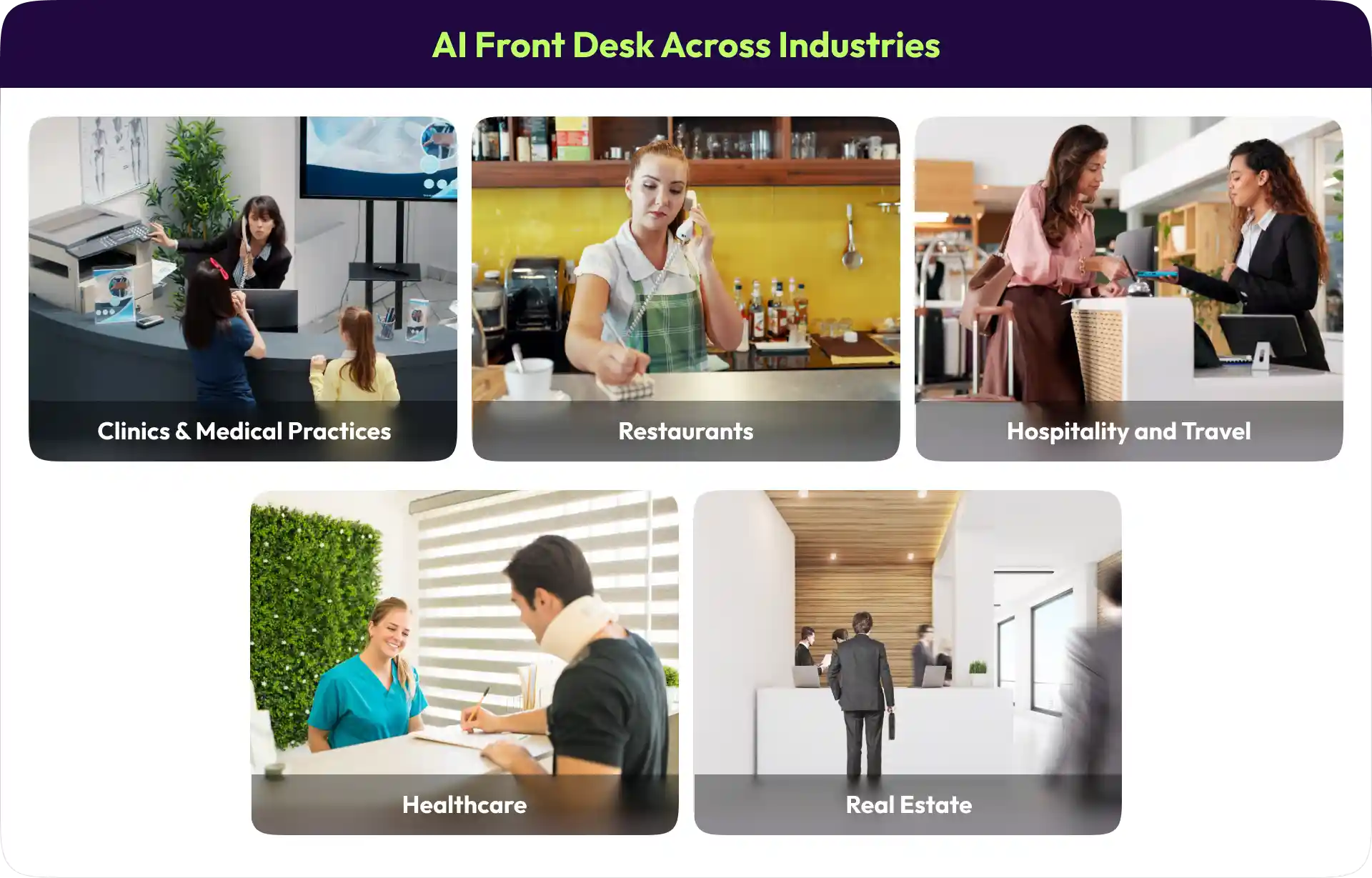
Front desk burnout looks different from one industry to another, but the underlying challenge is often the same: too many repetitive tasks and not enough time. Here's how AI is helping different sectors reduce administrative pressure without compromising customer experience.
Clinics and Medical Practices
Medical clinics handle a constant flow of patient communication. Appointments need to be booked, prescriptions requested, referrals confirmed, insurance questions answered, and after-hours calls managed.
During busy periods, receptionists often spend more time answering phones than helping patients standing in front of them. An AI front desk can:
Schedule and reschedule appointments
Send reminders automatically
Answer common patient questions
Collect intake information before visits
Handle after-hours inquiries
Route urgent requests to the appropriate team
The result is shorter wait times, fewer missed appointments, and a calmer workload for administrative staff.
Restaurants
Restaurants experience intense call spikes during lunch, dinner, and weekends. Hosts are expected to greet guests, manage waitlists, answer reservation calls, explain menus, and respond to customer questions, all at the same time. AI helps by:
Taking reservation calls
Confirming bookings
Updating cancellations
Answering common questions about hours, menus, parking, or events
Managing waitlist inquiries
This allows restaurant staff to stay focused on guests already in the dining room instead of constantly answering the phone.
Hospitality and Travel
Hotels and travel businesses rarely stop receiving inquiries. Guests call to change reservations, ask about check-in times, request amenities, or seek local recommendations.
Providing round-the-clock service with human staff alone can be expensive. AI can support hospitality teams by:
Managing booking inquiries
Confirming reservations
Answering guest questions
Handling late-night calls
Routing urgent issues to hotel staff
Guests receive faster responses, while front desk employees spend more time delivering personalized service during the stay.
Healthcare
Larger healthcare organizations face even greater communication demands. Hospitals, specialist practices, diagnostic centers, and allied health providers coordinate thousands of appointments and patient interactions every month.
Administrative teams often spend significant time on scheduling, referrals, appointment reminders, and routine patient communication. AI helps streamline these processes while integrating with existing scheduling systems.
Real Estate
Real estate agencies receive inquiries at all hours. Prospective buyers ask about listings. Sellers request valuations. Investors want property details. Existing clients need updates.
Every missed inquiry can mean a missed opportunity. AI can:
Answer property inquiries
Qualify new leads
Book property viewings
Route prospects to the right agent
Follow-up after inspections
Respond to after-hours calls
Agents spend less time managing inbound communication and more time meeting clients and closing deals.
Key Benefits of an AI Front Desk Receptionist
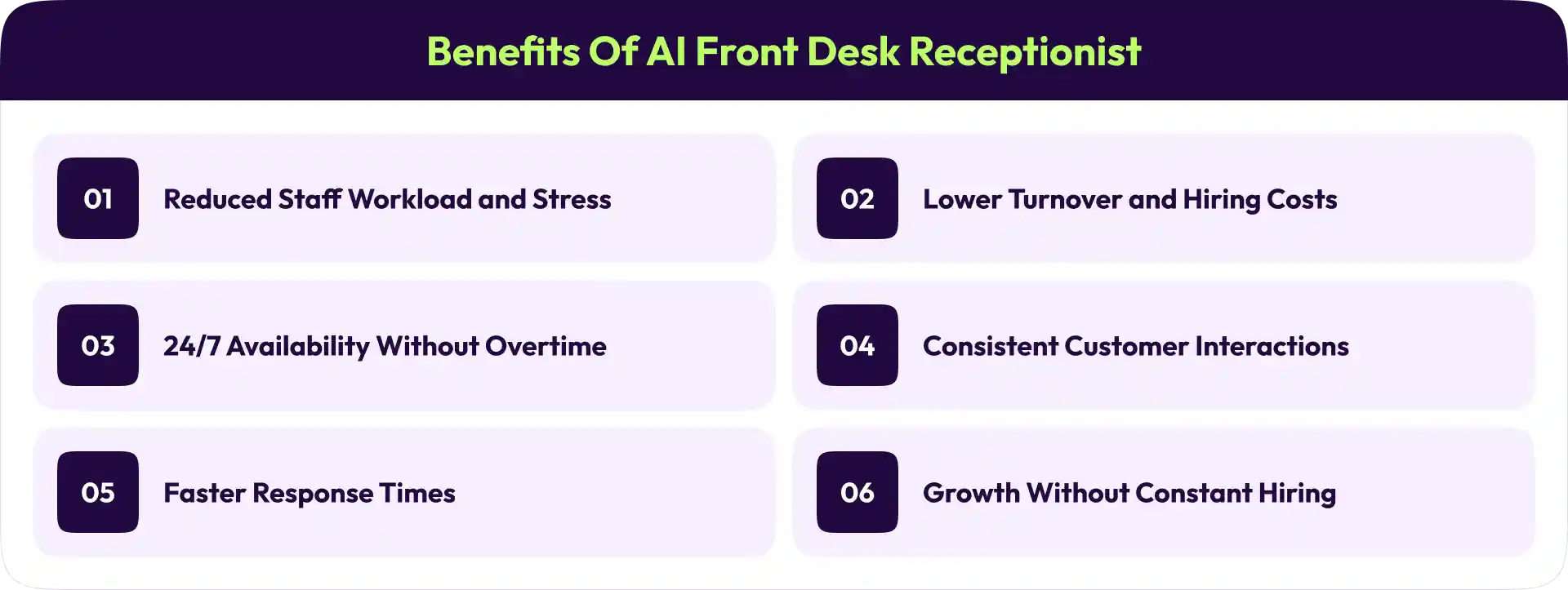
Businesses don't invest in AI simply to adopt new technology. They do it to solve operational problems that directly affect customer experience, employee satisfaction, and growth. When implemented correctly, AI front desk automation delivers benefits across the entire organization.
1. Reduced Staff Workload and Stress
Instead of spending hours answering routine questions or scheduling appointments, employees can focus on conversations that require problem-solving, empathy, and personal attention.
Many businesses find that staff become more productive because they're no longer constantly switching between calls, messages, and administrative work.
2. Lower Turnover and Hiring Costs
Replacing experienced front desk employees isn't cheap. Recruitment, onboarding, and training require time and resources, while new hires often need weeks before becoming fully productive.
Although AI won't eliminate turnover, it can reduce one of its biggest causes burnout. By taking repetitive work off employees' plates, businesses create a more manageable work environment and improve long-term retention.
3. 24/7 Availability Without Overtime
Customers don't always contact businesses during office hours. Whether someone wants to book an appointment late at night or ask a question early in the morning, AI ensures every inquiry receives a response.
This helps businesses capture opportunities that might otherwise be lost to voicemail or unanswered messages.
4. Consistent Customer Interactions
People naturally have different communication styles, especially during busy periods. AI delivers the same accurate information every time, helping businesses maintain consistency across phone calls, SMS, web chat, and other channels.
5. Faster Response Times
Waiting on hold or leaving a voicemail often leads to frustration, particularly when other businesses are only a quick search away. By responding immediately, AI improves the overall customer experience and helps businesses convert more inquiries into bookings, reservations, or sales.
6. Growth Without Constant Hiring
As businesses grow, communication volumes usually grow with them. Traditionally, that meant hiring more receptionists.
AI changes the equation by handling a larger share of routine interactions automatically, allowing businesses to manage increasing demand without expanding administrative teams at the same pace.
What to Look for in an AI Front Desk Automation Platform
Not every AI platform offers the same capabilities. Before choosing the right AI solution platform, consider how well it fits your existing workflows, not just its feature list.
Omnichannel Communication
Customers communicate in different ways. Some call, others text, and many prefer live chat. Choose a platform that supports voice AI, SMS, email, and chat so conversations remain consistent regardless of the channel.
Natural Conversations
People shouldn't feel like they're talking to a scripted phone menu. Look for AI that understands natural language, asks follow-up questions, and responds conversationally. The smoother the interaction, the better the customer experience.
Integration With Existing Systems
An AI front desk should work with your scheduling software, CRM, EHR, PMS, or other business tools. Without integration, staff may still need to update records manually, defeating much of the purpose of automation.
Strong Security and Compliance
For industries like healthcare, compliance is essential. Choose a solution that supports secure data handling, role-based access, audit logs, and, where applicable, HIPAA compliance. Protecting customer and patient information should never be an afterthought.
Real-Time Reporting
Good AI doesn't just automate tasks; it provides visibility. Analytics can reveal call volumes, response times, missed opportunities, booking trends, and common customer questions, helping businesses improve operations over time.
Easy Deployment and Scalability
Implementation shouldn't disrupt daily operations. Look for a platform that integrates quickly, requires minimal training, and can scale as your business grows.
Common Mistakes Businesses Make When Automating the Front Desk
AI works best when it's treated as part of a broader operational strategy, not a quick fix. Here are a few mistakes businesses should avoid.
Automating Only One Communication Channel
Some businesses automate phone calls but leave SMS, chat, and email completely manual. Customers don't think in channels; they simply expect consistent communication wherever they reach out.
Ignoring Existing Systems
An AI platform that doesn't connect with scheduling software or CRM tools often creates extra work instead of reducing it. Integration should be a priority from day one.
Skipping Real-World Testing
AI should be tested using actual customer scenarios before going live. Testing helps identify unclear responses, unusual questions, and workflow gaps that may not appear during setup.
Forgetting Human Escalation
Not every conversation belongs with AI. Customers should always have a clear path to speak with a person when situations become complex, urgent, or emotionally sensitive. The best customer experiences combine automation with human expertise.
Treating AI as a "Set It and Forget It" Tool
Businesses evolve, and customer questions change. Review AI conversations regularly, update knowledge, and refine workflows based on real interactions. Continuous improvement keeps automation effective over time.
Final Thought
Front desk burnout isn't a staffing problem, it's a workflow problem. As customer expectations grow, businesses need a smarter way to manage routine communication without overloading their teams.
AI helps by automating repetitive tasks like calls, scheduling, reminders, and follow-ups, giving employees more time to focus on meaningful customer interactions. The result is a more efficient front desk, a better customer experience, and a team that's free to do its best work.
Frequently Asked Questions (FAQs)
1. What is an AI front desk?
An AI front desk is a conversational AI system that manages routine customer interactions such as answering calls, scheduling appointments, responding to FAQs, sending reminders, and routing inquiries to the right team members.
2. Can AI really replace front desk staff?
No. AI is designed to automate repetitive administrative tasks, not replace employees. Human staff remain essential for complex conversations, problem-solving, and situations that require empathy or business judgment.
3. How does AI handle calls it can't resolve?
Modern AI platforms recognize when a conversation requires human assistance. They transfer the call to the appropriate employee while sharing relevant context, so customers don't have to repeat themselves.
4. Is AI front desk automation expensive?
Costs vary depending on the platform and business size. However, many organizations find that automation reduces missed opportunities, administrative workload, and overtime costs, making it a cost-effective investment over time.
5. Which industries benefit most from front desk automation?
Healthcare providers, dental practices, restaurants, hotels, real estate agencies, legal firms, home service businesses, and professional service companies all benefit from automating routine customer communication.
Shravan Rajpurohit
CEO & Co-Founder
Shravan Rajpurohit is the Co-Founder & CEO of The Intellify, a leading Custom Software Development company that empowers startups, product development teams, and Fortune 500 companies. With over 10 years of experience in marketing, sales, and customer success, Shravan has been driving digital innovation since 2018, leading a team of 50+ creative professionals. His mission is to bridge the gap between business ideas and reality through advanced tech solutions, aiming to make The Intellify a global leader. He focuses on delivering excellence, solving real-world problems, and pushing the limits of digital transformation.

Stay Updated
with AI Insights
Get the latest articles on AI, automation, and enterprise technology delivered to your inbox weekly.

500+ people have already subsribed!
No spam. Unsubscribe anytime.