
How AI Agents Can Reduce Insurance Claims Processing Delays



In insurance, claims processing has always been a bit messy, with too many steps, too much manual work, and, honestly, too many delays. Teams are already dealing with rising costs, while customers expect quick updates and faster settlements. That gap is hard to manage. Often, the slowdown comes from simple things like missing documents or long review cycles. This is where AI agents start to make a real difference. In this blog, we’ll look at how they help streamline claims, where delays usually happen, and what actually improves when automation is in place.
Why Insurance Claims Processing Delays Are a Growing Challenge
Delays in processing claims can cause frustration for both insurers and policyholders, leading to higher churn rates and dissatisfaction. Several hurdles contribute to these slowdowns:
Rising Claim Volumes: With more people seeking coverage, especially in health, auto, and property sectors, claims are piling up.
Unstructured Data: Claims come with a mountain of forms, invoices, reports, and photos, making data management a real challenge.
Manual Checks: Labor-intensive policy checks and document validation can stretch out decision-making timelines.
Capacity Constraints: Limited adjuster availability can lead to backlogs, particularly during busy times.
Customer Expectations: Today's consumers expect swift updates and resolutions, raising the pressure on insurers.
Compliance Needs: Growing regulatory demands add layers of complexity to claims operations, making timely decisions tougher.
What Are AI Agents for Insurance Claims?
AI agents are smart digital systems crafted to process information, make quick decisions, and manage tasks automatically. Unlike traditional automation, AI agents can adapt to unique scenarios and the nuances of different claims:
• They can read and interpret documents, verify policy details, and kick off subsequent actions based on what they find.
• By acting as digital assistants, AI agents bolster claims teams’ capabilities without sidelining human oversight.
• Managing repetitive, time-consuming tasks allows adjusters to focus on more complex claims and enhance customer service.
How Insurance Claims Processing Automation Works
To understand how insurance claims processing automation operates, let’s break down the end-to-end claims workflow:
1. Claim Intake: Information floods in through various channels like mail, email, or online portals.
2. Data Capture and Validation: The automation system captures and validates claim information in real time.
3. Approval Processes: Claims move through automated decision pathways, guided by verified data.
4. Communications: Automated updates keep both claims teams and policyholders in the loop, ensuring constant engagement.
5. Human Oversight: While automation handles standard claims, complex cases get flagged for adjuster review.
Thanks to the continuous integration of different systems, AI agents provide seamless coordination across all stages of claims processing, significantly boosting efficiency.
Where Delays Occur in the Claims Workflow
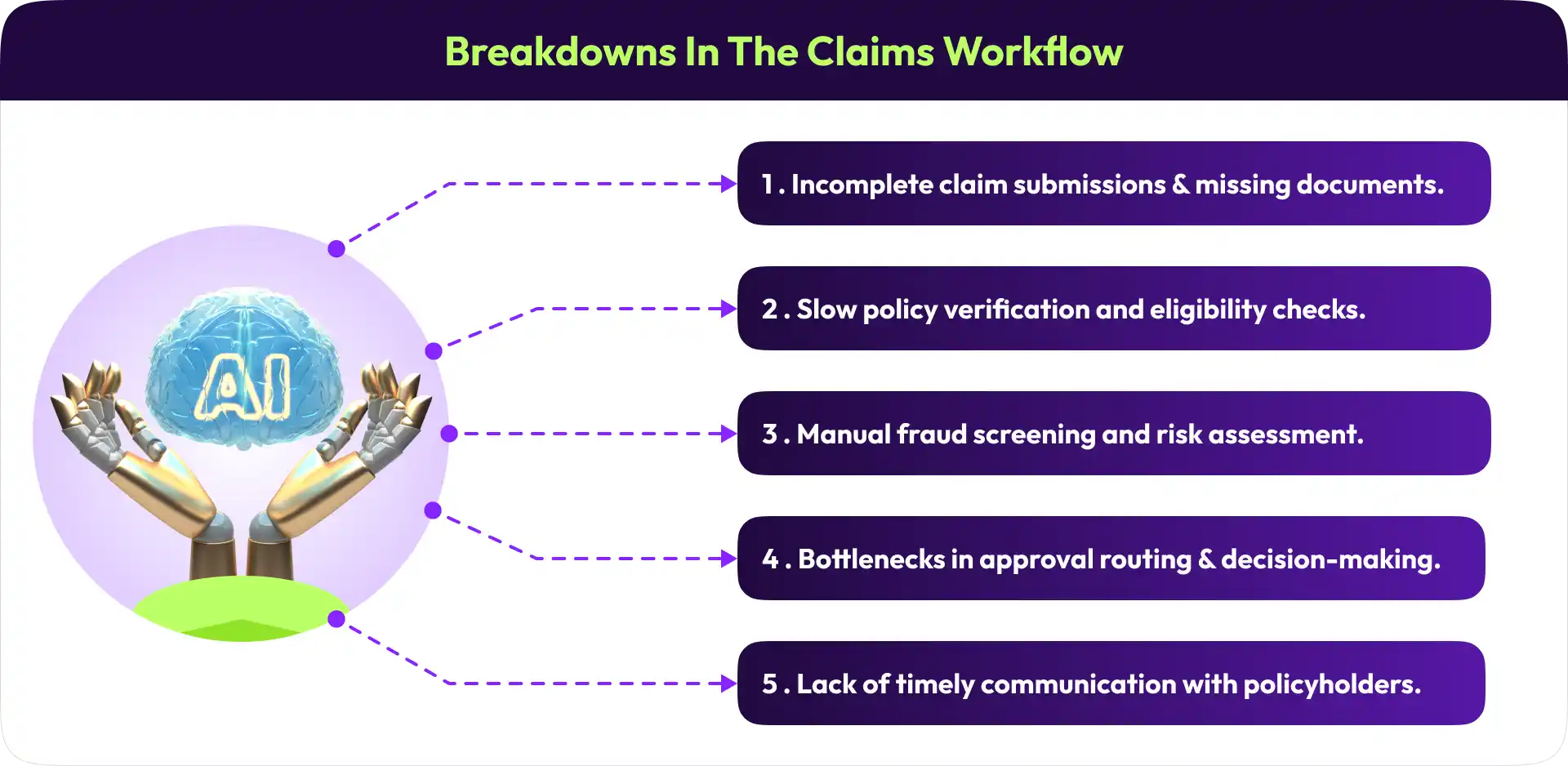
Delays often stem from specific breakdowns in the claims workflow:
Incorrect or Incomplete Submissions: Missing supporting documents can put the brakes on the process.
Slow Eligibility Checks: Manual verifications can be time-consuming, delaying policy confirmation and claim approvals.
Fraud Checks: Manual reviews of fraud indicators can slow down the entire process.
Approval Bottlenecks: Delays often happen when approvals are incorrectly routed or await busy adjusters' decisions.
Communication Gaps: Delayed updates can leave policyholders feeling frustrated and unsure about the status of their claims.
How AI in Insurance Claims Automation Speeds Up Every Step
AI in insurance claims processing doesn’t magically fix everything overnight, but it does remove a lot of the friction that slows teams down. Here’s what actually changes at each step:
Real-Time Data Capturing
As soon as a claim comes in, AI picks up the details and checks them on the spot. No waiting around for someone to review basic info.
Document Requests
If something’s missing, the system flags it immediately and asks for it. No back-and-forth emails days later… which honestly is where a lot of delays creep in.
Data Extraction
Instead of someone reading through PDFs or scanned docs, AI pulls out the needed data in seconds. It’s not perfect every time, but it’s fast and that matters.
Policy Rule Compliance
The system checks claims against policy rules automatically. This cuts down the time spent double-checking coverage or digging through records.
Prioritization
Not every claim should sit in the same queue. Urgent or high-value cases get pushed forward without someone manually sorting them.
Routing Exceptions
When a claim looks unusual, it’s sent straight to the right person. No guessing, no unnecessary handoffs.
Instant Updates
Customers and teams get updates as things move along. That alone reduces a lot of frustration, people just want to know what’s happening.
Step-by-Step Example of an Automated Insurance Claims Process
Let’s walk through how this usually plays out when automation is in place:
A policyholder submits a claim through an app or website, nothing complicated here.
The system pulls in the details and checks if everything looks right. This happens almost instantly, which saves a lot of early-stage delay.
If something’s missing, it doesn’t sit idle. The system asks for the required documents right away.
Coverage gets verified, and policy rules are checked in real time. No one has to dig through files manually.
The claim is scanned for any fraud signals. It’s more of a quick filter than a deep investigation at this stage.
Straightforward claims move ahead fast. The tricky ones? They’re passed to an adjuster with all the context already prepared.
And throughout all this, the customer keeps getting updates. Not constantly, but enough to know things are moving, which honestly makes a big difference.
Real-World Use Cases in Insurance Claims Operations
AI agents are already being used across different types of insurance claims. It’s not one-size-fits-all, but the impact is pretty clear in each area:
Health Insurance
Claims get reviewed and processed faster with automated adjudication. Teams spend less time on paperwork, which, honestly, is where most of the effort used to go.
Auto Claims
Accident claims move quicker from submission to resolution. Customers don’t have to wait endlessly for updates, which improves their overall experience.
Property and Casualty Claims
Assessments become more consistent. AI helps speed things up while reducing errors that usually happen during manual reviews.
Workers’ Compensation
Faster claim handling means employees aren’t stuck waiting for support. That delay can be frustrating, so this makes a noticeable difference.
Life and Disability Claims
Processing becomes smoother and more predictable. Families or individuals dealing with these claims already have enough going on; delays just make it harder.
Subrogation and Recovery
The recovery process is handled more efficiently, with fewer missed steps. It’s not always visible upfront, but it helps insurers close the loop faster.
Benefits of Insurance Claims Processing Automation
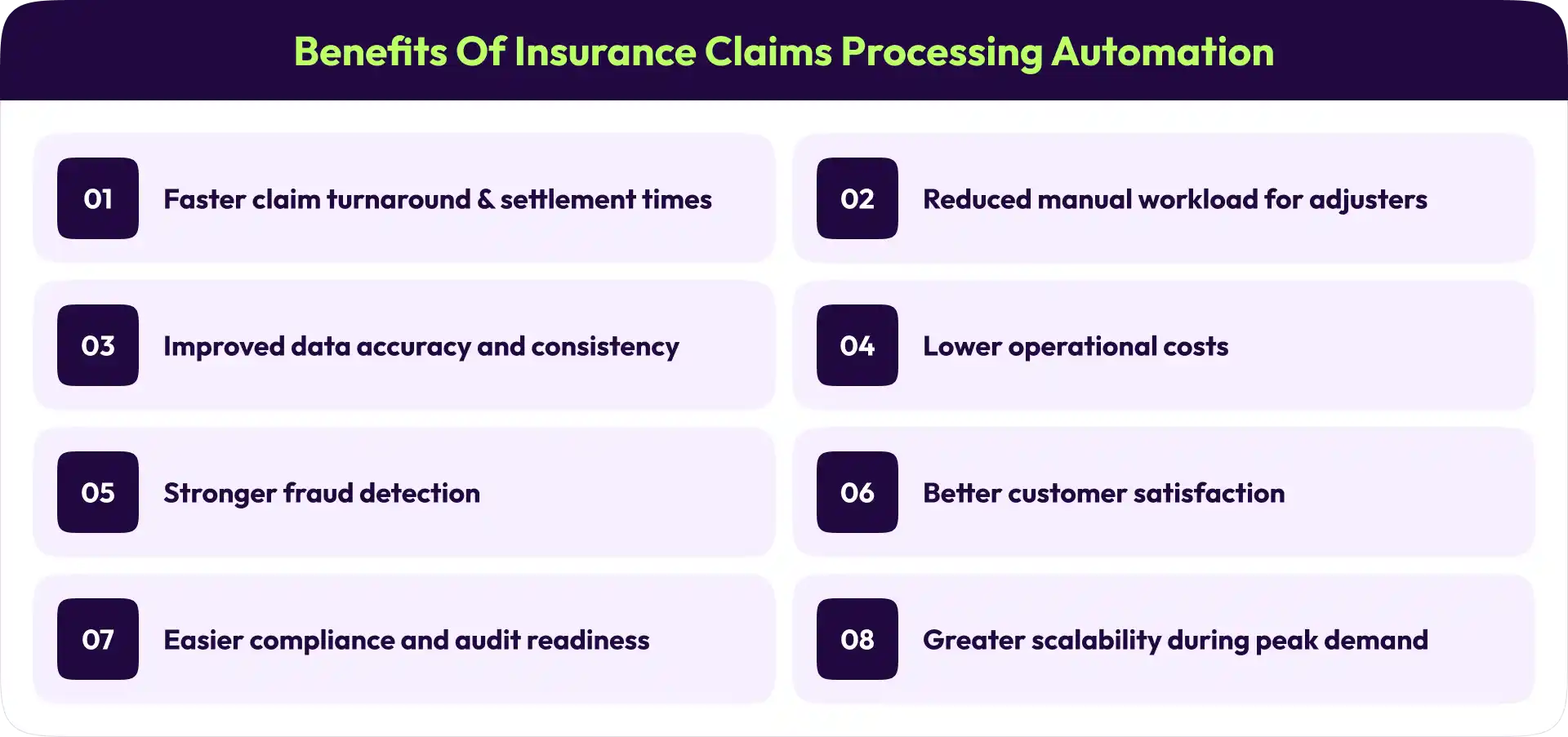
Automation in claims processing isn’t just about speed, it changes how the whole system runs day to day. Here’s what that actually looks like:
Faster Resolutions: Claims move more quickly from submission to settlement. Less waiting, fewer follow-ups… things just get done faster.
Lower Manual Workload: Adjusters aren’t buried in repetitive tasks anymore. They can focus on cases that actually need judgment.
Enhanced Data Accuracy: When data is captured automatically, there’s less room for small human errors that can slow everything down later.
Cost Efficiency: With fewer manual steps and delays, operational costs naturally come down. Not overnight, but it adds up.
Stronger Fraud Detection: AI can flag unusual patterns early. It’s not foolproof, but it does catch things that might otherwise slip through.
Higher Customer Satisfaction: Faster responses and regular updates make a big difference. People just want clarity and some sense of progress.
Improved Compliance: Rules and checks are applied consistently, which makes staying compliant a bit less stressful for teams.
Scalability: When claim volumes spike, the system can handle it without putting extra pressure on staff. That’s a huge relief during peak times.
Why AI Voice Agents Matter in Claims Intake
AI Voice agents don’t replace your team, but they do take a lot of pressure off the first step of claims intake. Here’s how they actually help:
24/7 Claim Reporting: Policyholders can report claims anytime, not just during working hours. That flexibility matters more than you’d think.
Guided Conversations: Instead of open-ended calls, voice agents ask structured questions. This helps capture the right details without missing key information.
Instant Claim Initiation: As details come in, the system can verify policy basics and start the claim right away. No need to wait for manual entry later.Follow-Ups and
Scheduling: Voice agents can handle simple next steps like booking inspections or setting reminders without needing human involvement.
Multilingual Support: Language barriers become less of an issue. Customers can interact in the language they’re comfortable with, which improves clarity.
Reduced Contact Center Load: Routine calls don’t pile up as much. Teams get fewer repetitive queries and can focus on cases that actually need attention.
What to Look for in an Insurance Claims Automation Solution
Choosing the right automation solution can greatly influence your overall success. Key features to consider include:
Seamless Integration: The solution should mesh smoothly with your existing systems.
Secure Data Handling: It’s crucial to protect sensitive information.
Customizable Workflows: Flexibility to tailor workflows to your specific business needs is essential.
Human Oversight: Look for solutions that include a review process for exceptional cases.
Multi-channel Support: Ensure it can handle requests across various platforms like voice, chat, email, and portals.
Real-time Analytics: Performance tracking aids in continuous improvement.
Scalability and Compliance Controls: Verify that solutions can grow with your business and meet regulations.
How Alris AI Helps Insurers Reduce Claims Delays
At Alris AI, the focus isn’t just on adding automation, it’s about fitting it into how your claims process already works. Here’s how we can help:
Automated Claim Intake: Claims get captured and processed faster right from the start. Less manual entry, fewer delays in getting things moving.
24/7 Claims Reporting: With AI voice agents, claims can be reported anytime. No dependency on business hours, which helps reduce backlog.
System Integration: The solution works with your existing systems. You don’t have to rebuild everything just to get started, that’s usually a big concern.
Enterprise-Grade Security: Customer data is handled with strict security controls. That part isn’t optional, especially in insurance.
Supportive and Scalable Deployments: As claim volumes grow, the system scales with you. It’s built to handle more without creating extra pressure on your team.

Conclusion
AI agents are well-equipped to tackle the core issues behind delays in insurance claims processing. By adopting insurance claims automation, insurers can accelerate settlements while simultaneously lowering costs and workloads. In a landscape where operational efficiency and customer satisfaction reign supreme, it’s vital for insurance leaders to explore how Alris AI can modernize their operations. The transformation begins now. Let’s embrace the future of claims processing together.
Frequently Asked Questions (FAQs)
1. What is Insurance claims processing automation?
Insurance claims processing automation involves using intelligent systems to speed up and enhance how insurance claims are handled. This includes automating tasks like data extraction, eligibility checks, and communication.
2. How do AI agents help in insurance claims processing?
AI agents streamline the claims workflow by automating repetitive tasks, verifying policy details, and providing real-time updates, leading to faster resolutions and greater accuracy.
3. What are the main benefits of automating insurance claims?
Benefits include reduced turnaround times, lower operational costs, enhanced data accuracy, improved fraud detection, and higher customer satisfaction.
4. How does automation address common delays in claims processing?
Automation reduces delays by streamlining document verification, speeding up approvals, and delivering timely updates, effectively minimizing bottlenecks in the workflow.
5. Can AI agents replace human adjusters in claims processing?
AI agents support human adjusters by taking on routine tasks, but they don’t replace them. Human expertise remains essential for handling complex cases that require nuanced judgment.
6. What should insurers look for when choosing an automation solution?
Insurers should look for solutions offering seamless integration, secure data handling, customizable workflows, real-time analytics, and multi-channel support.
7. How does Alris AI contribute to improving claims processing?
Alris AI creates custom automation systems tailored to enhance claims intake and processing, integrate seamlessly with existing workflows, and improve customer experience and operational efficacy.
Shravan Rajpurohit
CEO & Co-Founder
Shravan Rajpurohit is the Co-Founder & CEO of The Intellify, a leading Custom Software Development company that empowers startups, product development teams, and Fortune 500 companies. With over 10 years of experience in marketing, sales, and customer success, Shravan has been driving digital innovation since 2018, leading a team of 50+ creative professionals. His mission is to bridge the gap between business ideas and reality through advanced tech solutions, aiming to make The Intellify a global leader. He focuses on delivering excellence, solving real-world problems, and pushing the limits of digital transformation.

Stay Updated
with AI Insights
Get the latest articles on AI, automation, and enterprise technology delivered to your inbox weekly.

500+ people have already subsribed!
No spam. Unsubscribe anytime.