
AI Outbound Calling: What It Is, How It Works & Key Use Cases [2026]



![AI Outbound Calling: What It Is, How It Works & Key Use Cases [2026]](https://alris-ai-cms.theintellify.net/uploads/AI_Outbound_Calling_1x_282b0d68f9.webp)
Summary: Most businesses know they should be following up faster, sending more reminders, and chasing payments before they become a problem. The reality is, doing that manually doesn't scale. This guide breaks down how AI outbound calling works, where it makes sense, and what to look for in a platform, from lead follow-up and appointment reminders to compliance, CRM integration, and real-world use cases across six industries.
Most businesses are pretty good at answering calls. The harder part is making them consistently, at scale, without burning through staff time on tasks that follow the same script every single time.
Follow up with that lead before they go cold. Remind the patient about their appointment. Chase the overdue invoice. Confirm the booking. These are all important, but they're also repetitive. And when the list is long, something always slips.
AI outbound calling is changing how businesses handle proactive communication. Instead of relying on a team to manually work through a call list, AI initiates the calls, holds the conversation, captures the response, and updates the system automatically.
This guide covers what AI outbound calling actually is, how it works under the hood, where it makes the most sense, and what to look for if you're considering it for your business. Whether you run a medical practice, a real estate agency, or an e-commerce operation, the principles here apply.
What Is AI Outbound Calling?
AI outbound calling is an automated system that initiates phone calls on behalf of a business, conducts a natural, conversational interaction with the person on the other end, and takes action based on the response, all without a human agent making the call.
It's not a recording. It's not a pre-set script that plays regardless of what the other person says. The AI listens, understands, and responds in real time.
How AI outbound calling differs from traditional outbound call centers
Traditional outbound calling relies on human agents working through a call list manually. They dial, wait, introduce themselves, follow a script, handle objections, update the CRM, and move to the next number. It works, but it doesn't scale well, and the cost per call is high when you factor in salaries, training, and turnover.
AI outbound calling removes the human from the repetitive part of this loop. It handles the calls that don't require judgment, empathy, or complex problem-solving: appointment confirmations, payment reminders, lead follow-ups, while human agents stay focused on calls that actually need them.
Where AI outbound calling fits in modern business communication
Think of it as the proactive layer of your communication stack. Inbound tools handle calls that come to you. AI outbound calling handles the calls you need to initiate follow-ups, reminders, check-ins, and reactivation campaigns without those tasks piling up on your team's to-do list.
How AI Outbound Calling Works
The process is more straightforward than it sounds. Here's a typical end-to-end flow:
Trigger Event (appointment due, payment overdue, new lead inquiry, post-visit follow-up)
↓ AI Initiates Call - dials the contact at the scheduled time, handles time zone logic automatically
↓ Natural Conversation Begins - greets the person by name, states the purpose of the call clearly
↓ Goal Achieved - confirmation received, appointment rescheduled, payment arranged, feedback captured
↓ CRM Updated Automatically - call outcome logged, contact record updated, next steps triggered
Follow-up Triggered - confirmation SMS sent, email dispatched, next call scheduled if needed
How the AI understands responses and adapts mid-call
The system uses natural language understanding to interpret what the person says, not just keywords, but intent. If someone says "I need to move that to next week" instead of "reschedule," the AI understands what they mean and responds accordingly.
How it handles voicemails, no-answers, and callbacks
When a call goes to voicemail, the AI detects it and either leaves a pre-configured message or schedules a callback for later. No-answers get rescheduled automatically based on rules you set. The system keeps trying without anyone manually tracking who still needs to be called.
Escalation to human agents when needed
If a conversation gets complex a complaint, an unusual request, something that genuinely needs a person the AI flags it and routes accordingly. The human agent picks up with context already available, so the customer doesn't have to start over.
AI Outbound Calling vs Traditional Outbound Calling
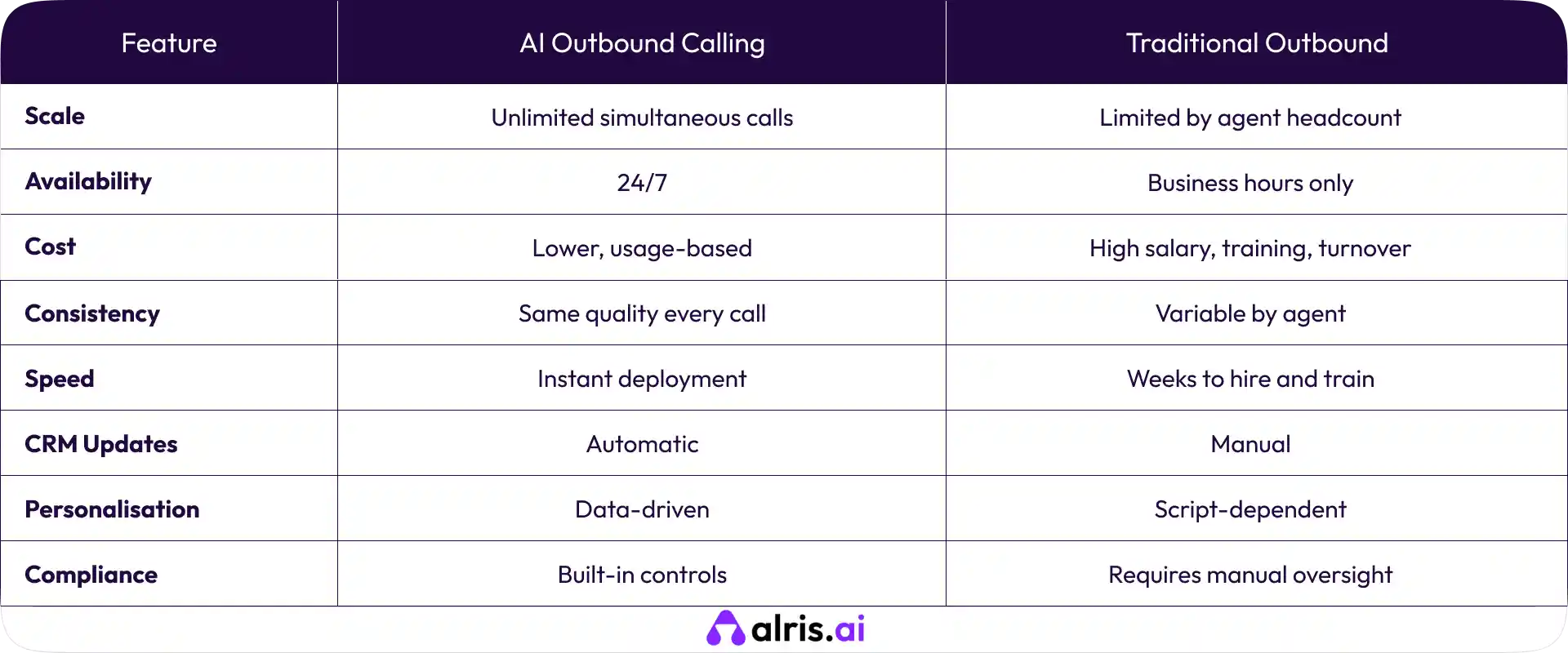
AI Outbound Calling vs Robocalls: Key Differences
The word "automated calling" makes some people nervous, and fair enough; robocalls have earned that reaction. But AI outbound calling is a different thing entirely, and the distinction matters.
Robocalls are one-way. A pre-recorded message plays, and that's it. There's no conversation, no response handling, no adaptation based on what the person says. They're also widely used for spam and scams, which is why they've developed such a bad reputation.
AI outbound calling is two-way. The system initiates the call, but what happens next depends on the conversation. The person can ask questions, push back, reschedule, request more information, and the AI handles all of it in real time.
From a compliance standpoint, the two are also treated differently. Robocalls face strict regulation under TCPA rules precisely because they offer no real interaction or opt-out mechanism. AI outbound calling platforms are built with consent management and compliance controls that robocall systems simply don't have.
For businesses, the practical difference is this: a robocall delivers a message. An AI outbound call completes a task.
Core Use Cases for AI Outbound Calling
Appointment Reminders and Confirmations
This is probably the most common use case, and for good reason. No-shows cost businesses real money; an empty appointment slot is revenue that doesn't come back. AI outbound calling handles reminder calls automatically, allows the person to confirm or reschedule during the call, and updates the calendar in real time. The whole loop runs without anyone on the team initiating it manually.
Payment and Invoice Follow-ups
Chasing overdue payments is one of those tasks that nobody enjoys, and everyone puts off. AI handles it without the awkwardness; calls go out automatically when a payment is overdue, the AI explains the situation, offers options, and captures the outcome. For businesses with high volumes of recurring invoices, this alone can make a meaningful difference to cash flow.
Lead Follow-up and Qualification
Speed matters in lead follow-up. The longer a lead sits uncontacted, the less likely they are to convert. AI outbound calling reaches out immediately after an inquiry comes in before the lead goes cold, asks qualifying questions, and routes the hot ones to a human sales rep with context already captured.
Customer Reactivation and Retention
Every business has a list of customers who've gone quiet. Re-engaging them manually is time-consuming. AI outbound calling can work through that list automatically: a friendly check-in, a relevant offer, a reminder that they're overdue for a visit, and flag the ones who respond positively for human follow-up.
Surveys and Feedback Collection
Post-visit or post-purchase feedback calls used to require a dedicated team. AI handles them at scale, asks the same structured questions every time, captures the responses, and feeds the data into your reporting system. The feedback you get is more consistent and easier to analyse than ad hoc conversations.
Event and Webinar Reminders
Registration numbers and actual attendance are rarely the same. AI outbound calling bridges that gap: a reminder call the day before an event, with the option to confirm attendance or get joining details, consistently improves show-up rates.
Order and Delivery Updates
Proactive communication about orders and deliveries reduces inbound support calls significantly. Instead of customers calling to ask where their order is, the AI calls them first with an update. It's a small thing that has a noticeable effect on customer satisfaction and call volume.
AI Outbound Calling Across Industries
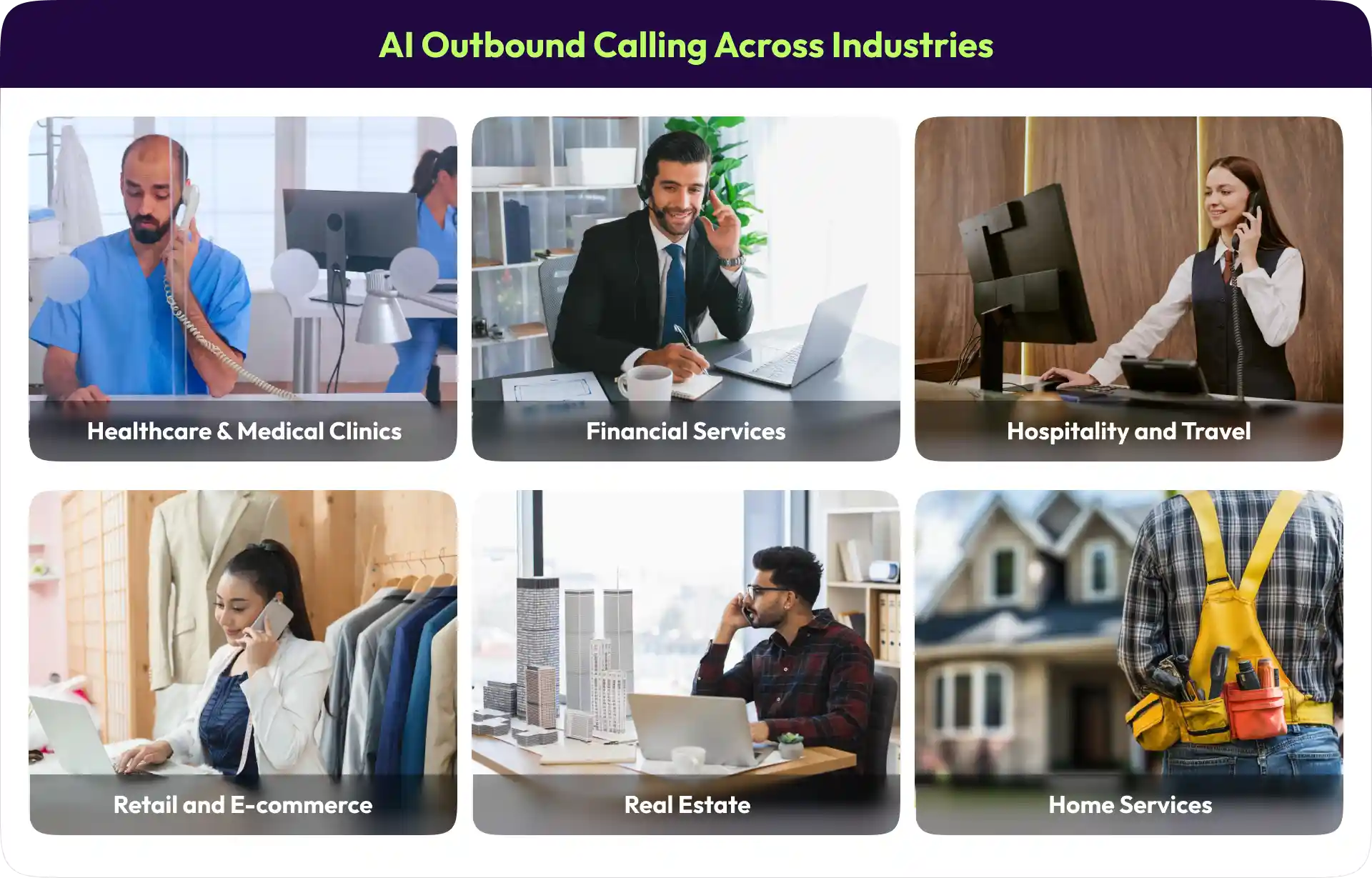
Healthcare and Medical Clinics
Healthcare has one of the clearest use cases for AI outbound calling. Appointment no-shows are expensive, recall outreach is time-consuming, and post-visit follow-ups are often skipped because there's simply not enough time. AI handles all three: reminder calls go out automatically, recall campaigns run without manual effort, and post-visit check-ins happen consistently rather than only when staff has capacity.
Real Estate
Real estate moves fast, and leads go cold quickly. AI outbound calling follows up with every property inquiry immediately; no more leads sitting in a spreadsheet waiting for someone to get to them. It qualifies interest, books viewings, and routes serious buyers directly to agents.
Financial Services
Payment reminders, policy renewals, and account reviews have a lot of time-sensitive outbound communication that doesn't require a senior person to handle it. AI takes care of the routine outreach, flags exceptions, and keeps the human team focused on relationships and complex queries.
Retail and E-commerce
Order confirmations, shipping updates, delivery notifications, and post-purchase follow-ups all of this can run automatically via AI outbound calling. The proactive communication reduces inbound support volume and improves customer experience at the same time.
Hospitality and Travel
Hotels and travel operators deal with a constant flow of booking-related communication, confirmations, pre-arrival information, changes, and post-stay feedback. AI handles all of it at scale, which matters especially during peak seasons when the volume would otherwise overwhelm front desk staff.
Home Services
For plumbers, electricians, HVAC companies, and similar trades, appointment confirmation calls and job completion follow-ups are standard practice but time-consuming to do manually. AI handles both automatically and can follow up after the job to request reviews or schedule the next service visit.
Key Benefits of AI Outbound Calling
1. Scale Without Hiring
A human agent can make maybe 50 to 80 calls in a day. AI can make thousands simultaneously. For businesses with large contact lists and time-sensitive outreach needs, this isn't just convenient; it's the only way to keep up.
2. Consistent Message Delivery Every Call
Every call gets the same quality of interaction: same tone, same information, same follow-through. No tired agents, no off days, no script deviations.
3. Faster Lead Response and Follow-up
AI responds to new leads in seconds, not hours. In competitive markets, that speed difference is the difference between converting the lead and losing it.
4. Reduced No-Shows and Missed Payments
Proactive reminder calls the kind that actually get answered move the needle on both. Businesses consistently report meaningful reductions in no-show rates after implementing automated outbound reminders.
5. Lower Cost Per Outbound Interaction
Once the system is set up, the cost per call is a fraction of what it would be with human agents handling the same volume.
6. Real-Time CRM Updates and Call Logging
Every call outcome gets logged automatically. No manual data entry, no gaps in the contact record, no "I thought someone else was following up on this."
7. 24/7 Outbound Capability
Some calls are better made in the evening or early morning after work hours when people are more likely to answer. AI doesn't have a shift; it calls whenever the data says it's the right time.
Compliance and Ethics in AI Outbound Calling
This section matters more than most people think, and it's worth understanding before launching any outbound campaign.
TCPA Compliance: What Businesses Need to Know
The Telephone Consumer Protection Act (TCPA) regulates automated calling in the US. Violations carry significant fines up to $1,500 per call in some cases. The rules cover consent requirements, calling hours, and disclosure obligations. Any AI outbound calling platform you use should have built-in TCPA compliance controls, not leave it to you to manage manually.
Do Not Call (DNC) List Management
Calling someone on the National Do Not Call Registry is a compliance violation. AI outbound calling platforms should automatically scrub contact lists against DNC registries before any campaign goes live.
Consent Requirements for AI-Initiated Calls
Prior express written consent is required for certain types of AI-initiated calls, particularly for marketing purposes. The consent rules differ depending on the nature of the call; transactional calls (reminders, confirmations) have different requirements than promotional calls.
Disclosure Rules: Does the AI Need to Identify Itself?
In some US states, AI must disclose at the start of the call that the caller is an automated system. California is the most prominent example. Disclosure requirements are evolving, so staying current matters, and a good platform will handle this automatically.
Data Privacy and Call Recording Regulations
Call recording laws vary by state and country. Some require one-party consent, others require all parties to be notified. Any platform handling call recordings should manage this automatically based on the caller's location.
Best Practices for Staying Compliant
Keep consent records, respect opt-outs immediately, call only during permitted hours, and choose a platform that handles compliance controls at the system level rather than leaving it as a manual checklist.
Key Features to Look for in an AI Outbound Calling Platform
1. Natural, Human-Like Voice and Conversation Quality
If the AI sounds robotic, people will hang up. The conversation quality voice tone, pacing, and natural responses is what determines whether the call actually achieves its goal.
2. CRM and Business Tool Integration
The platform should connect directly with your CRM, scheduling software, and data sources so call triggers, outcomes, and updates flow automatically without manual work.
3. Voicemail Detection and Handling
A good platform detects voicemail automatically, and either leaves a configured message or schedules a callback without logging a failed call every time someone doesn't answer.
4. Call Scheduling and Time Zone Management
Calls should go out at the right time for the contact's location. Time zone mismatches are one of the most common and avoidable compliance and experience problems.
5. Compliance Controls: TCPA, DNC, Consent Management
These should be built into the platform, not an afterthought. Look for automated DNC scrubbing, consent tracking, and disclosure management.
6. Real-Time Analytics and Call Reporting
Connection rates, completion rates, goal achievement, call outcomes by campaign you need visibility into what's actually happening to know whether the system is working.
7. Omnichannel Follow-Up: SMS and Email After Calls
The call is often just the first touchpoint. A confirmation text after a reminder call, or an email with details after a lead qualification call, completes the interaction and reduces confusion.
8. Easy Workflow and Campaign Configuration
If building a new outbound campaign requires weeks of technical setup, the tool isn't serving you well. Look for platforms where campaign configuration is intuitive and quick to adjust.
How to Get Started With AI Outbound Calling
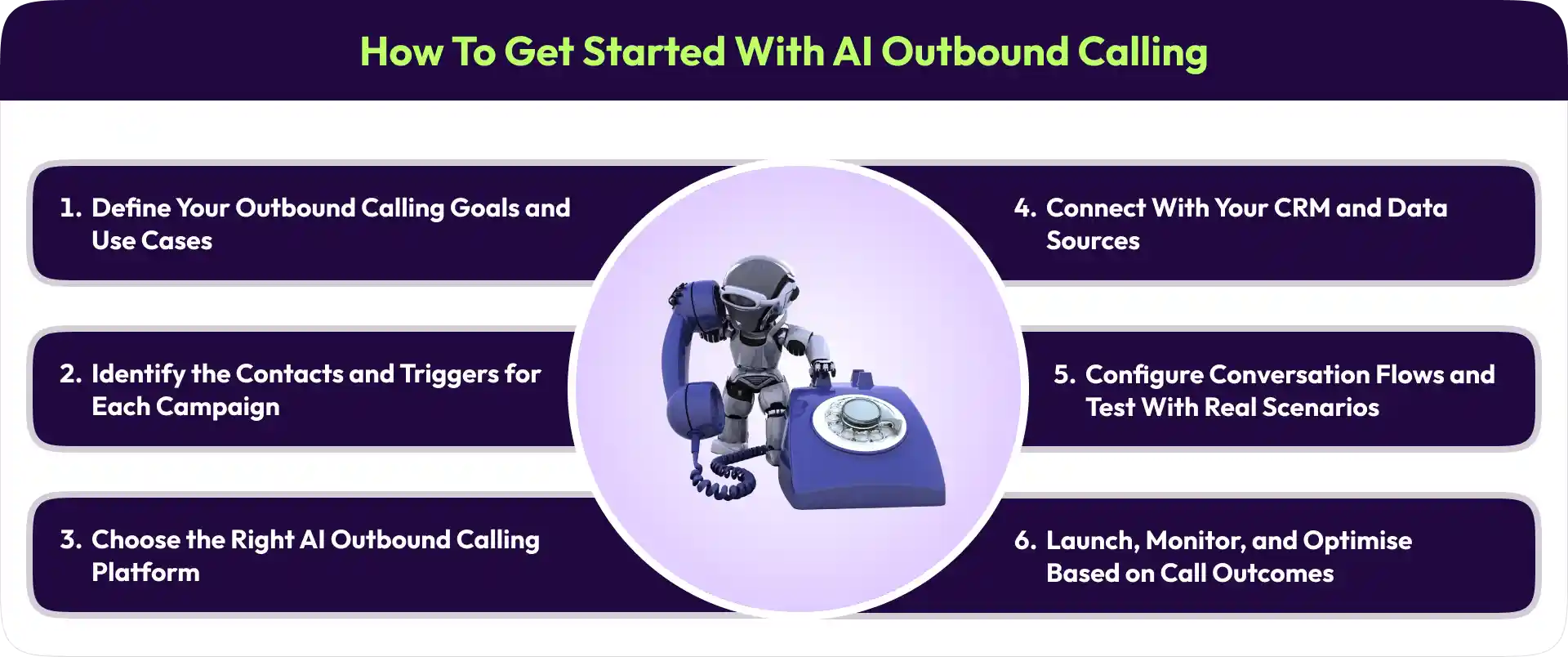
Step 1: Define Your Outbound Calling Goals and Use Cases
What problem are you actually trying to solve? Appointment no-shows? Slow lead follow-up? Overdue payments? Starting with a specific use case gives you a clear benchmark for measuring success.
Step 2: Identify the Contacts and Triggers for Each Campaign
Who gets called, when, and why? Map out the trigger conditions for each campaign: what event initiates the call, what the call should accomplish, and what happens based on different responses.
Step 3: Choose the Right AI Outbound Calling Platform
This is where picking the right partner matters. Alris AI is built as a full omnichannel communication platform, meaning outbound calls don't sit in isolation. A call can trigger an automatic SMS follow-up, update the CRM, and schedule the next touchpoint, all within one connected system rather than separate tools stitched together.
Step 4: Connect With Your CRM and Data Sources
Get the platform integrated with your contact database, scheduling system, and CRM before going live. The quality of your outbound calling is only as good as the data feeding it.
Step 5: Configure Conversation Flows and Test With Real Scenarios
Build out the conversation logic, then test it thoroughly, including edge cases, unexpected responses, and voicemail handling. Don't go live until the system handles the scenarios your contacts are actually likely to throw at it.
Step 6: Launch, Monitor, and Optimise Based on Call Outcomes
Start with a smaller segment before rolling out to your full contact list. Review call recordings and outcome data, identify where conversations are going off track, and adjust the flows accordingly.
Measuring the Success of AI Outbound Calling
Call Connection Rate
How many calls are actually being answered? A low connection rate might indicate a timing issue, caller ID problem, or contact data quality issue.
Conversation Completion Rate
Of the calls that connect, how many reach a natural conclusion rather than dropping off mid-conversation?
Goal Achievement Rate
This is the one that matters most: how many calls actually accomplish what they were supposed to? Confirmation received, appointment rescheduled, payment arranged, feedback captured.
No-Show and Missed Payment Reduction
Compare rates before and after implementation. This is usually the clearest way to demonstrate the business impact.
Cost Per Successful Outbound Interaction
What does it cost to achieve a successful call outcome, compared to what it was costing with human agents?
CRM Update Accuracy
Are call outcomes being logged correctly and completely? Inaccurate CRM data downstream is a sign something's off in the integration.
Customer Satisfaction Post-Call
A quick follow-up survey or NPS check after outbound campaigns tells you how contacts are experiencing the calls, which matters for long-term retention.
Final Thought
Manual outbound calling doesn't scale. It's time-consuming, inconsistent, and expensive, and the problem gets worse as call volumes grow.
AI outbound calling fixes the bottleneck. Calls go out on time, every time. Leads get followed up before they go cold. Reminders cut no-shows. Payments get chased without anyone dreading the conversation. Every outcome logs automatically so nothing slips through.
The businesses getting the most out of this aren't using it as a standalone tool. They're running outbound calls alongside SMS follow-ups, CRM updates, and inbound handling, one connected workflow instead of separate systems doing separate things.
If proactive outreach is eating up your team's time or simply not happening at the scale it should, AI outbound calling is worth a serious look.
Frequently Asked Questions (FAQs)
1. What is AI outbound calling?
AI outbound calling is an automated system that initiates phone calls, conducts natural two-way conversations, and takes action based on the response, all without a human agent on the line. It's used for appointment reminders, lead follow-up, payment chasing, feedback collection, and other proactive communication tasks.
2. Is AI outbound calling legal?
Yes, when done correctly. AI outbound calling is subject to regulations including TCPA in the US, which governs consent requirements, calling hours, and disclosure obligations. Reputable platforms include built-in compliance controls to help businesses stay within the rules.
3. How is AI outbound calling different from robocalls?
Robocalls play a pre-recorded message and don't respond to what you say. AI outbound calling is a two-way conversation; the system listens, understands, and responds in real time based on what the person actually says. They're fundamentally different in both technology and purpose.
4. Can AI outbound calling integrate with my CRM?
Most modern AI outbound calling platforms integrate with common CRM and business tools, allowing call outcomes to be logged automatically and contact records updated in real time. Integration capability should be confirmed before selecting a platform.
5. What industries use AI outbound calling?
Healthcare, real estate, financial services, retail, hospitality, and home services are among the most common. Any business that makes regular outbound calls for reminders, follow-ups, or proactive communication can benefit from it.
6. How much does AI outbound calling cost?
Pricing varies by platform and usage volume. Most platforms charge per minute of call time or per completed call, making costs scale with usage rather than requiring a fixed staffing overhead.
7. Can AI outbound calling replace my sales team?
No, and it's not designed to. AI handles the repetitive, high-volume outbound tasks that don't require relationship-building or complex judgment. Sales teams are freed from working through routine call lists and can focus on the conversations that actually benefit from a human approach.
Shravan Rajpurohit
CEO & Co-Founder
Shravan Rajpurohit is the Co-Founder & CEO of The Intellify, a leading Custom Software Development company that empowers startups, product development teams, and Fortune 500 companies. With over 10 years of experience in marketing, sales, and customer success, Shravan has been driving digital innovation since 2018, leading a team of 50+ creative professionals. His mission is to bridge the gap between business ideas and reality through advanced tech solutions, aiming to make The Intellify a global leader. He focuses on delivering excellence, solving real-world problems, and pushing the limits of digital transformation.

Stay Updated
with AI Insights
Get the latest articles on AI, automation, and enterprise technology delivered to your inbox weekly.

500+ people have already subsribed!
No spam. Unsubscribe anytime.