
How Restaurants Cut Labor Costs With AI Phone Agents in 2026



Summary: Restaurants spend more on phone handling than most owners realise, staff pulled off the floor for calls, overtime for after-hours coverage, and orders remade because of phone errors. This guide breaks down how AI phone agents take that workload off the team, what the labor savings actually look like for your specific operation, and what to look for before choosing a platform.
Labor is the highest controllable cost in most restaurants. Food cost is what it is; you can negotiate margins, but the room to move is limited. Labor is where the real decisions get made, and where the pressure shows up first when things get tight. Phone handling sits in an awkward corner of that problem. It doesn't show up as a line item on most P and Ls, but it takes real time, pulls staff away from the floor, and gets more expensive the busier the restaurant gets.
AI phone agents are changing how restaurants think about this, not by cutting headcount that's not the point but by taking the call volume off the team's plate entirely. Orders, reservations, FAQs, and after-hours calls are handled automatically, without anyone putting down a plate to pick up a phone.
Where Restaurant Labor Costs Actually Come From
The real cost of phone coverage
Phone calls during service are expensive in ways that rarely get calculated properly. It's not just the call itself; it's the interruption. A host managing a reservation call during a Friday rush isn't managing the floor. A server who steps away to answer the phone loses the thread of what they were doing.
Across a week, how many calls does your restaurant receive, how many staff are involved in handling them, and how many minutes per call? For most busy restaurants, the number is larger than expected, and that's before factoring in the bookings and orders lost because nobody could get to the phone.
Peak hour staffing pressure
The phone rings most when the restaurant is busiest. Conventional solution: overstaff slightly to ensure coverage. That works, but it's costly, and it compounds across multiple shifts and locations.
Turnover and training overhead
Front-of-house staff turn over at high rates. Every time someone leaves, phone handling gets retrained. It's not complicated work, but it's recurring overhead that adds up over a year.
What Is an AI Phone Agent for Restaurants?
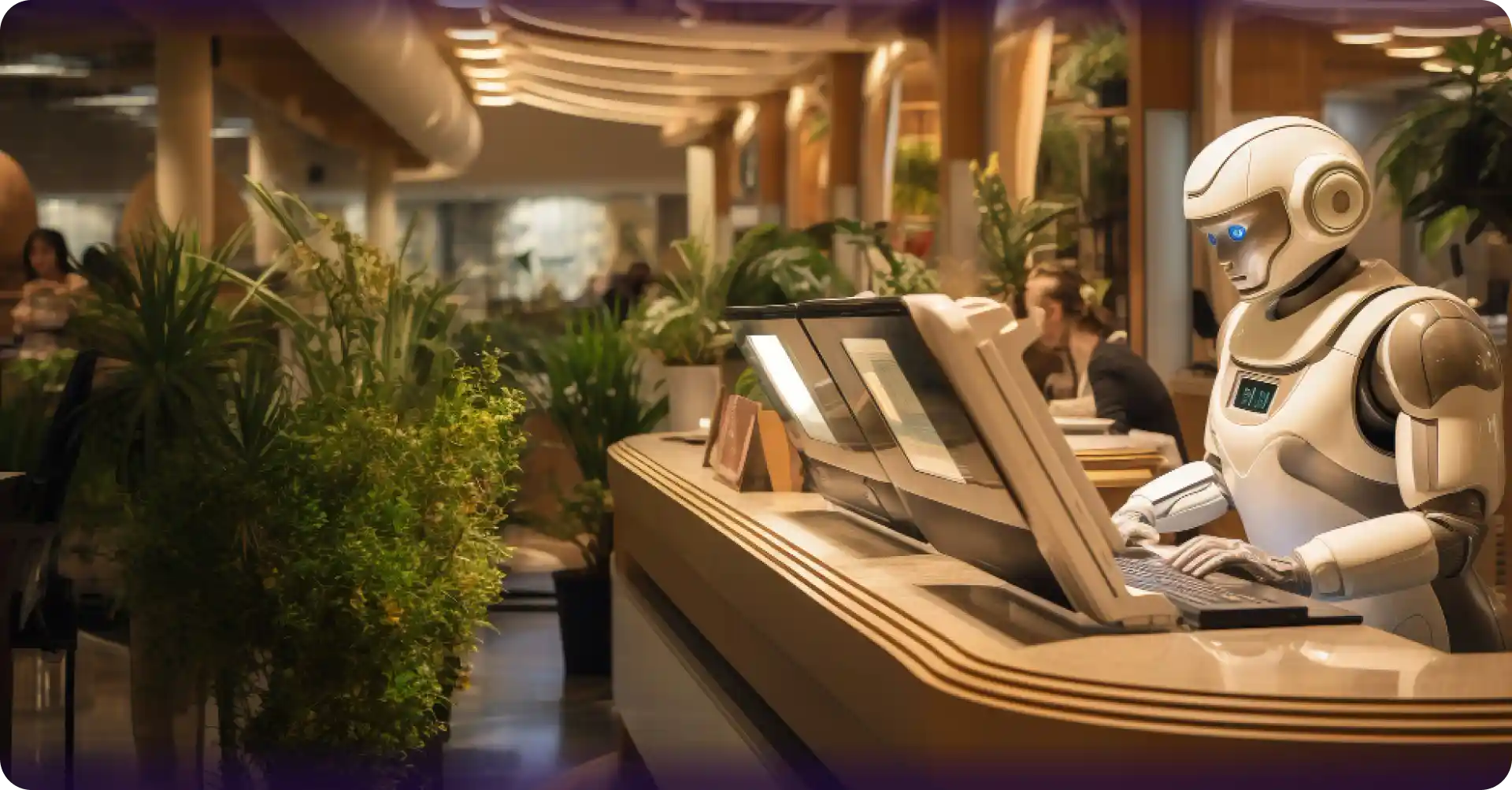
An AI phone agent answers inbound calls, understands what the caller is asking, and handles requests for food orders, table bookings, and menu questions conversationally, without a staff member involved.
It's not an IVR. It doesn't ask callers to press buttons. It listens to natural speech and responds the same way a trained staff member would, except it's available 24/7, handles multiple calls at once, and never has an off day.
It's also different from a generic AI answering service. Restaurant-specific platforms are built around how food service actually works: menu modifiers, real-time reservation availability, POS integration, and the specific queries restaurant customers ask.
What a restaurant AI phone agent handles
The core functions, once properly configured:
Answering every inbound call instantly, regardless of time or call volume
Taking phone orders, including modifications, special requests, and dietary requirements
Booking reservations in real time and sending automatic confirmations
Answering FAQ queries: hours, location, menu items, allergens, specials
Covering after-hours calls without overtime or additional staffing
Sending outbound reminders and reducing no-shows
Escalating to a human staff member when a call genuinely needs one
How AI Phone Agents Reduce Restaurant Labor Costs
Handling call volume without adding headcount
Calls that previously required staff time now run automatically. During a busy service, the phone ringing no longer means someone stops what they're doing. Orders arrive, get confirmed, and go to the POS without anyone on the floor involved.
As call volume grows with the business, the AI handles the increase without requiring proportional staffing growth. That's a meaningful change in the relationship between revenue and labor cost.
Eliminating after-hours staffing costs
After-hours coverage is genuinely expensive: overtime pay, on-call arrangements, or simply lost bookings because nobody answered. AI phone agents cover after-hours completely at a fixed monthly cost, typically a fraction of what overtime staffing costs.
Reducing errors and the cost of fixing them
Manual phone orders generate errors: missed modifiers, wrong quantities, allergy notes that don't make it through. Each error means a remade dish, potentially a comped meal, and staff time managing the fallout.
AI confirms the full order back to the caller before logging it. Errors get caught before they reach the kitchen.
Freeing staff for higher-value work
Staff not managing calls focus entirely on in-restaurant service. Some restaurants find they can run leaner during quieter periods because the phone workload has been removed. That's a direct cost reduction, not by cutting corners, but by removing a function that never needed a person in the first place.
AI Phone Agent vs Hiring More Staff: The Real Comparison
The comparison most restaurant owners are actually making isn't "AI vs no AI"; it's "AI vs hiring someone to handle this." Here's how that breaks down:
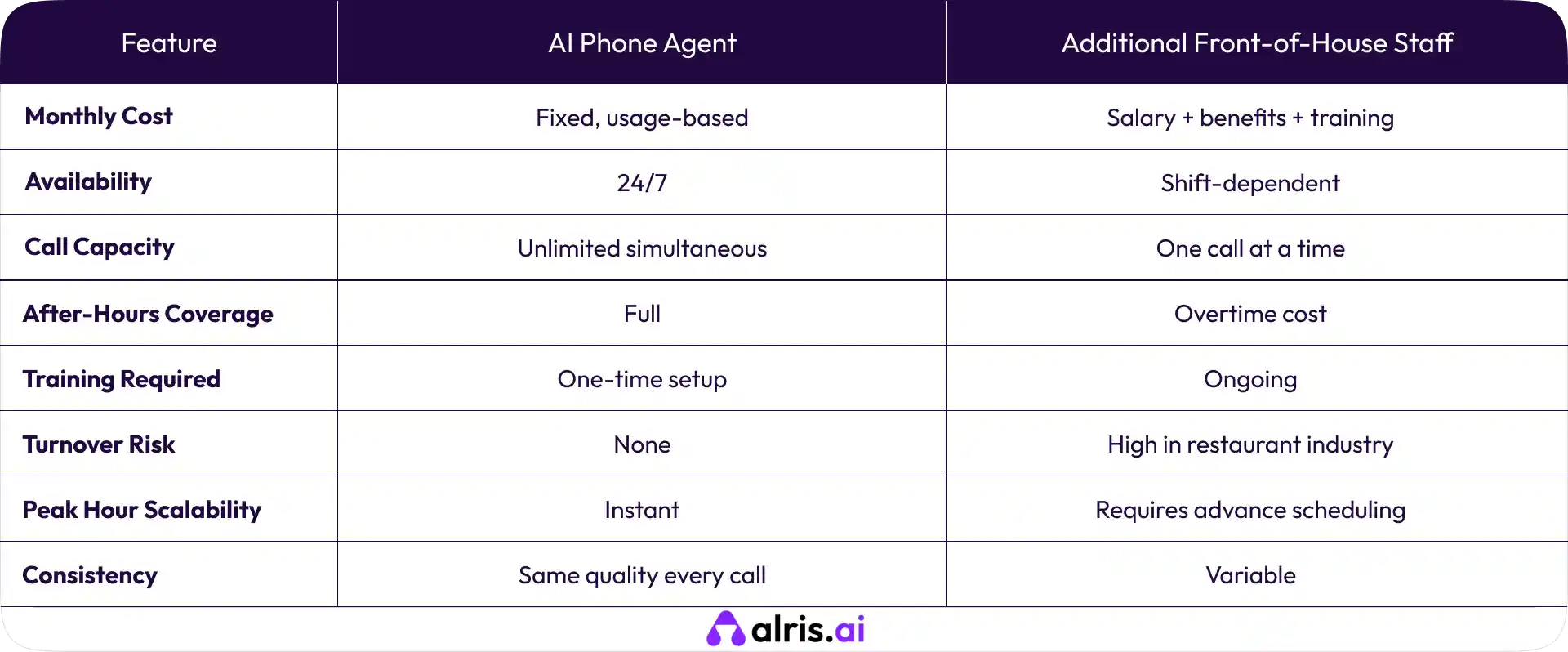
The math isn't complicated. The AI phone agent handles more calls, at more hours, with more consistency, for less ongoing cost. The only area where a human wins is in genuinely complex, relationship-driven interactions, and those represent a minority of the total call volume for most restaurants.
What AI Phone Agents Actually Do in a Restaurant
Taking phone orders accurately
The AI takes the order conversationally, handles modifications, confirms the full order back to the caller, and logs it directly to the POS. No manual re-entry, no miscommunication between phone and kitchen.
Managing reservations without staff involvement
Checks real-time availability, confirms the booking during the call, sends an automatic SMS confirmation, and handles cancellations and rescheduling without staff involvement.
Answering high-volume FAQ calls
Hours, menu items, allergens, wait times. These happen dozens of times a day and don't need a trained person. The AI answers them accurately every time.
After-hours and overflow coverage
Calls at 10:30 pm get answered. Weekend morning bookings get confirmed. Orders near closing time get captured. What used to go to voicemail becomes revenue.
How Much Can Restaurants Actually Save?
There's no universal number. Anyone quoting a specific percentage without knowing your call volume, staffing model, and hourly rates is using someone else's data. The honest calculation:
Step 1: Track how many calls your restaurant receives per week, including after-hours.
Step 2: Estimate how many minutes of staff time each call type takes (order calls tend to run 3-5 minutes, reservation calls 24 minutes, FAQ calls under 2 minutes).
Step 3: Multiply total call minutes by your average staff hourly rate. That's your current phone handling labor cost per week.
Step 4: Add the cost of after-hours coverage, either overtime paid or the estimated value of bookings and orders missed because nobody answered.
Step 5: Compare that total against the monthly cost of an AI phone agent platform.
For most restaurants handling meaningful call volume, the platform costs less than the labor it replaces. The secondary savings fewer errors, lower turnover in phone-heavy roles, better floor coverage are harder to quantify but real.
Savings vary by restaurant size, call volume, and staffing model. This calculation gives you a starting point based on your actual operation.
How to Implement an AI Phone Agent in Your Restaurant
Step 1: Calculate your current phone handling cost
Before doing anything else, get a realistic picture of what phone handling currently costs. Count calls per day across different times. Estimate staff time per call type. Factor in after-hours gaps. This number becomes your baseline and your benchmark for measuring whether the system is working.
Step 2: Choose the right AI phone agent platform
The platform needs to be built for restaurants like Alris AI, not adapted from a generic business tool. Restaurant-specific features matter: menu understanding, modifier handling, real-time POS integration, reservation system connectivity.
Ask specifically: Does it integrate with your POS? Does it handle your menu's modification logic? Does it cover after-hours with the same capability as business hours? What does the setup process actually look like?
Step 3: Integrate with your POS and reservation system
This step is non-negotiable for order-taking use cases. If orders taken by the AI don't flow directly into the POS, someone still has to enter them manually. That's more work, not less, and it eliminates most of the labor savings.
Confirm integration with your specific systems before committing to a platform. "We integrate with POS systems" and "we have a direct integration with your specific POS" are meaningfully different things.
Step 4: Configure for your menu and workflows
Set up the full menu items, modifiers, pricing, and availability. Configure reservation windows, party size limits, and how special occasions are handled. Set escalation paths so the AI knows when to transfer a call to a human and what context to pass along.
This is the step that determines whether the system actually works in practice. Take the time to do it properly. Test with real scenarios before going live.
Step 5: Go live and track the impact
Launch with monitoring in place. Review call recordings in the first two weeks. Track staff time freed from phone handling. Compare missed call rates before and after. Look for calls where the AI struggled and adjust the configuration.
The system gets better with attention in the first month. Most of the edge cases that show up can be fixed quickly once you know they exist.
What to Look for in a Restaurant AI Phone Agent Platform
POS integration: orders need to flow directly to the kitchen. No manual re-entry.
Natural conversation quality: if it sounds robotic, customers notice. Test with real call scenarios before committing.
24/7 availability: full after-hours coverage, not just extended business hours. The distinction matters.
SMS and email follow-up: confirmations and reminders sent automatically after every relevant interaction.
Omnichannel capability: voice calls are the priority for this use case, but platforms that also handle SMS and email create a more complete communication system.
Real-time analytics: call volumes, resolution rates, order accuracy, staff time saved. You need this data to know what's working.
Easy menu updates: seasonal changes, 86'd items, new specials. Updates should take effect immediately.
Multilingual support: relevant for restaurants in areas with diverse customer bases. Worth confirming before committing.
Conclusion
Restaurant labor costs aren't going down on their own. Wages are rising, turnover stays expensive, and the pressure to run leaner keeps increasing.
Phone handling is one of the few places where the labor cost is genuinely addressable without compromising service quality. Staff time spent on calls, overtime for after-hours coverage, and errors from rushed order-taking these are real, recurring costs that AI phone agents are built to remove.
The restaurants doing this well aren't replacing their teams. They're removing a function that was never a good use of their team's time and putting that time back where it actually matters.
Frequently Asked Questions (FAQs)
1. How do AI phone agents reduce restaurant labor costs?
By handling the inbound call volume that currently requires staff time: orders, reservations, FAQ queries, and after-hours calls. Staff hours that went to phone handling go back to in-restaurant service, reducing the need for additional front-of-house hiring and cutting overtime costs.
2. How much can a restaurant save with an AI phone agent?
It depends on your call volume, staffing model, and hourly rates. Calculate your current weekly phone handling cost using the framework in this guide, then compare it to the monthly platform cost. For most restaurants with significant call volume, the platform costs less than the labor it replaces.
3. Can AI phone agents replace restaurant staff entirely?
No. They handle the operational and transactional layer: calls, orders, reservations, reminders. In-restaurant hospitality, guest management, and anything requiring human judgment still need staff. The goal is to redirect staff time, not reduce headcount across the board.
4. Do AI phone agents integrate with restaurant POS systems?
Most modern platforms do. POS integration is essential for order-taking; without it, orders still require manual entry, which eliminates most of the labor savings. Confirm integration with your specific POS before committing to a platform.
5. What types of calls can an AI phone agent handle?
Phone orders with modifications, reservation booking and management, FAQ queries, after-hours calls, and outbound reminders. Complex or unusual requests are escalated to staff with full conversation context already captured.
6. How quickly can a restaurant implement an AI phone agent?
Most straightforward single-location implementations go live within one to two weeks. More complex setups with multiple locations or custom integrations take longer.
7. Is an AI phone agent suitable for small independent restaurants?
Yes, small restaurants often benefit most. They're least able to dedicate staff to phone handling and most likely to have calls go unanswered during service. The platform cost is typically offset quickly by recovered orders and reduced overtime.
Shravan Rajpurohit
CEO & Co-Founder
Shravan Rajpurohit is the Co-Founder & CEO of The Intellify, a leading Custom Software Development company that empowers startups, product development teams, and Fortune 500 companies. With over 10 years of experience in marketing, sales, and customer success, Shravan has been driving digital innovation since 2018, leading a team of 50+ creative professionals. His mission is to bridge the gap between business ideas and reality through advanced tech solutions, aiming to make The Intellify a global leader. He focuses on delivering excellence, solving real-world problems, and pushing the limits of digital transformation.

Stay Updated
with AI Insights
Get the latest articles on AI, automation, and enterprise technology delivered to your inbox weekly.

500+ people have already subsribed!
No spam. Unsubscribe anytime.