
The True Cost of an AI Receptionist vs. Hiring Front Desk Staff



Summary: Hiring a dental front-desk employee involves more than salary. Practices must also account for benefits, payroll taxes, recruiting costs, onboarding, training, overtime, and turnover. An AI receptionist offers a predictable monthly subscription that answers calls 24/7, books appointments, integrates with dental practice management software, and reduces missed calls without increasing staffing costs. For many dental practices, AI receptionist solutions deliver lower operating costs, improved patient responsiveness, and stronger long-term ROI compared to expanding front-desk teams.
It is a Monday morning in Austin, and a practice owner is staring at two numbers on a spreadsheet. One is a job posting budget for a new front desk hire, complete with a signing bonus she hopes will finally attract a qualified candidate. The other is a quote from an AI voice agent vendor, a flat monthly number that barely moves no matter how many calls come in.
She is not alone in running this comparison. As hiring costs climb and front desk turnover keeps disrupting scheduling, more owners are weighing the real AI receptionist cost for a dental practice against the true, fully loaded cost of hiring a person for the same job.
On paper, a human salary looks like the simpler number. In practice, it is only the starting point. Benefits, payroll taxes, recruiting fees, training time, and turnover all stack on top of it, while an AI receptionist's pricing stays flat and predictable.
This guide breaks down both costs line by line, so practices in Austin, Dallas, Houston, San Antonio, El Paso, and Plano can make an informed decision instead of comparing a salary number to a subscription number and assuming that is the whole picture.
Why the Sticker Price of a New Hire Is Never the Real Cost
Most practice owners budget for a front desk hire using one number: the salary. That number is almost always an undercount of what the position actually costs the practice each year.
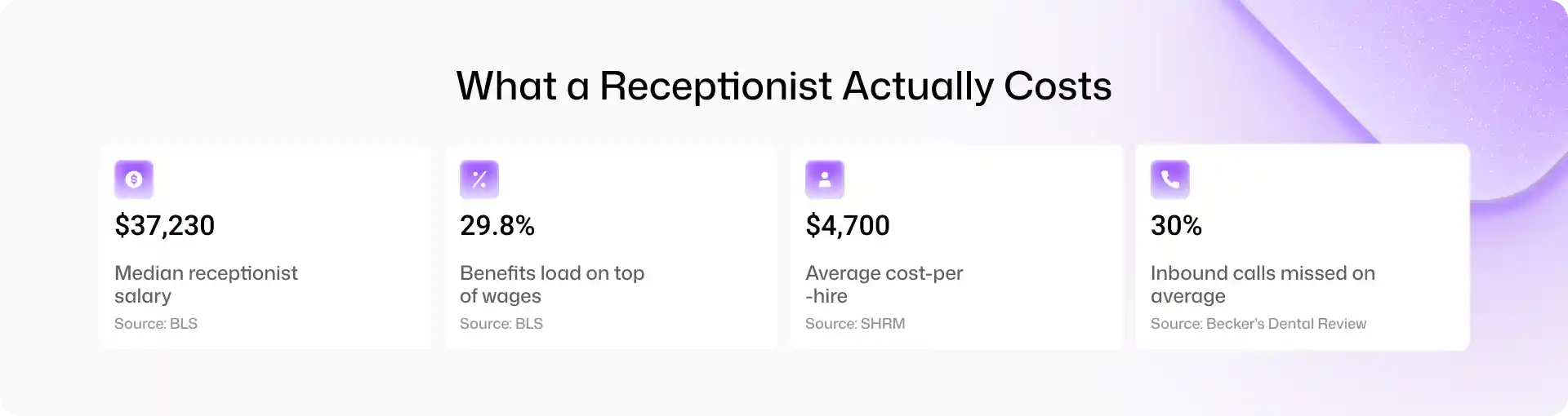
According to the Bureau of Labor Statistics, the median annual pay for a receptionist nationally was $37,230 in 2024. That figure covers wages only, before a single dollar of benefits, taxes, or overhead is added.
Those additions are not small. The BLS Employer Costs for Employee Compensation report found that benefits made up 29.8% of total private industry compensation as of June 2025, with wages accounting for the remaining 70.2%. Applying that same ratio to a $37,230 salary pushes the fully loaded cost of one front desk hire to roughly $53,000 a year, before overtime, recruiting, or a single sick day is factored in.
Recruiting itself is not free either. The Society for Human Resource Management estimates the average cost-per-hire across industries at approximately $4,700, covering job postings, recruiter time, interviews, and onboarding. Dental hiring is not immune to this, and it is arguably harder than average right now.
Median receptionist pay: $37,230/year before benefits (BLS, 2024)
Benefits load: 29.8% of total compensation (BLS ECEC, June 2025)
Average cost-per-hire: approximately $4,700 (SHRM)
Moreover, the dental labor market is exceptionally tight right now. The ADA Health Policy Institute found that 91% of dentists actively recruiting a hygienist call the process very or extremely challenging, a sign of how strained dental hiring has become across every front-office and clinical role. As a result, a vacant front desk seat does not just cost money; it costs time, and every day it sits open is a day of missed calls. Becker's Dental Review reports that the average dental practice misses close to 30% of its inbound calls, a gap that widens further whenever the front desk is short-staffed.
What an AI Receptionist Cost Structure Actually Looks Like
An AI receptionist is a voice-based system that answers every call, books appointments, and handles patient intake without a person sitting at the desk. For a dentist or office manager comparing costs, the easiest way to think about it is a flat, predictable line item instead of a variable one.
Unlike a salaried hire, an AI voice agent does not carry a benefits package, does not accrue paid time off, and does not require payroll taxes or workers' compensation coverage. The practice pays a subscription fee, and that fee covers unlimited call answering around the clock, not just the eight hours a single employee can work in a day.
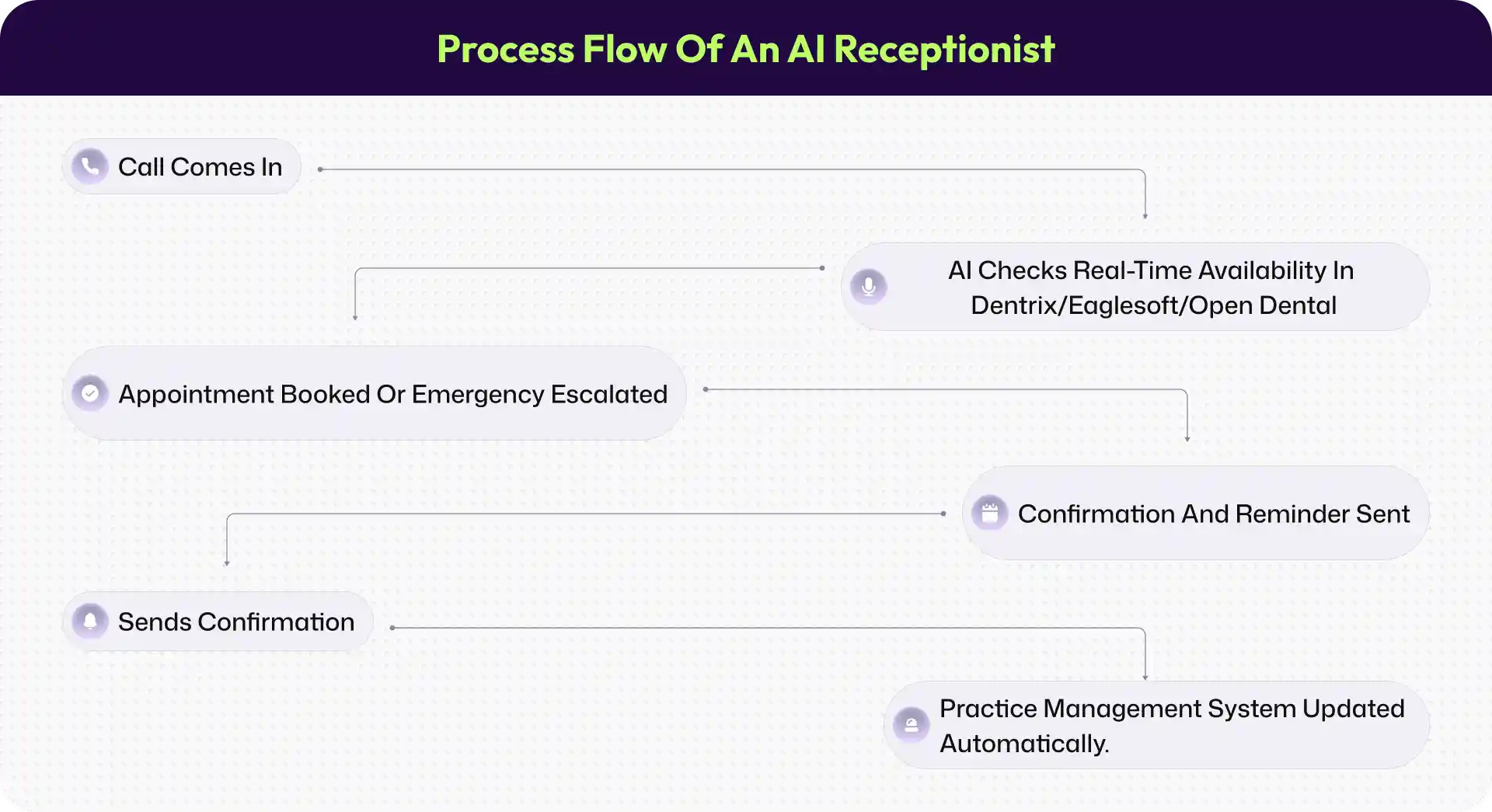
The AI voice agent connects directly to the practice's existing scheduling system, whether that is Dentrix, Eaglesoft, Open Dental, or Curve Dental, and checks real-time availability before booking. It also handles Spanish-language calls, confirms insurance details before the visit, sends automated reminders, and escalates true emergencies to a live provider immediately.
Furthermore, because the system runs on software rather than headcount, it does not experience the turnover that drives up the true AI receptionist cost dental practice comparison in the human column. There is no exit interview, no gap in coverage, and no six-week ramp-up period for a replacement to learn the practice's workflow.
Benefits and Business Impact of Choosing an AI Receptionist
Comparing costs on paper is useful, but the business impact goes further than the monthly invoice. Here is what practices typically see once they make the switch.
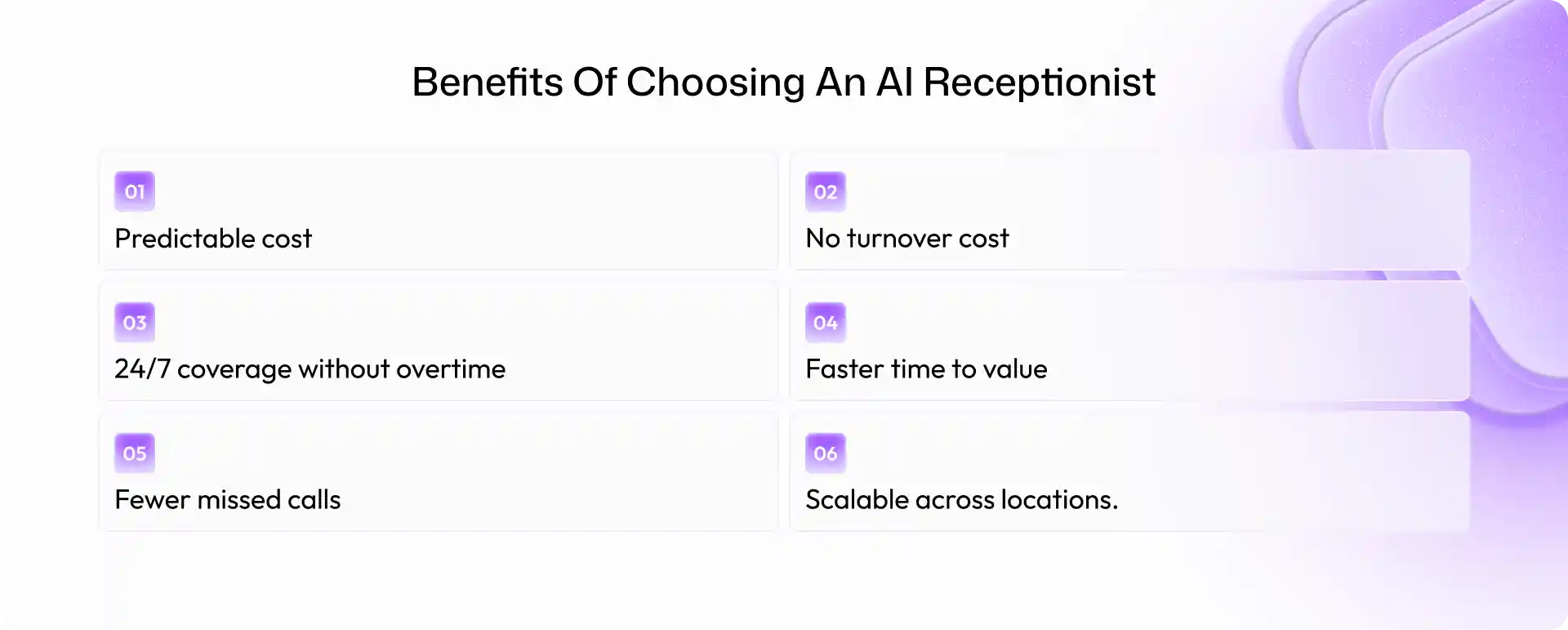
1. Predictable, flat monthly cost
A subscription fee does not fluctuate with overtime, raises, or benefits renewals. Budgeting becomes simpler because the largest line item in front desk operations stops moving every quarter.
2. Elimination of turnover cost
With the average cost-per-hire sitting near $4,700 per SHRM, and front desk positions among the hardest to keep filled in a tight labor market, removing turnover from the equation protects both budget and scheduling continuity.
3. Coverage without overtime
A single employee cannot realistically answer calls at 7 p.m. or on a Saturday without overtime pay. An AI voice agent answers every call, every hour, at the same flat rate.
4. Faster time to value
A new hire typically needs weeks of training before working independently. An AI receptionist is configured to the practice's scheduling rules, insurance workflows, and call scripts in a fraction of that time.
5. Fewer missed calls, more booked revenue
Since the average practice misses close to 30% of inbound calls according to Becker's Dental Review, closing that gap directly converts into more booked appointments without adding headcount.
6. Scalability across locations
Group practices and DSOs can extend the same AI receptionist across every location instantly, instead of recruiting, training, and managing a front desk team at each site.
Industry-Specific Use Cases
A solo practitioner in Austin currently splits front desk duties between one full-time coordinator and the dentist's own overflow coverage during lunch. Adding an AI voice agent removes the need for a second hire entirely, closing coverage gaps at a fraction of what a second salary would cost.
A group practice with three locations across Dallas and Houston previously budgeted for six front desk staff, two per site, to cover open hours and call volume. Centralizing call answering through a shared AI receptionist reduces the need for redundant headcount at each site while keeping every location staffed with live coverage for in-person patients.
A multi-location DSO operating across San Antonio, El Paso, and Plano faces a different challenge: standardizing front desk quality and cost across a dozen or more offices with different staffing levels. Deploying the same AI receptionist configuration everywhere gives leadership one predictable line item per location instead of a patchwork of salaries, benefits, and turnover rates that vary office to office.
Implementation Considerations
Before signing with any AI receptionist vendor, practices should ask a few direct questions.
1. Does the pricing model scale with call volume or stay flat regardless of how busy the practice gets? Unpredictable per-call pricing can erase the cost advantage over a salaried hire.
2. Does the system integrate natively with the practice's existing scheduling software, such as Dentrix, Eaglesoft, Open Dental, or Curve Dental? A system that requires manual double-entry defeats the purpose of automating the front desk.
3. Will the vendor sign a Business Associate Agreement? Any system handling patient scheduling or intake touches protected health information, and a signed BAA is non-negotiable for HIPAA compliance. Alris AI provides a signed BAA to every practice as part of onboarding.
4. Ask how the system handles true emergencies. A cost-effective receptionist that cannot recognize and escalate a patient in pain is not actually solving the front desk problem; it is just moving it.
Future Trends in Dental Front Desk Staffing Costs
Over the next 12 to 18 months, expect three shifts in how practices think about front desk economics.
1. AI receptionist pricing models will continue to mature, with more vendors offering usage-based tiers that make the cost comparison against a salaried hire even more transparent.
2. Hybrid staffing models will become more common, where practices keep a smaller in-person team for patient-facing tasks while an AI voice agent absorbs phone volume, reducing headcount needs without eliminating the human touch at checkout and treatment planning.
3. DSOs will increasingly standardize AI receptionist deployment across every location as a budgeting tool, using the flat, predictable cost structure to forecast front desk expenses years in advance instead of re-negotiating staffing budgets office by office.
Conclusion
The sticker price on a job posting was never the real cost of a front desk hire. Once benefits, payroll taxes, recruiting fees, and turnover are added in, a single position can cost a practice tens of thousands of dollars more than the base salary suggests, and that is before accounting for the revenue lost to missed calls when the seat sits empty.
Weighing the AI receptionist for dental practice against that full picture changes the calculation. A flat, predictable subscription that covers 24/7 coverage, integrates with existing practice management software, and never experiences turnover is not just a technology upgrade; it is a budgeting decision.
As more practices in Texas and across the country run this comparison for themselves in 2026, the practices that act early are the ones locking in predictable costs before hiring gets even tighter.

Frequently Asked Questions (FAQs)
1. How much does an AI receptionist cost for a dental practice?
AI receptionist pricing varies by vendor and call volume, but most platforms charge a flat monthly subscription rather than an hourly wage. Unlike a salaried hire, that fee does not increase with benefits, overtime, or payroll taxes, which typically makes it a fraction of the fully loaded cost of one front desk employee.
2. Is an AI receptionist cheaper than hiring front desk staff?
In most cases, yes. A single front desk hire costs roughly $53,000 a year once benefits and payroll taxes are factored into the median $37,230 salary reported by the BLS, before adding recruiting or turnover costs. An AI receptionist's flat subscription typically comes in well below that fully loaded figure.
3. Does an AI receptionist replace all front desk staff?
Not necessarily. Most practices use an AI voice agent to handle call answering, scheduling, and intake, while keeping in-person staff for checkout, treatment coordination, and patient interactions that benefit from a face-to-face presence.
4. Can an AI receptionist integrate with my practice management software?
Yes. Alris AI integrates directly with Dentrix, Eaglesoft, Open Dental, and Curve Dental, checking real-time availability and writing appointments back into the system automatically, without manual double-entry from staff.
5. Is an AI receptionist HIPAA compliant?
A properly built AI receptionist should be. Look for encrypted call handling, access controls, audit trails, and a signed Business Associate Agreement. Alris AI provides a signed BAA to every practice it works with.
6. Does an AI receptionist work for multi-location DSOs?
Yes. DSOs can deploy the same AI receptionist configuration across every location, standardizing both cost and call quality instead of managing separate front desk budgets and staffing levels at each site.
Sources & References:
1. U.S. Bureau of Labor Statistics. "Receptionists." Occupational Outlook Handbook.
2. U.S. Bureau of Labor Statistics. "Employer Costs for Employee Compensation." June 2025.
3. Society for Human Resource Management. "The Real Costs of Recruitment."
4. American Dental Association Health Policy Institute. "Dental Hygienist Shortage." 2026.
Shravan Rajpurohit
CEO & Co-Founder
Shravan Rajpurohit is the Co-Founder & CEO of The Intellify, a leading Custom Software Development company that empowers startups, product development teams, and Fortune 500 companies. With over 10 years of experience in marketing, sales, and customer success, Shravan has been driving digital innovation since 2018, leading a team of 50+ creative professionals. His mission is to bridge the gap between business ideas and reality through advanced tech solutions, aiming to make The Intellify a global leader. He focuses on delivering excellence, solving real-world problems, and pushing the limits of digital transformation.

Stay Updated
with AI Insights
Get the latest articles on AI, automation, and enterprise technology delivered to your inbox weekly.

500+ people have already subsribed!
No spam. Unsubscribe anytime.