
AI Receptionist for Clinics: How to Automate Your Front Desk in 2026



Summary: Most clinics miss more calls than they realise, and each one is a potential appointment lost. This guide covers how AI receptionists work, what they actually do for dental, chiropractic, med spa, and general practice clinics, and how to choose the right platform. From 24/7 call answering to automated reminders and recall outreach, here's everything you need to know before making a decision.
Patient expectations have changed. They want answers immediately, whether they're calling after hours, texting to reschedule, or trying to book online at 11 pm on a Sunday. A voicemail isn't good enough anymore. Neither is being put on hold for five minutes while the front desk handles a patient standing right in front of them.
The problem is, most clinics are still running on manual front desk processes that weren't built for this. One receptionist, multiple phone lines, a packed waiting room, and a schedule that needs constant managing. Something always slips through.
That's where AI receptionists come in. Not as a replacement for your team but as a way to make sure every patient gets a response, every call gets answered, and every appointment gets booked, even when your staff can't get to it.
This guide covers everything clinics need to know about AI receptionists: how they work, what they actually do, the benefits, which clinic types they suit, and how to choose the right one. Whether you're a solo practitioner or managing multiple locations, this should give you a clear picture of whether this technology makes sense for your practice.
What Is an AI Receptionist for Clinics?
An AI receptionist is software that handles patient communication, automatically answering calls, booking appointments, sending reminders, responding to texts, and routing queries without needing a human to do it manually.
It's not a chatbot with a list of preset replies. And it's not a basic phone menu asking patients to press 1 for this or 2 for that. A proper AI receptionist understands what a patient is asking, responds in natural language, and takes action, booking the appointment, updating the record, and sending the confirmation.
How it differs from IVR
IVR (Interactive Voice Response) is the "press 1 for appointments, press 2 for billing" system most patients actively dislike. It routes calls based on keypad inputs and pre-recorded menus. There's no real understanding happening. An AI receptionist holds an actual conversation, understands what the patient needs without making them navigate a menu, and resolves the request directly.
How it all connects:
Patient → AI Receptionist → Voice / SMS / Email → Clinic Software (EHR, Calendar, CRM)
Every interaction flows through one system, connected to your existing tools, so nothing gets lost between channels.
Why Clinics Are Moving to AI Receptionists
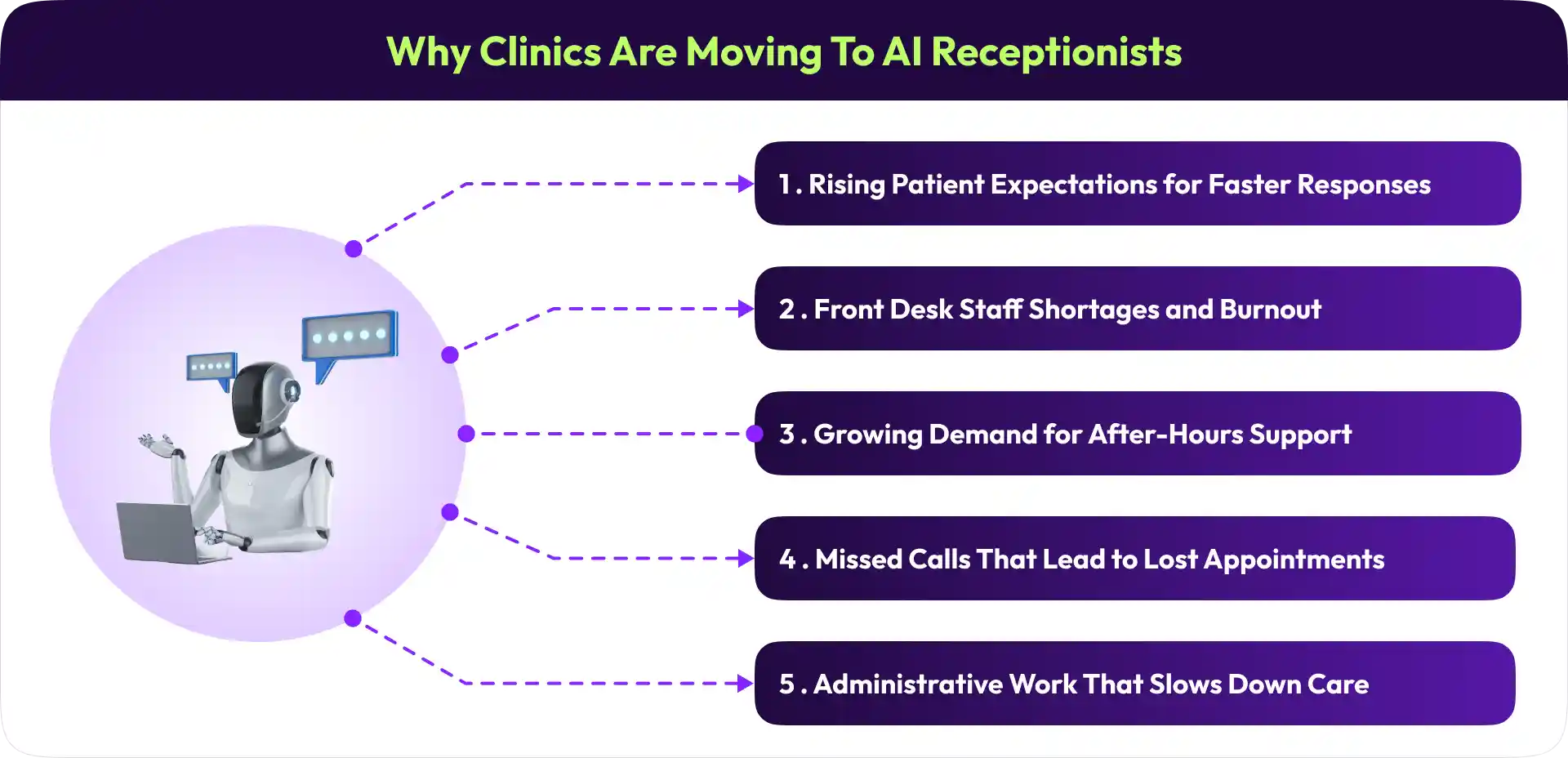
Growing patient expectations
Patients are used to booking things online, getting instant confirmations, and communicating over text. When a clinic can't offer that, when the only option is calling during business hours and hoping someone picks up, it creates friction. Some patients will wait. A lot won't.
Staff shortages
Healthcare staffing has been under real pressure for the last few years, and front desk roles haven't been immune. Finding and keeping reliable administrative staff is harder and more expensive than it used to be. AI receptionists don't solve every staffing problem, but they do reduce the volume of routine tasks that fall on the people you have.
After-hours demand
Studies suggest that a significant share of appointment requests and patient inquiries happen outside business hours, evenings, weekends, and early mornings. If your clinic isn't available, then those patients either wait until the next business day or find somewhere that can help them now. An AI receptionist keeps the clinic accessible around the clock without anyone working overtime.
Missed calls
The average medical practice misses a meaningful percentage of inbound calls, particularly during busy periods. Each missed call is a potential appointment that didn't get booked, a patient question that went unanswered, or a new patient who called a competitor instead. At even modest appointment values, missed calls add up to real revenue loss over the course of a month.
Administrative burden
Front desk staff spend a significant portion of their day on tasks that don't require clinical judgment: answering routine questions, confirming appointments, sending reminders, updating records. That's time that could be spent on higher-value work, or simply on giving in-clinic patients the attention they deserve. AI handles the repetitive layer so staff can focus on what actually needs a human.
How an AI Receptionist Works
The workflow is simpler than it sounds. Here's how a typical patient interaction plays out from start to finish:
Patient Calls: The AI receptionist answers immediately, no hold time, no voicemail.
AI Answers: It greets the patient by name if they're an existing contact, or introduces itself and asks how it can help.
Books Appointment: The patient states what they need. The AI checks real-time availability and confirms a slot during the call.
SMS Confirmation: A confirmation text goes out automatically with the appointment details and any preparation instructions.
Reminder: A day or two before the appointment, a reminder goes out via SMS or email, with an option to confirm, reschedule, or cancel.
Patient Arrives: Check-in can be handled digitally, with intake forms sent ahead of time.
Follow-up: After the visit, an automated follow-up message goes out with care instructions, a satisfaction check, and next steps.
Recall Reminder: When the patient is due for their next visit, the system flags it and sends a recall message automatically.
The whole loop runs without anyone at the front desk initiating each step manually. The staff gets notified when something needs attention. Everything else just happens.
Core Features of an AI Receptionist
24/7 Call Answering
The AI picks up every call, any time of day. No after-hours voicemail, no missed calls during lunch, no calls going unanswered while the front desk is with a patient.
Appointment Scheduling
Patients can book during the call itself. The AI checks live availability, confirms the appointment, and updates the calendar no manual entry needed.
Appointment Rescheduling
When a patient needs to move their appointment, the AI handles it end-to-end. It finds a new available slot, updates the booking, cancels the old one, and sends a new confirmation.
SMS Automation
Confirmations, reminders, follow-ups, and recall messages go out automatically via text. Patients can reply to reschedule or confirm, and the system handles those responses too.
Email Automation
For patients who prefer email, the same automated workflows apply to booking confirmations, appointment reminders, post-visit follow-ups, and recall notices.
Patient Intake
Intake forms can be sent automatically before the appointment, completed digitally by the patient, and synced directly into the clinic's system so the front desk isn't spending the first ten minutes of every visit entering information manually.
Call Routing
When a call genuinely needs a human a clinical question, an urgent concern, a complex situation, the AI routes it to the right person with context already captured, so the staff member isn't starting from scratch.
CRM Integration
Patient information, call logs, appointment history, and communication records sync automatically with the clinic's CRM or practice management software.
Calendar Sync
The AI connects directly with the clinic's scheduling system, so availability is always accurate. Double bookings and scheduling errors get eliminated.
Analytics & Reporting
Call volumes, appointment booking rates, missed call data, no-show rates, and patient communication trends are tracked automatically and are available in a reporting dashboard.
Multi-Language Support
For clinics serving diverse patient populations, multi-language capability means patients can communicate in the language they're most comfortable with, which matters more than most clinics realize when it comes to patient trust and retention.

Benefits of AI Receptionists for Clinics
Never Miss Patient Calls
Every call gets answered, every time. No more voicemail backlog, no more callbacks that take half a day to clear. Patients get a response immediately, which is increasingly the baseline expectation.
Reduce No-Shows
Automated reminders sent via SMS and email, especially ones that let patients confirm or reschedule with a simple reply, consistently reduce no-show rates. Fewer gaps in the schedule mean more appointments completed and less revenue lost to empty slots.
Lower Administrative Work
Routine communication tasks, such as booking confirmations, reminders, follow-ups, and recall messages, run automatically without anyone at the front desk managing them individually. That's hours returned to the team every week.
Improve Patient Experience
A patient who gets their call answered immediately, receives a confirmation text within seconds, and gets a reminder the day before their appointment has a materially better experience than one who reached voicemail and never heard back. The bar for patient communication has risen, and clinics that meet it see it reflected in reviews and retention.
Increase Appointment Bookings
When every call gets answered and booking is instant, more calls convert to appointments. Patients who would have hung up and tried elsewhere complete the booking in the first interaction.
Support Multi-Location Clinics
A single AI receptionist system can handle communications across multiple clinic locations simultaneously, with the same consistent experience everywhere, without duplicating front desk staff at each site.
Reduce Front Desk Burnout
Constant phone calls, repetitive questions, and the pressure of managing everything at once are genuinely exhausting for front desk staff. Taking the routine, high-volume tasks off their plate doesn't just save time, it makes the job more manageable and reduces turnover.
Cost Savings vs Traditional Staffing
A full-time receptionist in the US costs somewhere between $35,000 and $50,000 per year in salary alone, before benefits, training, and management overhead. AI receptionist solutions typically cost a fraction of that and cover tasks that would otherwise require more than one person, including after-hours coverage that no single employee can provide.
AI Receptionist for Every Patient-Facing Clinic
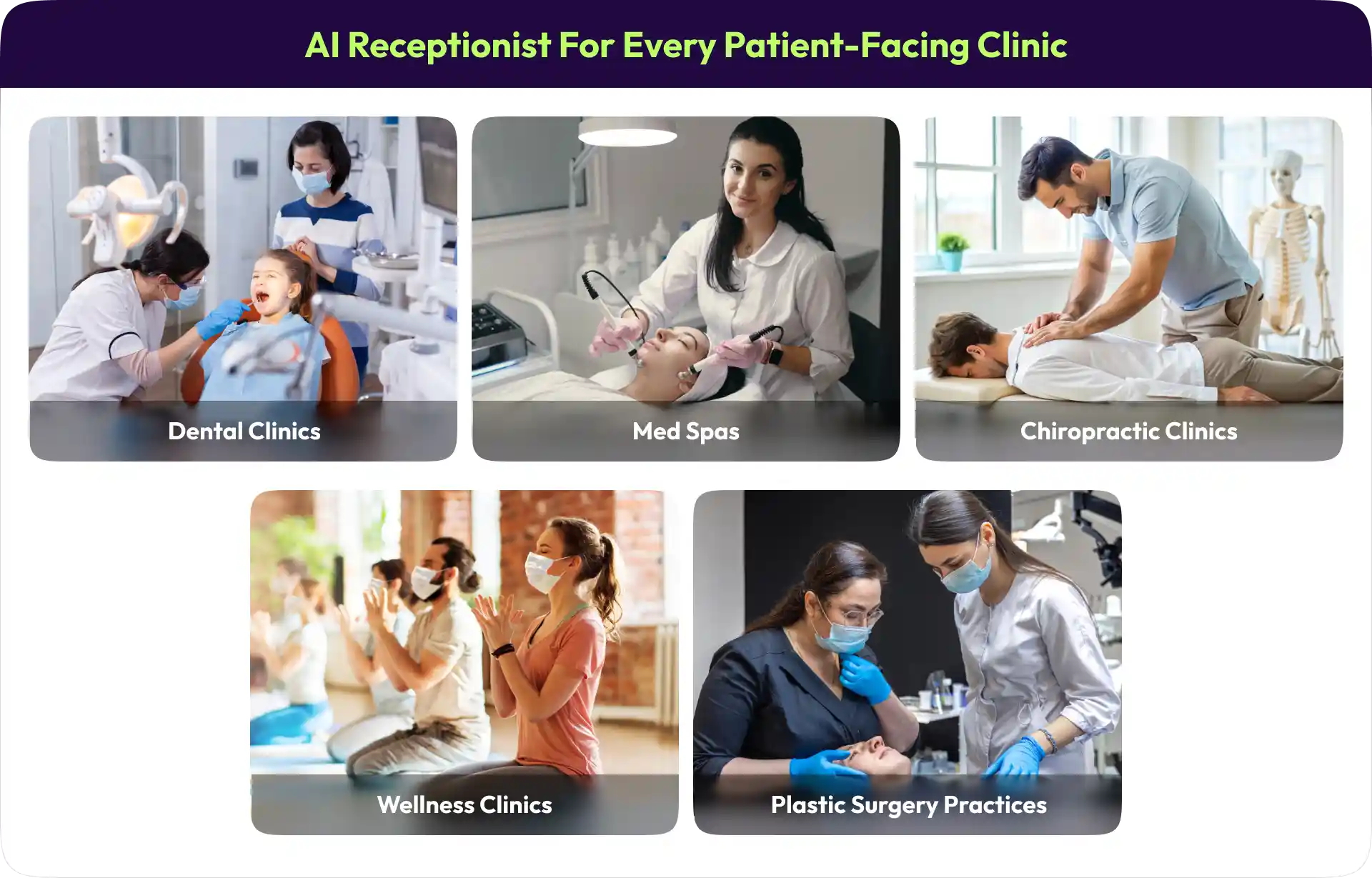
Dental Clinics
Key Challenges: Dental clinics deal with high appointment volumes, frequent rescheduling, and patients who delay booking until pain forces their hand. Front desk staff spend a lot of time on confirmation calls and reminder follow-ups that could run automatically.
How AI Solves It: The AI handles all inbound booking and rescheduling calls, sends automated reminders that reduce no-shows, and manages recall outreach for patients due for their next cleaning or checkup without anyone on the front desk chasing each one manually.
Med Spas
Key Challenges: Med spa clients often book outside business hours, evenings, and weekends, and expect a seamless, premium experience from the first interaction. Missing a call from a potential client is a direct revenue loss.
How AI Solves It: 24/7 call answering ensures no inquiry goes unanswered. The AI books consultations, sends confirmation and preparation messages, and follows up after visits, delivering a consistent client experience at every touchpoint.
Chiropractic Clinics
Key Challenges: Chiropractic patients often have recurring appointments and need to reschedule regularly based on how they're feeling. Managing a high volume of recurring bookings manually takes significant front desk time.
How AI Solves It: The AI manages recurring appointment scheduling, sends reminders before each visit, handles rescheduling requests via SMS, and flags patients who haven't booked a follow-up when they should have.
Wellness Clinics
Key Challenges: Wellness clinics typically offer a range of services and need to match patients with the right provider and appointment type, not just find the next available slot. Communication also tends to span multiple channels.
How AI Solves It: The AI qualifies the caller's needs during the conversation, matches them with the appropriate service and provider, and manages multi-channel follow-up across voice, SMS, and email.
Plastic Surgery Practices
Key Challenges: Plastic surgery inquiries are sensitive, high-value, and require careful handling. Patients calling for the first time are often doing initial research and need a reassuring, professional first interaction, not a voicemail.
How AI Solves It: The AI answers every call professionally, captures patient details, books consultation appointments, and ensures the practice never loses a potential patient to an unanswered call.
How to Choose the Best AI Receptionist for Your Clinic
Not every platform is built the same. Before committing to one, run through this checklist:
HIPAA readiness: Does the platform offer a Business Associate Agreement (BAA)? Is call data encrypted? How is patient information stored and accessed?
Natural conversations: Does it sound human enough that patients won't be put off? Test it with real call scenarios before going live.
Appointment scheduling: Can it book, reschedule, and cancel appointments in real time, connected to your actual calendar?
CRM integrations: Does it connect with your existing practice management or EHR system, or does it sit separately and require manual syncing?
SMS capability: Can it send and receive texts automatically as part of the patient communication workflow?
Email automation: Does it handle email confirmations and reminders, or just calls and texts?
Reporting: What data does it give you? At a minimum, you want call volumes, booking rates, and no-show trends.\
Security: Beyond HIPAA, how does the platform handle data breaches, access controls, and audit logs?
Scalability: If you open a second or third location, can the system scale without a major re-implementation?
Support: What does onboarding look like? Is there ongoing support if something breaks or needs adjusting?
Implementation Checklist
Getting an AI receptionist up and running doesn't have to take months. Here's a realistic week-by-week timeline:
1. Map Workflows
Document your current call-handling process. What types of calls do you receive most often? What does a typical booking call look like? What questions do patients ask most frequently? This becomes the foundation for how the AI is configured.
2. Connect Scheduling
Integrate the AI receptionist with your calendar and scheduling system. This is the step that makes real-time booking possible; without it, the AI can only take messages rather than actually book appointments.
3. Train the AI
Configure the conversation flows, test with sample calls, and refine responses. Run through edge cases, patients who are hard to understand, unusual requests, and calls that need escalation. Adjust until the system handles them well.
4. Launch
Go live, initially with a portion of your call volume, if you want to be cautious. Let the team know what to expect, and make sure escalation paths are clear so nothing falls through the cracks during the first week.
5. Optimize
Review call logs, booking conversion rates, and any calls that needed human intervention. Identify patterns and adjust the AI's configuration to handle them better going forward.
Conclusion
AI receptionists are becoming a practical, everyday tool for clinics that want to stay on top of patient communication without burning out their front desk staff or missing calls they can't afford to lose.
They don't replace the people working in your clinic. What they do is take the repetitive communication load, the calls, the bookings, the reminders, the follow-ups, the recalls, and run it automatically, consistently, and around the clock. That frees your team to focus on what they're actually there to do: take care of patients.
The clinics getting the most out of this technology aren't the ones who bought a voice-only bot and called it done. They're the ones using platforms that connect voice AI, SMS, email, scheduling, and patient records into a single workflow so nothing falls through the cracks between channels. If that sounds like something your clinic needs, the next step is seeing how it actually works in practice.
Frequently Asked Questions (FAQs)
1. What is an AI receptionist for clinics?
An AI receptionist is software that handles patient communication, automatically answering calls, booking appointments, sending reminders, and managing follow-ups without requiring manual input from front desk staff.
2. How much does an AI receptionist cost?
Costs vary by platform and usage volume, but most AI receptionist solutions for clinics are priced significantly below the cost of a full-time receptionist. Many platforms offer monthly subscription plans, often starting in the low hundreds of dollars per month, depending on features and call volume.
3. Can AI schedule appointments?
Yes, and this is one of the core functions. AI receptionists with calendar integration can check real-time availability, book appointments during the call, send confirmations, and handle rescheduling or cancellations automatically.
4. Does AI integrate with clinic scheduling software?
Most modern AI receptionist platforms integrate with common practice management and EHR systems. Integration capability should be one of the first things you confirm before selecting a platform. A system that doesn't connect with your existing software creates manual work rather than eliminating it.
5. Can AI answer clinic calls after hours?
Yes, 24/7 availability is one of the primary reasons clinics adopt AI receptionists. Every call gets answered regardless of when it comes in, which is particularly valuable for after-hours appointment requests and urgent patient inquiries.
6. Can AI reduce clinic no-shows?
Yes, and this is one of the clearest measurable benefits. Automated appointment reminders sent via SMS and email, particularly ones that allow patients to confirm or reschedule with a simple reply, consistently reduce no-show rates across clinic types.
Shravan Rajpurohit
CEO & Co-Founder
Shravan Rajpurohit is the Co-Founder & CEO of The Intellify, a leading Custom Software Development company that empowers startups, product development teams, and Fortune 500 companies. With over 10 years of experience in marketing, sales, and customer success, Shravan has been driving digital innovation since 2018, leading a team of 50+ creative professionals. His mission is to bridge the gap between business ideas and reality through advanced tech solutions, aiming to make The Intellify a global leader. He focuses on delivering excellence, solving real-world problems, and pushing the limits of digital transformation.

Stay Updated
with AI Insights
Get the latest articles on AI, automation, and enterprise technology delivered to your inbox weekly.

500+ people have already subsribed!
No spam. Unsubscribe anytime.