
How AI Receptionists Help Clinics Handle More Patient Calls



For many US clinics, the front desk has the same problem every day: the phone keeps ringing while staff are already busy with patients standing in front of them.
US healthcare offices receive an average of 53 patient calls per day, with staff spending more than an hour managing those calls, according to the research referenced in the original outline.
When call volume gets too high, patients may wait, calls may go to voicemail, and new appointment opportunities can be missed.
Hiring another receptionist can help, but it also adds salary, benefits, training, and turnover costs. It may not make sense to add full-time staff just to handle peak call periods.
An AI receptionist for clinics offers another approach. It can answer routine calls, handle appointment requests, support after-hours communication, and take care of repetitive front-desk tasks while human staff focuses on patients in the clinic.
Here’s how it works and what US clinics should consider before implementing one.
Why US Clinics Struggle to Handle Patient Call Volume
The structural mismatch: peak calls and peak patients arrive together
The busiest call periods often overlap with the busiest times inside the clinic. Patients arrive for appointments while other patients call to schedule, reschedule, ask questions, or check availability. One receptionist is then expected to manage the phone and the waiting room at the same time.
Something has to wait. The caller may be placed on hold. The patient at the desk may have to wait. Or another call may go unanswered.
This isn't necessarily because the staff isn't working hard enough. There are simply limits to how many conversations one person can manage at once.
The real cost of missed and abandoned patient calls
A missed call can be more than a missed conversation. A new patient who cannot reach the clinic may call another provider instead. A referral may not turn into an appointment. An existing patient may simply decide to try again later or not.
The frustrating part is that clinics often don't know how many opportunities disappear this way.
Every unanswered call isn't automatically lost revenue, of course. But when missed calls happen repeatedly, especially during busy periods, they can affect appointment volume and patient experience.
Why hiring more front desk staff doesn't scale
Adding another medical receptionist can increase capacity, but it also increases operating costs. There is salary, benefits, onboarding, training, scheduling, and turnover to consider. More importantly, the additional employee may be most useful during a few busy hours rather than throughout the entire day.
For an independent practice or small clinic group, that can be difficult to justify.
The result is a familiar cycle: understaffed during peaks, over capacity during quieter periods, and constantly trying to balance patient service with payroll.
After-hours - the patient call gap nobody measures
Patients don't always call during office hours. Calls can come in after 5 p.m., on weekends, or during holidays. If those calls simply reach voicemail, the patient has to wait for a response.
For an existing patient, that may be inconvenient. For a new patient looking for an appointment, it may be enough to try another clinic.
After-hours coverage can therefore become an important part of the overall patient communication workflow.
What Is an AI Receptionist for Clinics?
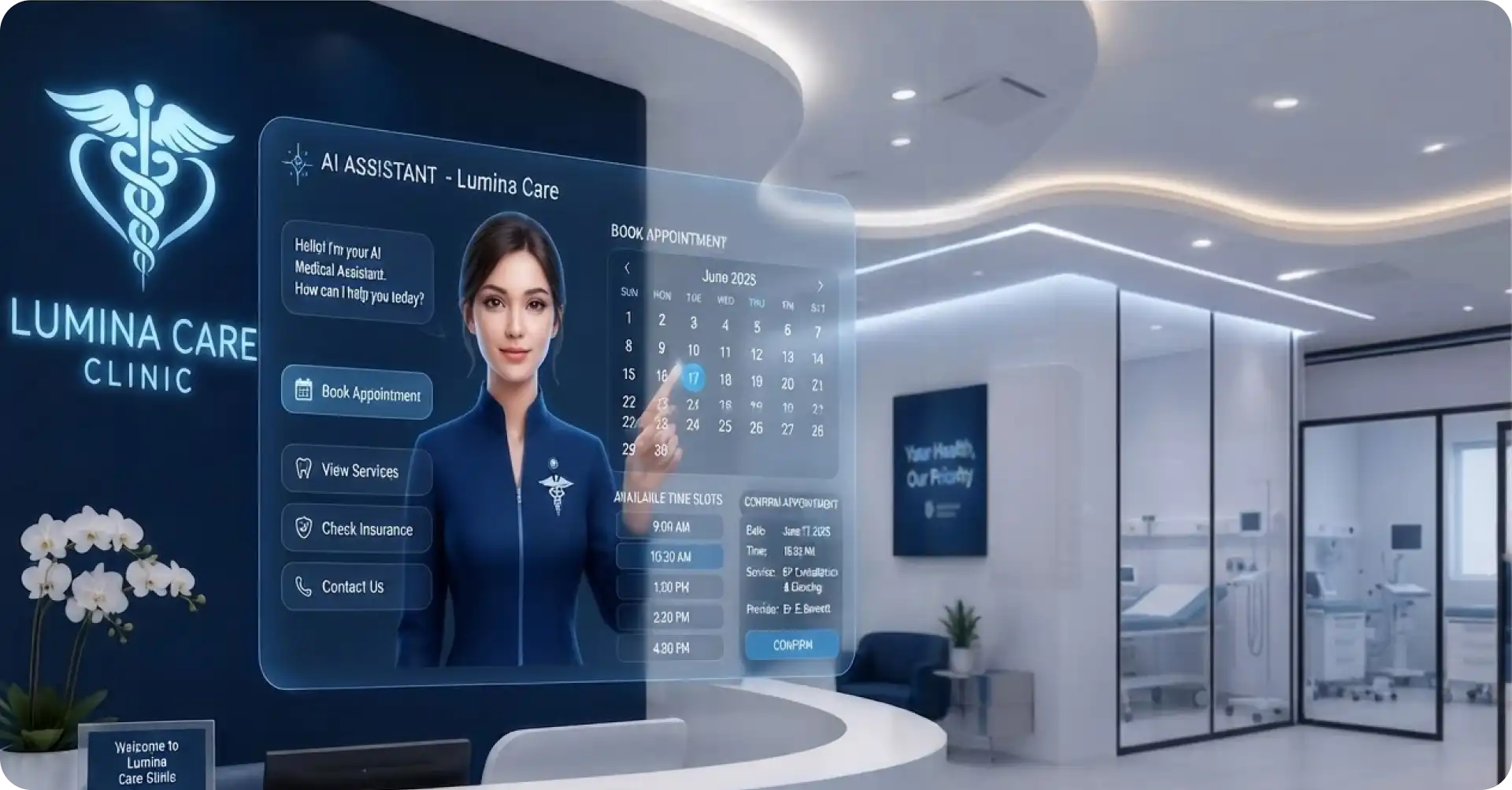
An AI receptionist is a voice-based system that can answer patient calls, understand what the caller needs, and handle defined administrative tasks.
It is different from a basic phone menu or chatbot. Instead of asking callers to press numbers or navigate a rigid menu, the system can hold a natural conversation.
It can also be different from a generic AI answering service because healthcare workflows involve appointment types, patient information, referrals, insurance questions, and specific escalation rules.
The AI receptionist works alongside the clinic's existing front desk rather than replacing every human interaction.
What an AI clinic receptionist handles
Depending on the platform and integrations, an AI clinic receptionist can help with:
Inbound patient calls
Appointment scheduling and rescheduling
Common patient questions
Patient intake
Appointment confirmations and reminders
After-hours calls
Recall and reactivation outreach
Post-visit follow-ups
English and Spanish call handling
Routing calls that require staff attention
Integration is especially important. When connected to the appropriate EHR or practice management system, the AI can work with real-time appointment availability instead of simply taking a message.
How AI Receptionists Help Clinics Handle More Patient Calls
Answering every call instantly, eliminating hold times and missed calls
One of the simplest benefits is availability. Instead of every caller waiting for the same receptionist, an AI receptionist can handle multiple conversations at the same time, depending on the platform's capabilities.
That matters when several patients call during the morning rush.
Rather than hearing "please hold," patients can start their conversation immediately, while front desk staff continues helping people inside the clinic.
Managing the morning call spike without adding staff
Morning call volume can put significant pressure on a small front desk team. An AI receptionist can handle routine appointment requests, FAQs, and other defined tasks during this period.
That leaves staff with more time for patients who are physically present. It's a small operational change, but it can remove one of the most persistent interruptions at the front desk: the phone that never seems to stop ringing.
After-hours patient call coverage
An AI receptionist can continue answering calls outside regular office hours. Depending on its configuration, it can schedule appointments, collect new patient information, answer common questions, and route calls according to the clinic's escalation process.
A patient calling on Saturday morning doesn't necessarily have to wait until Monday to begin the appointment process.
Scaling call volume without scaling headcount
Call volume tends to increase as a clinic grows. More patients and more locations mean more scheduling requests, questions, and follow-ups.
An AI receptionist can handle increased call volume without requiring a new receptionist for every increase in demand.
For multi-location clinic groups, it can also provide a consistent call-handling process across locations.
How an AI Clinic Receptionist Works: The Patient Call Journey
A typical workflow can look like this:
Patient Calls the Clinic
↓
AI Receptionist Answers
↓
Identifies the Request - appointment, billing, referral, or general question
↓
Handles the Interaction - answers, schedules, or captures information
↓
Confirms Details With the Patient
↓
EHR / Practice Management System Updated
↓
SMS Confirmation Sent
↓
Appointment Reminder Triggered
↓
Post-Visit Follow-up Triggered
The system can also handle simultaneous calls during busy periods and route urgent or clinical conversations to staff according to the clinic's defined workflow.
AI Receptionists for Clinics Across US Healthcare Settings
Primary Care and Family Medicine Practices
Primary care practices handle a wide range of routine calls, including appointment requests, referrals, prescription-related questions, and preventive care visits. An AI receptionist can take care of defined administrative calls while staff focus on patients already at the clinic.
Specialty Clinics
Specialty practices may need more detailed scheduling workflows. The AI can collect information about referrals, appointment types, and other requirements before routing complex cases to staff.
Urgent Care Centers
Urgent care clinics often deal with same-day appointment demand. Patients may call about availability, wait times, operating hours, or whether they should come in.
An AI receptionist can handle routine enquiries and capture information before the patient arrives.
Mental Health and Behavioral Health Practices
These practices require particular care because some calls may involve sensitive situations. An AI receptionist can handle defined administrative conversations and route calls requiring clinical attention according to the practice's escalation process.
Multi-Location Clinic Groups
For multi-location groups, a centralized AI receptionist can help standardize routine call handling across locations. It can also provide centralized reporting and make it easier to scale call handling as new locations are added.
AI Receptionist vs Traditional Medical Receptionist
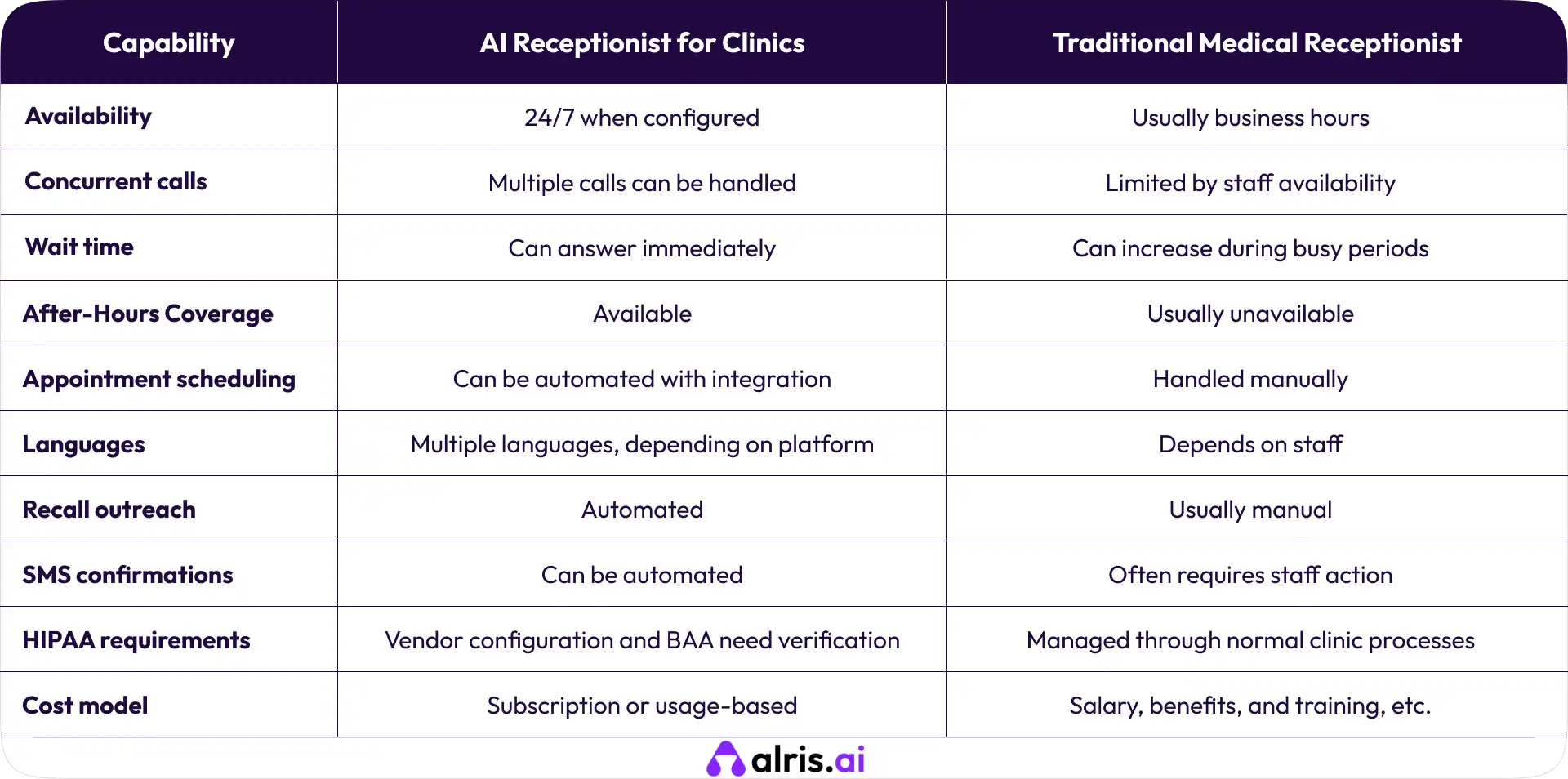
The two approaches don't have to compete. For many clinics, the practical model is to let technology handle repetitive communication while staff focus on interactions that require human judgment.
The Business Case for AI Receptionists at US Clinics
The revenue recovery calculation
Start with the calls your clinic already receives.
How many are missed?
How many go to voicemail?
How many are new patient calls?
How many arrive after hours?
Then look at how many of those calls could have resulted in appointments. The goal isn't simply to increase the number of calls answered. It's to determine whether better call coverage leads to more completed appointments.
The staffing cost comparison
The outline uses an estimated US medical receptionist salary range of 36,000-42,000 per year before benefits as a reference point.
A full staffing comparison should also consider training, onboarding, turnover, and management time. AI receptionist pricing generally follows a different model, such as monthly subscriptions or usage-based pricing.
Clinics should compare the overall coverage and workload reduction rather than salary versus software cost alone.
The no-show reduction value
Automated reminders can help clinics maintain consistent communication before appointments. SMS and email reminders can be triggered automatically, while waitlist workflows may help fill appointments that become available after cancellations.
The actual impact will vary by clinic, but automation removes the need for staff to manually initiate every reminder.
The patient experience and retention argument
Patients expect to be able to reach their healthcare providers. Repeated unanswered calls can create frustration, particularly when someone is trying to schedule a first appointment.
Consistent call answering doesn't solve every patient experience issue, but it can remove one avoidable source of friction.
What to Look for in an AI Receptionist for Clinics
When evaluating an AI receptionist for clinics, look for:
HIPAA compliance and BAA: Verify the vendor's documentation and responsibilities before handling PHI.
EHR and PMS integration: Confirm support for your specific system.
Healthcare conversation quality: It should understand appointment types and healthcare terminology.
24/7 coverage: Make sure after-hours functionality goes beyond simply taking messages.
Appointment scheduling: Look for real-time scheduling capabilities where supported.
SMS and email automation: Confirmations and reminders should be easy to automate.
Recall and reactivation: Useful for reconnecting with overdue patients.
Bilingual support: English and Spanish can be important for many US clinics.
Omnichannel communication: Voice, SMS, and email can work together.
Call analytics: Look for answered calls, appointment conversion, and after-hours activity.
Scalable pricing: Understand how costs change as usage and locations grow.
How to Implement an AI Receptionist at Your US Clinic
Step 1: Measure your current call volume and missed call rate
Track daily calls, peak periods, missed calls, voicemail volume, new patient calls, and after-hours enquiries. This gives you a baseline.
Step 2: Choose the right AI receptionist platform for your clinic type
Verify HIPAA-related requirements, BAA availability, EHR compatibility, and after-hours capabilities. Don't settle for "we integrate with most systems." Confirm yours.
Step 3: Integrate with your EHR and practice management system
Test appointment availability, booking, rescheduling, and cancellation workflows before going live. The goal is to avoid creating another manual process for staff.
Step 4: Configure for your clinic's call types and workflows
Set up appointment types, provider availability, escalation rules, recall workflows, and language preferences.
Step 5: Test across your highest-volume scenarios
Test simultaneous calls, morning peaks, after-hours enquiries, Spanish calls, appointment booking, and urgent-call escalation. Real testing will reveal issues that a demo may not.
Step 6: Monitor and measure the impact
Track calls answered, appointment conversion, after-hours capture, no-show rates, and front-desk workload. Also ask your staff whether the phone burden has actually decreased.
Common Mistakes US Clinics Make When Evaluating AI Receptionists
Choosing a generic platform not built for healthcare
A general voice AI may sound natural but still lack the healthcare workflows a clinic needs. Appointment types, insurance terminology, patient information, and escalation rules all matter.
Not verifying HIPAA compliance before signing
Don't rely on a simple "HIPAA compliant" claim. Review the documentation and BAA requirements that apply to your use case before the system handles patient information.
Skipping EHR integration
If the AI can't work with the clinic's scheduling system, staff may still have to call patients back and manually book appointments. That defeats part of the purpose.
Treating after-hours as optional
If missed calls are a problem, limiting automation to office hours leaves a significant part of the communication gap untouched. Check what the system can actually do after hours.
Measuring calls answered instead of appointments converted
A high number of answered calls doesn't necessarily mean the system is helping the clinic. Look at appointment conversion, new patient acquisition, and the amount of work removed from staff.
Conclusion
US clinics don't always need more people to answer more calls. Sometimes they need a better way to handle the calls they already receive.
An AI receptionist for clinics can answer routine patient calls, manage appointment requests, support after-hours communication, automate reminders, and route conversations that need human attention.
The first step is understanding the current problem. How many calls are missed? When do they happen? How many are new patient calls? How much time does the front desk spend handling routine phone work?
Once those numbers are clear, clinics can determine whether an AI receptionist fits their workflow and where it can take some pressure off the front desk without taking the human side out of patient care.
Frequently Asked Questions (FAQS)
1. What is an AI receptionist for clinics?
An AI receptionist for clinics is software that answers patient calls, understands the caller's request, and handles defined administrative tasks such as scheduling, FAQs, patient intake, and call routing.
2. How do AI receptionists help clinics handle more patient calls?
They can answer multiple calls without placing every patient into the same queue. They can also handle routine calls after hours, allowing front desk staff to focus on patients inside the clinic.
3. Can an AI receptionist schedule patient appointments?
Yes, when it has the appropriate integration with the clinic's scheduling or EHR system. It can check available slots, book an appointment, and send confirmation.
4. How does an AI receptionist handle after-hours patient calls?
It can answer calls outside office hours and, depending on configuration, schedule appointments, answer routine questions, capture patient information, and route calls requiring human attention.
5. Can AI receptionists handle calls in Spanish?
Many healthcare-focused platforms support English and Spanish. Clinics should test the actual conversation quality and language-handling capabilities before implementation.
6. Is an AI receptionist suitable for small independent US clinics?
It can be suitable when a small team receives more calls than it can comfortably manage. The decision should be based on call volume, missed calls, staffing costs, appointment opportunities, and the clinic's workflow.
Shravan Rajpurohit
CEO & Co-Founder
Shravan Rajpurohit is the Co-Founder & CEO of The Intellify, a leading Custom Software Development company that empowers startups, product development teams, and Fortune 500 companies. With over 10 years of experience in marketing, sales, and customer success, Shravan has been driving digital innovation since 2018, leading a team of 50+ creative professionals. His mission is to bridge the gap between business ideas and reality through advanced tech solutions, aiming to make The Intellify a global leader. He focuses on delivering excellence, solving real-world problems, and pushing the limits of digital transformation.

Stay Updated
with AI Insights
Get the latest articles on AI, automation, and enterprise technology delivered to your inbox weekly.

500+ people have already subsribed!
No spam. Unsubscribe anytime.