
AI Receptionist vs. Traditional Answering Service: What Dental Practices Need to Know



Summary: Dental practices need reliable phone coverage that does more than simply take messages. This guide compares AI-powered and traditional answering solutions across appointment booking, cost, HIPAA compliance, scheduling integrations, bilingual support, and 24/7 availability, helping dentists and dental groups identify the approach that can capture more calls, improve patient access, and reduce front-desk workload.
It is 7 p.m. on a Wednesday in Plano, and a patient with a chipped incisor is calling around to find a dentist who can see her tomorrow. The first office routes her to a generic answering service that reads from a script, takes a message, and promises a callback in the morning. She hangs up and dials the next name on her list. The second practice answers with a system that checks real availability, books her appointment on the spot, and texts a confirmation before she even sets her phone down.
This is the real stake behind the AI receptionist vs answering service decision that more dental practices are weighing in 2026. Both promise to answer every call. Only one actually resolves it.
For years, a live human answering service was the only alternative to voicemail. It solved the coverage problem but rarely solved the booking problem, since a message-taker sitting in a call center cannot see a practice's real-time schedule, insurance rules, or treatment history. AI receptionists close that gap, and practice owners in Austin, Dallas, Houston, San Antonio, El Paso, and Plano are increasingly comparing the two options before their next contract renewal.
This guide breaks down how each option actually works, what the research says about cost, compliance, and patient experience, and the specific questions every practice should ask before choosing between an AI receptionist and a traditional answering service.
The Hidden Cost of Missed Calls and Delayed Callbacks
Most practice owners assume any answering solution is better than voicemail. That assumption is only half true. The data shows that how a call gets answered matters just as much as whether it gets answered at all.
According to a 2026 Becker's Dental Review analysis, the average dental practice still misses about 30% of its inbound calls, even with some form of after-hours coverage in place. Moreover, a generic answering service that cannot see a practice's schedule often converts a would-be booking into nothing more than a message slip, which still requires a callback the next business day. Patients in pain rarely wait for that callback.
The compliance exposure is just as real. Every vendor that takes a patient's name, symptoms, or appointment details is handling protected health information, and that vendor must operate under a signed Business Associate Agreement. Effective January 28, 2026, HHS raised its civil penalty tiers so that willful neglect violations that go uncorrected can cost between $73,011 and $2,190,294 per violation category, per year. A traditional answering service without a documented BAA and encrypted call handling is not a compliance shortcut. It is a liability sitting on the other end of the phone line.
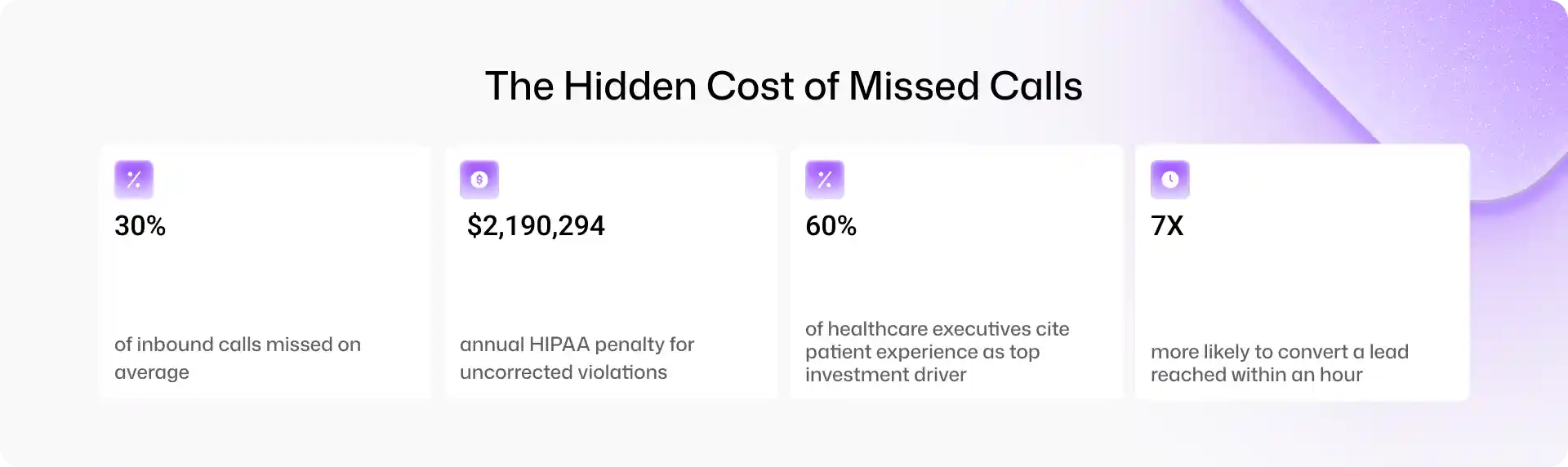
Practices still miss close to 30% of inbound calls on average, even with after-hours coverage in place (Becker's Dental Review, 2026)
Uncorrected willful neglect HIPAA violations can now cost up to $2,190,294 per year, per violation category (HHS, effective January 28, 2026)
60% of healthcare executives say patient experience is the primary reason they are investing in call center technology upgrades (Relatient and Becker's Healthcare survey)
As a result, the real question is not whether a practice needs call coverage. Nearly every practice already has some version of it. The real question is whether that coverage actually books patients, protects data, and holds up against the growing expectations patients bring to every phone call.
AI Receptionist vs. Answering Service: What’s the Difference?
A traditional answering service is a call center staffed by live agents who follow a script written for hundreds of different businesses, not just dental practices. When a call comes in, the agent takes down basic information, such as name, callback number, and a short note, then passes that message along to the practice to handle later. The agent typically has no visibility into the practice's actual schedule.
An AI receptionist is a different kind of system entirely. It is an AI voice agent built specifically for dental practices, not a chatbot and not a phone tree. When a call comes in, it holds a natural conversation, checks real-time availability inside the practice's own scheduling system, whether that is Dentrix, Eaglesoft, Open Dental, or Curve Dental, and books, reschedules, or confirms the appointment directly. No message is left for someone to interpret the next morning.
For a dentist or office manager without a technical background, the simplest way to picture the difference is this: a traditional answering service takes notes on your behalf, while an AI receptionist acts on your behalf. One creates a task for your team to finish later. The other finishes the task while the patient is still on the line.
Benefits of an AI Receptionist for Dental Practices
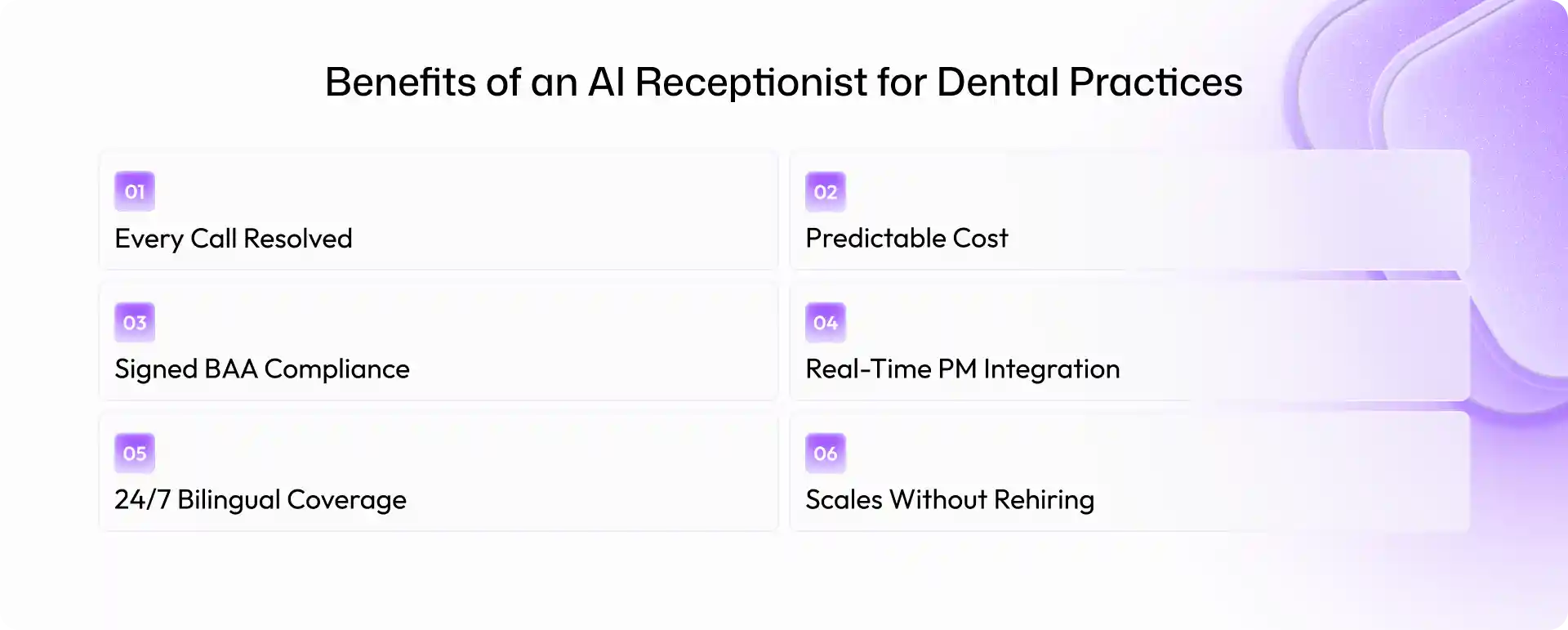
1. Answer and Resolve More Calls, 24/7
An AI receptionist does not simply pick up the phone. It completes the booking, verifies insurance details, and confirms the visit in the same call, which means fewer callbacks and fewer patients who wander off to a competitor while waiting for a message to be returned.
2. Reduce Call Handling Costs With Predictable Pricing
Traditional answering services typically bill per minute or per call, with overage charges, holiday premiums, and bilingual surcharges that can push a modest monthly estimate well past budget. An AI receptionist runs on a flat, predictable subscription that does not spike when call volume does.
3. Documented HIPAA Compliance With a Signed BAA
Alris AI operates under a signed Business Associate Agreement, with encrypted call handling and an audit trail that your practice can produce if OCR ever asks for one. That is a very different starting point than a call center that promises compliance verbally but cannot show the paperwork behind it.
4. Book Appointments Directly From Your Practice Management System
Because the AI receptionist connects directly to Dentrix, Eaglesoft, Open Dental, or Curve Dental, it books against your actual open chairs instead of guessing at availability, which eliminates the double-booking and scheduling conflicts that come with a message-based system.
5. Deliver Consistent 24/7 Support in English and Spanish
Every caller gets the same accurate, on-brand experience at 2 p.m. or 2 a.m., in the language they are most comfortable speaking, instead of a rotating cast of call center agents with varying scripts and varying familiarity with your practice.
6. Scale Call Coverage Without Adding Front-Desk Staff
A traditional answering service still depends on human staff who can turn over, get retrained, and vary in quality from shift to shift. An AI receptionist scales instantly across every location a practice opens, with no onboarding period and no coverage gap while a new hire learns the ropes.
How AI Receptionists Fit Different Dental Practice Models
Solo Dental Practices, San Antonio
A single-dentist office with one front desk coordinator cannot staff a phone line during lunch, cleanings, or after 5 p.m. An AI receptionist absorbs every call the coordinator cannot take, without adding a second salary.
Multi-Location Dental Groups, Austin
A five-location group with a shared call center struggles to keep scripts and scheduling rules consistent across sites. An AI receptionist applies the same standardized workflow everywhere, so a patient calling the Austin office gets the same experience as one calling the Round Rock location.
DSO, Dallas, and Houston
A multi-location DSO managing dozens of practices needs call handling that reports back into a central system for visibility. An AI receptionist logs every call, booking, and outcome centrally, giving operations leaders real data instead of anecdotes from individual front desks.
What to Look for When Choosing a Dental Answering Solution
Before switching from a traditional answering service, or before signing with one in the first place, practices should ask vendors a few direct questions.
Will the vendor sign a Business Associate Agreement, and can they produce documentation of their security practices, not just a verbal assurance?
Does the system integrate directly with Dentrix, Eaglesoft, Open Dental, or Curve Dental, or does it only take messages that a staff member has to enter manually?
Practices should also ask how the system handles a true dental emergency versus a routine booking request, and whether calls are escalated to a live team member when needed. Finally, ask for a transparent, all-in monthly cost, since hidden per-minute overages and holiday surcharges are exactly what make traditional answering service bills unpredictable.
The Future of AI-Powered Dental Call Handling
Over the next 12 to 18 months, expect three shifts to reshape this comparison further.
1. More state dental boards and payers will expect documented HIPAA safeguards from any vendor touching patient calls, which will make undocumented traditional answering services harder to justify.
2. AI receptionists will deepen their integrations with insurance verification and revenue cycle tools, closing the loop between the first phone call and the finished claim.
3. Patient expectations for instant, 24/7 responses will keep climbing, making any system that still relies on next-business-day callbacks feel increasingly out of step with how patients already behave.
Conclusion
The AI receptionist vs answering service decision comes down to a simple distinction: one system takes a message, and the other finishes the job. Traditional answering services solved the coverage problem of a previous era, but they were never built to book appointments, verify insurance, or meet the compliance bar patients and regulators now expect. Dental AI receptionists close every one of those gaps while keeping costs predictable. As patient expectations and compliance requirements keep rising through 2026 and beyond, the practices that make the switch now will be the ones that stop losing patients to whichever competitor answers the phone first.
Frequently Asked Questions (FAQs)
1. Is an AI receptionist more expensive than a traditional answering service?
Usually not. Traditional answering services often bill per minute or per call, with overage charges, holiday premiums, and bilingual surcharges that inflate the advertised price. AI receptionists typically run on a flat monthly subscription, which makes budgeting easier and avoids the surprise charges common with call center billing models.
2. Can a traditional answering service book appointments directly into my schedule?
Most cannot. Traditional answering services take a message and pass it along, requiring a staff member to call the patient back and manually enter the appointment. An AI receptionist connects directly to your practice management system and books the visit in real time, during the original call.
3. Are traditional answering services HIPAA-compliant?
Some are, but not all, and a claim of compliance is not the same as a signed Business Associate Agreement and documented safeguards. Practices should always ask for that documentation before sending any vendor patient information, whether the vendor is a traditional call center or an AI system.
4. Does an AI receptionist replace my front desk staff?
No. An AI receptionist absorbs overflow calls, after-hours calls, and routine scheduling requests, which frees your front desk team to focus on patients who are physically in the office instead of juggling a ringing phone at the same time.
5. Can an AI receptionist handle a real dental emergency?
Yes. A well-built AI receptionist is trained to recognize urgent symptoms and escalate the call to a live team member immediately, rather than treating an emergency the same way it treats a routine cleaning request.
6. Does an AI receptionist support Spanish-speaking patients?
Yes. Alris AI answers calls in English or Spanish based on how the caller speaks, which matters significantly in Texas markets like San Antonio and El Paso, where a large share of patients prefer to communicate in Spanish.
7. How long does it take to switch from an answering service to an AI receptionist?
Most practices can transition within a few weeks, since the setup mainly involves connecting the AI receptionist to your existing practice management system and confirming scheduling rules, rather than rebuilding your phone workflow from scratch.
Sources & References:
Becker's Dental Review. "AI in dental operations: How practices are reducing missed calls." 2026.
HIPAA Journal. "HIPAA Violation Fines: Updated for 2026."
Relatient. "From Healthcare Call Centers to Smart Access Hub: Survey Insights on Access and AI."
Harvard Business Review. "The Short Life of Online Sales Leads." 2011.
American Dental Association Health Policy Institute. "Dental Hygienist Shortage." 2024-2026.
MGMA. "Stabilized but not solved: Staff turnover in medical practices looking no better, no worse in 2026."
Shravan Rajpurohit
CEO & Co-Founder
Shravan Rajpurohit is the Co-Founder & CEO of The Intellify, a leading Custom Software Development company that empowers startups, product development teams, and Fortune 500 companies. With over 10 years of experience in marketing, sales, and customer success, Shravan has been driving digital innovation since 2018, leading a team of 50+ creative professionals. His mission is to bridge the gap between business ideas and reality through advanced tech solutions, aiming to make The Intellify a global leader. He focuses on delivering excellence, solving real-world problems, and pushing the limits of digital transformation.

Stay Updated
with AI Insights
Get the latest articles on AI, automation, and enterprise technology delivered to your inbox weekly.

500+ people have already subsribed!
No spam. Unsubscribe anytime.