
AI Reservation System vs Traditional Booking Software: Key Differences



Summary: AI reservation systems and traditional booking software serve different but complementary purposes. While booking software organizes reservations and table availability, AI can help restaurants answer phone calls, handle guest inquiries, and manage reservation requests. This guide compares their features, costs, integrations, and use cases to help US restaurant owners decide which solution best fits their operations.
Restaurant reservations may look simple from the guest's side. A customer calls, asks for a table, and expects a quick answer. But behind the scenes, restaurant staff are juggling walk-ins, online bookings, order questions, cancellations, and guests who want to change their plans at the last minute.
Traditional booking software helps organize reservations. AI reservation systems can add another layer by handling guest conversations, especially over the phone. The two are not always competing solutions, though. In many restaurants, they can work together.
So, what's the difference between an AI reservation system and traditional booking software? And which option makes more sense for your restaurant? Let's break it down.
What Is an AI Reservation System?
An AI reservation system uses artificial intelligence to help restaurants manage booking-related tasks and guest interactions. Depending on the solution, it may answer phone calls, respond to common questions, collect reservation details, manage booking requests, and help guests make changes.
For restaurants in the United States, this can be useful during busy dinner services, weekends, holidays, or after closing time. Instead of relying entirely on an employee to answer every call, an AI-powered voice agent can handle supported requests automatically.
However, not every AI reservation system works the same way. Some can connect directly to a restaurant's booking platform and create reservations. Others collect guest details or reservation requests that staff must confirm later.
Key Features of an AI Reservation System
Common features may include:
AI phone answering: Answers incoming calls and handles routine guest questions.
Reservation assistance: Collects the date, time, party size, and other booking details.
Cancellation and modification support: Helps process changes when the system has the necessary permissions and integrations.
After-hours call handling: Answers calls outside normal business hours.
Guest inquiry management: Provides information about opening hours, location, parking, and other frequently asked questions.
Integration with existing systems: Connects with supported reservation platforms or other restaurant tools.
The exact capabilities depend on the provider and its integrations. Restaurants should check which tasks the system can complete independently and which still require staff involvement.
How AI Handles Restaurant Phone Reservations
Imagine a customer calls a restaurant in Chicago at 9:30 p.m. The dining room is closed, but the customer wants to book a table for four on Saturday.
An AI voice agent can answer the call, ask about the preferred time, collect the necessary details, and check availability if connected to a compatible reservation platform. If the requested time is unavailable, it may offer another available option.
Once the customer confirms, the system can complete the booking if its integration supports direct reservations. Otherwise, it can record the request for the restaurant team to review.
This matters because phone calls don't always happen at convenient times. A host may be helping guests at the front desk or carrying out several tasks at once. An AI agent can handle supported calls without requiring an employee to step away from those responsibilities.
What Is Traditional Booking Software?
Traditional booking software helps restaurants organize reservations through a digital platform. It typically allows guests to book tables online and gives restaurant staff a place to view, manage, and update those bookings.
Many established platforms also support table management, guest profiles, waitlists, reminders, and connections with other restaurant tools. Their exact features vary by provider and subscription plan.
For example, a restaurant in New York might use booking software to display available time slots on its website. Guests can select a date, choose a party size, and reserve a table without calling the restaurant.
The booking appears in the restaurant's system, allowing staff to plan seating and manage availability.
Traditional software remains useful because it provides structure and visibility. The main limitation is that managing a reservation digitally is not the same as answering every guest question or handling a phone conversation.
Key Features of Traditional Booking Software
Depending on the platform, traditional booking software may include:
Online reservations: Guests book tables through a website or booking interface.
Table management: Staff organize seating, availability, and reservation schedules.
Guest information: The system stores booking details and may maintain guest profiles.
Booking notifications: Automated confirmations and reminders help guests keep track of reservations.
Waitlist management: Staff can manage guests waiting for a table.
Reporting: Some platforms provide information about booking patterns and restaurant activity.
These features help restaurants manage reservations more consistently. They can also reduce the need for handwritten lists, spreadsheets, or separate records.
Where Traditional Systems Have Limitations
The limitations depend on how the restaurant uses its software. Many platforms already offer automation, online booking, and integrations. It's not accurate to assume that every traditional system is entirely manual.
However, some gaps remain.
A customer who wants to make a reservation by phone still needs someone or a separate automated service to answer the call. If staff are busy, the call may go unanswered. If the restaurant is closed, the customer may need to call again later.
Online booking can solve part of this problem, but not every guest wants to use a website. Some have questions about large parties, dietary accommodations, accessibility, or special occasions before they book.
Traditional booking software can manage the reservation once it's entered. Handling the conversation that leads to the reservation may require additional tools or staff support.
AI Reservation System vs Traditional Booking Software: Key Differences
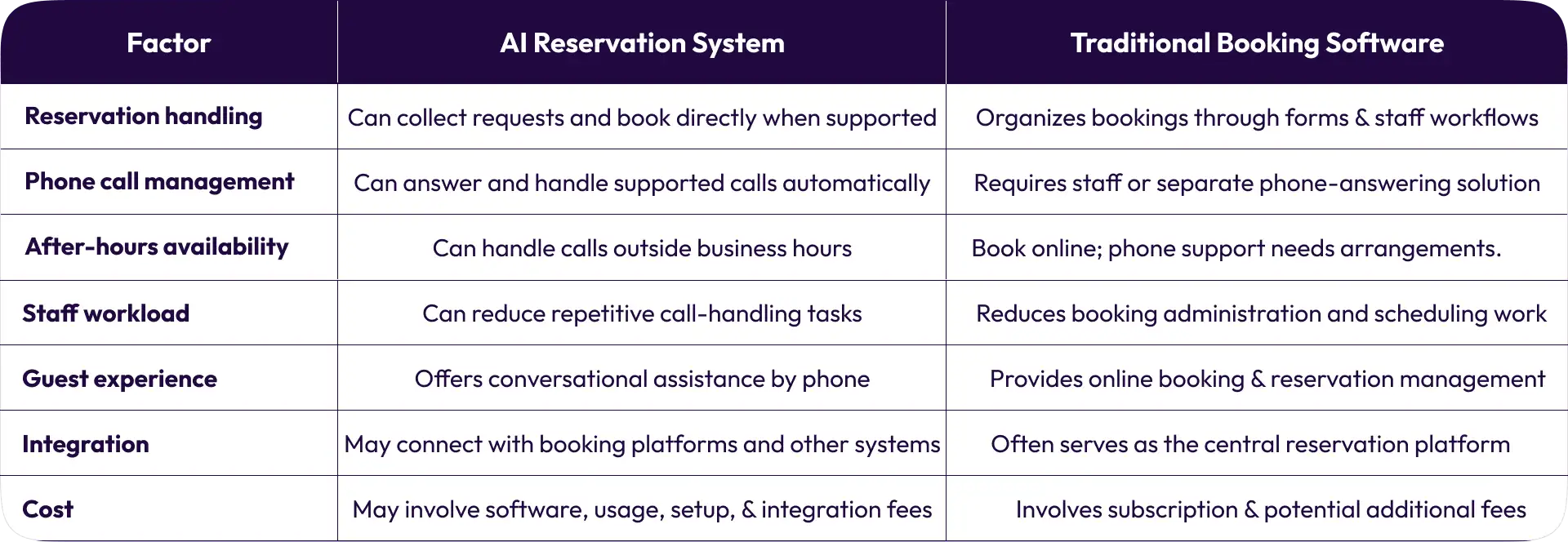
The biggest difference is how each solution handles guest interactions and reservation workflows. Traditional booking software primarily organizes bookings, while an AI reservation system can add conversational assistance and automate certain tasks.
Here's how the two compare.
1. Reservation Handling
Traditional booking software gives guests a way to reserve a table and allows staff to manage availability. An AI system can help collect booking details through a conversation and, where supported, complete the reservation. The distinction is particularly useful for customers who prefer calling rather than navigating an online booking form.
2. Phone Call Management
This is one of the clearest differences. An AI voice agent can answer incoming calls and respond to supported questions without requiring an employee to pick up every time.
Traditional booking software may not include this capability. A restaurant might need to rely on its front-of-house team, a separate phone service, or an additional integration.
3. After-Hours Availability
Online booking systems can accept reservations when the restaurant is closed. But customers who want to speak with someone may still encounter a problem.
An AI phone agent can provide another option by answering calls after hours. Whether it can confirm a reservation immediately depends on its access to current availability and the restaurant's booking system.
4. Staff Workload
Both options can reduce administrative work, but they address different tasks. Booking software organizes reservation records and schedules. AI phone handling can reduce interruptions caused by routine questions, availability checks, and booking requests.
For a busy restaurant, fewer interruptions can help staff focus on guests who are already in the dining room.
5. Cost and Integration
Traditional booking software and AI solutions have different pricing structures. Restaurants should compare subscription fees, call usage charges, setup costs, integration fees, and any additional costs associated with their existing systems.
The cheapest option isn't always the most practical. A restaurant receiving frequent unanswered calls may value phone automation differently from a small operation that receives most bookings online.
Can AI Work With Existing Restaurant Booking Software?
Yes, in many cases. A restaurant may be able to add an AI phone agent without replacing its existing reservation platform.
This approach can be practical for US restaurants that already use booking software for online reservations, table management, and guest records. Instead of rebuilding the entire workflow, the restaurant adds a tool that helps manage incoming calls.
For example, a restaurant using an established reservation platform could connect an AI agent to answer phone calls and check available booking slots. Guests could then make reservations by phone while the restaurant continues using its existing system.
The important question is whether the specific AI solution supports the restaurant's current platform.
Connecting AI Phone Agents With Reservation Platforms
An integration may allow an AI agent to retrieve availability, create bookings, update reservation details, or process cancellations. The supported actions depend on the platform's APIs, permissions, and the AI provider's implementation.
If direct integration isn't available, the AI agent might only collect details and forward requests to staff. That's still potentially useful, but it offers a different level of automation.
Before choosing a solution, restaurants should confirm that reservation data stays synchronized and that the system avoids duplicate bookings or outdated availability information.
What Restaurants Should Check Before Integrating AI
A few checks can prevent problems later:
Platform compatibility: Confirm that the AI provider supports your current booking software.
Booking permissions: Find out whether the agent can create, change, and cancel reservations or only collect requests.
Availability accuracy: Make sure the integration uses current reservation data.
Escalation options: Determine how unusual requests or technical issues are transferred to staff.
Data handling: Review how guest information is stored, accessed, and protected.
Testing: Run realistic booking scenarios before making the system available to customers.
Integration should make the reservation process more reliable, not introduce another disconnected tool for staff to manage.
When Should a Restaurant Choose AI Reservation Software?
AI reservation software can be worth considering when phone calls create a recurring operational problem. The goal isn't to automate every interaction. It's to identify tasks that take staff away from higher-priority work and determine whether AI can handle them reliably.
Restaurants with frequent incoming calls, evening inquiries, or limited front-of-house coverage may have a stronger reason to explore it.
Best Fit for Small and Independent Restaurants
Small restaurants often operate with limited staff. During lunch or dinner service, the same employee may greet guests, manage tables, answer questions, and handle takeout inquiries.
Every phone call competes for that person's attention.
A voice AI solution can help answer routine questions and handle supported reservation requests while staff focus on the dining room. It may also help restaurants respond to calls outside their normal business hours.
For an independent restaurant, the decision should come down to actual need. If the restaurant receives only a few calls each day and most reservations happen online, adding AI may not provide enough value. If missed calls are common, the calculation could look different.
Best Fit for Busy and Multi-Location Restaurants
Restaurants with high call volumes or multiple locations face a different challenge. Guests may ask about different locations, operating hours, reservation policies, or available seating.
AI can help standardize routine responses and manage supported requests across locations, provided it has access to the right information and permissions.
However, multi-location operators should check how the system handles location-specific booking rules, menus, hours, and availability. A single incorrect answer can create confusion for both guests and staff.
The best fit is a restaurant where call volume, missed inquiries, or repetitive questions create a measurable operational burden.
How to Choose the Right Reservation Solution for Your Restaurant
Before investing in new technology, look at how your restaurant currently handles reservations. Start with the problem, then compare solutions. That approach is more useful than choosing a product simply because it includes AI.
Check Your Reservation and Call Volume
Review how many reservations come through your website, booking platform, and phone. Look at when calls arrive and how often staff cannot answer them.
Ask a few practical questions:
How many calls go unanswered during busy service periods?
Do guests regularly call after closing time?
How much time do employees spend answering repetitive questions?
Do customers frequently call to change or cancel reservations?
Are phone inquiries creating delays for guests in the restaurant?
These answers can help you determine whether conventional booking software is sufficient or whether phone automation could address a genuine gap.
Compare Integration, Reliability, and Total Cost
Once you've identified the need, compare the options based on what they can actually do.
Check compatibility with your reservation platform, the accuracy of availability information, the process for transferring calls to staff, and the support available when something goes wrong.
Also consider the total cost of ownership. Include subscription fees, call usage, implementation, integrations, and ongoing maintenance where applicable.
If possible, test the solution with realistic calls before committing. Check whether it understands different accents, handles background noise, responds appropriately to unusual requests, and clearly communicates when it cannot complete a task.
The right system should fit your restaurant's workflow and make booking easier for guests. More automation isn't automatically better.
Final Thoughts
Traditional booking software remains useful for managing reservations, tables, and guest information. An AI reservation system adds another capability by helping restaurants handle phone calls and booking-related conversations.
For US restaurants, the choice depends on where the biggest gaps are. If online bookings work well and phone calls are manageable, existing software may be enough. If staff regularly miss calls or spend too much time answering routine questions, AI phone handling may be worth exploring.
Alris AI helps restaurants explore AI-powered phone support for guest inquiries and reservation-related tasks. If your team is struggling to keep up with calls, take a closer look at how Alris AI could fit into your current workflow without requiring an unnecessary overhaul.
Frequently Asked Questions (FAQs)
1. What Is the Difference Between an AI Reservation System and Booking Software?
Traditional booking software manages reservation schedules, table availability, and guest records. An AI reservation system can add conversational assistance, including answering calls and handling booking requests. Some AI solutions integrate directly with booking platforms, allowing them to manage reservations as well.
2. Can AI Make Restaurant Reservations Over the Phone?
Yes, if the AI system supports phone reservations and has access to the required booking functionality. It can collect guest details, check availability, and confirm a booking when properly integrated. Some systems only collect requests for staff to review.
3. Can AI Reservation Systems Work With Existing Booking Platforms?
Many can, but compatibility varies. Restaurants should confirm whether the AI provider supports their current platform and which actions the integration allows, such as checking availability, creating reservations, or processing cancellations.
4. Does AI Reservation Software Replace Restaurant Staff?
No, it doesn't have to. AI can handle supported, repetitive tasks while employees focus on hospitality, complex requests, and in-person service. Staff may still need to review unusual bookings, resolve issues, and manage situations that require human judgment.
Shravan Rajpurohit
CEO & Co-Founder
Shravan Rajpurohit is the Co-Founder & CEO of The Intellify, a leading Custom Software Development company that empowers startups, product development teams, and Fortune 500 companies. With over 10 years of experience in marketing, sales, and customer success, Shravan has been driving digital innovation since 2018, leading a team of 50+ creative professionals. His mission is to bridge the gap between business ideas and reality through advanced tech solutions, aiming to make The Intellify a global leader. He focuses on delivering excellence, solving real-world problems, and pushing the limits of digital transformation.

Stay Updated
with AI Insights
Get the latest articles on AI, automation, and enterprise technology delivered to your inbox weekly.

500+ people have already subsribed!
No spam. Unsubscribe anytime.