
How AI Voice Agents Help Hospitals Reduce Missed Patient Calls



In hospitals and healthcare clinics, every patient call matters. Sometimes it’s a patient trying to book an appointment, while other times it could be someone needing urgent medical guidance or follow-up support. But with rising call volumes and limited front-desk staff, many healthcare providers struggle to answer every call on time.
This is where an AI voice agent can make a real difference.
Today, hospitals are using AI-powered voice systems to handle patient calls automatically, reduce wait times, and improve patient communication without increasing staff workload. These systems are helping healthcare providers ensure that no patient feels ignored or disconnected.<br>In this blog, we’ll explore how AI voice agents in hospitals are transforming patient communication, reducing missed calls, and improving overall operational efficiency.
The Problem: Why Hospitals Miss Patient Calls
Many hospitals deal with hundreds or even thousands of incoming calls every day. Managing all these calls manually is difficult, especially during busy hours. Some of the most common reasons hospitals miss patient calls include:
High Call Volumes and Limited Staff
Front-desk teams often handle appointments, walk-in patients, billing questions, and administrative work at the same time. When call volumes suddenly increase, it becomes impossible to answer every call quickly.
Delays During Peak Hours
Morning hours, lunch breaks, and post-clinic timings usually create heavy call traffic. Patients are often placed on hold for long periods, which leads many to disconnect before speaking to someone.
After-Hours Gaps in Availability
Most hospitals cannot keep large support teams available 24/7. Calls that come in during evenings, weekends, or holidays may go unanswered.
Patients Dropping Off Due to Long Wait Times
People today expect fast responses. If they wait too long, many patients simply hang up and contact another healthcare provider instead.
The Impact of Missed Patient Calls on Hospitals and Patients
Missed calls may seem like a small operational issue, but over time, they can create major problems for both hospitals and patients.
Patients Choosing Other Providers
When patients cannot connect easily, they often move to another clinic or hospital that responds faster. This directly affects patient acquisition and retention.
Missed Appointments and Revenue Loss
Unanswered calls can lead to unbooked appointments, missed follow-ups, and empty consultation slots. Over time, this impacts hospital revenue.
Delays in Care and Follow-Ups
Patients may postpone treatment simply because they couldn’t reach the hospital. Follow-up care can also be delayed if communication is weak.
Poor Patient Experience and Trust Issues
Long hold times and unanswered calls create frustration. Patients may feel the hospital is unresponsive or difficult to access.
What Happens When Patient Calls Go Unanswered
The effects of missed calls usually go beyond communication problems.
Patients may switch to competing healthcare providers
Delays in treatment or follow-up care become more common
Administrative teams spend extra time returning missed calls
Staff productivity decreases due to repeated interruptions
Patient trust slowly weakens over time
In many hospitals, these issues continue to grow as patient demand increases.
What Is an AI Voice Agent?
An AI voice agent for healthcare is an intelligent voice-based system that can answer and manage patient phone calls automatically.
Unlike traditional phone menus or IVR systems, modern AI voice agents understand natural conversations and respond in a more human-like way. Instead of pressing multiple buttons, patients can simply speak naturally.
For example:
“I want to book an appointment with a cardiologist tomorrow.”
The AI system understands the request, checks availability, and helps complete the booking. In simple words, it works like a virtual receptionist that can handle patient conversations over the phone.
How AI Voice Agents Handle Patient Calls
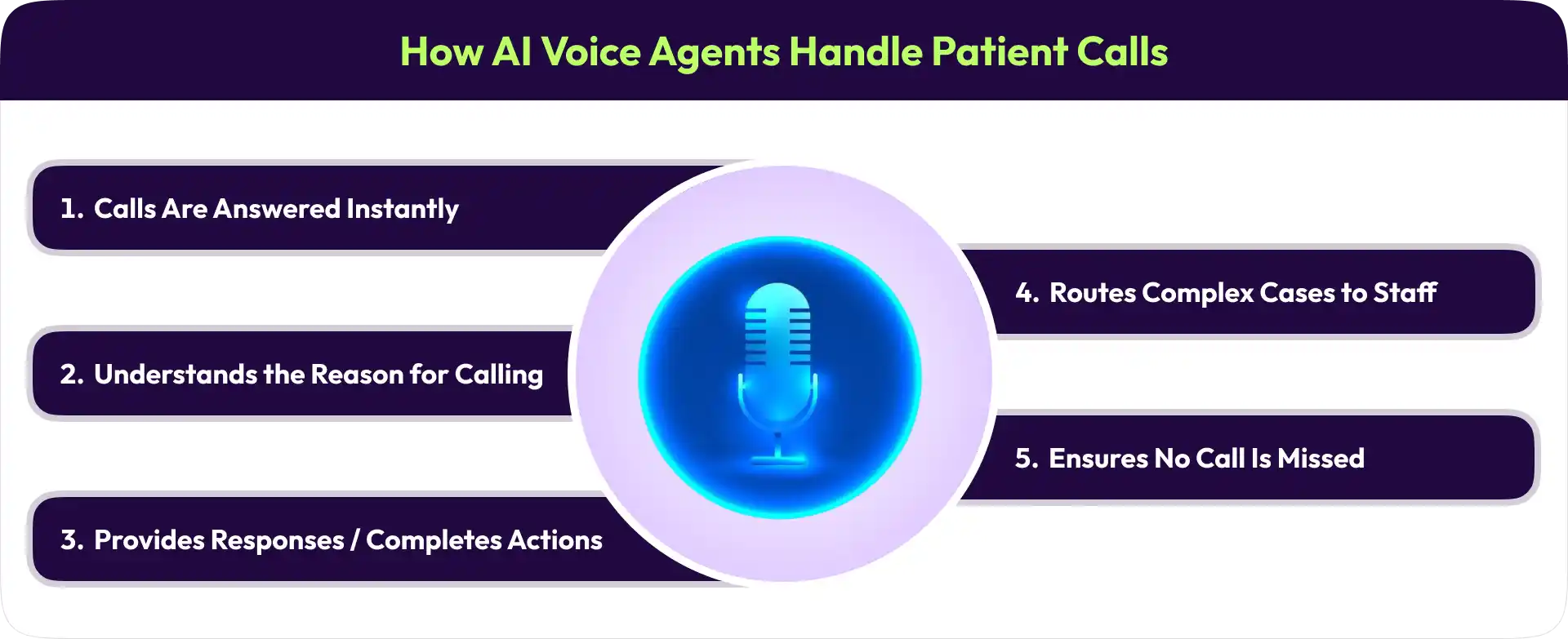
Modern voice AI for healthcare systems is designed to manage the complete patient call journey.
Calls Are Answered Instantly
AI voice agents respond immediately without making patients wait on hold.
Understands the Reason for Calling
The system can identify patient intent, whether it’s:
Appointment booking
Appointment rescheduling
Billing questions
Insurance queries
Prescription follow-ups
General hospital information
Provides Responses or Completes Actions
The AI can complete actions like:
Booking appointments
Sending confirmations
Sharing clinic timings
Providing doctor availability
Sending reminders
Routes Complex Cases to Staff
If the situation requires human support, the call can be transferred to the right department.
Ensures No Call Is Missed
Since AI systems can manage multiple calls together, patients are less likely to face busy lines or unanswered calls.
How AI Voice Agents Help Reduce Missed Calls
The biggest advantage of using an AI voice agent is that hospitals no longer depend only on human staff to manage every incoming call.
Handles Every Incoming Call Without Delay
AI systems answer calls instantly, even during busy hours.
Manages Multiple Calls at Once
Unlike human operators, AI voice agents can handle many patient calls simultaneously.
Works 24/7, Including After Hours
Patients can book appointments or ask questions anytime, even outside regular working hours.
Reduces Overload During Peak Times
During high-traffic periods, AI systems reduce pressure on reception and support teams.
Minimizes Call Drop-Offs
Patients are less likely to disconnect because they receive immediate assistance.
Ensures Follow-Ups if Calls Disconnect
If a call ends unexpectedly, the system can trigger callbacks, reminders, or follow-up workflows.
Captures Caller Information Automatically
Patient details, call reasons, and appointment requests can be stored for better follow-up and reporting.
Reducing Staff Workload While Maintaining Service Quality
One major reason hospitals are adopting hospital call automation is to reduce administrative pressure without lowering service quality.
Automates Repetitive Tasks
Tasks like appointment confirmations, reminder calls, and basic FAQs can be fully automated.
Reduces Call Burden on Front-Desk Teams
Staff members no longer spend most of their time answering repetitive patient questions.
Allows Staff to Focus on Patient Care
Instead of constantly managing phone calls, healthcare teams can focus more on in-person patient support.
Improves Efficiency Without Hiring Extra Staff
Hospitals can manage growing call volumes without significantly increasing operational costs.
Reduces Interruptions During In-Person Interactions
Reception staff can provide better patient attention without constant phone interruptions.
Improving Patient Experience and Accessibility
Better communication directly improves patient satisfaction.
Faster Response Times: Patients receive immediate assistance instead of waiting in long queues.
No Long Hold Queues: AI systems reduce frustration caused by extended waiting times.
Easy AI Appointment Booking: Patients can easily schedule, cancel, or reschedule appointments through voice conversations.
Consistent Communication: Every patient receives the same level of support and information accuracy.
Support Beyond Working Hours: Patients can access hospital services anytime, including nights and weekends.
Reduces Frustration From Unanswered Calls: Patients feel heard and supported, which improves overall trust.
Common Use Cases of AI Voice Agents in Hospitals
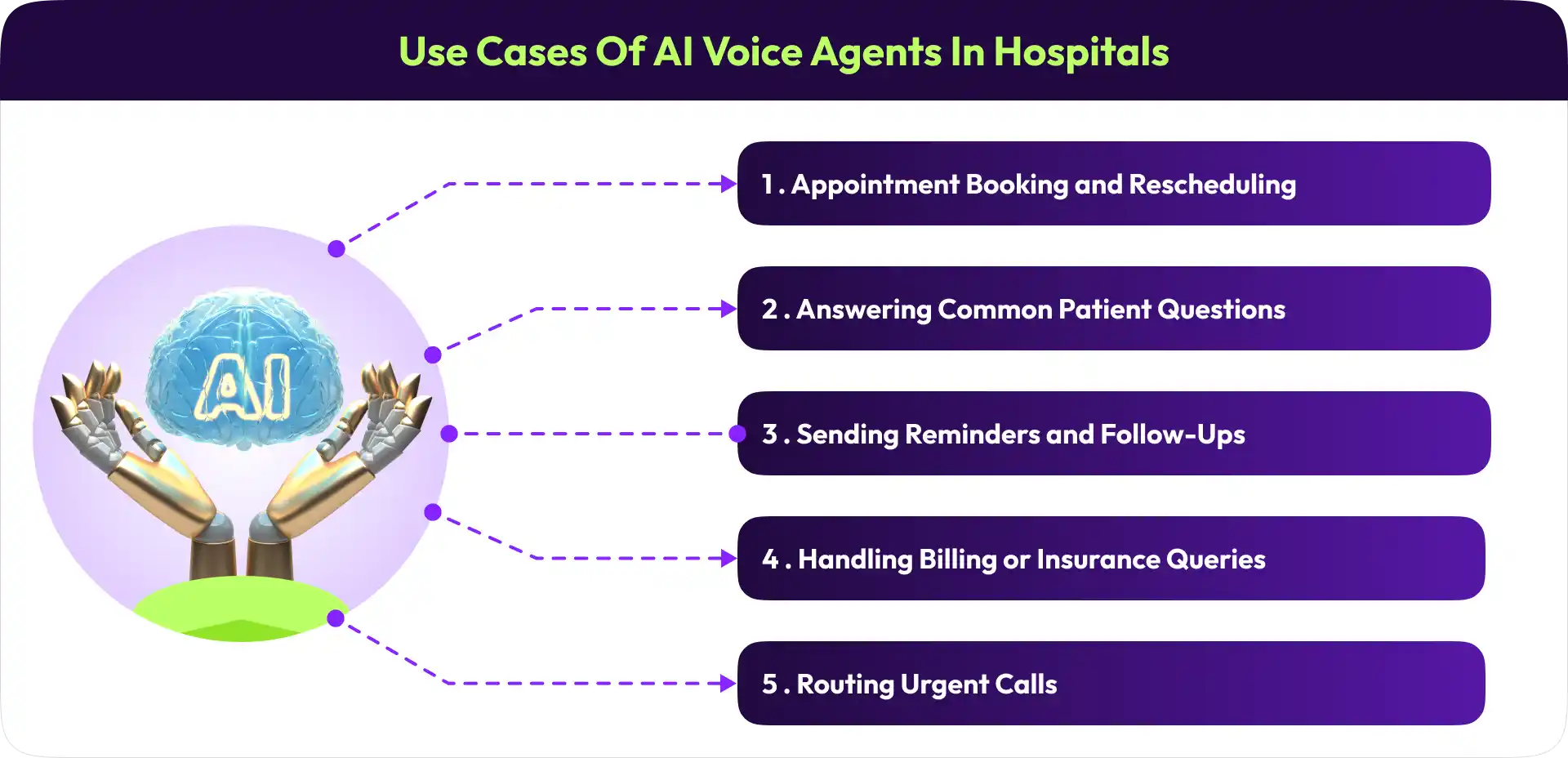
Hospitals are using AI voice agents across multiple departments and workflows.
Appointment Booking and Rescheduling
AI systems can manage the complete appointment scheduling process automatically.
Answering Common Patient Questions
Patients can quickly get answers related to:
Doctor availability
Hospital timings
Test preparation instructions
Department information
Sending Reminders and Follow-Ups
AI can automatically remind patients about:
Upcoming appointments
Medication schedules
Follow-up consultations
Handling Billing or Insurance Queries
Basic billing support and insurance guidance can be managed through voice automation.
Routing Urgent Calls
Emergency or high-priority calls can be transferred immediately to the right medical staff.
How Hospitals Can Start Automating Call Handling
Hospitals do not need to automate everything at once. A phased approach works best.
Identify High-Volume Call Areas: Start with departments that receive the highest number of patient calls.
Define Patient Interaction Workflows: Understand the most common reasons patients contact the hospital.
Integrate With Existing Hospital Systems: AI voice agents should connect with appointment scheduling and patient management systems.
Start Small and Scale Gradually: Many hospitals begin with appointment booking automation before expanding to other workflows.
Track Performance and Improve: Monitor call resolution rates, patient satisfaction, and missed call reductions regularly.
Why Hospitals Are Moving Toward AI-Based Call Handling
The healthcare industry is rapidly changing, and patient expectations are evolving too.
Patients Expect Faster Communication
People now expect quick responses similar to other digital services they use daily.
Call Volumes Continue to Increase
Growing patient demand makes manual call handling harder every year.
Manual Systems Are No Longer Efficient
Traditional reception workflows struggle to scale efficiently.
Voice AI Is More Accurate and Reliable
Modern AI systems understand natural speech far better than older IVR technology.
Hospitals Need Better Patient Access
Healthcare providers want to improve accessibility without dramatically increasing staffing costs.
Consistent and Error-Free Communication Matters
AI reduces human errors in repetitive communication tasks.
What to Consider When Choosing an AI Voice Agent Solution
Not every AI solution is designed for healthcare environments. Here are a few important things hospitals should evaluate before implementation:
Accuracy in Understanding Patient Queries
The system should understand different accents, speaking styles, and healthcare-related requests accurately.
Multi-Language Support
Hospitals serving diverse communities should look for multilingual voice support.
Integration With Existing Systems
The solution should work smoothly with hospital scheduling and CRM systems.
Data Privacy and Compliance
Healthcare communication must follow privacy and security regulations.
Flexibility and Scalability
The system should grow as patient demand increases.
Choosing the Right AI Voice Agent Partner for Your Hospital
Implementing an AI solution is not only about automation. It’s about improving patient communication in a way that feels natural and reliable. The right technology partner should:
Understand healthcare-specific workflows
Build voice systems that sound conversational, not robotic
Support easy deployment and training
Offer scalable solutions for growing hospitals
Focus on improving patient access and operational efficiency
A good AI voice agent for healthcare should help hospitals reduce missed calls while still keeping the patient experience personal and supportive.

Conclusion: From Missed Calls to Better Patient Access
Missed patient calls are one of the most common communication challenges hospitals face today. But they are also one of the easiest problems to improve with the right technology. An AI voice agent helps hospitals answer every call, reduce patient wait times, automate appointment booking, and improve communication quality without overloading staff.
As patient expectations continue to rise, hospitals need smarter systems that can provide fast, reliable, and accessible communication around the clock. With the right AI voice solution in place, healthcare providers can move from missed calls and frustrated patients to a smoother, more connected patient experience.
Frequently Asked Questions (FAQs)
1. Can AI voice agents handle multiple patient calls at the same time?
Yes, they can handle multiple calls simultaneously without delays. This ensures every patient call is answered, even during peak hours when call volume is high.
2. How is an AI voice agent different from a traditional IVR system?
IVR systems follow fixed menus, while AI voice agents understand natural speech and respond accordingly. This makes conversations faster, smoother, and less frustrating for patients.
3. Do AI voice agents completely replace hospital front-desk staff?
No, they are designed to support staff, not replace them. They handle routine calls so teams can focus on patients who need direct attention.
4. Can AI voice agents book and manage patient appointments directly?
Yes, they can schedule, reschedule, and confirm appointments in real time. This reduces manual work and helps avoid missed bookings.
5. What happens if a patient has a complex or urgent query?
The system can identify such cases and transfer the call to the right department or staff member. This ensures patients still receive proper and timely support.
6. Are AI voice agents available outside hospital working hours?
Yes, they are available 24/7, including nights and weekends. Patients can reach out anytime without depending on staff availability.
7. How do AI voice agents help reduce missed patient calls?
They answer every call instantly and manage high volumes without overload. This prevents missed calls and ensures no patient is left waiting.
8. Can AI voice agents handle different languages for patients?
Many AI voice agents support multiple languages, making communication easier for diverse patient groups. This improves accessibility and overall patient experience.
9. Is patient data safe when using AI voice agents?
Yes, trusted solutions follow strict data security and healthcare compliance standards. Patient information is handled securely and responsibly.
Shravan Rajpurohit
CEO & Co-Founder
Shravan Rajpurohit is the Co-Founder & CEO of The Intellify, a leading Custom Software Development company that empowers startups, product development teams, and Fortune 500 companies. With over 10 years of experience in marketing, sales, and customer success, Shravan has been driving digital innovation since 2018, leading a team of 50+ creative professionals. His mission is to bridge the gap between business ideas and reality through advanced tech solutions, aiming to make The Intellify a global leader. He focuses on delivering excellence, solving real-world problems, and pushing the limits of digital transformation.

Stay Updated
with AI Insights
Get the latest articles on AI, automation, and enterprise technology delivered to your inbox weekly.

500+ people have already subsribed!
No spam. Unsubscribe anytime.