
How AI Voice Agent Supports High Volume Call Handling



The Growing Pressure of High Call Volumes
If you’ve ever called customer support and waited while listening to hold music, you already know how frustrating it feels. A recorded voice keeps saying, “Your call is important to us,” but nothing seems to move faster.
Now, imagine running that business. Phones are ringing nonstop. Agents are stretched thin. Customers are getting impatient. Somewhere in the middle, genuine opportunities are slipping away. This situation is becoming common across industries. Healthcare providers, online stores, banks, SaaS companies, and service businesses all face growing call volumes. Customers today expect fast, clear answers. They don’t want to wait. They don’t want to repeat themselves. And they don’t want excuses.
AI voice agents are helping businesses deal with this pressure. They answer calls instantly, manage high traffic, and support teams without increasing stress. They work quietly in the background, keeping things moving even during peak hours. In this blog, we’ll explore how AI voice agents support high-volume call handling in practical, real-world ways.
What Is an AI Voice Agent?
An AI voice agent is a system that can speak with callers using artificial intelligence. Unlike old automated phone menus, it doesn’t rely on fixed buttons or recorded responses. Instead, it listens to what the caller says, understands the meaning, and replies naturally. Behind the scenes, it uses technologies like speech recognition and language processing. But for customers, it feels like speaking to a trained support representative.
For example, instead of asking callers to press numbers, the AI allows them to speak freely. A customer can say, “I want to check my invoice,” and the system understands and responds. This makes conversations faster, simpler, and less stressful.
Why High Volume Call Handling Is So Difficult Today
Managing a large number of calls may sound straightforward, but in practice, it creates several challenges.
Long Wait Times
During busy periods, calls build up quickly. Morning hours, promotions, emergencies, and seasonal demand can overwhelm even experienced teams. When customers wait too long, many hang up and never call back.
Missed Revenue Opportunities
Every unanswered call may represent a lost sale, missed appointment, or unhappy customer. Over time, these small losses add up and affect business growth.
Agent Burnout
Support agents often handle the same questions repeatedly. Over time, this becomes exhausting. Fatigue leads to mistakes, low morale, and higher staff turnover.
Limited Scalability
Hiring and training new agents takes time. But call volumes can increase overnight. Most businesses cannot scale their teams fast enough to match sudden demand.
These challenges create a gap between what customers expect and what businesses can deliver. AI voice agents help close that gap.
How AI Voice Agent support high-volume calls?
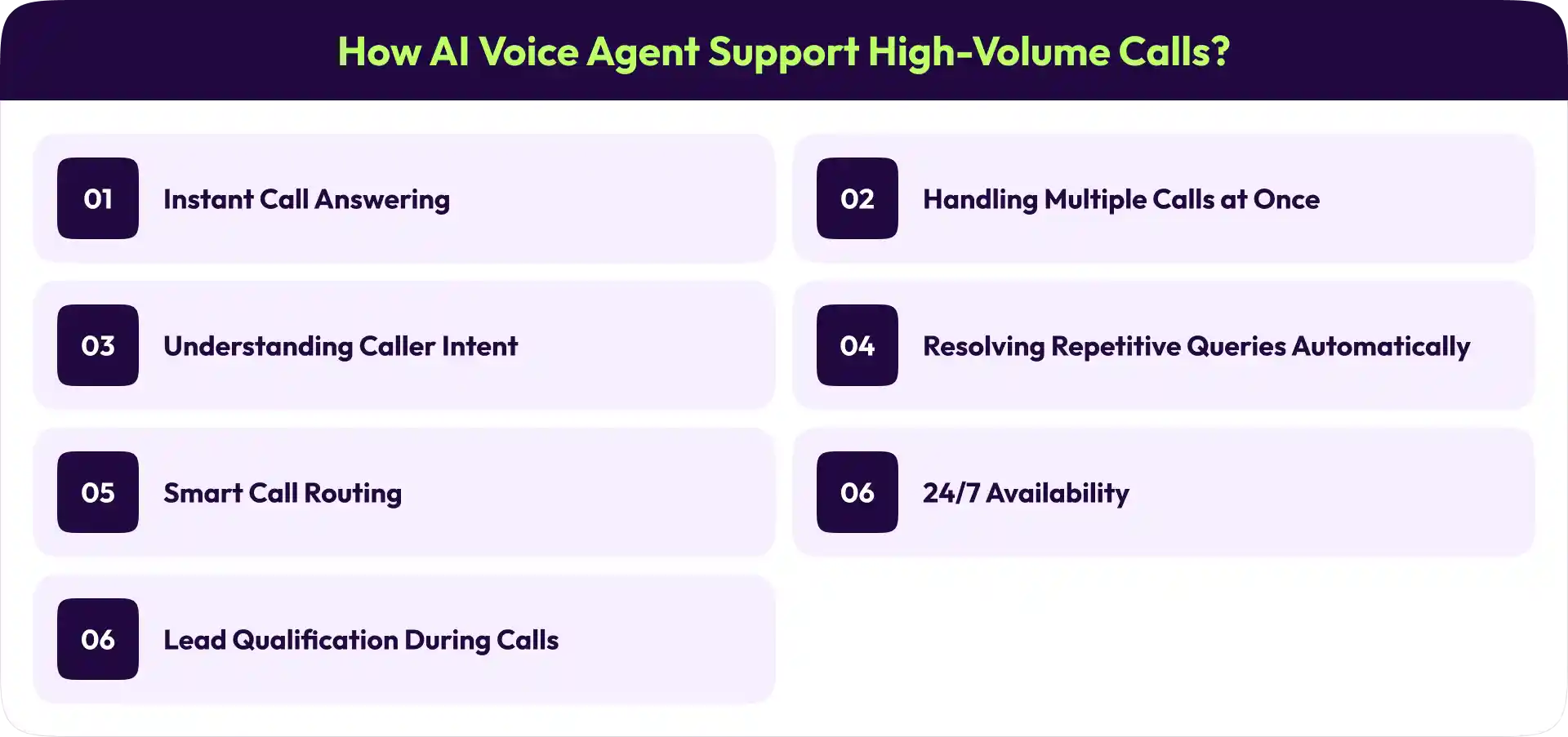
AI voice agents support high call volumes in several practical ways.
1. Instant Call Answering
AI systems answer calls immediately. There is no waiting and no queue buildup. Even when hundreds of people call at once, each caller receives a response. This alone improves customer satisfaction.
2. Handling Multiple Calls at Once
Human agents can handle only one call at a time. AI voice agents can manage hundreds or thousands simultaneously without slowing down or losing accuracy. Each caller receives full attention.
3. Understanding Caller Intent
AI voice agents focus on meaning, not just words. Different people may ask the same question in different ways. The system recognizes the intent and provides the right response. This reduces misunderstandings and saves time.
4. Resolving Repetitive Queries Automatically
A large percentage of support calls involve routine questions, such as order status, business hours, or password resets. AI voice agents handle these instantly. This frees human agents to focus on complex issues.
5. Smart Call Routing
When a call needs human support, the AI collects basic information first. It then transfers the call to the correct department along with relevant details. This avoids unnecessary transfers and repeated explanations.
6. 24/7 Availability
Customers may call late at night, early in the morning, or from different time zones. AI voice agents remain available at all times without additional staffing costs.
7. Lead Qualification During Calls
AI voice agents can ask structured questions to understand customer needs. They collect contact details, budget information, and timelines. By the time a human agent joins, the lead is already qualified.
Real-World Industry Use Cases
AI voice agents are not limited to one sector. High call volumes exist almost everywhere. Below are practical examples across major industries.
Healthcare
Healthcare organizations receive constant calls about appointments, test results, prescriptions, and reminders. AI voice agents manage AI appointment scheduling, confirmations, and basic inquiries. This reduces pressure on front-desk staff and helps patients receive faster service.
E-commerce & Retail
Online stores experience major call spikes during sales and holidays. Customers want updates about orders, returns, and refunds. AI voice agents provide instant answers, helping support teams stay focused and calm during busy periods.
Finance & Insurance
Financial institutions receive large volumes of time-sensitive calls. Customers often reach out when they are worried about payments, claims, or transactions. Typical inquiries include:
Account balance checks
Policy details
Claim status updates
Payment confirmations
Fraud reporting guidance
AI voice agents provide instant responses to common queries and route complex or sensitive cases to human agents with context already collected.
Travel & Tourism
Travel businesses experience unpredictable call surges, especially during weather disruptions, holiday seasons, or flight delays. Common calls include:
Booking confirmations
Ticket rescheduling
Cancellation requests
Refund status
Hotel availability checks
AI voice agents manage booking updates and basic changes instantly. During peak travel seasons, this helps companies avoid massive call queues. When disruptions happen, automated systems can handle thousands of rebooking requests simultaneously.
Logistics
Logistics companies deal with shipment tracking and delivery coordination calls every day. Typical queries include:
Shipment status
Delivery delays
Pickup scheduling
Address changes
Proof of delivery requests
AI voice agents integrate with tracking systems and provide real-time updates instantly. This reduces pressure on operations teams and improves communication accuracy. During high shipping seasons, this support becomes critical.
Real Estate
Real estate businesses rely heavily on inbound inquiries. Every missed call could mean a lost deal. Frequent calls include:
Property availability checks
Site visit scheduling
Pricing inquiries
Rental application status
AI voice agents can answer initial questions, collect buyer information, and schedule property visits automatically. This ensures leads are captured even after office hours, when serious buyers often call.
AI Voice Agent vs Traditional Call Center
Here is a simple comparison:
AI voice agents do not replace human teams. They support them by handling volume-heavy tasks.
Cost Benefits of AI Voice Agents
Traditional call centers involve ongoing expenses such as salaries, training, infrastructure, and management. AI voice agents reduce many of these costs over time. Although there is an initial setup investment, businesses often see long-term benefits, including:
Lower hiring needs
Reduced staff turnover
Higher call completion rates
Better lead capture
This leads to strong long-term returns.
Implementation: How Businesses Can Get Started
Adopting voice AI agents works best with a structured approach. A typical process includes:
Reviewing call data
Identifying common questions
Setting clear automation goals
Integrating with existing systems
Testing call flows
Launching in phases
Monitoring and improving
Gradual implementation usually produces better results than rushed deployment.
Common Concerns About AI Voice Agents
Many organizations hesitate before adopting AI. Here are common concerns.
Will Customers Dislike Talking to AI?
Poor automation frustrates users. Well-designed AI helps them. When implemented correctly, many callers do not even realize they are speaking to AI.
What About Complex Issues?
AI handles routine cases. Complex or sensitive issues are transferred to human agents with full context.
Is It Secure?
Enterprise AI systems follow strict security standards, including encryption and access controls.
The Future of High Volume Call Handling
Voice AI technology continues to improve. In the coming years, businesses can expect:
Emotion detection
Personalized conversations
Predictive assistance
Proactive customer outreach
Support systems will become more preventive and personalized.
Why Businesses Are Moving Toward AI Voice Automation
Companies are adopting AI voice agents for practical reasons. They face rising customer expectations, increasing costs, and global operations that never stop. Manual systems cannot keep up with this pace. AI makes customer support more predictable, scalable, and efficient.
How Alris AI Supports High Volume Call Handling
Alris AI focuses on building practical and reliable voice automation systems. Their solutions help businesses:
Answer calls instantly
Manage heavy traffic
Qualify leads
Schedule appointments
Integrate with CRM platforms
Operate across time zones
Maintain strong data security
The goal is simple: let automation handle volume while people focus on meaningful conversations.
Final Thoughts
High call volumes are becoming the norm, not the exception. Customers expect fast service. Support teams face growing pressure. Operating costs continue to rise. AI voice agents provide a balanced solution. They reduce waiting times, prevent missed opportunities, and protect employee well-being. They do not replace human agents. They strengthen them.
Frequently Asked Questions (FAQs)
1. What is an AI voice agent, and how does it work in high-volume call handling?
An AI voice agent is a system that answers phone calls using artificial intelligence. It listens to callers, understands their requests, and responds automatically. It can handle many calls at the same time, helping businesses manage heavy call traffic without long wait times.
2. How do AI voice agents improve customer support efficiency?
AI voice agents answer common questions instantly and reduce call queues. They handle routine tasks so human agents can focus on complex issues. This improves response speed, lowers workload, and helps teams serve more customers in less time.
3. Can AI voice agents really understand natural speech?
Yes. Modern AI voice agents are trained to understand everyday language. They recognize different ways people ask the same question and respond accurately, making conversations feel more natural and less robotic.
4. Are AI voice agents available 24/7?
Yes. AI voice agents work all day and night without breaks. They answer calls on weekends, holidays, and after business hours, ensuring customers always receive support, even outside normal working times.
5. Will customers know they are speaking to AI?
In most cases, AI voice agents sound natural. Some businesses inform callers upfront, while others let the conversation flow naturally. If needed, callers can always be transferred to a human agent.
6. What types of calls can AI voice agents handle?
AI voice agents can manage order tracking, appointment booking, account updates, billing questions, and basic technical support. They automatically resolve simple issues and send complex cases to human representatives.
7. How does Alris approach AI voice automation differently?
Alris AI voice solutions are based on real business needs. Their systems integrate with existing tools, collect useful call data, and ensure smooth handovers to human teams. The focus is on improving service quality, reducing workload, and delivering measurable business results.
Shravan Rajpurohit
CEO & Co-Founder
Shravan Rajpurohit is the Co-Founder & CEO of The Intellify, a leading Custom Software Development company that empowers startups, product development teams, and Fortune 500 companies. With over 10 years of experience in marketing, sales, and customer success, Shravan has been driving digital innovation since 2018, leading a team of 50+ creative professionals. His mission is to bridge the gap between business ideas and reality through advanced tech solutions, aiming to make The Intellify a global leader. He focuses on delivering excellence, solving real-world problems, and pushing the limits of digital transformation.

Stay Updated
with AI Insights
Get the latest articles on AI, automation, and enterprise technology delivered to your inbox weekly.

500+ people have already subsribed!
No spam. Unsubscribe anytime.