
How AI Voice Agents Improve the New Patient Experience for Dental Practices



Summary: The dental new patient experience often starts with a phone call, making fast, reliable communication essential for converting inquiries into appointments. This guide explains how AI voice agents help dental practices answer calls 24/7, book appointments, handle new-patient intake, and reduce front-desk workload. It also covers key benefits, practical use cases, implementation considerations, and how AI can create a more consistent first impression for prospective dental patients.
It is 9:15 a.m. on a Saturday in Dallas, and a mother of two is searching for a new family dentist after her insurance changed. She calls the first practice on her list. It rings four times, then rolls to a voicemail box that is already full. She calls the second practice. The phone is answered on the first ring by a friendly voice that checks real-time availability, books her whole family for the same afternoon, and texts a confirmation before she has even hung up.
That single phone call decides which practice earns her family's business for the next decade. It is also a clear illustration of why the dental new patient experience has become one of the most important factors separating practices that grow from practices that quietly stagnate. A new patient's very first interaction, often a phone call, sets the tone for whether they book, show up, and stay.
In 2026, patients expect that first interaction to be fast, personal, and available whenever they happen to be looking. Front desk teams are stretched thin, hold times are common, and voicemail still swallows a meaningful share of calls that never get returned. AI voice agents are changing that equation for practices across Austin, Dallas, Houston, San Antonio, El Paso, and Plano, answering every call instantly and turning first impressions into booked appointments. This guide explains why the new patient experience matters so much, what an AI dental receptionist actually does differently, and how to evaluate one for your practice.
Why the First Impression Makes or Breaks New Patient Growth
Most practices invest heavily in marketing to generate new patient calls, then lose a share of those calls before a human ever speaks to the caller. The data on appointment access and patient expectations shows just how much is riding on that first conversation.
According to the American Dental Association Health Policy Institute's Q1 2026 State of the U.S. Dental Economy report, the average new patient now waits 12.4 days for an initial appointment, though wait times have declined by roughly two days since Q1 2024. Meanwhile, about one in three dentists report they are not busy enough to fill their schedules, meaning many practices have open chair time sitting unused while new patient calls go unanswered or unreturned.
A nationwide patient survey published in the International Dental Journal and indexed on PubMed found that 84% of patients report satisfaction with their dental office, driven largely by good customer service rather than clinical factors alone. The same study found that having a practice that "values their time" was rated as one of the single most important attributes patients look for, ahead of nearly every other factor besides gentle care.
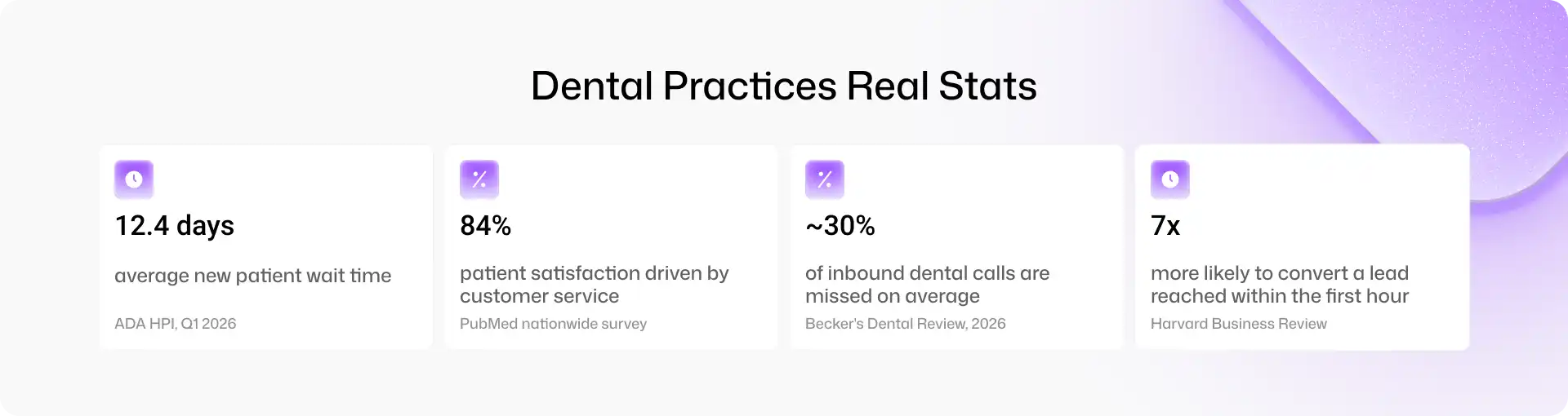
New patients wait an average of 12.4 days for a first appointment, even as roughly a third of dentists say they have open capacity.
84% of patients report satisfaction with their dental office, driven primarily by customer service and communication quality.
The average dental practice still misses close to 30% of its inbound calls, according to a 2026 Becker's Dental Review analysis, a gap that falls hardest on first-time callers who have no existing relationship with the practice.
Moreover, a first-time caller has no loyalty to fall back on. An existing patient might tolerate a missed call or a slow callback. A prospective patient simply calls the next practice on the list. As a result, the new patient phone call carries more weight and more risk than almost any other interaction a practice manages.
What an AI Receptionist Actually Does for New Patients
An AI receptionist is a conversational AI voice agent that answers every incoming call, understands what a caller needs in natural language, and takes real action immediately. For a new patient's first call, that means no hold music, no voicemail, and no waiting for a callback the next business day.
For a busy dentist or practice manager with no technical background, the easiest way to picture it is a front desk team member who never takes a lunch break, never calls in sick, and always has the real schedule open. When a new patient calls, the AI voice agent checks live availability directly inside the practice's system, whether that is Dentrix, Eaglesoft, Open Dental, or Curve Dental, and books the appointment on the spot.
The stronger systems go further for first-time callers specifically. They collect basic intake information during the call, explain what to expect at the first visit, confirm insurance details before the patient arrives, and send automated reminders in the days that follow. For practices in Texas, a bilingual AI voice agent can also answer the same call fluently in Spanish, removing a language barrier that keeps many prospective patients from booking at all. Furthermore, every call is handled the same way, every time, so a new patient's experience never depends on which staff member happens to answer the phone.
Benefits and Business Impact of Improving the New Patient Experience
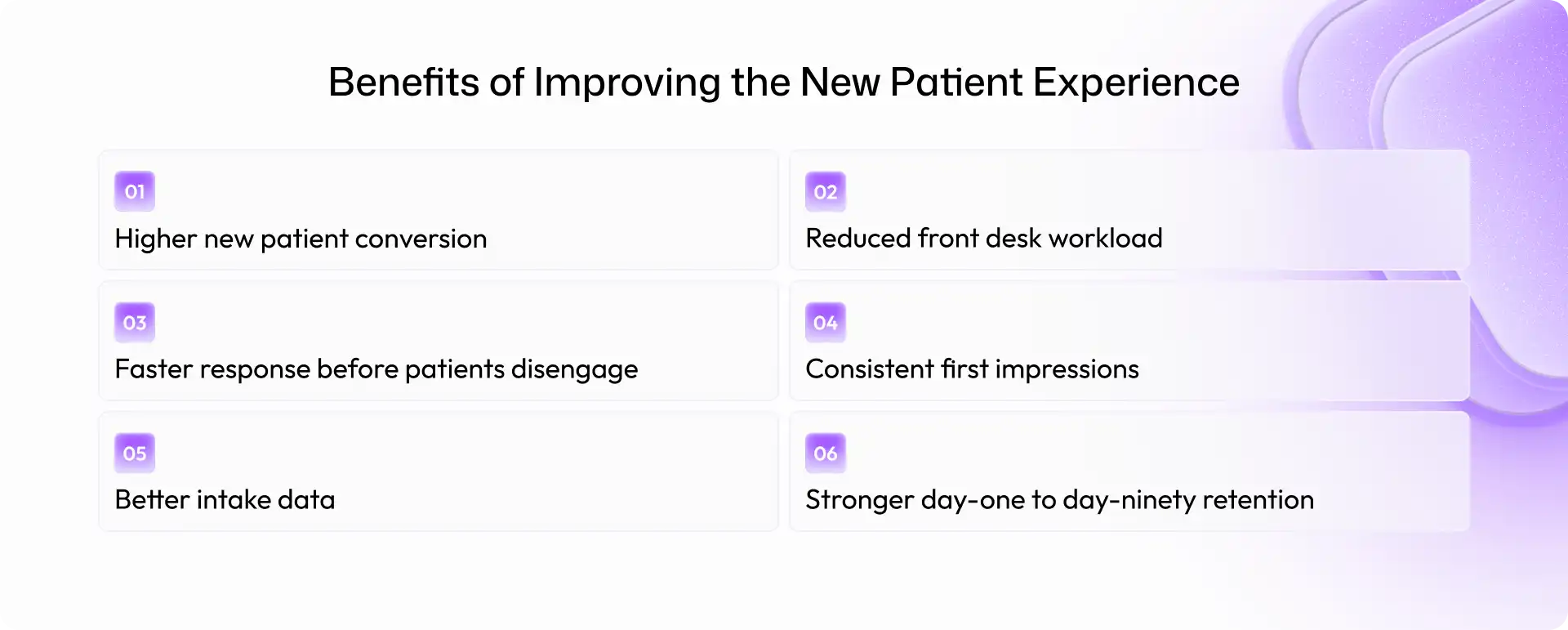
A stronger new patient experience is not just a courtesy. It shows up directly in the numbers that matter to a growing practice.
1. Higher new patient conversion
When every call is answered instantly instead of being routed to voicemail, a far greater share of inquiries convert into booked appointments instead of calls to a competing practice.
2. Reduced front desk workload
An AI voice agent absorbs the repetitive intake questions and scheduling logistics that otherwise consume a coordinator's entire morning, freeing staff to focus on patients already in the office.
3. Faster response, before patients disengage
Prospective patients researching dentists rarely wait around. Answering and booking within the first call, rather than after a delayed callback, keeps momentum on the practice's side.
4. Consistent, professional first impressions
Every new patient hears the same warm, accurate, on-brand greeting, regardless of call volume, time of day, or which staff member would otherwise have answered.
5. Better data at intake
Insurance details, medical history flags, and scheduling preferences are captured accurately during the first call, reducing paperwork delays and confusion on the day of the visit.
6. Stronger day-one to day-ninety retention
A smooth, low-friction first experience makes a new patient more likely to return for hygiene visits, accept treatment plans, and refer family members.
Industry-Specific Use Cases Across Texas Dental Practices
1. A solo general practice in Austin relies on one or two front desk staff to cover phones, checkout, and insurance verification at the same time. When both lines ring during a mid-morning rush, new patient calls are the ones most likely to go unanswered. An AI voice agent absorbs that overflow automatically, booking new patients without pulling staff away from the patients already checking in.
2. A multi-doctor group practice in Houston fields a much higher volume of new patient inquiries from marketing campaigns, referrals, and online searches. Consistency becomes the challenge rather than volume alone, since different staff members may quote different wait times or handle intake questions differently. A standardized AI dental receptionist ensures every caller gets the same accurate information and the same fast booking experience, regardless of which location or which day they call.
3. A dental service organization spanning San Antonio, El Paso, and several surrounding cities faces both challenges at once, plus the added complexity of tracking new patient conversion rates across every site. An AI voice agent gives DSO leadership a single, consistent front door for every location, along with call-level data that shows exactly how many new patient calls convert into booked appointments at each office.
Implementation Considerations for Practices Evaluating AI
Before selecting a vendor, a practice should confirm that the system integrates directly with its existing practice management software, whether that is Dentrix, Eaglesoft, Open Dental, or Curve Dental, so new patient bookings sync automatically without manual double entry.
Ask how the system handles a caller's first impression specifically. Does it sound natural, or does it feel like an automated phone tree with a different voice? Request a live call demo with a new patient scenario before signing anything. In addition, confirm that the vendor signs a Business Associate Agreement and encrypts call data, since even a first-time caller's name and reason for calling count as protected health information once it touches a scheduling system.
Finally, ask about bilingual support if your patient base includes Spanish speakers, and ask how quickly the system can be configured to reflect your practice's specific new patient intake process, insurance requirements, and scheduling rules.
Future Trends in the Dental New Patient Experience
Over the next 12 to 18 months, expect AI voice agents to take on a larger role in pre-visit preparation, automatically sending new patients personalized intake forms, insurance verification requests, and appointment reminders tailored to the specific procedure they booked.
Practices will also increasingly connect AI voice agents to their marketing and review platforms, so a new patient's first call, first visit, and first follow-up request for a review all flow through one coordinated system rather than several disconnected tools.
Furthermore, bilingual and multilingual capabilities will keep expanding beyond English and Spanish, helping practices in diverse Texas metro areas like Houston and San Antonio reach even more prospective patients at that critical first point of contact.
Conclusion
The dental new patient experience often comes down to a single phone call, and that call either turns into a booked appointment or a lost opportunity to a competitor down the street. Practices that rely on voicemail and delayed callbacks are quietly losing new patients they already paid to attract.
AI voice agents solve this by answering every call instantly, booking appointments in real time, and delivering the same warm, professional first impression no matter when a prospective patient calls. As competition for new patients keeps intensifying across Austin, Dallas, Houston, San Antonio, El Paso, and Plano in 2026, the practices that win will be the ones that never let a new patient's first call go unanswered.
Frequently Asked Questions (FAQs)
1. How does an AI voice agent improve the new patient experience?
It answers every call instantly instead of sending prospective patients to voicemail, checks real-time availability, and books the appointment during the first conversation. This removes the delay and uncertainty that often cause new patients to call a competing practice instead.
2. Will a new patient know they are talking to an AI receptionist?
Modern AI voice agents use natural, conversational speech rather than a rigid script, so most callers experience a smooth, human-like interaction. Practices can also choose to disclose that callers are speaking with an AI-powered system, depending on preference and local guidance.
3. Does an AI voice agent work in Spanish for Texas practices?
Yes. A bilingual AI receptionist can detect whether a caller is speaking English or Spanish and respond fluently in either language, which matters significantly in Texas markets with large Spanish-speaking populations.
4. Is patient data handled by an AI receptionist HIPAA-compliant?
It should be. Practices should confirm that any AI voice agent vendor signs a Business Associate Agreement and encrypts call data and transcripts both in transit and at rest, the same standard expected of any staff member handling protected health information.
5. Does an AI receptionist replace front desk staff?
No. It is designed to absorb overflow calls, after-hours calls, and repetitive scheduling tasks so existing staff can focus on patients physically in the office, rather than eliminating the front desk role entirely.
6. How quickly can a practice set up an AI voice agent for new patient calls?
Most practices can implement a system within a few weeks, including integration with practice management software like Dentrix, Eaglesoft, Open Dental, or Curve Dental, along with customization for the practice's specific new patient intake process.
Sources & References:
3. Harvard Business Review. "The Short Life of Online Sales Leads." 2011.
4. Becker's Dental Review. "AI in Dental Operations: How Practices Are Reducing Missed Calls." 2026.
Shravan Rajpurohit
CEO & Co-Founder
Shravan Rajpurohit is the Co-Founder & CEO of The Intellify, a leading Custom Software Development company that empowers startups, product development teams, and Fortune 500 companies. With over 10 years of experience in marketing, sales, and customer success, Shravan has been driving digital innovation since 2018, leading a team of 50+ creative professionals. His mission is to bridge the gap between business ideas and reality through advanced tech solutions, aiming to make The Intellify a global leader. He focuses on delivering excellence, solving real-world problems, and pushing the limits of digital transformation.

Stay Updated
with AI Insights
Get the latest articles on AI, automation, and enterprise technology delivered to your inbox weekly.

500+ people have already subsribed!
No spam. Unsubscribe anytime.