
How AI Voice Agents Are Replacing Traditional IVR Systems in 2026



Summary: IVR systems were built for a different era. Customers today expect fast, natural conversations, not phone menus with five options that never quite match what they need. This guide breaks down how AI voice agents work, why businesses across industries are replacing traditional IVR with them, and what to look for when making the switch.
Nobody likes hearing "your call is important to us" for the fifth time while stuck in a phone menu. You know the drill: press 1 for sales, press 2 for support, press 3 to repeat this menu... and somehow you still end up talking to the wrong department. It's 2026, and customers are done with it.
Traditional IVR (Interactive Voice Response) systems were a big deal once. They helped businesses handle more calls without hiring an army of receptionists. But the technology hasn't really evolved at the same pace as customer expectations. People now want fast, natural conversations, not a maze of button presses that often leads nowhere.
That's where AI voice agents come in. Unlike IVR, they actually listen, understand what you're asking, and respond like a real conversation. No menus. No repeating yourself three times. Just talk, and the system figures out what you need.
This guide breaks down what's changing, why it matters, and how AI voice agents are quietly replacing IVR systems across industries. Whether you're a business owner tired of complaints about your phone system or someone exploring better ways to handle customer calls, this one's for you.
What Is an IVR System and Why Is It Falling Short
IVR stands for Interactive Voice Response. It's the automated phone system that greets you with a menu of options and asks you to press numbers or say short commands to get routed somewhere.
How traditional IVR systems work
IVR runs on pre-recorded prompts and a fixed decision tree. Caller picks an option, system routes them based on that choice, and so on until (hopefully) they reach the right person or department. It's rule-based; there's no real understanding happening, just if-this-then-that logic.
Common IVR frustrations: rigid menus, long wait times, repetitive prompts
Honestly, most people have a horror story here. You call in with a slightly unusual request, and the menu just doesn't have an option for it. You end up pressing 0 repeatedly, hoping to reach a human. Or you're stuck listening to the same prompt over and over because the system didn't register your input correctly. It's clunky, and it shows its age fast.
Why customer expectations have outgrown IVR technology
We're used to talking to Alexa, Siri, and chatbots that actually get what we mean. So when a business phone system forces us back into a 1990s-style menu, it feels like a step backward. Customers expect speed and understanding now, not a scavenger hunt through automated options.
How AI Voice Agents Work
How an AI voice agent handles an inbound call end-to-end
A call comes in; the AI agent picks up, greets the caller, and starts listening. From there, it identifies what the person needs and works through the request in real time, pulling data, answering questions, or taking action directly.
Understanding caller intent without rigid menu trees
There's no "press 1 for this" happening here. The caller just talks, and the system parses the request to figure out intent. Ask about your order, your appointment, or a billing issue the agent picks up on it without needing a specific keyword or menu path.
Real-time conversation flow instead of "press 1 for..."
This is the part people notice immediately. It feels like talking to a person, not navigating a phone tree. The agent can ask follow-up questions, clarify, and keep the conversation moving naturally.
Escalating to a human agent when needed
Good AI voice agents know their limits. If a request is too complex, sensitive, or simply needs a human touch, the system hands off the call smoothly, often with full context already passed along so the caller doesn't have to repeat themselves.
Logging and syncing call data across systems
Every call gets logged automatically into the CRM or support platform, so there's a record of what happened, what was resolved, and what (if anything) needs follow-up.
IVR vs AI Voice Agents: Key Differences
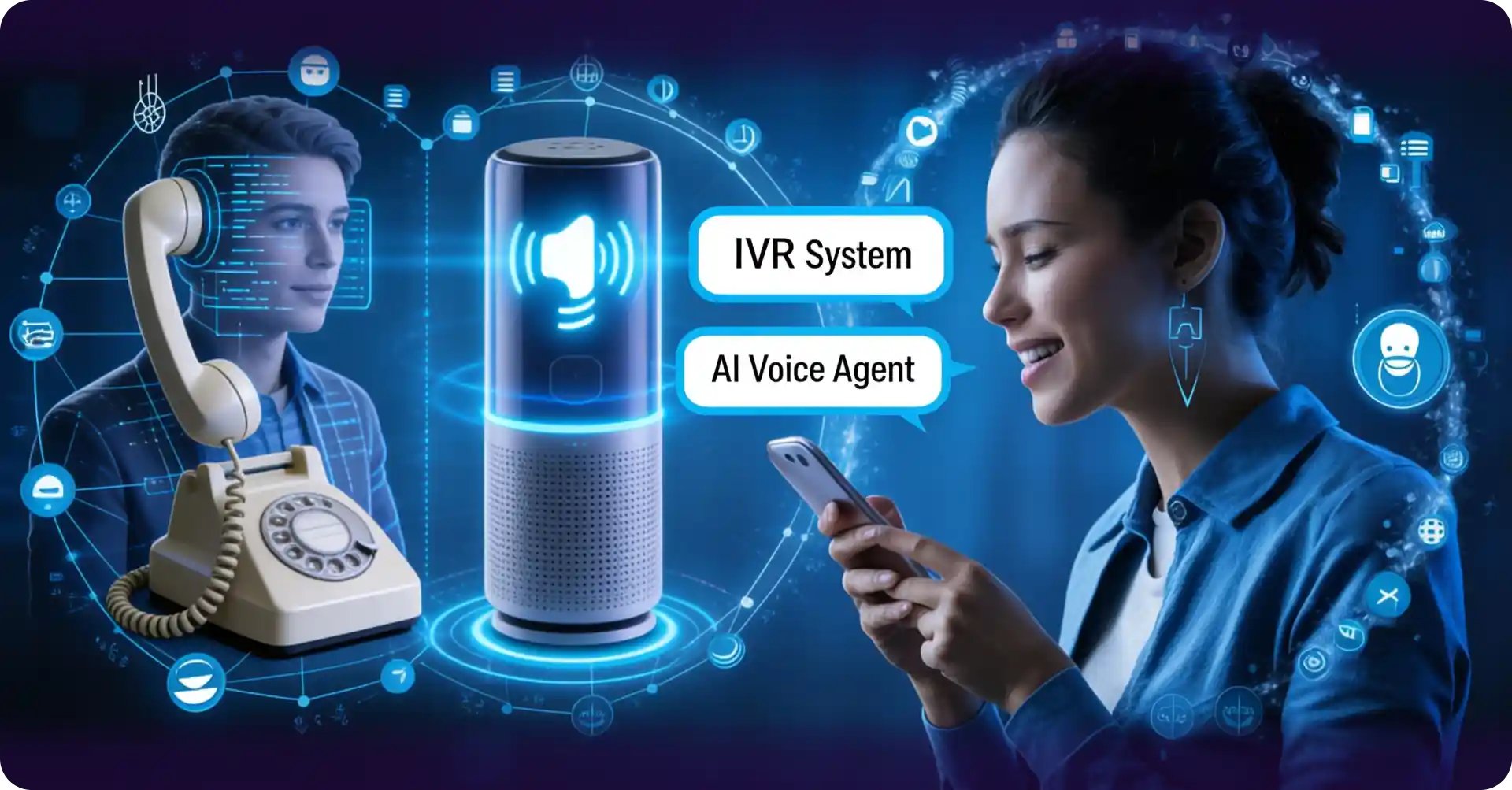
Menu-based navigation vs natural conversation
IVR: press buttons, follow a tree.
AI voice agents: just talk like you would to a person.
Fixed scripts vs dynamic, context-aware responses
IVR scripts are static; they don't adapt mid-call. AI voice agents adjust based on what's actually being said, pulling in context as the conversation develops.
Caller frustration vs faster resolution
IVR often increases frustration the longer a call goes on. AI voice agents tend to resolve things faster because there's no menu friction slowing things down.
Limited scalability vs handling unlimited concurrent calls
IVR systems can technically handle volume, but the experience degrades fast under pressure (longer hold times, more dropped calls).
AI voice agents can manage a high volume of simultaneous calls without a drop in quality.
One-way interaction vs personalized, two-way conversation
IVR is mostly one-directional: the system talks; you respond with limited options.
AI voice agents create an actual two-way exchange, often pulling in account or order history to personalize the interaction.
Why Businesses Are Replacing IVR With AI Voice Agents in 2026
Rising customer expectations for natural, human-like interactions
People aren't patient with clunky tech anymore. If a competitor offers a smoother phone experience, customers notice, and they remember.
The cost and limitations of maintaining legacy IVR systems
Old IVR platforms aren't cheap to maintain, and updating menu logic or adding new options often requires technical work that slows everything down.
Missed calls and lost revenue from IVR drop-offs
Every time someone hangs up mid-menu out of frustration, that's a missed opportunity: a sale, a booking, a support resolution that never happened.
The competitive pressure to modernize customer communication
Businesses that switch to AI voice agent solutions are setting a new bar. Once customers experience the difference, going back to a traditional IVR system feels like a downgrade.
Why "press 1 for sales" no longer meets modern expectations
It's not just outdated; it actively works against conversion and retention. Friction at the first point of contact is a bad first impression, full stop.
Key Benefits of AI Voice Agents Over IVR
Faster call resolution without menu navigation: No detours through irrelevant menu options. The conversation gets straight to the point.
24/7 availability without added staffing costs: The agent doesn't need breaks, shifts, or overtime pay. It's available around the clock.
Reduced call abandonment rates: Fewer people hang up out of frustration when the system actually understands them from the first sentence.
Personalized, context-aware conversations: Pulling in caller history or account details makes the interaction feel tailored, not generic.
Seamless handling of high call volumes: Whether it's 10 calls or 1,000 calls at once, the experience stays consistent.
Improved customer satisfaction and brand perception: A smooth phone experience reflects well on the business overall; it signals that the company actually cares about the customer's time.
Lower long-term operational costs: Less reliance on large support teams for repetitive, high-volume calls means real savings over time.
Core Use Cases for AI Voice Agents
1. Handling frequently asked questions automatically
Hours of operation, pricing, policies, the stuff that eats up a lot of agent time, can be handled instantly.
2. Appointment scheduling and booking management
Callers can book, reschedule, or cancel appointments directly through the conversation, no transfers needed.
3. Order status and delivery inquiries
"Where's my order?" is one of the most common calls businesses get and one of the easiest to automate well.
4. Billing and payment support
Basic billing questions, payment confirmations, and account balance checks can all be handled without human intervention.
5. Lead qualification and call routing
The agent can ask a few quick questions to understand intent and route serious leads to the right team faster.
6. After-hours and overflow call handling
When the team's busy or it's outside business hours, the AI voice agent keeps things moving instead of sending callers to voicemail.
7. Outbound reminders and follow-up calls
Appointment reminders, payment due dates, or check-ins can be handled proactively, reducing no-shows and missed payments.
AI Voice Agents Across Industries
Healthcare and dental practices: Appointment scheduling, reminders, and basic patient queries without tying up front-desk staff.
Retail and E-commerce: Order tracking, returns, and product questions are handled instantly, even during high-traffic periods like sales events.
Financial services: Balance checks, transaction queries, and basic account support, all while maintaining security protocols.
Real estate and property management: Handling tenant maintenance requests, scheduling property viewings, and answering common leasing questions.
Hospitality and travel: Booking confirmations, reservation changes, and answering guest questions around the clock.
Home services and field service businesses: Scheduling service calls, confirming appointments, and managing rescheduling requests without playing phone tag.
SaaS and technology companies: Handling support tier-1 questions, onboarding queries, and basic troubleshooting before escalating to technical staff.
AI Voice Agents and Omnichannel Communication
Why voice alone isn't enough in 2026
Customers don't stick to one channel anymore. They might call first, then follow up over text, then check email for confirmation. A voice agent that only handles calls and nothing else creates gaps in the experience.
Connecting voice agents with SMS, chat, and email
The real value comes when voice is part of a bigger, connected system. The AI agent that just answered your call can also trigger a text confirmation or follow-up email automatically.
Creating a seamless cross-channel customer journey
Instead of starting over every time you switch channels, the conversation carries through context and all.
Example: a call ending and a follow-up text arriving automatically
You call to book an appointment, the AI agent confirms the details, and within seconds, a text lands on your phone with the appointment time and a calendar link. That kind of cross-channel handoff is something IVR (and honestly, most voice-only tools) simply can't do.
How to Implement AI Voice Agents in Your Business
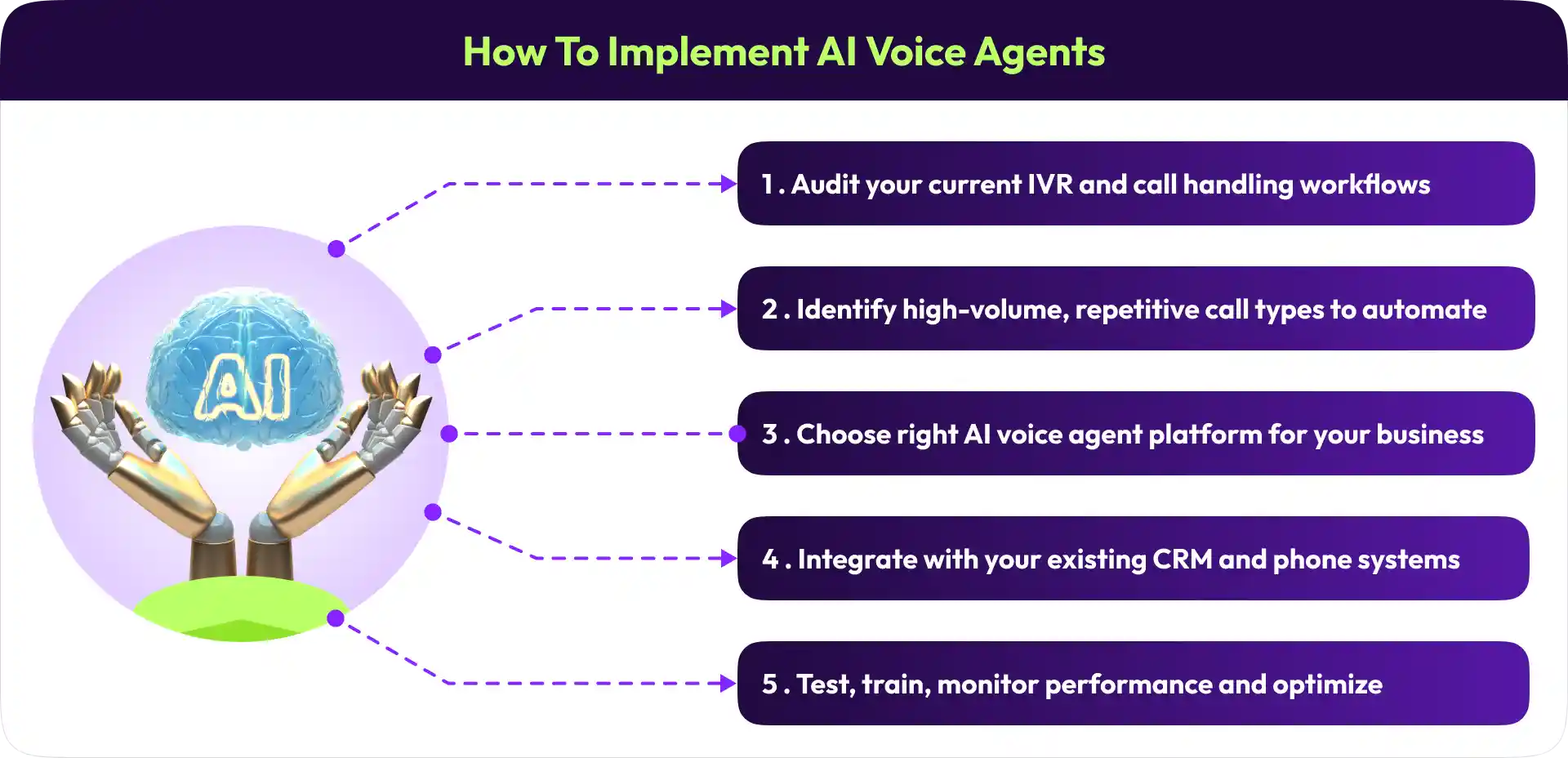
Step 1: Audit your current IVR and call handling workflows
Before jumping in, map out what's actually happening today. Where are calls getting stuck? What are the most common requests?
Step 2: Identify high-volume, repetitive call types to automate
Focus on the calls that eat up the most time but don't require complex judgment; these are the easiest wins for automation.
Step 3: Choose the right AI voice agent platform for your business
This is where picking the right partner matters. Alris AI, for example, is built as an omnichannel AI communication platform, meaning it doesn't just handle voice calls; it connects voice, SMS, and other channels into one system, so the handoff between a call and a follow-up text actually feels seamless instead of disconnected.
Step 4: Integrate with your existing CRM and phone systems
The AI voice agent needs to talk to your existing tools like CRM, scheduling software, and support platform so data flows both ways without manual entry.
Step 5: Test, train, and refine conversation flows
Run real scenarios before going live. Listen to how the agent handles edge cases and tweak the responses accordingly.
Step 6: Monitor performance and continuously optimize
This isn't a "set it and forget it" tool. Keep an eye on call resolution rates and adjust as you learn what's working and what's not.
Key Features to Look for in an AI Voice Agent Platform
Natural, human-like conversational ability: If it still sounds robotic, customers will notice, and not in a good way.
Seamless human handoff and escalation: When a call needs a real person, the transition should be smooth, with context carried over.
CRM and business tool integrations: The platform should plug into what you're already using, not force you to rebuild your tech stack.
Real-time call analytics and reporting: You need visibility into what's happening on calls, resolution rates, common issues, and drop-off points.
Multi-language support: If your customer base isn't entirely English-speaking, this becomes a non-negotiable feature fast.
Security, compliance, and data privacy: Especially important for industries like healthcare and finance, where call data often includes sensitive information.
Omnichannel capability beyond just voice: The strongest platforms connect voice with SMS, chat, and email so the whole customer journey stays consistent.
Common Challenges and How to Overcome Them
Ensuring conversations feel natural, not robotic
This takes some tuning. Voice tone, pacing, and response phrasing all need attention, not just the underlying logic.
Integrating with legacy phone systems
Older phone infrastructure can be a pain to connect with. Worth checking compatibility before committing to a platform.
Managing complex or sensitive call scenarios
Not every call should be fully automated. Knowing when to escalate is just as important as the automation itself.
Staff adjustment to AI-assisted call handling
Teams sometimes worry that the technology is there to replace them. In practice, it usually just takes the repetitive load off their plate, freeing them up for the calls that actually need a human.
Best practices for a smooth transition from IVR
Start small. Automate the highest-volume, lowest-complexity calls first, then expand once you've seen how it performs.
Conclusion
IVR had its time, but it's not built for what customers expect today. AI voice agents solve the core problems of frustration, long waits, and rigid menus while opening up new possibilities like cross-channel follow-ups and smarter call routing.
At the end of the day, this isn't just a tech upgrade. It's about how a customer feels after calling your business: rushed and annoyed, or actually helped. Businesses that make this shift early are setting themselves up to meet expectations that are only going to keep rising.
How Alris AI helps businesses replace IVR with intelligent voice agents
If you're tired of customer complaints about your phone menu, it might be time to look at what an AI voice agent can actually do. Alris AI brings voice, SMS, and other channels together in one platform, so replacing IVR doesn't mean building yet another disconnected tool; it means finally having a phone system that keeps up with your customers.
Frequently Asked Questions (FAQs)
1. What is the difference between IVR and an AI voice agent?
IVR routes callers through fixed menus using keypad inputs. An AI voice agent uses natural language understanding to interpret what a caller actually says, holding a real conversation instead of forcing them through a decision tree.
2. Can AI voice agents completely replace IVR systems?
For most repetitive, high-volume calls, yes. Complex or sensitive scenarios still benefit from human escalation, but a well-built AI voice agent can resolve a large share of inbound calls end-to-end without needing IVR at all.
3. Are AI voice agents expensive to implement?
Costs vary by provider and call volume, but most platforms are priced to scale with usage. Many businesses see cost savings over time since fewer staff hours are needed for repetitive, high-volume calls.
4. Do AI voice agents work for small businesses or only enterprises?
Both. Small businesses use AI voice agents to handle overflow and after-hours calls without hiring extra staff, while enterprises use them to manage high call volumes across multiple departments and locations.
5. How do AI voice agents handle calls they can't resolve?
They escalate to a human agent and pass along full context from the conversation, so the caller doesn't have to repeat themselves. This keeps handoffs smooth instead of starting the call over.
Shravan Rajpurohit
CEO & Co-Founder
Shravan Rajpurohit is the Co-Founder & CEO of The Intellify, a leading Custom Software Development company that empowers startups, product development teams, and Fortune 500 companies. With over 10 years of experience in marketing, sales, and customer success, Shravan has been driving digital innovation since 2018, leading a team of 50+ creative professionals. His mission is to bridge the gap between business ideas and reality through advanced tech solutions, aiming to make The Intellify a global leader. He focuses on delivering excellence, solving real-world problems, and pushing the limits of digital transformation.

Stay Updated
with AI Insights
Get the latest articles on AI, automation, and enterprise technology delivered to your inbox weekly.

500+ people have already subsribed!
No spam. Unsubscribe anytime.