
7 Healthcare Administrative Tasks AI Work Assistants Can Automate



If you have ever spent time inside a clinic or hospital office, you already know this: admin work never really stops. It keeps piling up quietly in the background. Scheduling appointments, updating records, verifying insurance, calling patients back, and handling billing all add up. Most of these tasks are repetitive, but they still take a huge amount of time.
That is where automation in healthcare administration starts to make sense. Instead of depending fully on manual effort, healthcare teams can use an AI work assistant to handle routine work in the background, reduce delays, and keep operations moving more smoothly.
What AI Automation Means in Healthcare Administration
In simple terms, an AI work assistant acts like a digital support system for administrative teams. It reads information, follows workflow patterns, and completes repetitive tasks based on rules and data.
It can capture patient details, update systems, send reminders, schedule appointments, and trigger the next step automatically. The goal is not to replace staff. It is to support them by taking repetitive work off their plate.
That means teams still handle judgment, exceptions, and patient-facing decisions, while AI manages the background tasks that usually slow everything down.
How AI Work Assistants Automate Daily Healthcare Processes
Most administrative workflows in healthcare follow a simple pattern. Information comes in through forms, calls, emails, or system inputs. That information is then processed, organized, and validated. After that, an action happens, such as booking an appointment, updating a record, or sending a notification.
An AI work assistant fits directly into this flow. It captures data from different touchpoints, processes it in real time, and triggers the right action without someone having to manually move information between systems.
Because it can work across scheduling tools, EHR systems, and billing platforms, it helps healthcare teams move faster while also improving consistency. Tasks do not get missed as easily, updates happen immediately, and staff spend less time chasing small operational issues.
How AI Assistants and Voice Automation Work Together
AI assistants and AI voice automation are even more powerful when they work together. The AI assistant manages workflows and decisions based on available data, while voice automation handles live patient conversations such as answering calls, responding to questions, and sending reminders.
For example, a patient calls the clinic, the voice system answers instantly and understands the request, the AI assistant checks availability and books the appointment, and a confirmation message is sent automatically. No manual coordination is needed.
This kind of setup reduces pressure on staff during busy hours and makes AI in healthcare operations far more practical at scale.
7 Healthcare Administrative Tasks AI Work Assistants Can Automate
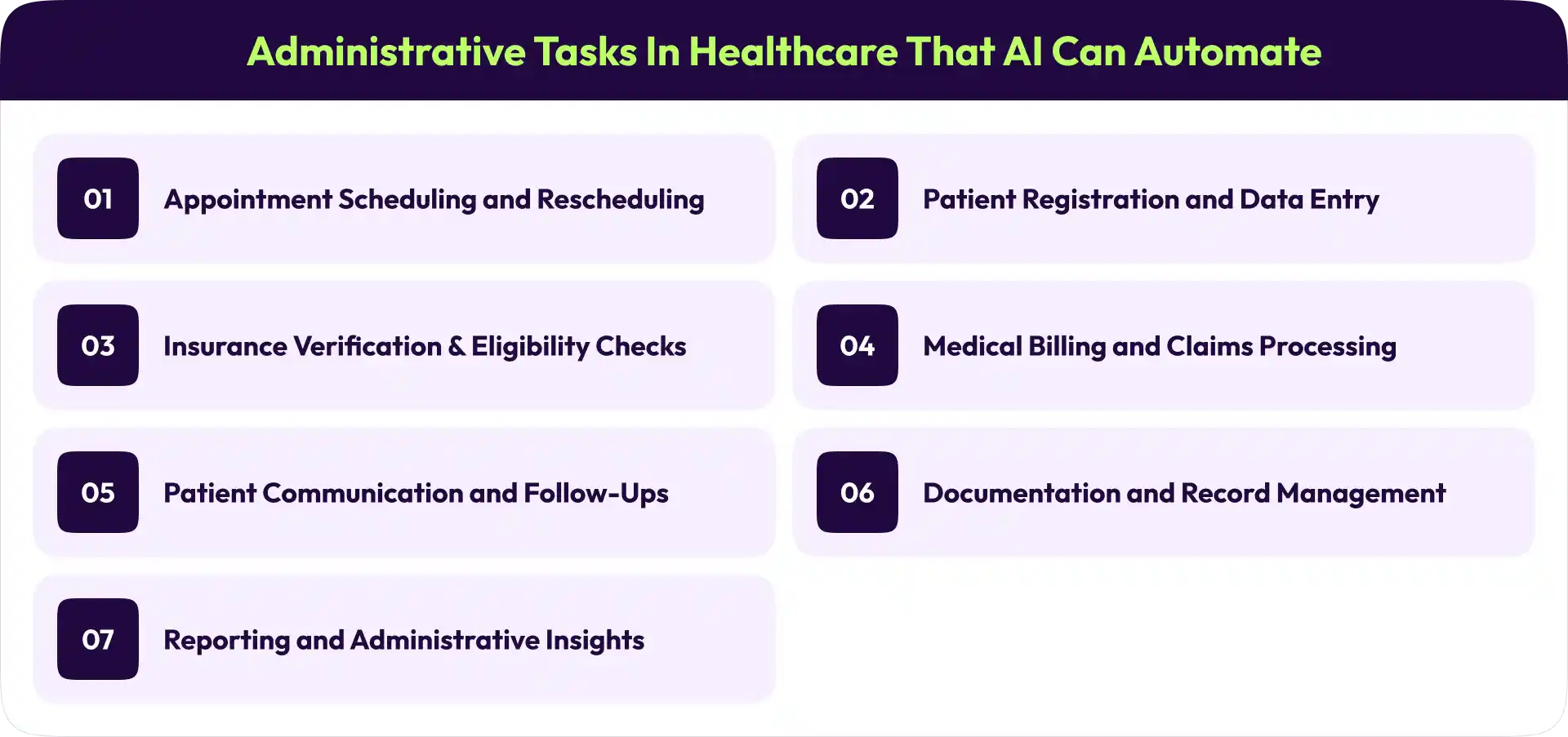
1. Appointment Scheduling and Rescheduling Without Manual Coordination
Appointment handling takes up more time than many teams expect. Calls, availability checks, slot conflicts, and last-minute changes can easily create delays.
An AI work assistant can automatically book appointments, check real-time availability, and handle rescheduling requests without human input. This reduces missed bookings and improves time management across the front desk.
2. Patient Registration and Data Entry Automation for Faster Onboarding
Manual data entry is repetitive and often leads to duplicate work. Staff spend too much time entering the same kinds of details into multiple systems.
AI can capture patient information automatically, update records instantly, and reduce duplicate entries. That makes onboarding faster and lowers the chances of common administrative errors.
3. Insurance Verification and Eligibility Checks in Real Time
Insurance verification is one of the most frustrating parts of healthcare administration because it often requires multiple checks before treatment can even begin.
With AI in healthcare administration, systems can run real-time eligibility checks, identify missing or incorrect details, and speed up verification. This helps prevent delays and creates a smoother patient experience before care starts.
4. Medical Billing and Claims Processing With Reduced Errors
Billing errors often create major slowdowns. Missing details, incorrect coding, and rejected claims all increase rework and administrative pressure.
AI can pre-check billing data, identify issues before submission, and improve claim accuracy. That leads to smoother processing and fewer headaches for billing teams.
5. Patient Communication and Follow-Ups Without Manual Effort
Follow-ups often get delayed or missed, not because teams do not care, but because they are already overloaded with administrative work.
AI assistants can send appointment reminders, follow-up messages, and responses to common patient queries automatically. This improves communication and patient engagement without adding extra workload to staff.
6. Documentation and Record Management Without Repetitive Manual Updates
Record updates consume a large amount of time in healthcare administration, especially when information needs to stay consistent across systems. AI can structure notes, update patient history, and keep records organized with less manual effort. This saves time while improving documentation accuracy.
7. Reporting and Administrative Insights for Better Decision-Making
Manual reporting is tedious and often delayed, which makes it harder for teams to make timely operational decisions. AI helps by generating reports automatically, highlighting trends, and providing insights into daily operations. That makes decision-making faster and more informed.
Use Cases of AI in Healthcare Administration
AI in healthcare administration is not limited to large hospitals. Clinics are already using it to improve front-desk efficiency by automating appointment handling, patient intake, and basic communication.
In hospitals, the impact is broader. AI helps reduce administrative workload across billing, scheduling, documentation, and coordination. Staff spend less time on repetitive tasks and more time focusing on patient care.
Patients may not always notice the technology directly, but they do experience the results through faster responses, fewer delays, and smoother day-to-day processes.
Benefits of Using AI Work Assistants in Healthcare Administration
The benefits of using an AI work assistant are very visible in daily operations. Tasks that used to take hours can now be completed in minutes, which creates immediate time savings.
Automation also reduces manual errors because data is captured and processed more consistently. Process speed improves, bottlenecks decrease, and patients receive quicker responses and more timely communication.
Most importantly, staff can focus more on meaningful work instead of repetitive administration. That is where the real operational value begins to show.
How to Start With AI in Healthcare Operations
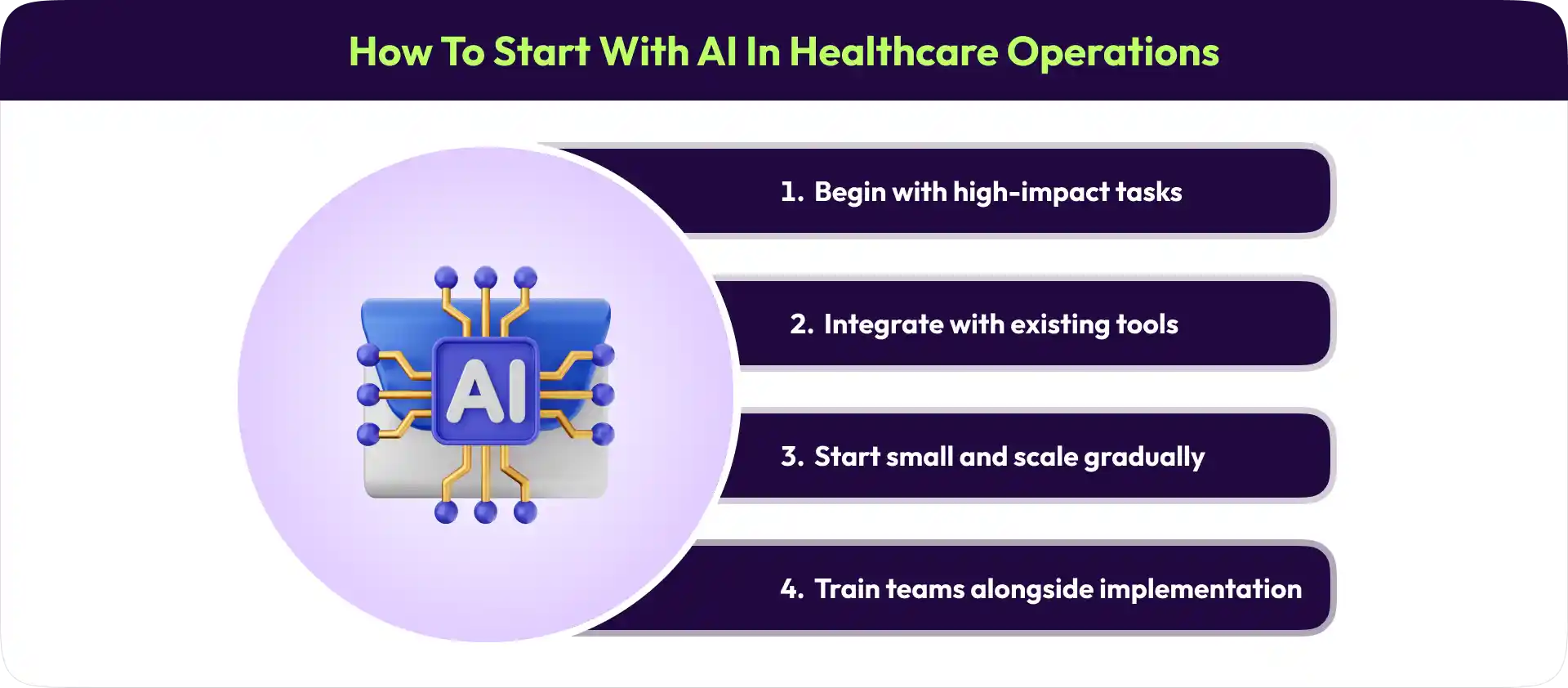
Getting started with AI does not mean changing everything at once. A better approach is to begin with high-impact areas such as appointment scheduling, patient communication, or billing.
The key is integration. The AI should work with existing tools rather than forcing a complete replacement. Starting small, testing the workflow, and gradually expanding into more areas usually makes adoption smoother.
Team training matters as well. When staff understand how the system supports them, adoption becomes easier and more effective.
Why Healthcare Administration Is Moving Toward Automation
Healthcare administration is becoming more complex every year. There is more patient data to manage, more processes to coordinate, and greater pressure to deliver speed and accuracy.
Manual processes simply cannot keep up with this pace on their own anymore. That is why automation in healthcare administration is growing so quickly. It helps teams handle increasing workloads without adding more pressure on already stretched staff.
There is also a growing need for accuracy. Errors in scheduling, billing, or documentation lead to delays and financial losses. Automation helps reduce these risks and is quickly becoming a standard part of daily workflows.
How AI Work Assistants Support Healthcare Administration
An AI work assistant supports healthcare administration by automating routine tasks such as scheduling, billing coordination, patient communication, and record updates without interrupting existing systems.
Solutions like Alris AI are built to support both backend workflows and communication tasks. That means they can process operational data while also interacting with patients through calls, messages, and reminders.
By reducing dependency on manual coordination, AI helps teams avoid delays, missed tasks, and operational gaps. Over time, that creates smoother workflows and a more reliable administrative system overall.
Final Thought
Healthcare administration will always be a critical part of operations, but the way it is handled is clearly changing. Relying entirely on manual processes is no longer practical as workloads continue to grow.
AI offers a practical way to manage this shift. It handles repetitive tasks, reduces errors, and keeps workflows running consistently without overwhelming teams.
The biggest value is not only efficiency. It is the balance it creates. Teams get to focus more on patient care, while the background work keeps moving smoothly. That is what makes healthcare administration smarter and much more manageable.
Frequently Asked Questions (FAQs)
1. What is an AI work assistant in healthcare administration?
An AI work assistant is a digital tool that helps manage routine tasks like scheduling, billing, and patient communication. It works alongside healthcare teams to reduce manual effort and keep operations running smoothly.
2. How can AI help reduce administrative workload in healthcare?
AI automates repetitive tasks such as appointment booking, follow-ups, and data entry. This reduces manual work, minimizes delays, and allows staff to focus more on patient care instead of administrative tasks.
3. Which healthcare administrative tasks can be automated using AI?
AI can handle tasks like scheduling, patient registration, insurance verification, billing, communication, and reporting. Solutions like Alris AI bring these processes together to simplify daily operations.
4. Is AI in healthcare administration safe and reliable?
Yes, AI systems are built to handle data securely and process tasks consistently. They reduce human errors and improve accuracy, while staff still manage critical decisions and exceptions.
5. Will AI replace administrative staff in healthcare?
No, AI supports staff rather than replacing them. It takes over repetitive tasks, allowing teams to focus on more important responsibilities like patient interaction and coordination.
6. How can healthcare providers start using AI for administration?
Healthcare providers can begin with areas like scheduling or communication, then gradually expand. AI tools can be integrated with existing systems, making adoption simple without major changes.
Shravan Rajpurohit
CEO & Co-Founder
Shravan Rajpurohit is the Co-Founder & CEO of The Intellify, a leading Custom Software Development company that empowers startups, product development teams, and Fortune 500 companies. With over 10 years of experience in marketing, sales, and customer success, Shravan has been driving digital innovation since 2018, leading a team of 50+ creative professionals. His mission is to bridge the gap between business ideas and reality through advanced tech solutions, aiming to make The Intellify a global leader. He focuses on delivering excellence, solving real-world problems, and pushing the limits of digital transformation.

Stay Updated
with AI Insights
Get the latest articles on AI, automation, and enterprise technology delivered to your inbox weekly.

500+ people have already subsribed!
No spam. Unsubscribe anytime.