
How to Choose the Best AI Voice Agent for Your Dental Practice: 2026 Buyer's Guide



Summary: Compare the best AI voice agents for dental practices with confidence. This 2026 buyer's guide covers essential features, HIPAA compliance, PMS integrations, ROI, and key questions to ask vendors before choosing the right solution for your practice.
A practice manager in Plano is three vendor demos into her search for an AI voice agent for her dental practice, and every pitch sounds identical. 24/7 call answering. Seamless booking. Happier patients. She closes her laptop with more questions than she started with, because nobody has told her what actually separates a good system from a mediocre one, or what happens six months after the contract is signed.
This is the stage most dentists and practice owners reach in 2026. They already know AI can help. What they need is a framework for evaluating vendors, avoiding costly mistakes, and choosing a system that fits their practice management software, their patient mix, and their budget.
This guide walks through what an AI voice agent for a dental practice actually does, the real business impact it delivers, the specific questions to ask vendors before signing anything, and where the technology is headed over the next 12 to 18 months. Whether the practice is a solo office in Austin or a multi-location group across Houston and San Antonio, the evaluation process below applies.
Why So Many Dental Practices Are Evaluating AI Voice Agents Right Now
The pressure to act is not hypothetical. According to a 2026 Becker's Dental Review analysis, the average dental practice misses about 30% of its inbound calls. For a mid-size group, that gap translates into thousands of patients each month who never make it onto the schedule at all.
Moreover, the staffing side of the equation has not improved. The ADA Health Policy Institute reports that only 60% of dentists have an adequate number of hygienists on staff, and among dentists actively recruiting, 91% describe the process as very or extremely challenging. Front desk roles face similar pressure, and the U.S. Bureau of Labor Statistics projects that receptionist employment will show little to no growth through 2034, in part because organizations are increasingly automating administrative functions rather than expanding headcount.
The financial stakes are not abstract either. A widely cited Dental Economics analysis, drawing on American Dental Association per-patient spending data, found that a general dentist's average patient is worth roughly $514 a year. Multiply that across just ten missed new-patient calls, and a practice can be looking at more than $15,000 in forgone revenue, from a single week of gaps in phone coverage.
Practices miss close to a third of incoming calls on average (Becker's Dental Review, 2026)
Nine in ten dentists recruiting hygienists call the process very or extremely difficult (ADA HPI)
Receptionist job growth is projected to be flat through 2034 as automation expands (BLS)
As a result, practices are no longer asking whether to adopt an AI voice agent. They are asking which one, and how to tell a genuinely capable system from a rebranded call center script.
What an AI Voice Agent for a Dental Practice
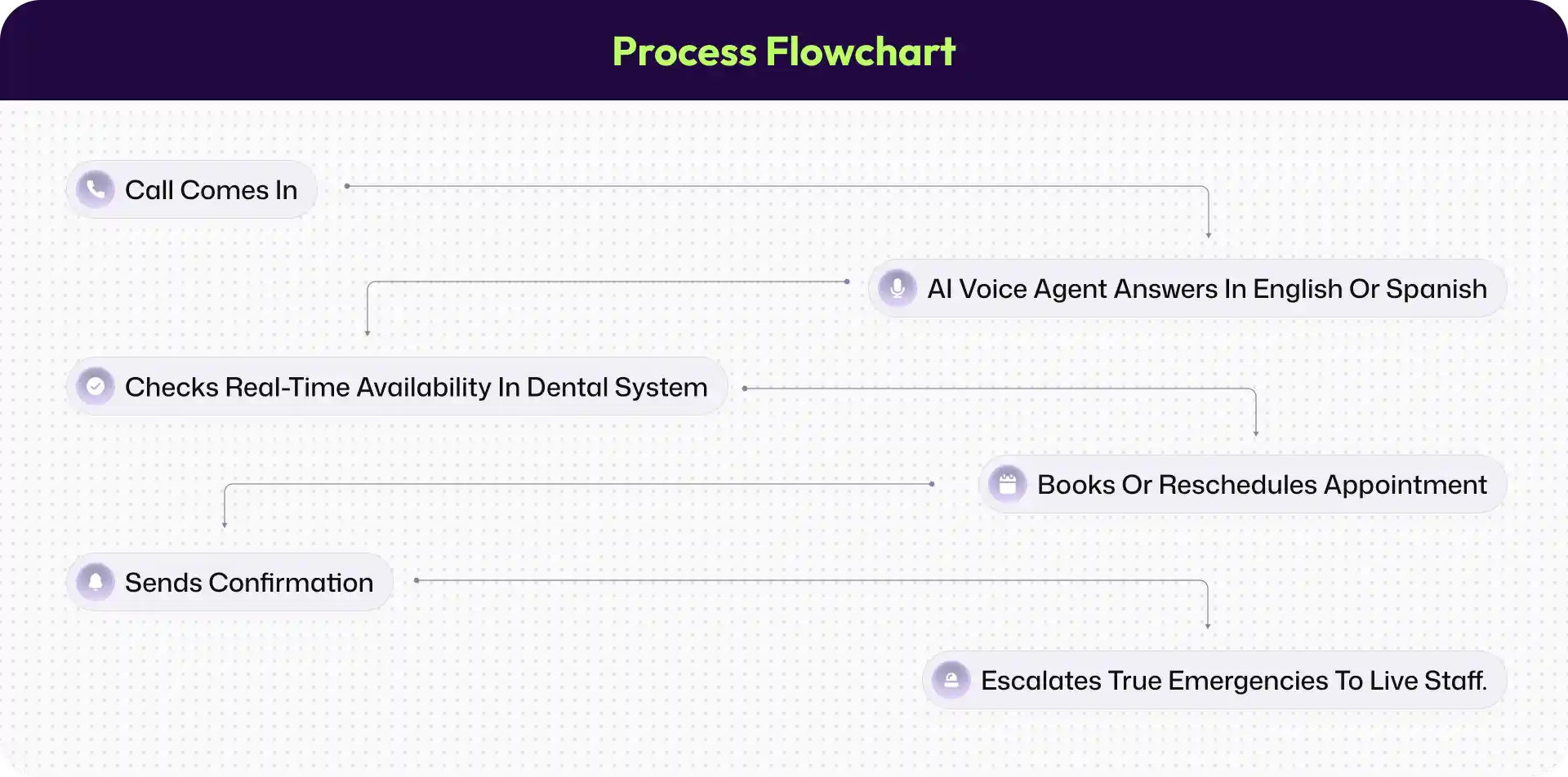
An AI voice agent is a conversational system that answers a practice's phone lines, understands what a caller needs in natural language, and takes real action, such as booking, rescheduling, or answering a billing question, without a staff member picking up the phone. It is not a chatbot, and it is not an interactive voice tree that forces callers to press a number and wait.
For a dentist or office manager without a technical background, the easiest way to picture it is a front desk team member who never takes a lunch break, never calls in sick, and always has the schedule open. When a call comes in, the AI voice agent checks real-time availability inside the practice's system and books the appointment directly, no callback required.
The stronger platforms go further. They handle patient intake, confirm insurance details before the visit, send automated reminders, escalate true emergencies to a live team member immediately, and, for practices in Texas and other states with large Spanish-speaking populations, hold the entire conversation in Spanish when that is the caller's preference. Alris AI, for example, is built specifically for dental practices around this exact workflow, connecting directly into the practice management system rather than sitting on top of it as a separate, disconnected tool.
The Benefits of Choosing the Right AI Voice Agent
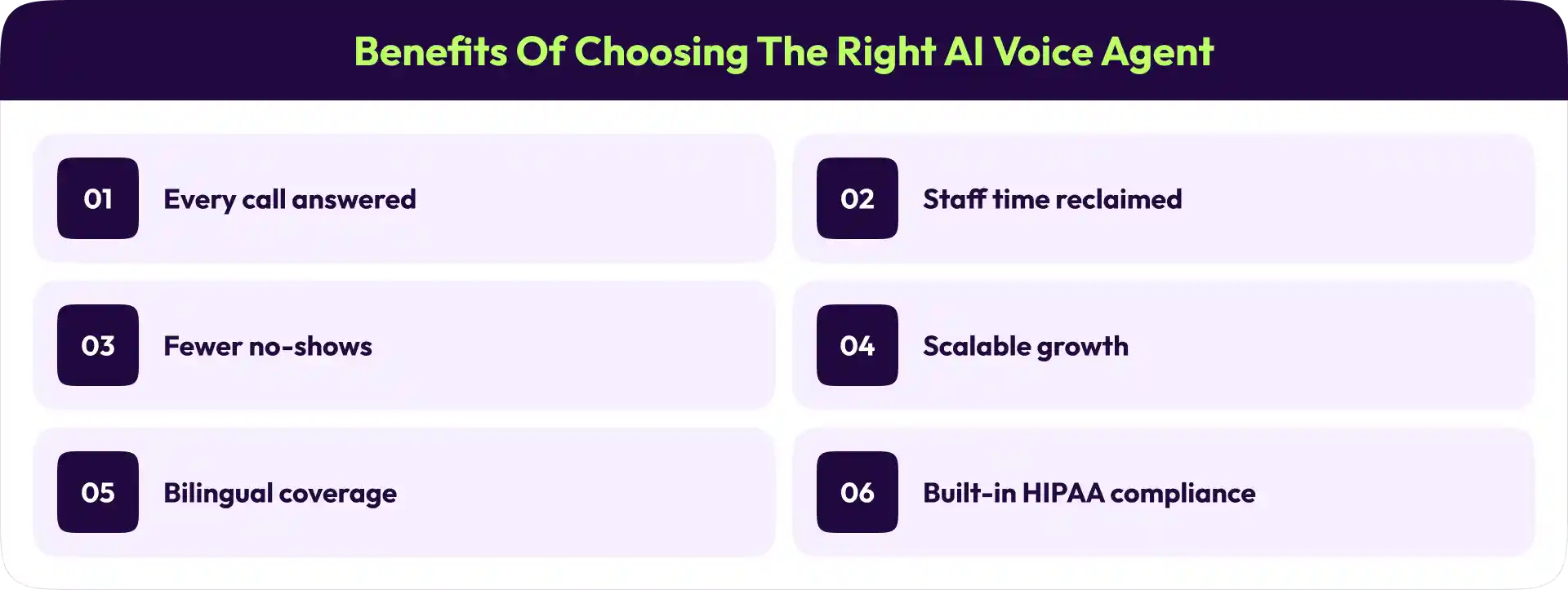
The difference between a well-chosen AI voice agent and a poorly chosen one shows up directly in the practice's numbers. Here is what a strong implementation typically delivers.
1. Every call gets answered, every time
Instead of losing roughly 30% of inbound calls to voicemail or a busy signal, practices using an AI voice agent answer calls around the clock, including evenings, weekends, and lunch hours when front desk staff are unavailable.
2. Front desk staff reclaim hours for in-office patients
When routine calls, bookings, reminders, and rescheduling are automated, existing staff spend less time on hold with insurance companies or juggling three lines at once, and more time with the patient standing in front of them.
3. Fewer no-shows and last-minute cancellations
Automated, multi-channel reminders and instant rebooking close the gaps that a manual recall list often misses, keeping the schedule fuller without adding administrative work.
4. Practices scale without proportional headcount growth
A second location or an expanded schedule no longer automatically means hiring another front desk coordinator. The AI voice agent handles the added call volume from day one.
5. Language is no longer a barrier to access
A bilingual AI voice agent captures Spanish-speaking callers who would otherwise hang up and call a competitor, a meaningful advantage in Texas markets including San Antonio, El Paso, and Houston.
6. Compliance is built in rather than bolted on
A properly built AI voice agent operates under a signed Business Associate Agreement and encrypts patient data in transit and at rest, reducing the practice's HIPAA exposure instead of adding to it.
How Different Dental Practices Use an AI Voice Agent
1. Solo Practice
A solo practice in Austin with one dentist and a two-person front desk team uses an AI voice agent primarily to eliminate missed calls during lunch, after 5 p.m., and on Fridays when the office closes early. The system books directly into the existing Dentrix schedule, and the practice adds new patients without adding a third staff member.
2. Group Practice
A group practice with three locations across Dallas and Plano uses the AI voice agent to centralize call handling across every office. Instead of each location managing its own overflow, one system handles all inbound calls, routes emergencies appropriately, and gives ownership a single dashboard to see call volume and booking trends across every site.
3. Dental Service Organization (DSO)
A DSO managing a dozen practices across Houston and San Antonio uses the AI voice agent as a standardized front-door experience for every acquired practice, regardless of what legacy phone system or scheduling habits that office had before. This shortens onboarding after each acquisition and gives regional managers consistent reporting on call answer rates and conversion across the whole network.
What to Evaluate Before You Sign a Contract
Not every AI voice agent on the market is built for dental practices specifically, and that distinction matters more than most sales pitches let on. Before committing, a practice should get clear answers to the following.
1. Does the vendor integrate directly with your practice management system, or does it require manual syncing? A system that writes appointments straight into Dental systems in real time is fundamentally more reliable than one that requires a staff member to double-check a separate calendar.
2. Will the vendor sign a Business Associate Agreement? This is not optional for any system that handles patient information, and a vendor that hesitates or delays on this question should be treated as a warning sign, not a technicality to revisit later.
3. How does the system handle a true emergency call, such as a patient in significant pain after hours? Ask for a live demonstration of the escalation path, not just a description of it.
4. What does onboarding actually look like, and how long until the system is handling live calls?
5. Furthermore, ask what happens when the practice's hours, providers, or scheduling rules change, since the system needs to adapt without a lengthy support ticket process.
6. Finally, ask for reporting. A practice should be able to see call volume, booking conversion, and missed-call recovery in a dashboard, not just take the vendor's word for it every quarter.
Where AI Voice Agents for Dental Practices Are Headed
Three shifts are likely to shape the next 12 to 18 months.
1. Deeper integration between the AI voice agent and clinical systems will let these tools pre-verify insurance and flag treatment plan follow-ups automatically, not just handle scheduling.
2. More DSOs will standardize on a single AI voice agent platform across every acquired location, treating it as core infrastructure rather than a location-by-location add-on.
3. Regulatory scrutiny around AI and patient data will tighten, meaning practices that chose a vendor with strong HIPAA compliance and a signed BAA from the start will be far better positioned than those that treated compliance as an afterthought.
Final Thought
Choosing the right AI voice agent for a dental practice is no longer a question of if the technology works. It is a question of which vendor integrates cleanly with your systems, protects patient data properly, and can prove its results with real reporting rather than a sales deck. Practices in Austin, Dallas, Houston, San Antonio, El Paso, and Plano that get this evaluation right in 2026 are already answering every call, filling more chairs, and running leaner front desks without sacrificing the patient experience. The practices still waiting are the ones losing patients to whoever answers the phone first.
Frequently Asked Questions (FAQs)
1. What does an AI voice agent for a dental practice cost?
Pricing varies by call volume, number of locations, and feature set, typically ranging from a flat monthly fee for a solo practice to a custom enterprise contract for a multi-location DSO. Most vendors, including Alris AI, offer a free assessment to scope cost against a practice's actual call data before any commitment.
2. Will an AI voice agent replace my front desk staff?
No. It is designed to absorb routine, repeatable calls, bookings, reminders, rescheduling, and FAQs, so existing staff can focus on patients physically in the office and on more complex conversations that genuinely need a person.
3. Is an AI voice agent HIPAA compliant?
It can be, but compliance is not automatic. A practice should confirm the vendor signs a Business Associate Agreement, encrypts data in transit and at rest, and maintains audit trails before relying on the system for any patient interaction.
4. Can the AI voice agent handle Spanish-speaking callers?
Yes, with the right vendor. Bilingual support is especially important for Texas practices, where a significant share of callers prefer to speak Spanish, and a system that detects language automatically avoids forcing callers through a menu.
5. What happens if the AI voice agent cannot answer a caller's question?
A well-built system escalates to a live staff member or an on-call provider immediately for anything outside its scope, particularly emergencies, rather than leaving the caller stuck or providing an inaccurate answer.
Sources & References:
1. Becker's Dental Review. "AI in dental operations." 2026
2. American Dental Association Health Policy Institute. "Dental Hygienist Shortage." 2026
3. U.S. Bureau of Labor Statistics. "Receptionists: Occupational Outlook Handbook."
4. U.S. Bureau of Labor Statistics. "Dental Assistants: Occupational Outlook Handbook." 2025
5. "Phone calls: Are you losing patients at 'Hello'?" Dental Economics.
Shravan Rajpurohit
CEO & Co-Founder
Shravan Rajpurohit is the Co-Founder & CEO of The Intellify, a leading Custom Software Development company that empowers startups, product development teams, and Fortune 500 companies. With over 10 years of experience in marketing, sales, and customer success, Shravan has been driving digital innovation since 2018, leading a team of 50+ creative professionals. His mission is to bridge the gap between business ideas and reality through advanced tech solutions, aiming to make The Intellify a global leader. He focuses on delivering excellence, solving real-world problems, and pushing the limits of digital transformation.

Stay Updated
with AI Insights
Get the latest articles on AI, automation, and enterprise technology delivered to your inbox weekly.

500+ people have already subsribed!
No spam. Unsubscribe anytime.