
Why Texas Dental Practices Need a Bilingual AI Receptionist in 2026


Summary: Texas dental practices risk losing Spanish-speaking patients when language barriers lead to missed calls. This blog explains how a bilingual AI receptionist answers calls in English and Spanish 24/7, books appointments, integrates with your practice management system, and improves patient access. Learn how AI helps reduce staffing challenges, enhance patient experience, and support sustainable practice growth across Texas.
It is 6:40 p.m. at a family dental practice in San Antonio. The front desk closed twenty minutes ago, but a phone call comes in anyway. A mother is calling about her son's tooth pain, and she is more comfortable speaking Spanish than English. The call rolls to voicemail. She hangs up without leaving a message and calls the next practice on her list instead, one that happens to answer in Spanish on the first ring.
This scene repeats itself across Texas every day, and it is exactly why a bilingual dental receptionist has become a competitive necessity rather than a nice-to-have. Nearly 40 percent of Texas residents identify as Hispanic or Latino, and millions of them speak Spanish at home. When a practice cannot answer a call in the patient's preferred language, that patient does not wait around. They move on.
In 2026, the practices winning new patients in Austin, Dallas, Houston, San Antonio, El Paso, and Plano are not necessarily hiring more bilingual staff. Many of them cannot find bilingual staff at all, given the same hiring crunch affecting every front desk position. Instead, they are deploying an AI voice agent that answers every call in English or Spanish, twenty-four hours a day, without ever missing a patient because of a language gap.
What Is a Bilingual AI Receptionist for Dental Practices?
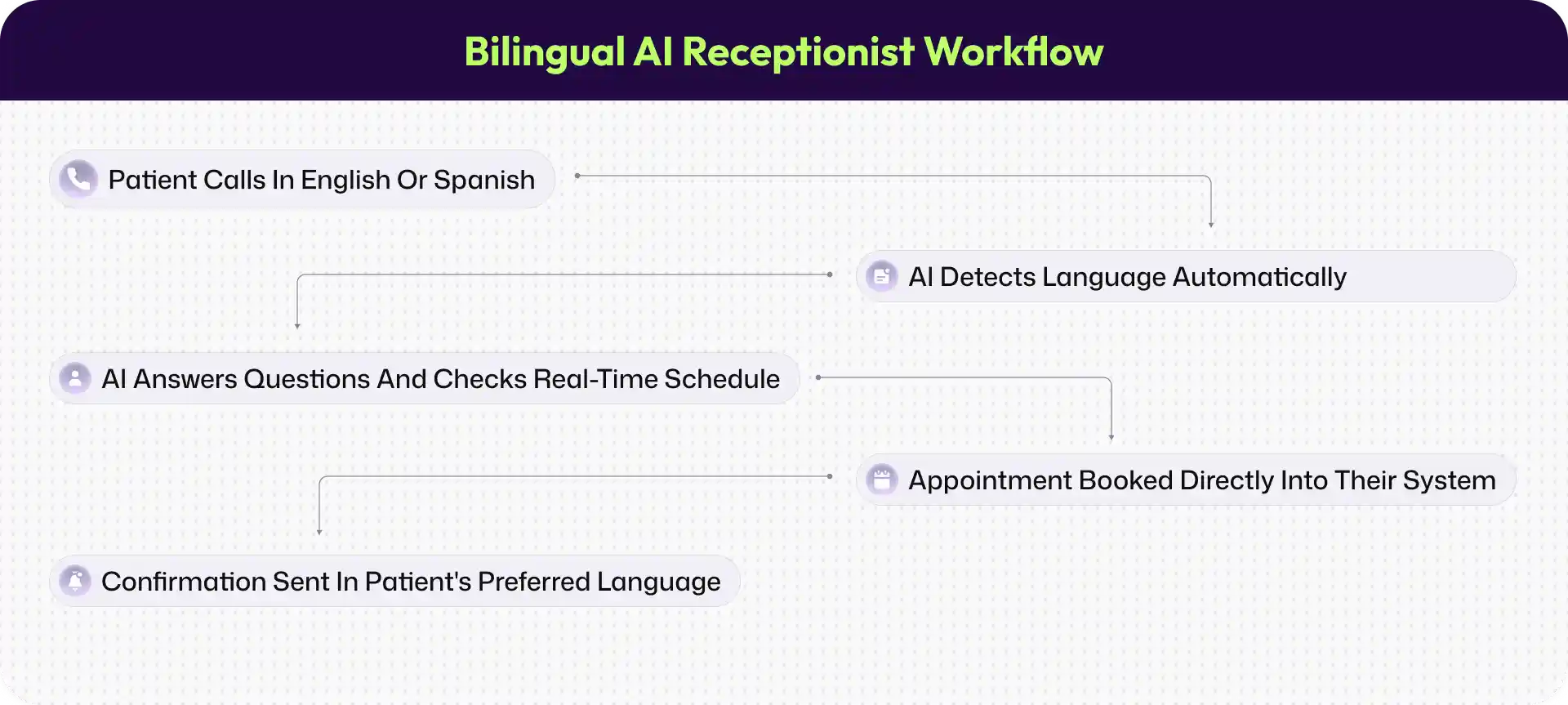
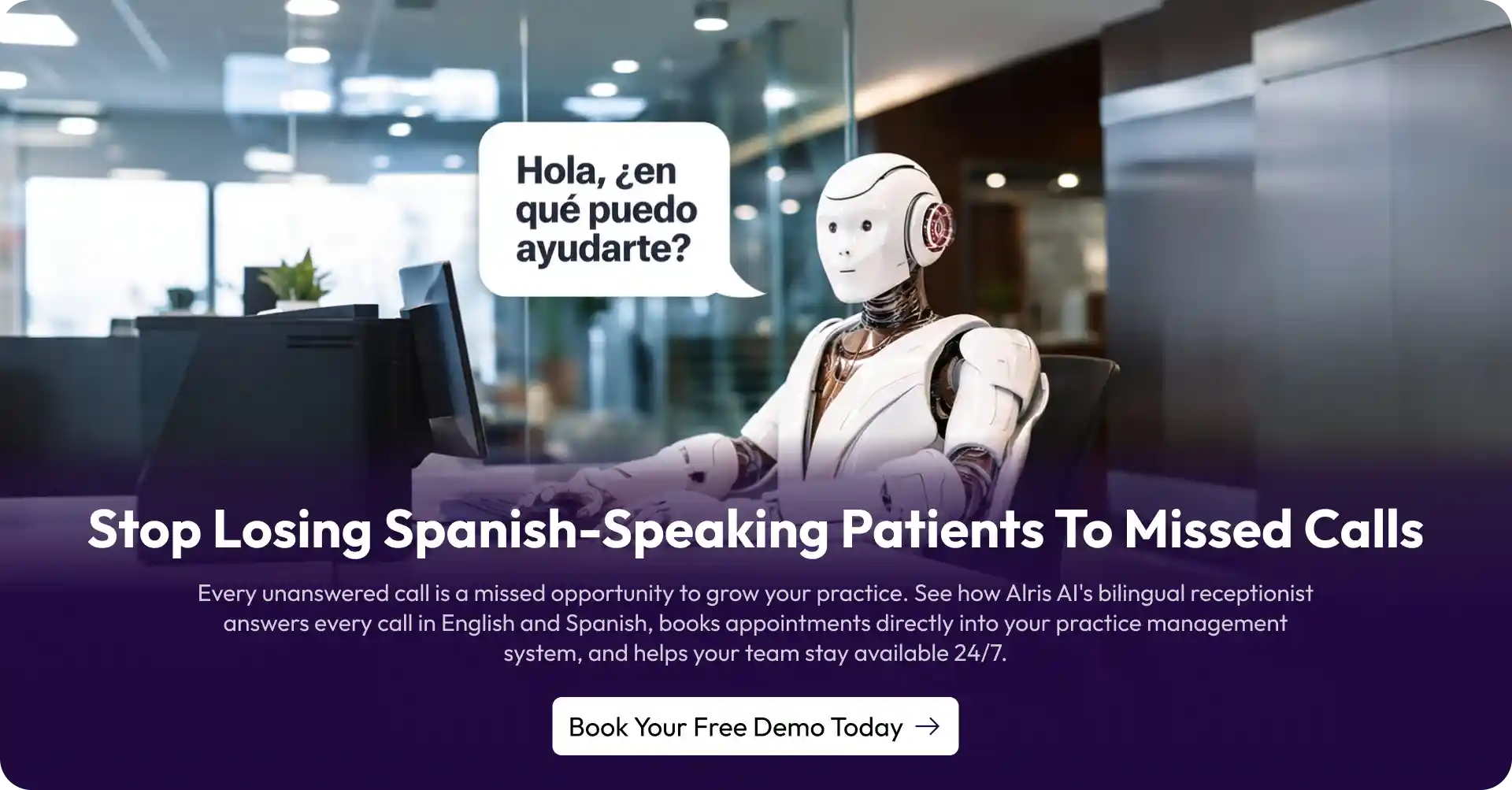
A bilingual AI receptionist is an AI voice agent that answers incoming calls, understands natural spoken language, and responds fluently in either English or Spanish, based on how the caller speaks. It is not a phone tree that forces a caller to press 2 for Spanish and then waits on hold. It is a conversational system that detects language automatically and handles the entire call from there.
For a busy dentist or practice manager, the technology underneath does not need to be complicated to understand. The AI voice agent connects directly to the practice's scheduling system and checks real appointment availability in real time. A caller can ask a question, book a visit, reschedule, or ask about services, all in the language they are most comfortable using, and the system updates the practice's actual schedule immediately.
Because the AI receptionist never clocks out, it also answers calls after hours, during lunch breaks, and on weekends, which is exactly when many working patients and parents are calling. For Spanish-speaking callers specifically, this closes a gap that most practices have never been able to staff around, since finding bilingual talent willing to work evenings or weekends is even harder than filling a standard front desk shift.
The Language Gap Is Costing Texas Dental Practices Real Patients
Texas is not a state where Spanish-speaking patients are a niche segment. According to the U.S. Census Bureau's American Community Survey five-year estimates, roughly 28.5 percent of Texans age 5 and older, nearly 7.8 million people, speak Spanish at home. In cities like San Antonio and El Paso, that share climbs well above the state average.
A meaningful portion of those residents are not just Spanish speakers by preference. They are limited English proficient, meaning they report speaking English less than "very well." The Migration Policy Institute's analysis of Census Bureau data found Texas has roughly 3.6 million residents who fall into this category, accounting for about 14 percent of the entire limited English proficient population in the United States.
The consequences show up directly in healthcare access. A study published in the Journal of General Internal Medicine found that only 45.3 percent of adults with limited English proficiency reported having a usual source of care, compared with 73.8 percent of adults with higher English proficiency. That gap does not close on its own. It closes when a practice removes the language barrier at the very first point of contact: the phone call.
Moreover, the research on language-concordant care is consistent. A study published in a peer-reviewed community health journal found that Spanish-speaking patients who received care from a language-concordant provider reported an overall satisfaction score of 4.62 out of 5, along with high scores for trust and understanding of medical information. As a result, when a practice communicates in a patient's preferred language from the first phone call, that patient is more likely to book, show up, and return.
Benefits and Business Impact of a Bilingual AI Receptionist
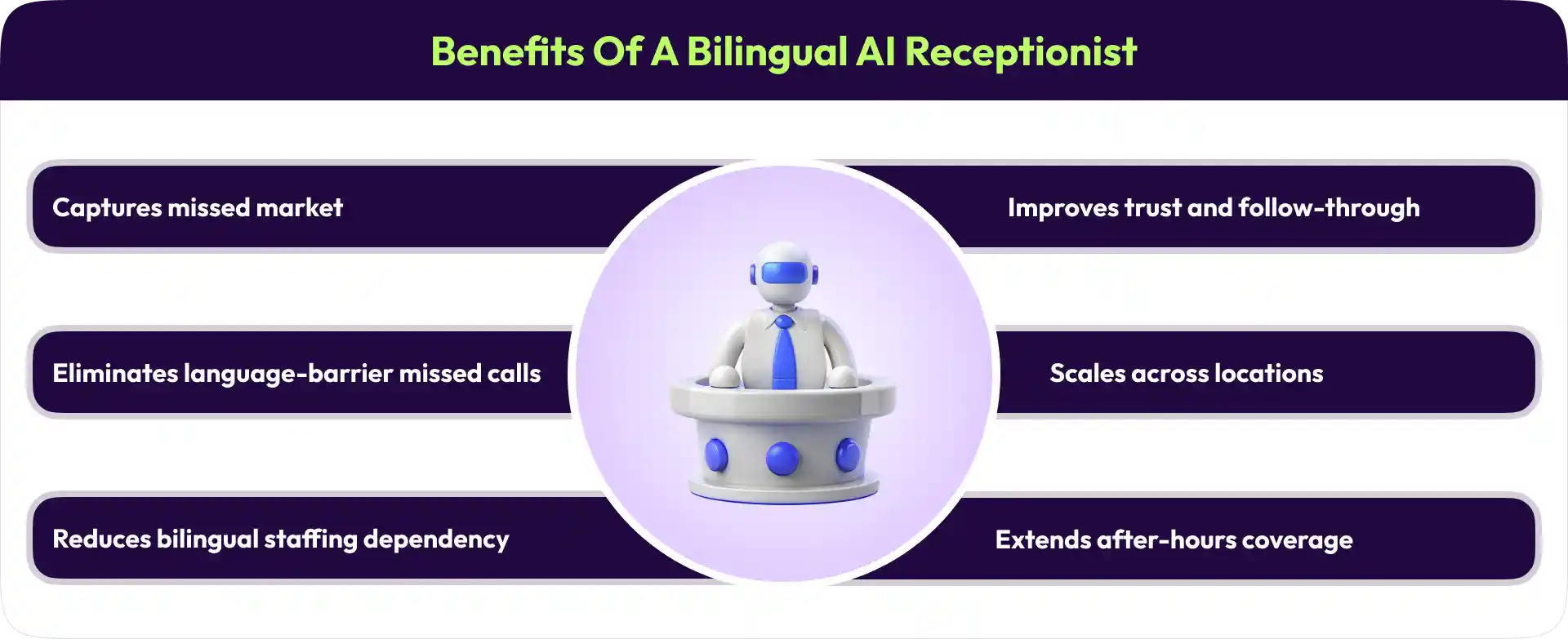
The case for a bilingual AI voice agent goes well beyond convenience. Here is what it actually changes for a Texas dental practice.
1. Captures a patient base that competitors are missing
With nearly 7.8 million Spanish speakers in Texas, a practice that cannot serve them fluently is handing that market to whichever competitor can. An AI receptionist opens the phone line to the full local population, not just the English-speaking share of it.
2. Eliminates missed calls from language barriers, not just staffing gaps
Every unanswered or mishandled Spanish-language call is a booked appointment that goes to a competitor instead. An AI voice agent answers every call in either language on the first ring.
3. Reduces dependency on hard-to-find bilingual staff
Bilingual front desk talent is difficult to recruit and expensive to retain in competitive Texas metro markets. An AI receptionist delivers fluent, consistent bilingual service without adding a specialized hire to payroll.
4. Improves patient trust and follow-through
As the language-concordant care research shows, patients who are served in their preferred language report higher trust, better understanding of instructions, and stronger satisfaction, all of which translate into fewer no-shows and better treatment acceptance.
5. Extends coverage to evenings and weekends
Spanish-speaking working parents often call outside standard business hours. An AI receptionist captures those calls instead of losing them to voicemail.
6. Creates a scalable advantage for growth
As a practice adds locations across Texas, from Dallas to Houston to El Paso, a bilingual AI voice agent scales instantly across every phone line without needing to separately staff and train bilingual receptionists at each site.
Bilingual AI in Action: Use Cases Across Texas Dental Practices
Solo practice in San Antonio
A single-dentist family practice on the city's West Side serves a patient base that is majority Spanish-speaking. Without a dedicated bilingual hire, the owner relied on whichever staff member happened to be available to translate. A voice AI now answers every call fluently in Spanish or English and books directly into the practice's schedule.
Group practice in Dallas-Fort Worth
A four-location group practice found that Spanish-speaking callers were disproportionately landing in voicemail during peak hours because only one location had a bilingual staff member. Deploying a bilingual AI receptionist across all four locations standardized the experience and immediately increased booked calls from Spanish-speaking patients.
DSO expanding into El Paso and the Rio Grande Valley
A dental service organization expanding into majority-Hispanic border markets used a bilingual AI voice agent to launch new locations without first needing to hire and train bilingual front desk teams from scratch, allowing new offices to open fully staffed for phone coverage on day one.
How Do You Choose the Right Bilingual AI Receptionist?
Not every AI voice agent handles Spanish the same way. Practice owners evaluating options should ask a few direct questions before choosing a vendor.
1. Confirm the system offers true bilingual conversation, meaning it detects and responds in the caller's language automatically, rather than requiring a menu selection.
2. Verify the AI integrates directly with your existing practice management system, so bookings sync without manual entry.
3. Ask how the system escalates emergencies. A caller in pain, in either language, needs a clear path to urgent care, not a dead end.
4. In addition, ask about HIPAA compliance and whether the vendor signs a Business Associate Agreement, since any system handling patient scheduling and health information must meet the same privacy standards as your practice.
5. Request a sample call recording in Spanish, not just English, to judge whether the voice and phrasing sound natural to a native speaker rather than mechanically translated.
What Is the Future of Bilingual AI Receptionists in Dentistry?
Three trends are likely to shape bilingual AI adoption in dental practices over the next 12 to 18 months.
1. AI voice agents will expand beyond English and Spanish into additional languages as practices in diverse metro areas like Houston serve growing Vietnamese, Mandarin, and Arabic-speaking populations.
2. Bilingual AI systems will increasingly handle post-appointment follow-up, not just inbound booking, sending reminders and care instructions in the patient's preferred language automatically.
3. Expect deeper integration between AI receptionists and insurance verification tools, so a Spanish-speaking patient can book an appointment and have their coverage confirmed in the same call, in the same language, without a separate step.
Final Thought
The language gap at the front desk is not a small operational detail. It is the difference between capturing or losing a large share of the Texas dental market. With millions of Spanish-speaking residents across Austin, Dallas, Houston, San Antonio, El Paso, and Plano, practices that cannot serve callers fluently in their preferred language are turning away patients before they ever become patients at all.
A bilingual dental receptionist powered by AI closes that gap immediately. It answers every call, in English or Spanish, at any hour, and books directly into the practice's real schedule. As Texas's Hispanic population continues to grow through 2026 and beyond, the practices that adapt now will be the ones building lasting patient relationships, while the ones that wait will keep losing callers to voicemail.
Frequently Asked Questions (FAQs)
1. Does a bilingual AI receptionist really understand natural spoken Spanish, or does it require simple commands?
A well-built AI voice agent understands natural conversational Spanish, including regional phrasing, not just rigid commands. It detects the caller's language automatically and responds fluently, the same way a bilingual staff member would, without forcing the caller through a menu.
2. Will a bilingual AI receptionist replace my bilingual front desk staff?
No. Most practices use an AI voice agent to handle high call volume, after-hours calls, and overflow, freeing bilingual staff to focus on in-office patients and more complex conversations. It is designed to support your team, not eliminate it.
3. Is a bilingual AI receptionist HIPAA compliant?
Yes, when built correctly. Look for a vendor that signs a Business Associate Agreement and encrypts patient data end-to-end, including calls handled in Spanish. Alris AI operates under a signed BAA for every practice it serves.
4. Which practice management systems work with a bilingual AI receptionist?
Alris AI integrates with Dental systems, so appointments booked in either English or Spanish sync directly into your existing schedule without manual data entry.
5. How quickly can a Texas dental practice add bilingual phone coverage?
Most practices can implement a bilingual AI voice agent within a few weeks, including integration with their existing scheduling system. Multi-location groups and DSOs can typically roll it out across all sites on the same timeline.
6. Does the AI receptionist handle dental emergencies in Spanish?
Yes. A properly configured AI voice agent recognizes emergency language in either English or Spanish and escalates the call to on-call staff immediately, rather than treating it as a routine booking request.
7. Which Texas cities benefit most from a bilingual AI receptionist?
Practices in San Antonio, El Paso, Houston, Dallas, Austin, and Plano see the strongest impact, given their large Spanish-speaking populations, though any practice serving a mixed-language patient base benefits from removing the language barrier on the phone line.
Sources & References:
All sources were verified in June 2026.
1. U.S. Census Bureau. "Language Spoken at Home, American Community Survey
2. Patient Satisfaction With Language-Concordant Provider Encounters. PMC.
Shravan Rajpurohit
CEO & Co-Founder
Shravan Rajpurohit is the Co-Founder & CEO of The Intellify, a leading Custom Software Development company that empowers startups, product development teams, and Fortune 500 companies. With over 10 years of experience in marketing, sales, and customer success, Shravan has been driving digital innovation since 2018, leading a team of 50+ creative professionals. His mission is to bridge the gap between business ideas and reality through advanced tech solutions, aiming to make The Intellify a global leader. He focuses on delivering excellence, solving real-world problems, and pushing the limits of digital transformation.

Stay Updated
with AI Insights
Get the latest articles on AI, automation, and enterprise technology delivered to your inbox weekly.

500+ people have already subsribed!
No spam. Unsubscribe anytime.