
The Hidden Cost of Missed Patient Calls: How Medical Practices Lose Revenue and Patients



Summary: Missed patient calls can cost medical practices valuable appointments, potential revenue, and patient trust. Discover why US clinics struggle to manage incoming calls, how unanswered inquiries affect front-desk operations, and practical ways to improve patient access. Learn how an AI-powered voice agent for clinics helps medical practices answer calls, manage appointment requests, and streamline patient communication.
The Cost of a Missed Patient Call
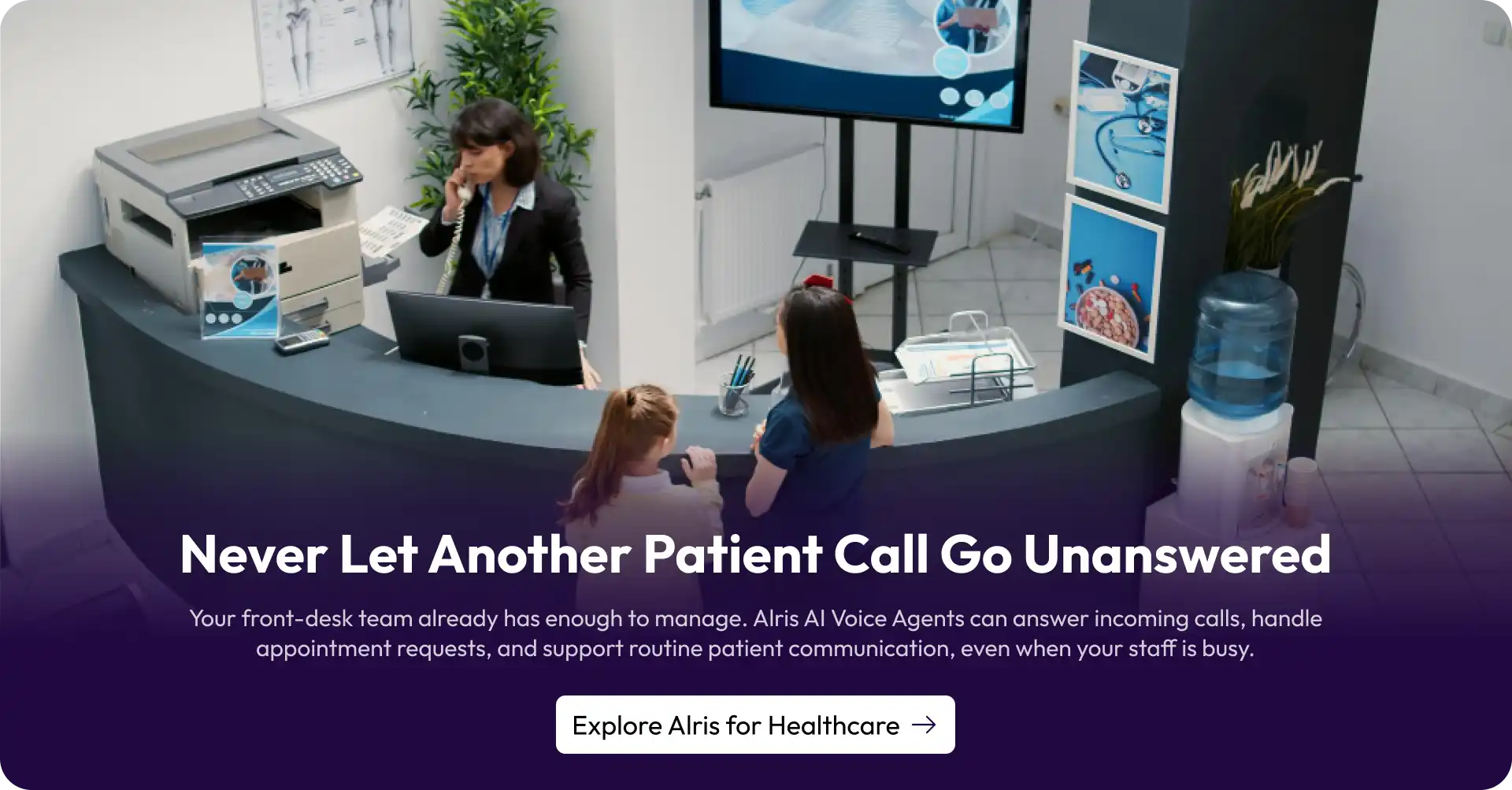
A patient calls your medical office to schedule an appointment. The front desk is busy checking in another patient. The phone rings a few times, then goes unanswered. The caller hangs up.
It might seem like a small thing. But what if that person was a new patient looking for a primary care provider? Or someone trying to book an appointment with a specialist who has limited availability?
That unanswered call could mean a lost appointment, a missed opportunity to build a patient relationship, or even a patient choosing another healthcare provider.
Phone communication still plays a major role in US healthcare. A 2025 study published in Health Affairs Scholar found that 72.1% of surveyed US adults had used phone calls to schedule medical appointments during the previous year. More importantly, 56.4% identified phone calls as their primary scheduling method.
This tells us something important: despite the growth of patient portals and online booking, the telephone remains a key part of patient access.
For medical practices, the real question isn't simply how many calls go unanswered. It's what those missed connections mean for revenue, patient experience, and everyday operations.
Why Missed Patient Calls Are a Growing Problem for US Medical Practices
Medical practices handle a steady flow of calls throughout the day. Some are simple questions about office hours. Others involve new patient inquiries, appointment requests, insurance information, and follow-ups.
The problem starts when incoming calls compete with everything else happening at the front desk.
1. Patients Still Depend on Phone Calls to Reach Medical Offices
Not every patient wants to use an online portal or fill out a booking form. Some prefer speaking with someone before choosing a provider or scheduling a visit.
This is particularly relevant for patients who:
Are looking for a new primary care physician.
Need an appointment with a specialist.
Want to confirm whether a practice accepts their insurance.
Have questions about appointment availability.
Need help understanding the next steps before their visit.
For many people, a phone call is still the easiest way to get an answer.
2. Front-Desk Teams Have More Responsibilities Than Answering Calls
Medical receptionists and front-office staff rarely spend their entire day answering phones. They're also checking patients in, managing paperwork, verifying insurance details, coordinating schedules, and handling administrative requests.
A receptionist might answer one call while another patient is waiting at the counter. Something has to give. Even well-staffed practices can struggle during busy periods, especially when several patients call at once.
3. When Call Volume Exceeds Staff Capacity
Call volumes aren't always predictable. Monday mornings, lunch hours, and the beginning of the workday can bring a rush of appointment requests.
When multiple calls arrive together, staff may place callers on hold, send calls to voicemail, or miss them altogether.
The workload behind these calls is also growing. In a March 2026 poll of 294 practice leaders, MGMA found that 45% identified eligibility and prior authorization as their most time-consuming phone tasks, while 31% pointed to appointment scheduling.
The result is a front desk that has to manage patient communication while keeping several other workflows moving.
How Much Revenue Can Missed Patient Calls Cost a Medical Practice?
A missed call doesn't automatically mean lost revenue. Some callers may only need directions or basic information. Others might be existing patients calling about non-billable administrative matters.
But when an unanswered call comes from someone ready to schedule an appointment, the financial impact can be real.
Every Unanswered Call Can Represent a Lost Appointment Opportunity
Think about a person searching online for a family medicine clinic. They find your practice, check the services offered, and call to ask about availability.
Nobody answers. They might leave a voicemail. They might call again later. Or, quite possibly, they'll contact another clinic.
This is where missed calls become a patient acquisition issue. Your practice may have invested in local SEO, Google Business Profile optimization, paid advertising, and other marketing activities to attract potential patients. But if those people cannot reach your front desk, some of that effort may not translate into appointments.
The same applies to existing patients who struggle to contact your office when they need another visit.
Calculate the Potential Revenue Lost From Missed Calls
There isn't one reliable national figure for how much a missed patient call costs a medical practice. The amount depends on the specialty, appointment type, conversion rate, and average collected revenue.
However, practices can estimate their potential exposure using a simple calculation. Consider this example:
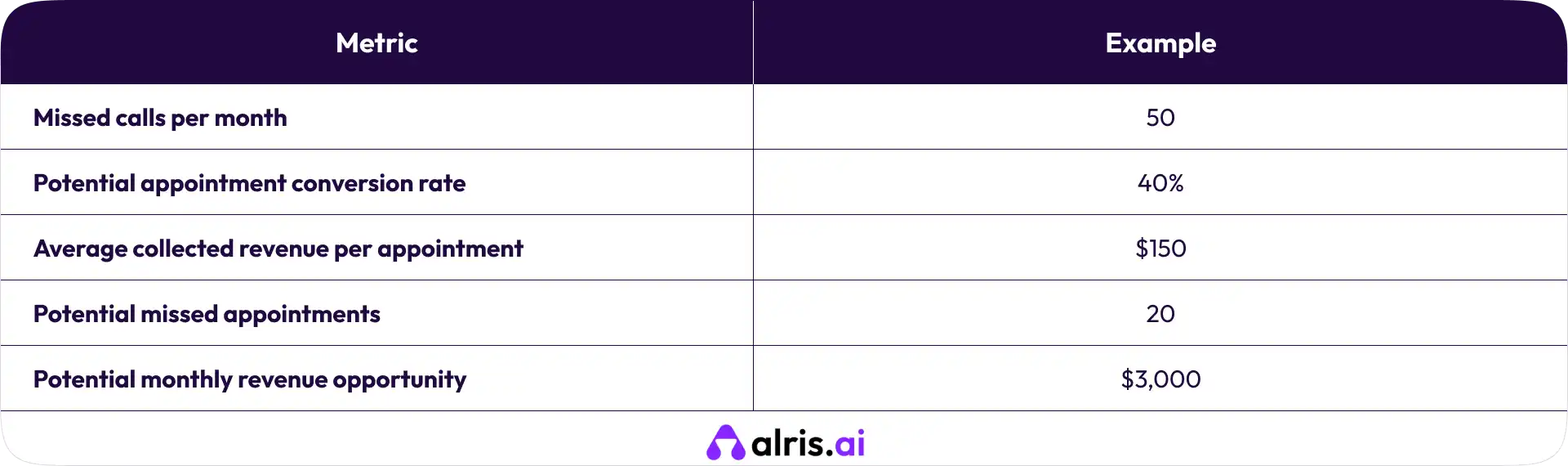
Potential annual revenue opportunity: $36,000.
Here's the calculation:
50 missed calls × 40% potential booking conversion = 20 appointments.
20 appointments × $150 = $3,000 per month.
Multiply that by 12 months, and the annual figure reaches $36,000.
These numbers are illustrative assumptions, not an industry benchmark or guaranteed financial loss. Not every missed caller is a prospective patient, and not every appointment request will convert into a completed, paid visit.
Still, the calculation helps practice managers understand why tracking missed calls is worth the effort.
Why New Patient Calls Can Be Particularly Valuable
A new patient inquiry can be the beginning of a longer relationship with a medical practice.
Depending on the specialty, that relationship may involve annual wellness visits, follow-up appointments, preventive care, or ongoing treatment.
When a potential patient cannot get through, the practice may lose more than one appointment opportunity. It may lose the chance to build a relationship over time.
That's why missed calls deserve attention alongside other patient acquisition and retention metrics.
The Financial Impact of Unfilled Appointment Slots
An unanswered call can also make it harder to keep the provider's schedule full.
For example, a clinic may have an available appointment slot but fail to connect with a patient looking to book. That opening could remain unused even though someone was actively searching for an appointment.
It's important to distinguish this from a patient no-show. A no-show happens when someone has already booked but doesn't attend. A missed call happens before or during the process of connecting with the practice.
Both can affect scheduling efficiency, but they require different solutions.
The Hidden Costs of Unanswered Patient Calls Beyond Revenue
Revenue is only one part of the problem. Unanswered calls can create other issues that affect how a medical practice operates.
1. Lost Patient Trust and Poor First Impressions
For a new patient, the first phone conversation may be their first direct interaction with your clinic.
If they repeatedly reach voicemail or spend too long on hold, it can leave a poor impression. They may question whether the practice will be responsive when they actually need care.
2. Patients Choosing Another Healthcare Provider
Patients usually have options, particularly in areas with several primary care or specialty practices.
When one clinic doesn't answer, another may pick up. A simple difference in phone accessibility can influence where a patient decides to book.
3. Increased Administrative Work for Front-Desk Staff
Missed calls don't always disappear. They often turn into voicemail backlogs, callback lists, and repeated attempts to contact patients.
Staff must find time to return calls while continuing to manage incoming requests and in-person responsibilities.
It becomes a cycle: missed calls create more work, and the additional work makes it harder to answer the next call.
4. Delayed Communication and Patient Access
Some calls involve time-sensitive administrative questions or requests that need to reach the appropriate staff member.
When communication gets delayed, patients may not know what to do next. Practices should have clear escalation processes for clinical concerns rather than relying on general voicemail or automated responses to manage them.
Why Medical Practices Miss Patient Calls
Most missed calls aren't the result of staff ignoring patients. They usually happen because the front desk has more work than it can handle at a particular moment.
Here are some common reasons.
High call volumes during peak hours: Several patients may call around the same time, particularly when the office opens or after weekends.
Limited front-desk staffing: Smaller practices may have only one or two people managing phones, check-ins, scheduling, and administrative tasks.
In-person patient responsibilities: Staff often need to prioritize patients who are physically present, leaving incoming callers waiting.
After-hours and weekend inquiries: Many patients look for appointments outside standard business hours. If the practice doesn't have an after-hours answering process, those calls may go unanswered.
Inefficient call routing and callback processes: Calls sent to the wrong department or voicemail box can take longer to resolve. Without a clear callback process, some inquiries may slip through.
Understanding the actual reasons behind missed calls is the first step toward reducing them.
How Medical Practices Can Reduce Missed Patient Calls
Medical practices don't necessarily need to hire more receptionists to improve phone access. In many cases, a combination of better processes and automation can make a meaningful difference.
Improve Front-Desk Call Management
Start by reviewing when most calls arrive and which types of inquiries take the longest. Assign clear responsibilities for answering calls, managing check-ins, and returning voicemails.
Even small changes to staff scheduling can help during predictable busy periods.
Introduce Callback and Call Queue Systems
Instead of leaving patients on hold indefinitely, consider a system that allows them to request a callback.
Keep track of missed calls and establish a reasonable response process. A callback system works best when someone is clearly responsible for following up.
Offer Online Appointment Scheduling
Online scheduling gives patients another way to book without waiting for someone to answer the phone.
It can reduce pressure on receptionists, particularly for routine appointments. However, it shouldn't be treated as a complete replacement for phone support. Patients may still need assistance with complex scheduling requests or other questions.
Use Automated Patient Reminders and Follow-Ups
Automated reminders can reduce the number of calls staff receive about appointment confirmations and basic scheduling details.
Practices can also use approved communication workflows to follow up on appointment requests and send relevant notifications.
The key is to make sure these messages are accurate, appropriate, and consistent with the patient's communication preferences.
Consider an AI-Powered Virtual Receptionist
An AI receptionist can provide another layer of phone coverage when staff is busy or unavailable.
Depending on its capabilities and integrations, it can answer routine inquiries, collect appointment requests, help schedule visits, and route calls to the right person.
It doesn't replace every front-desk responsibility. But it can help prevent routine calls from going unanswered simply because everyone is occupied.
What Should Medical Practices Look for in an AI Receptionist?
Choosing an AI receptionist involves more than checking whether it can answer a phone call. Medical practices should look for a solution that fits their existing operations and has clear boundaries.
Here are some important things to evaluate:
Natural voice interactions: Can patients communicate without struggling through rigid menus?
24/7 call answering: Can it handle calls during busy periods and after office hours?
Appointment scheduling: Can it connect with the practice's scheduling system and follow booking rules?
System integrations: Does it work with the tools the practice already uses?
Human call transfer: Can it route callers to staff when a request needs attention?
Call logs and reporting: Can managers review conversations, call outcomes, and recurring issues?
Healthcare data safeguards: Are the necessary agreements, access controls, and security measures in place?
Customizable workflows: Can the system reflect the clinic's actual processes instead of forcing staff to change everything?
A good solution should make patient communication easier, not introduce another complicated system for the team to manage.
How AI Voice Agents Help Medical Practices Capture More Patient Calls
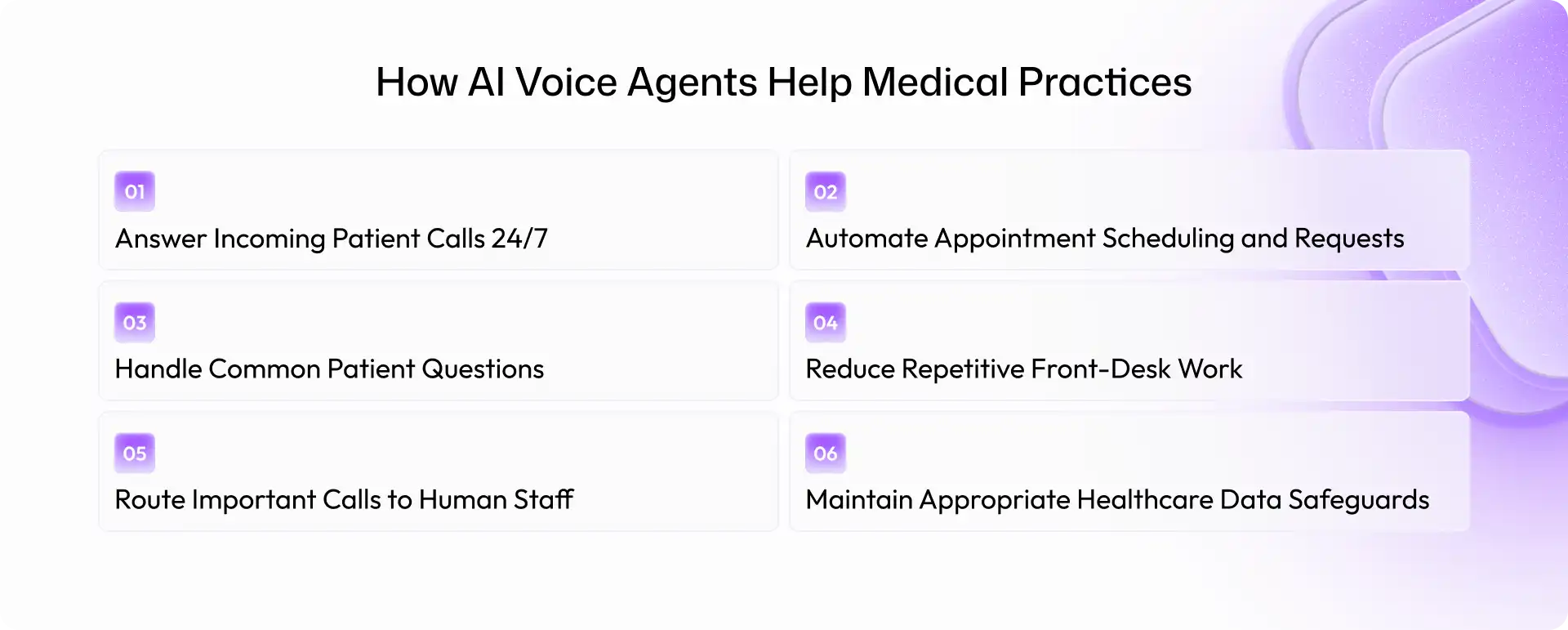
An AI voice agent can act as an additional point of contact for a medical practice. Rather than sending every unanswered call to voicemail, the system can interact with callers and complete configured tasks.
Here's where it can help.
1. Answer Incoming Patient Calls 24/7
Patients don't always call during convenient hours. Someone might search for a provider late in the evening or want to check appointment availability over the weekend.
An AI voice agent can answer calls beyond normal office hours, provide approved information, and capture requests for the team to review.
This gives patients another way to reach the practice without requiring front-desk staff to work around the clock.
2. Automate Appointment Scheduling and Requests
Scheduling is one of the most common reasons patients contact medical offices.
When connected to a supported scheduling system and configured with the practice's rules, an AI voice agent can help callers find available slots, book appointments, or submit scheduling requests.
It can also handle certain rescheduling and cancellation workflows, depending on the integration.
3. Handle Common Patient Questions
Not every call requires a receptionist. Patients often ask about office hours, clinic locations, available services, or general appointment procedures. An AI voice agent can respond using information approved by the practice.
For questions it cannot answer confidently, it should transfer the caller or direct the request to the appropriate staff member.
4. Reduce Repetitive Front-Desk Work
When routine calls are handled through automated workflows, receptionists can spend more time assisting patients who are physically present or need individual attention.
This doesn't mean removing the human element from healthcare. It means giving staff more room to focus on work that genuinely needs them.
5. Route Important Calls to Human Staff
Automation should have clear boundaries. A patient reporting concerning symptoms, requesting clinical advice, or raising an issue that needs staff judgment should not be left to a general-purpose automated conversation.
AI voice agents should follow defined escalation rules, transfer calls when appropriate, and provide a clear route to human assistance.
6. Maintain Appropriate Healthcare Data Safeguards
Healthcare practices must take patient information seriously when choosing any automated communication platform.
If a technology provider creates, receives, maintains, or transmits protected health information on behalf of a covered entity, HIPAA business associate requirements may apply. HHS guidance explains that an appropriate Business Associate Agreement (BAA) and applicable safeguards are required in these circumstances.
Before implementation, practices should review data handling, access controls, retention policies, vendor agreements, and security practices.
An AI receptionist alone does not make a medical practice HIPAA-compliant. The entire workflow and technology arrangement need to be assessed.
Every Patient Call Deserves an Answer
Missed patient calls may seem like a small operational issue, but their impact can extend across revenue, patient acquisition, and front-desk efficiency.
For US medical practices, the challenge is finding a practical way to stay accessible while managing everyday responsibilities. Better call management, online scheduling, callback systems, and AI voice agents can all help.
The goal isn't to remove human interaction. It's to make sure patients have a reliable way to reach the practice, even when staff is occupied.
With Alris Voice AI solutions, medical practices can explore a more consistent approach to incoming calls, appointment requests, and routine patient communication.
Frequently Asked Questions (FAQs)
1. How much revenue does a missed patient call cost?
There is no fixed cost for every missed patient call. It depends on whether the caller is a prospective patient, the likelihood of booking, and the average collected revenue per appointment. Practices can estimate the potential impact by tracking missed calls and their eventual booking outcomes.
2. What percentage of calls do medical practices miss?
There is no universally accepted national benchmark for missed calls across US medical practices. Call volumes and answer rates vary by practice size, specialty, staffing, and operating hours. Clinics should measure their own missed-call rate using phone system reports.
3. Why do patients call medical offices?
Patients commonly call to schedule, reschedule, or cancel appointments; ask about office hours and services; confirm insurance acceptance; request administrative assistance; and speak with staff about follow-up questions.
4. How can medical practices reduce missed patient calls?
Practices can improve call management, introduce callback systems, offer online scheduling, use automated reminders, and implement AI-powered voice agents to handle routine inquiries and appointment requests.
5. Can AI answer calls for a medical office?
Yes. An AI voice agent can answer incoming calls, respond to configured questions, capture appointment requests, support scheduling workflows, and transfer calls to staff. Its capabilities depend on the platform, integrations, and practice-specific configuration.
6. Is an AI receptionist HIPAA-compliant?
An AI receptionist is not automatically HIPAA-compliant simply because it is used in healthcare. Practices must evaluate how the provider handles protected health information, whether a Business Associate Agreement is required, and whether appropriate safeguards are in place.
Sources & References:
1. Health Affairs Scholar - What Methods Do Patients Use to Schedule Medical Appointments?
2. MGMA - Phones Are Still a Bottleneck Costing Medical Practices Time They Can't Afford
3. MGMA - Patient Access Priorities for 2026
Shravan Rajpurohit
CEO & Co-Founder
Shravan Rajpurohit is the Co-Founder & CEO of The Intellify, a leading Custom Software Development company that empowers startups, product development teams, and Fortune 500 companies. With over 10 years of experience in marketing, sales, and customer success, Shravan has been driving digital innovation since 2018, leading a team of 50+ creative professionals. His mission is to bridge the gap between business ideas and reality through advanced tech solutions, aiming to make The Intellify a global leader. He focuses on delivering excellence, solving real-world problems, and pushing the limits of digital transformation.

Stay Updated
with AI Insights
Get the latest articles on AI, automation, and enterprise technology delivered to your inbox weekly.

500+ people have already subsribed!
No spam. Unsubscribe anytime.