
Why Your Dental Answering Service Is Not Enough Anymore



Summary: 41% of patient calls to dental practices happen outside business hours, yet most dental answering services only take messages and call back the next morning. By that time, the patient has already booked elsewhere. This guide breaks down the real limitations of a traditional dental answering service, how AI voice agents handle those same calls differently, and the direct business impact dental practices see when they make the switch. Practices across the US, including fast-growing markets in Texas, are using AI voice agents to recover after-hours patients, reduce front desk workload, and compete with larger DSO chains on patient access.
A dental answering service was a practical solution when it was introduced. Patients called, a live operator picked up, took their details, and sent a message to the front desk. Your team followed up the next morning. Everyone expected that process, and it worked.
That expectation has changed. Today, 41% of patient calls to medical and dental practices happen outside standard business hours, according to the Relatient Communications Study, 2025. Patients search for dentists in the evenings, on weekends, and during their lunch breaks. When they find a practice they like, they call right then. If they reach a service that can only take a message, most of them do not wait for a callback. They search again and book with whoever responds first.
For dental practices across the United States, this is not a minor inconvenience. It is a patient acquisition gap that compounds every week. In high-growth markets like Houston, Dallas, Austin, and San Antonio, where competition for new patients is intense, and thousands of new residents move in each year, an after-hours call that results in a message is often a patient permanently lost to a competitor.
This guide explains why the traditional dental answering service falls short, what AI voice agents do differently, and what the shift means for patient numbers, staff efficiency, and revenue at your practice.
The Problem: After-Hours Calls That Never Become Patients
Dental practice owners often focus their patient acquisition efforts on business hours. However, the data points to a different reality. A significant share of patient calls, particularly from new patients, happen when the front desk is unavailable.
Here is what the numbers show:
41% of patient calls to medical and dental practices occur outside 9 AM to 5 PM weekday hours.
Patients searching for a new dentist are most active in the evenings and on weekends, when they have time to research and act
When patients cannot book on the first call, the majority move on to the next practice without leaving a voicemail or waiting for a callback.
Texas alone added over 500,000 new residents in 2023, all of whom are actively seeking healthcare providers, including dentists.
Moreover, this problem is not exclusive to large practices. Solo dentists, group practices, and multi-location clinics all face the same gap. A traditional dental answering service covers the phone but cannot close the booking. As a result, patients who were ready to schedule walk away unconverted.
The cost adds up fast. According to Dental Economics, the average dental patient has a lifetime value of $12,000 to $15,000. Losing a new patient to an unanswered after-hours call is not just a missed booking; it is a decade of relationship and revenue that never begins.
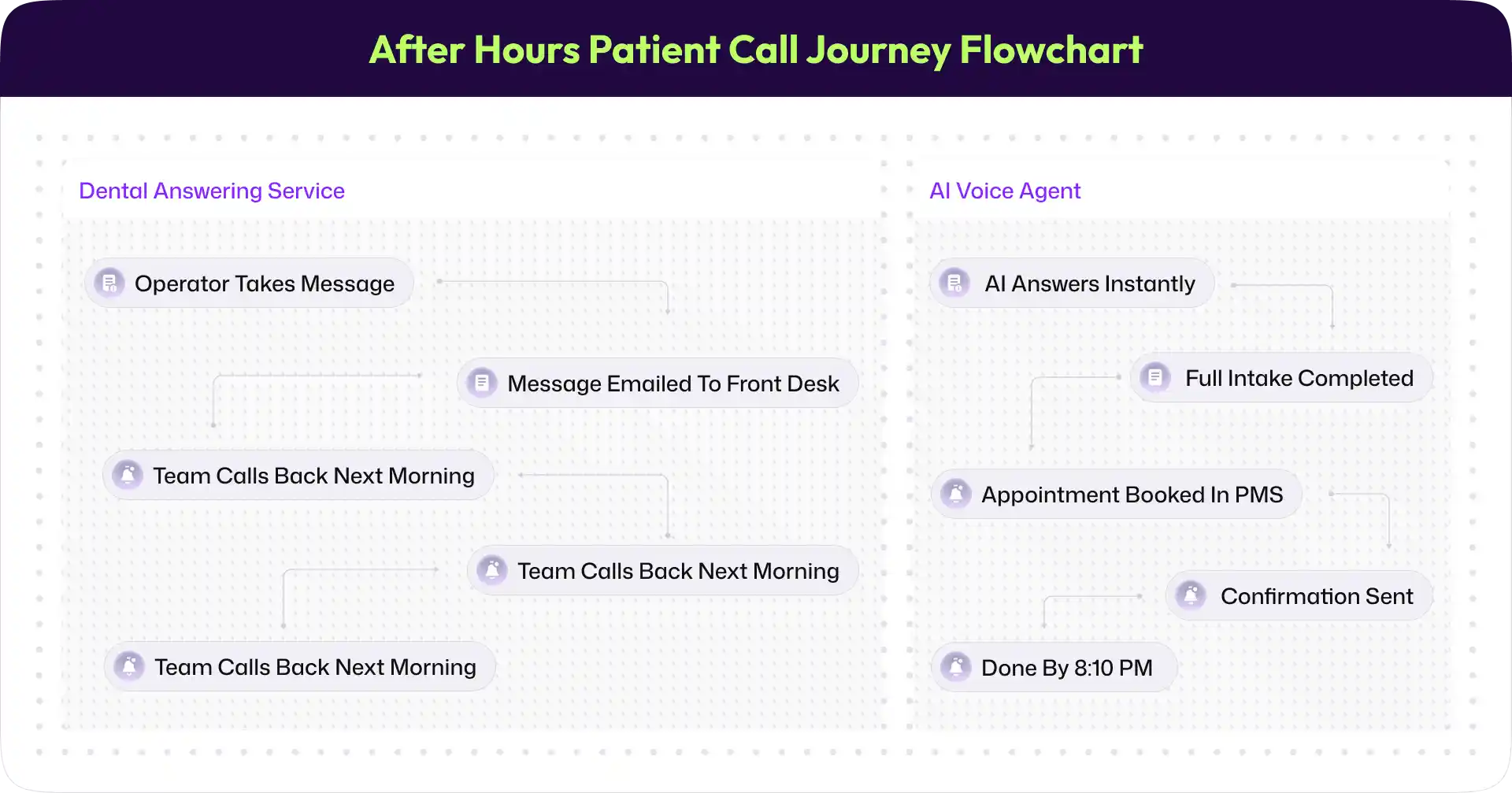
What a Dental Answering Service Actually Does (And What It Does Not)
A dental answering service provides human operators who answer calls when your front desk is unavailable, collect basic patient information, and relay a message to your practice. That is its designed function, and it performs that function reliably.
The issue is not that dental answering services fail at what they are built to do. The issue is that what they are built to do is no longer enough.
Here is what a traditional dental answering service cannot do:
Book, confirm, or reschedule appointments in real time
Access or update your practice management system
Answer specific questions about your services, accepted insurance plans, or appointment availability
Handle multiple simultaneous calls without hold time or dropped calls
Follow up automatically if a patient does not respond to a callback
Deliver a consistent, scripted experience on every single call
In addition, the pricing model adds cost without adding conversion. Traditional dental answering services charge $1 to $3 per minute, with monthly totals ranging from $200 to $800 or more, depending on call volume. A standard new patient call runs 5 to 8 minutes. At $3 per minute, that is up to $24 per call just to take a message.
For example, a practice that receives 40 after-hours calls per month is potentially paying $300 to $800 for a service that delivers 40 messages but zero bookings. Meanwhile, each of those callers is a potential new patient worth $12,000 to $15,000 in lifetime production who needs a dentist right now.
How an AI Voice Agent Handles the Same Call
A dental AI voice agent is a phone-based AI system built specifically for dental patient conversations. It answers inbound calls, guides patients through the intake process, and books appointments directly into the practice management system in real time. It does not take a message; book the appointment on the first call.
Here is what an AI voice agent completes in a single after-hours interaction:
Collects patient name, contact details, and reason for visit
Gathers insurance plan information and confirms basic details
Identifies the appropriate appointment type and confirms provider availability
Books directly into the PMS calendar without front desk involvement
Sends an automated booking confirmation to the patient before the call ends
The average interaction takes 3 to 5 minutes. The patient hangs up with a confirmed appointment and a confirmation in their inbox. Your front desk arrives the next morning to a booked schedule, not a list of callbacks to chase.
Furthermore, AI voice agents handle unlimited simultaneous calls at the same quality level. There are no hold times, no dropped calls during high-volume periods, and no variation in patient experience based on which operator is working.
Business Benefits of Switching to a Dental AI Voice Agent
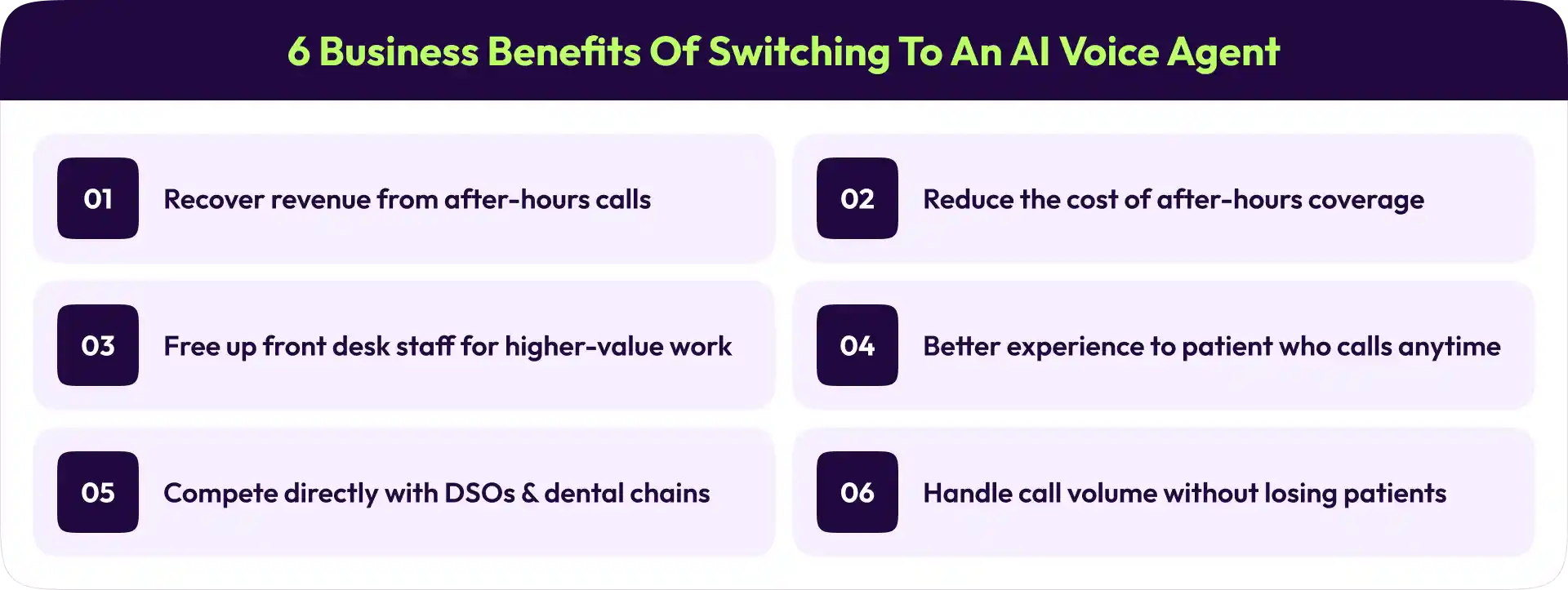
The shift from a traditional dental answering service to an AI voice agent is not just a technology upgrade. It produces measurable business outcomes for dental practices of all sizes.
1. Recover revenue from after-hours calls that currently convert to nothing
When after-hours calls result in messages instead of bookings, that revenue disappears. AI voice agents convert those same calls into confirmed appointments in real time. For a practice receiving 20 after-hours new patient calls per month, converting even half adds up to immediate monthly production gains. Over a 10-year patient relationship, each of those bookings represents $12,000 to $15,000 in lifetime production value (Dental Economics).
2. Reduce the cost of after-hours coverage
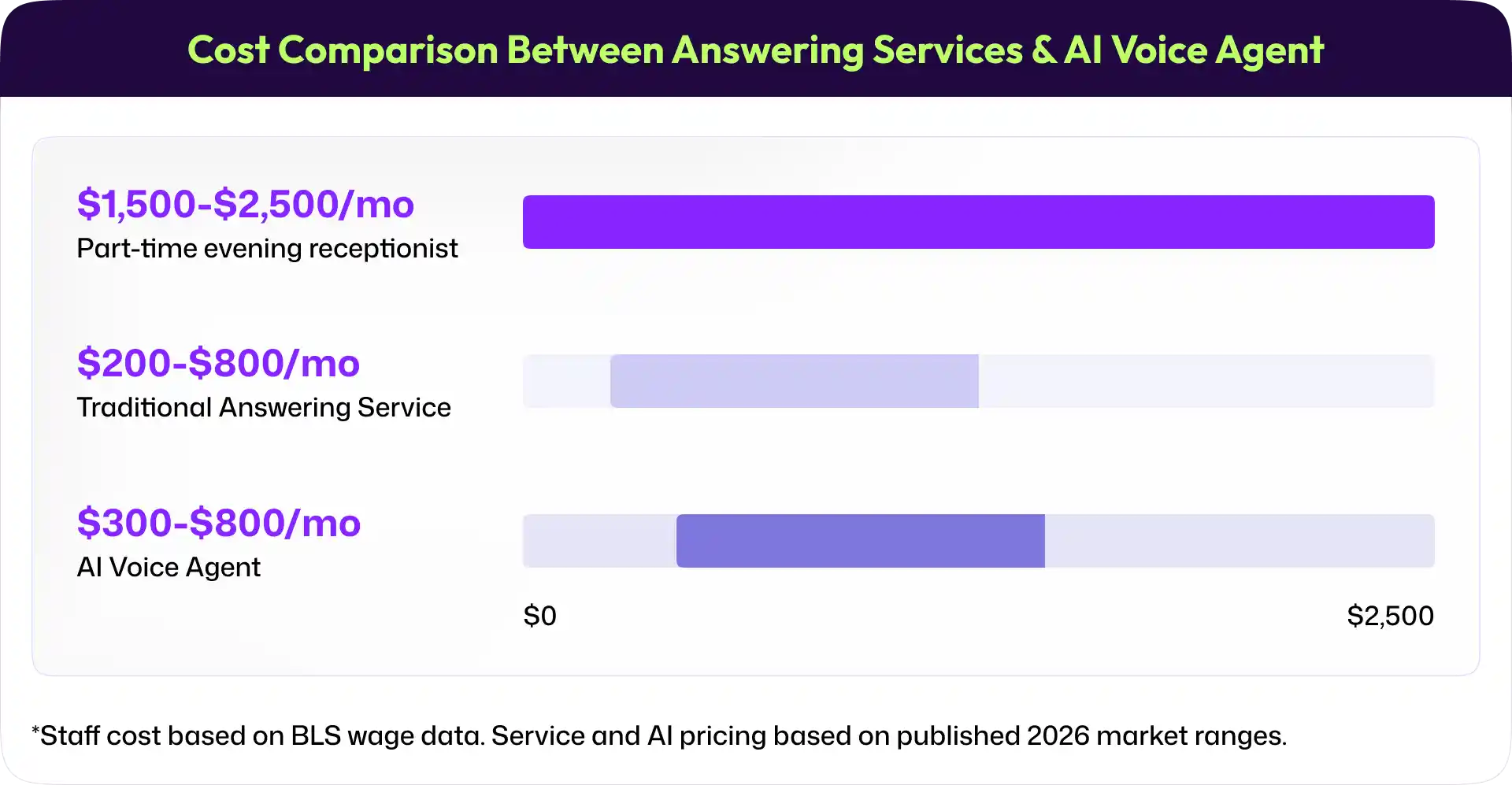
Hiring a part-time evening receptionist costs $1,500 to $2,500 per month before benefits and overhead. A traditional dental answering service costs $200 to $800 per month at $1 to $3 per minute, but only takes messages. An AI voice agent runs $300 to $800 per month on a flat rate, handles unlimited calls, and books patients without any additional staffing. As a result, practices get more output at a lower or comparable cost.
3. Free up front desk staff for higher-value work
When AI handles after-hours calls, the front desk no longer starts each morning with a backlog of overnight messages to follow up on. That time typically 30 to 60 minutes per morning per front desk team member shifts to patient-facing tasks, insurance verification, and treatment plan follow-ups. Meanwhile, the appointments are already in the system from the night before.
4. Deliver a better experience to every patient who calls after hours
Patients who call after hours and reach a system that books them immediately report a better first impression than patients who leave a message and wait. A confirmed appointment sent instantly builds confidence in the practice before the patient ever walks through the door. In addition, there is no risk of the callback going to voicemail or the patient losing interest overnight.
5. Compete directly with DSOs and large dental chains on patient access
Large DSO networks and multi-location dental chains already offer 24/7 phone coverage with booking capability. Independent practices using a traditional dental answering service cannot match that responsiveness. AI voice agents give solo and small-group practices the same 24/7 patient access that large chains have, without the headcount or the overhead.
6. Handle call volume spikes without losing patients
Monday mornings after a long weekend, the days following a holiday, and seasonal busy periods create predictable call spikes that overwhelm front desk staff. AI voice agents handle any volume of simultaneous calls with no reduction in quality. No patient waits on hold. No call goes unanswered because the lines are busy.
Industry Use Cases: Which Dental Practices See the Most Impact
Solo and small-group practices competing with DSOs
A solo dentist or a two-dentist practice cannot staff evening and weekend phones without a high additional cost. For example, a solo practitioner in Plano, Texas, competing against a DSO-affiliated clinic down the street, faces a real patient acquisition disadvantage if that competitor answers calls at 8 PM and the solo practice does not. AI voice agents eliminate that gap entirely, giving small practices the same after-hours booking capability that large chains have built into their operations.
Practices in high-growth markets across the US
Cities like Austin, Houston, San Antonio, Nashville, Phoenix, and Charlotte are adding new residents at some of the fastest rates in the country. Each new household represents a patient actively looking for a dentist. In these markets, practices that respond to after-hours inquiries immediately capture new patients at a rate that practices relying on next-morning callbacks simply cannot match. Meanwhile, the competition for those same new patients intensifies as more practices open in growing metro areas.
Multi-location group practices managing after-hours coordination
Groups managing two or more locations face coordination challenges with separate answering service contracts, inconsistent call handling across locations, and manual booking routing. A single AI voice agent system handles all locations, routes calls to the correct site based on patient ZIP code or provider availability, and books directly into each location's PMS without any manual coordination. As a result, every location delivers a consistent after-hours experience.
What Implementation Looks Like for a Dental Practice
Moving from a traditional dental answering service to an AI voice agent typically takes 1 to 2 weeks from contract to go-live. The process is straightforward and does not disrupt daily operations.
Week 1: Configuration
Practice information is loaded: services, accepted insurance plans, provider schedules, appointment types, and booking rules
Practice management software integration is configured and tested to confirm real-time booking capability
Emergency call protocols are defined: what happens when a patient reports severe pain, a broken tooth, or a dental emergency requiring immediate attention
Week 2: Testing and Go-Live
Test calls are run across common scenarios: new patient booking, existing patient reschedule, insurance inquiry, and emergency call
Front desk staff are briefed on how AI-booked appointments appear in the PMS and how to review call logs
Go-live begins with AI handling after-hours calls, with optional expansion to business-hours overflow based on call volume and practice needs
Before committing to any provider, confirm two things: which practice management software the platform integrates with, and whether that integration allows real-time two-way booking write-back or is limited to read-only access. This distinction determines whether your PMS updates automatically or still requires manual entry.
Where Dental AI Voice Agents Are Heading Next
The current generation of dental AI voice agents handles intake, scheduling, basic FAQ responses, and emergency call routing. Three capabilities are coming into wider deployment over the next 12 to 18 months:
Real-time insurance verification during the intake call
Rather than verifying insurance the following morning, AI voice agents will confirm basic coverage eligibility before the patient hangs up. For practices in Texas, where the insurance mix includes a complex combination of Medicaid, PPO, and HMO dental plans, this capability will cut verification workload significantly and reduce same-day cancellations due to coverage confusion.
Outbound recall and reactivation campaigns
The same AI that handles inbound calls will proactively reach out to patients overdue for cleanings or with open treatment plans. According to industry data, the average dental practice loses 20 to 30% of its active patient base to attrition each year. AI-powered outbound recall can reactivate a significant share of those lapsed patients within 90 days, recovering revenue without adding staff.
Multilingual call handling as a standard feature
Spanish-language AI voice agents are already in deployment at select platforms and will become standard across the market. In San Antonio, El Paso, Houston, Los Angeles, Miami, and dozens of other US markets, a significant share of dental patients prefer to communicate in Spanish. Practices that can serve those patients fluently in their first language gain a meaningful patient experience advantage.
Final Thought: The Dental Answering Service Still Picks Up. But AI Books the Patient.
A traditional dental answering service was the right solution for its time. It answered the phone, kept a record of who called, and gave the front desk something to work from the next morning. That process made sense when patients were willing to wait.
Most patients are not willing to wait anymore. They call when they are ready. If the dental answering service cannot book them at that moment, the opportunity is gone. The patient books with whoever can.
AI voice agents do not replace every function a dental answering service performs. They replace the one function that matters most: converting an after-hours call into a confirmed appointment. For practices focused on growing their patient base, reducing staff overhead, and keeping pace with larger competitors, that difference is what determines which patients they keep and which ones they lose. The dental answering service still picks up. But the AI voice agent books the patient.
Frequently Asked Questions
1. Can a dental AI voice agent handle after-hours dental emergencies?
Yes, when properly configured. During setup, practices define emergency call protocols based on their specific needs. When a patient describes severe pain, a broken tooth, significant swelling, or trauma, the AI voice agent can immediately send an urgent alert to an on-call dentist, connect the caller to emergency dental resources, or follow a custom escalation path defined by the practice. The specific protocol is configured before go-live and can be updated at any time.
2. Will patients know they are talking to an AI and not a human?
This depends on the provider's configuration and disclosure approach. Some dental AI voice agents identify themselves as AI at the start of the call. Others use a named virtual receptionist persona without proactively identifying as AI. Practices should review FTC guidance on AI disclosure in consumer interactions and configure their system to align with their patient communication standards and any applicable state-level requirements in their market.
3. How quickly can a dental practice switch from an answering service to an AI voice agent?
Most dental AI voice agent implementations take 1 to 2 weeks from contract signing to go-live. The timeline includes configuration of practice information, PMS integration setup, emergency escalation protocol definition, test calls, and front desk training on accessing the system. Some providers offer faster onboarding for practices with simpler scheduling structures, bringing the timeline to under a week.
4. Does a dental AI voice agent integrate with my practice management software?
Integration capability varies by provider, so this is one of the most important questions to ask before selecting a platform. The key question is whether the integration allows real-time two-way booking write-back, meaning the AI can write confirmed appointments directly into your PMS without manual entry, or whether it only reads availability without updating the calendar. Leading dental AI voice agents support direct booking write-back with major PMS platforms, including Dentrix, Eaglesoft, and Open Dental.
5. What happens to calls that the AI voice agent cannot resolve?
Dental AI voice agents are built with defined escalation paths for calls outside their configured scope. Depending on the practice's setup, those escalation paths include routing to an on-call team member, sending an urgent alert to the practice, offering the patient a scheduled callback during business hours, or connecting directly to emergency dental resources based on call urgency. All escalation logic is set by the practice during onboarding.
Sources & References:
1. Relatient Communications Study. (2025)
2. American Dental Association Health Policy Institute. (2025)
3. U.S. Census Bureau. State Population Totals: 2020–2023
Shravan Rajpurohit
CEO & Co-Founder
Shravan Rajpurohit is the Co-Founder & CEO of The Intellify, a leading Custom Software Development company that empowers startups, product development teams, and Fortune 500 companies. With over 10 years of experience in marketing, sales, and customer success, Shravan has been driving digital innovation since 2018, leading a team of 50+ creative professionals. His mission is to bridge the gap between business ideas and reality through advanced tech solutions, aiming to make The Intellify a global leader. He focuses on delivering excellence, solving real-world problems, and pushing the limits of digital transformation.

Stay Updated
with AI Insights
Get the latest articles on AI, automation, and enterprise technology delivered to your inbox weekly.

500+ people have already subsribed!
No spam. Unsubscribe anytime.