
How AI Voice Agents Help Dental DSOs Standardize Front Desk Operations



Summary: Dental DSOs often struggle to maintain consistent front desk operations as they expand across multiple locations. AI voice agents can standardize call handling, appointment scheduling, patient intake, and follow-ups across every practice. This blog explains how dental DSO front desk automation improves patient experience, reduces missed calls, increases operational visibility, supports faster acquisition onboarding, and helps DSOs scale without proportionally increasing front desk workload.
A regional operations director for a 14-location dental group is reviewing call logs on a Monday morning. One office in Dallas answers 95% of its calls before the second ring. Another in El Paso, two hours away, misses nearly a third of them, and its front desk still books appointments using a paper hold slip system nobody else in the network uses.
This is the reality behind dental DSO front desk automation in 2026. Every location in a group practice was built to deliver the same standard of care, yet the phone experience, the scheduling logic, and the insurance intake process often look nothing alike from one site to the next. That inconsistency quietly erodes the operational leverage a DSO is supposed to provide.
AI voice agents are changing that equation. Instead of relying on 14 different front desk teams to interpret the same policies 14 different ways, a DSO can deploy one standardized system that answers every call, books every appointment, and captures every patient interaction the same way, at every location, every time.
This guide explains why standardization breaks down as dental groups scale, what an AI voice agent actually does to fix it, and how DSOs across Texas and the rest of the country are using automation to bring every location up to the level of their best-performing site.
Why Dental DSOs Struggle to Standardize Front Desk Operations
Most DSOs are built on the promise of consistency: the same clinical standards, the same brand experience, and the same operational playbook, delivered at every location. In practice, the front desk is usually where that promise breaks first.
According to Becker's Dental Review, three-quarters of all dentists in the United States still work in a single-location practice, and dental services organizations represented only 16.1% of dentist affiliations in 2024, up from 7.2% in 2015. That growth means more practices are being folded into multi-location groups every year, and each new acquisition brings its own front desk habits, scripts, and shortcuts into the fold.
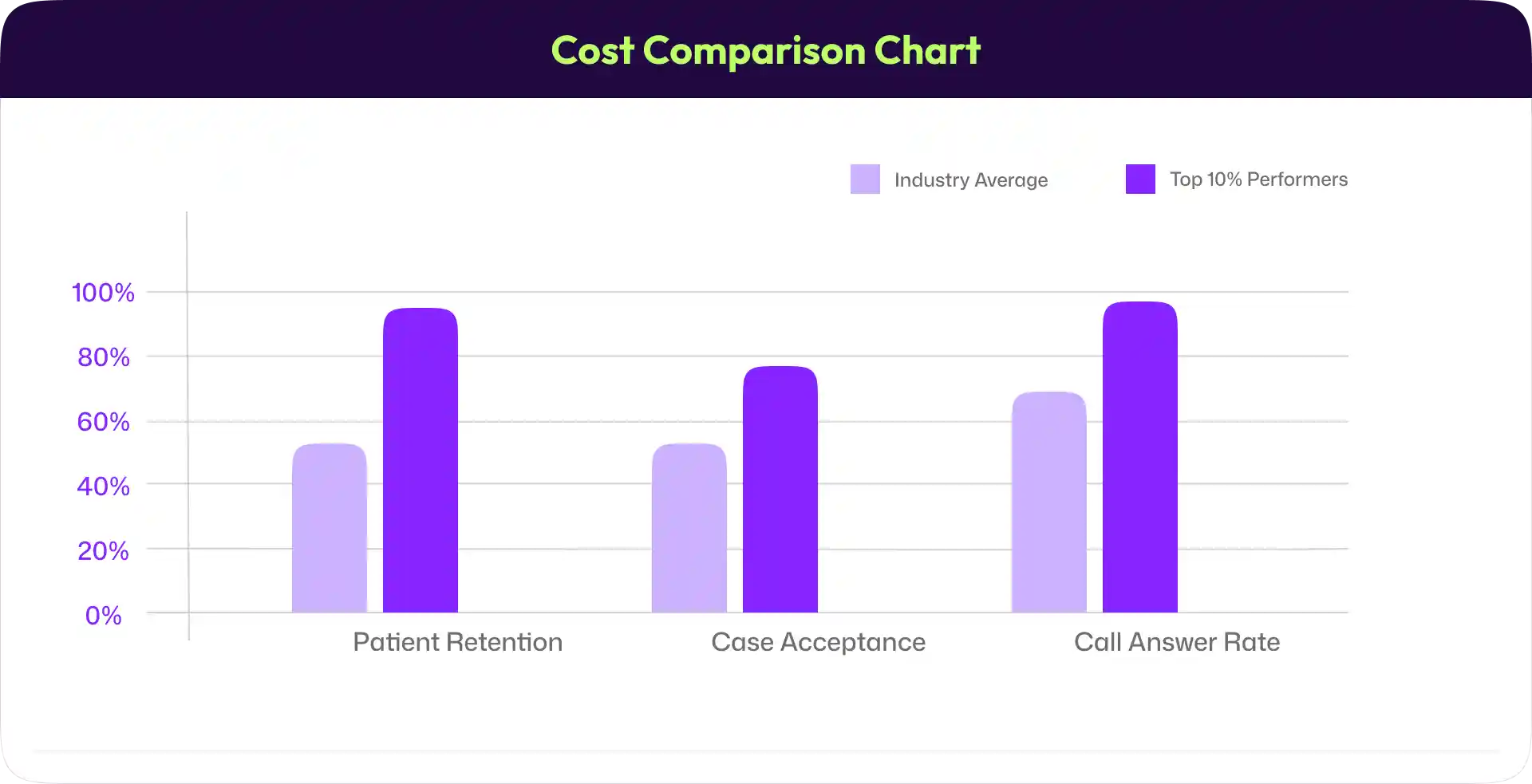
The 2026 Catalyst Index from Henry Schein One, a benchmarking study covering tens of thousands of DSOs and multi-location groups, quantifies exactly how much that inconsistency costs. Patient retention among groups with eight or more locations averages just 58%, down from a 70% average among solo practices, while the top 10% of multi-location groups still retain 90% of patients. Case acceptance tells a similar story: the industry average sits at 45%, while top-performing organizations reach 75%, a gap the report attributes primarily to inconsistent communication and financial transparency across sites rather than to organization size.
Multi-location groups (8+ sites) average 58% patient retention, compared to 70% for solo practices (Henry Schein One, 2026 Catalyst Index)
Case acceptance averages 45% industry-wide, while top-performing DSOs reach 75% (Henry Schein One, 2026 Catalyst Index)
The average dental practice misses about 30% of inbound calls, according to a 2026 Becker's Dental Review webinar recap, a gap that compounds across every additional location a DSO adds
Moreover, the root cause is rarely a lack of standards on paper. Most DSOs have a documented scheduling policy, a script for insurance questions, and a defined recall cadence. The problem is that those standards live in a binder, not in the actual workflow, and every site interprets them a little differently depending on who is answering the phone that day.
What Is Dental DSO Front Desk Automation?
Dental DSO front desk automation means using an AI voice agent, not a chatbot, to answer calls, book appointments, and handle patient intake the exact same way across every location in a group, regardless of which office the call reaches or who is on shift that day.
For a dentist or practice manager without a technical background, the simplest way to picture it is a single, consistent front desk team that never gets tired, never improvises off-script, and works identically whether the call comes from Austin, Houston, or a smaller satellite office two states away.
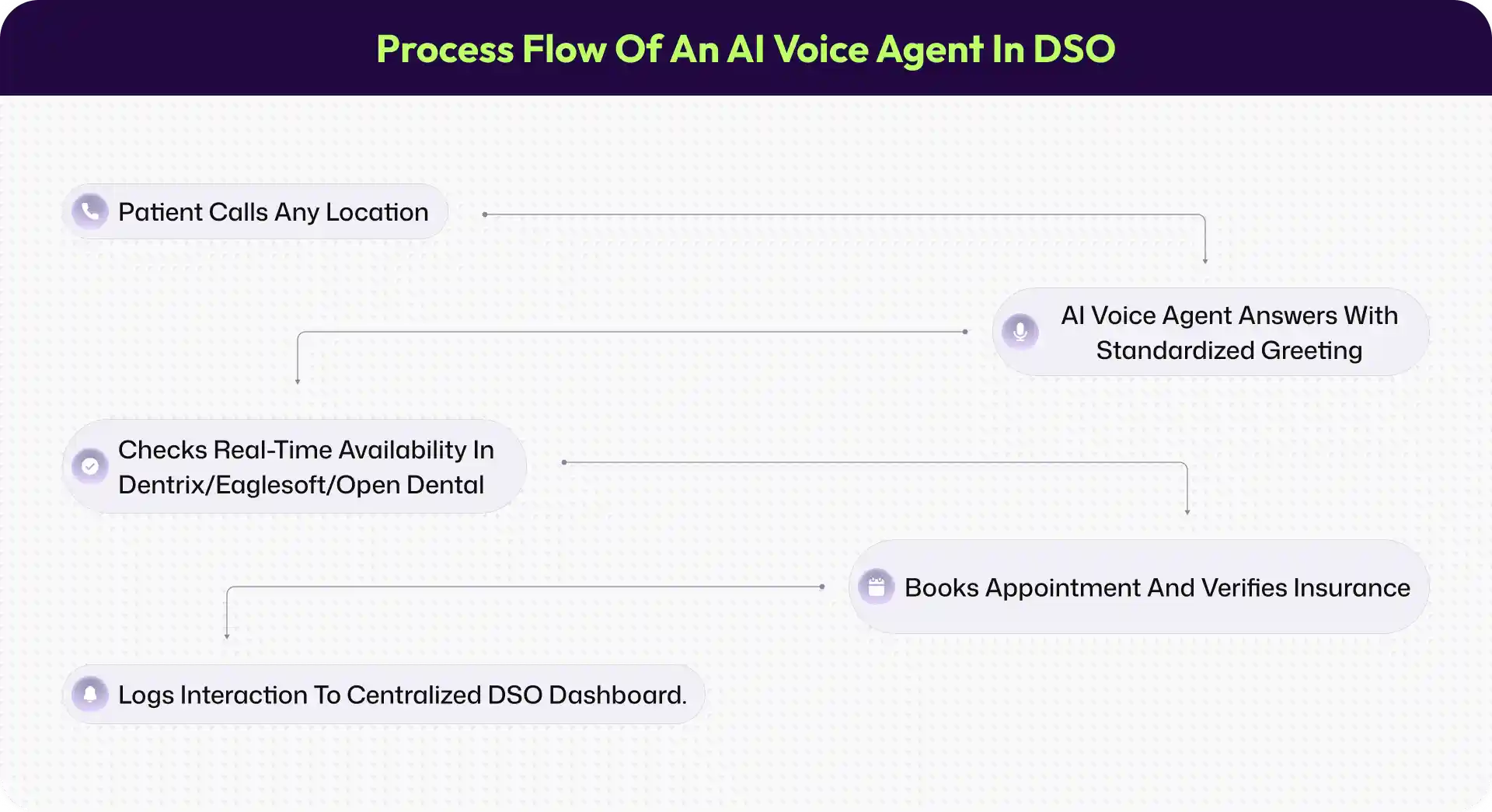
Here is how it works in practice. When a patient calls any location in the network, the AI voice agent answers using the same tone, the same booking logic, and the same policies the DSO has defined centrally. It connects directly to the practice management system in use at that site, whether that is Dentrix, Dentrix Ascend, Eaglesoft, Open Dental, or Curve Dental, and checks real-time availability before confirming an appointment.
The system also standardizes what happens after the call. Insurance details get pre-verified the same way at every site. Reminders go out on the same schedule. Emergency calls get escalated using the same triage logic, so a patient with facial swelling in Plano gets the same urgent response as one in San Antonio.
Furthermore, because every interaction is logged centrally, DSO leadership finally gets visibility into call volume, booking rates, and missed-call trends across the entire network, not just the handful of locations that happen to report reliably.
6 Benefits of AI Front Desk Automation for Dental DSOs
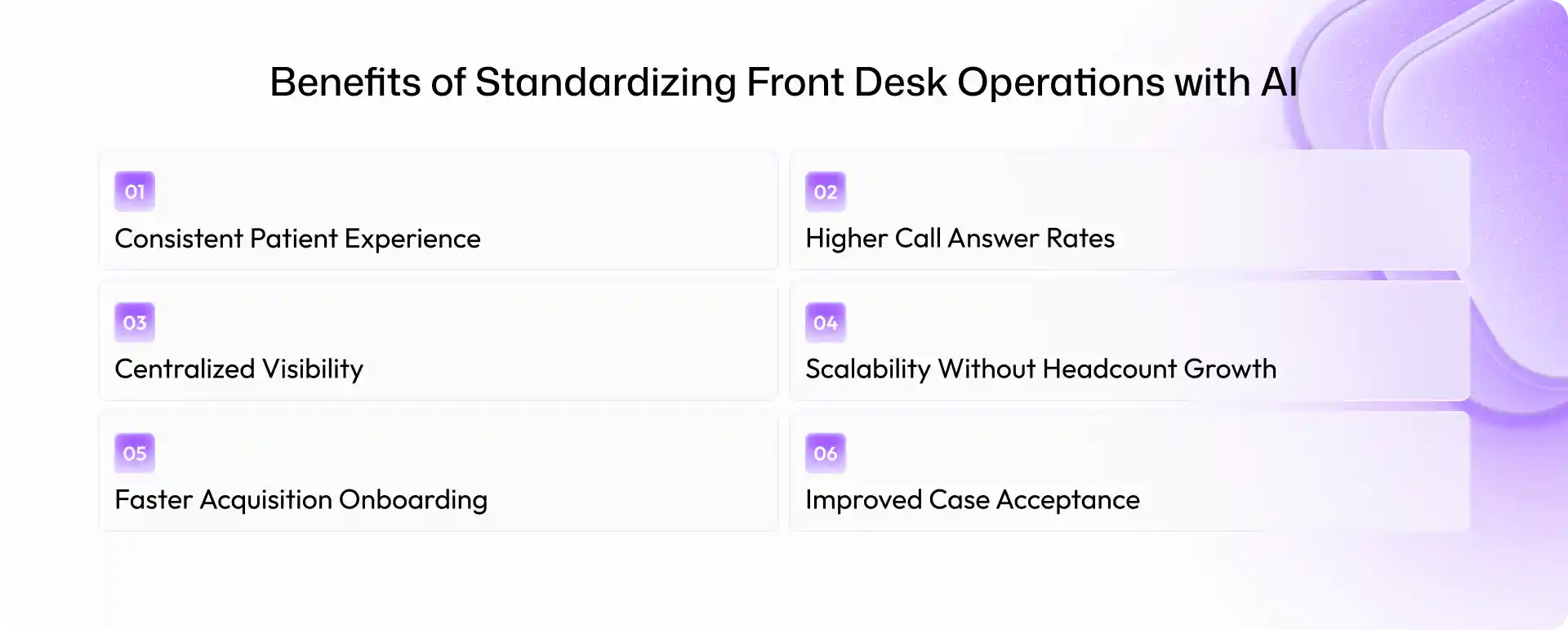
Standardizing the front desk with an AI voice agent delivers benefits that compound as a DSO adds locations. Here are the six that matter most to operators.
1. Consistent patient experience across every location
Every caller gets the same greeting, the same booking process, and the same follow-up, regardless of location. That consistency is exactly what the 2026 Catalyst Index identifies as the dividing line between top-performing and average multi-location groups.
2. Higher call answer rates across the network
Instead of a 30% miss rate at the weakest-performing site dragging down the group average, every location answers every call, closing the gap between a DSO's best and worst offices.
3. Centralized front desk visibility and reporting
Leadership can see booking rates, call volume, and missed-call patterns by location in real time, instead of waiting on a quarterly rollup that arrives too late to act on.
4. Scalability without proportional headcount growth
Adding a new location no longer means hiring and training an entirely new front desk team from scratch. The AI voice agent is deployed with the same configuration used everywhere else in the network.
5. Faster onboarding of acquired dental practices
When a DSO acquires an independent practice, the newly acquired site can be brought onto the standardized phone and scheduling workflow in days rather than the months it typically takes to retrain an existing front desk team.
6. More consistent insurance and case acceptance workflows
Because insurance verification and scheduling logic are handled the same way everywhere, patients get consistent, accurate information before they ever sit in the chair, directly supporting the kind of financial transparency the Catalyst Index ties to higher case acceptance.
How Dental Organizations Use AI Across Different Network Sizes
1. Solo/Small Dental Practice
A solo practice in Austin expanding to a second location often hits standardization problems long before it technically becomes a DSO. As soon as a second phone line and a second front desk hire enter the picture, the owner needs both sites to sound and operate the same way. An AI voice agent lets a two-location group maintain one consistent booking policy without the owner personally training every new hire on how the phones should be answered.
2. Mid-size DSOs
A mid-size group practice with six to eight locations across Dallas and Fort Worth faces a different challenge: uneven performance between its established offices and newer acquisitions. Standardizing the front desk with AI means the newest site, still absorbing an acquired practice's old habits, answers calls and books appointments exactly like the flagship location, closing the gap the Catalyst Index shows widens as DSOs scale.
3. Large DSO
A large DSO operating 20 or more locations across Houston, San Antonio, and El Paso needs something the first two examples do not: enterprise-level reporting. At this scale, an AI voice agent becomes the mechanism that gives corporate leadership a single dashboard showing call answer rates, booking conversion, and insurance verification completion by site, replacing a patchwork of manual reports that used to arrive weeks late.
How to Choose an AI Voice Agent for DSO Front Desk Automation
Choosing the right AI voice agent platform like Alris AI for a multi-location group is a different evaluation than choosing one for a single practice. A few questions separate a system that genuinely standardizes operations from one that simply adds another disconnected tool.
1. Ask whether the platform integrates with every practice management system already in use across the network. Many DSOs run a mix of Dentrix, Dentrix Ascend, Eaglesoft, Open Dental, and Curve Dental depending on how each location was acquired, and a solution that only supports one creates a new inconsistency rather than solving the existing one.
2. Ask how configuration works across locations. A true standardization tool should let corporate leadership set policies once, such as booking rules, insurance intake questions, and emergency escalation logic, and push them to every site, while still allowing for the handful of legitimate local differences like hours or specific provider availability.
3. Confirm the vendor's data security posture and whether they will sign a Business Associate Agreement covering every location in the network. Any system handling patient scheduling and intake across multiple sites is processing protected health information at scale, and a signed BAA should be non-negotiable before rollout begins.
4. Ask for visibility into reporting. A DSO evaluating dental DSO front desk automation should expect a centralized dashboard that shows performance by location from day one, not a promise that reporting will be built later.
The Future of AI Voice Agents in Dental DSO Operations
Over the next 12 to 18 months, three trends are likely to reshape how DSOs approach front desk standardization.
1. AI voice agents will move from answering calls to actively closing the loop on revenue cycle tasks, such as flagging incomplete insurance verifications before a patient arrives, a shift several DSO operations leaders have already flagged as the next frontier beyond call answering.
2. Expect deeper integration between AI front desk systems and practice management platforms like Dentrix Ascend, reducing the manual data entry that still happens even after a call is successfully booked.
3. DSOs will increasingly treat front desk consistency as a measurable KPI tracked alongside clinical metrics like case acceptance and retention, rather than as a soft, hard-to-quantify operational goal, following the same benchmarking approach the Catalyst Index has already applied to clinical performance.
Final Thought
Front desk inconsistency is one of the quiet costs of scaling a dental group, and it shows up directly in the metrics that matter most: retention, case acceptance, and missed-call rates. Dental front desk automation solves this by giving every location the exact same call handling, scheduling, and intake experience, regardless of size, history, or which staff member happens to be on shift.
As more independent practices join DSOs and networks keep growing across Texas and the rest of the country, the groups that standardize their front desk operations now will be the ones that turn scale into an advantage instead of a liability.
Frequently Asked Questions (FAQs)
1. How does an AI voice agent standardize operations across multiple dental locations?
The system applies the same booking rules, insurance intake questions, and emergency escalation logic at every site, while connecting to whichever practice management system that location already uses. Corporate leadership sets policies once centrally, and the AI voice agent applies them consistently, closing the gaps that come from different staff interpreting the same rules differently.
2. Will an AI voice agent integrate with our existing dental practice management software?
Most established platforms, including Alris AI, integrate directly with Dentrix, Dentrix Ascend, Eaglesoft, Open Dental, and Curve Dental. Since many DSOs run a mix of these systems across acquired locations, confirming multi-platform support during vendor evaluation is essential before committing to a rollout.
3. Is an AI voice automation HIPAA-compliant for dental DSOs?
A properly built AI voice agent is HIPAA-compliant, with encrypted call handling, access controls, and a signed Business Associate Agreement covering every location in the network. DSOs should confirm the BAA explicitly extends across all sites before deployment, not just the flagship location.
4. How long does it take to implement AI front desk automation across a DSO?
Timelines vary by network size, but most DSOs can bring their flagship and highest-volume locations onto a standardized AI voice agent within a few weeks, with newly acquired or smaller sites following shortly after. Newly acquired practices typically onboard faster than a manual retraining process would take.
5. Does AI front desk automation replace dental front desk staff?
Most DSOs use AI voice agents to absorb call volume and overflow rather than to eliminate front desk roles outright. Staff shifts toward higher-value tasks like in-office patient care and complex case coordination, while the AI voice agent handles routine calls, scheduling, and reminders consistently across every site.
6. What is the biggest sign a DSO needs front desk automation?
A wide performance gap between a network's best and worst-performing locations, particularly in call answer rates, booking conversion, or patient retention, is the clearest signal. The 2026 Catalyst Index shows this gap widens as organizations grow past seven or eight locations, making it a natural point to evaluate automation.
Sources & References:
1. Becker's Dental Review. "10 trends for DSO leaders to know." 2025
2. Becker's Dental Review. "AI in dental operations: How practices are reducing missed calls." 2026
3. Henry Schein One. "DSO Patient Retention Rate: 2026 Benchmarks." 2026
Shravan Rajpurohit
CEO & Co-Founder
Shravan Rajpurohit is the Co-Founder & CEO of The Intellify, a leading Custom Software Development company that empowers startups, product development teams, and Fortune 500 companies. With over 10 years of experience in marketing, sales, and customer success, Shravan has been driving digital innovation since 2018, leading a team of 50+ creative professionals. His mission is to bridge the gap between business ideas and reality through advanced tech solutions, aiming to make The Intellify a global leader. He focuses on delivering excellence, solving real-world problems, and pushing the limits of digital transformation.

Stay Updated
with AI Insights
Get the latest articles on AI, automation, and enterprise technology delivered to your inbox weekly.

500+ people have already subsribed!
No spam. Unsubscribe anytime.