
Why Dental Emergencies Need an AI Voice Agent, Not Voicemail



Summary: Dental emergencies require immediate responses, but missed calls and voicemail can cause practices to lose patients to competitors. This blog explains how AI voice agents improve dental emergency call answering by providing 24/7 call coverage, triaging patient needs, booking appointments, and escalating urgent cases. It also covers the benefits, practical use cases, integration considerations, HIPAA compliance, and how AI-powered call handling can reduce front-desk workload while improving patient acquisition and retention.
It is 8:15 p.m. on a Thursday in San Antonio when a father calls his family dentist because his son took an elbow to the mouth during a basketball game. The tooth is loose, there is blood, and he needs to know what to do right now. The call rings four times and drops into a generic voicemail greeting. He hangs up, searches for an emergency dentist nearby, and books with the first practice that answers. That practice keeps a patient relationship that could have lasted for years.
This scenario repeats itself across Texas and the rest of the country every single day, and it is exactly why dental emergency call answering has become a defining factor in whether a practice grows or quietly loses patients to competitors who never stop answering the phone.
Voicemail was never built for moments like this. It assumes the caller can wait for a callback, but a patient in pain, or a parent watching a child bleed from a knocked-out tooth, cannot wait. They need direction immediately: whether to come in now, what to do with the tooth, and where to go if the office truly cannot see them.
This article explains why voicemail fails dental emergencies, what a dental AI voice agent does differently, and how practices in Austin, Dallas, Houston, and beyond are using always-on call answering to turn emergencies into loyal, lifelong patients instead of lost opportunities.
Why Dental Practices Miss Emergency Calls After Hours
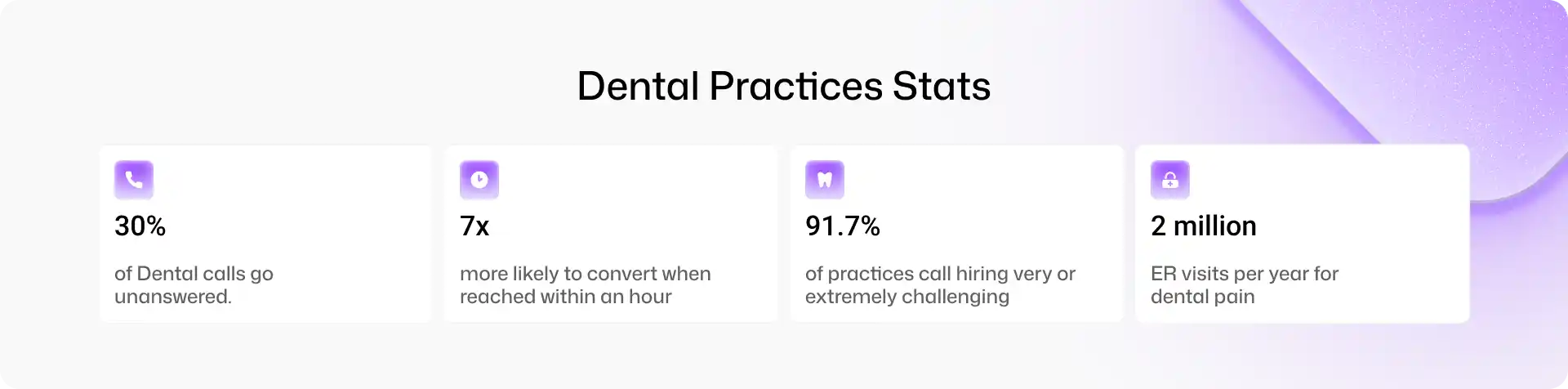
Dental emergencies do not follow business hours, and the data on missed calls shows just how costly that mismatch has become.
According to a 2026 Becker's Dental Review analysis, the average dental practice misses close to 30% of its inbound calls. For a practice fielding emergency inquiries alongside routine scheduling, that gap includes patients in genuine pain who simply move on to whoever picks up next.
The stakes of a slow response are well documented outside dentistry, too. A landmark Harvard Business Review study that audited 2,241 companies found that businesses responding to a new inquiry within an hour were nearly seven times more likely to qualify that lead than those that waited longer, and 23% of companies in the study never responded at all. A caller with a cracked molar or a knocked-out tooth behaves the same way: they do not wait around for a callback.
Staffing shortages compound the problem. ADA Health Policy Institute survey data shows that 91.7% of dental practices actively recruiting a hygienist call the process very or extremely challenging, and front-desk roles face similar strain. When a practice is short-staffed, the phone is often the first thing that goes unanswered, especially outside core hours.
As a result, emergency calls, the ones with the highest urgency and the highest lifetime value, are often the ones most likely to hit voicemail.
How AI Voice Agents Handle Dental Emergency Calls
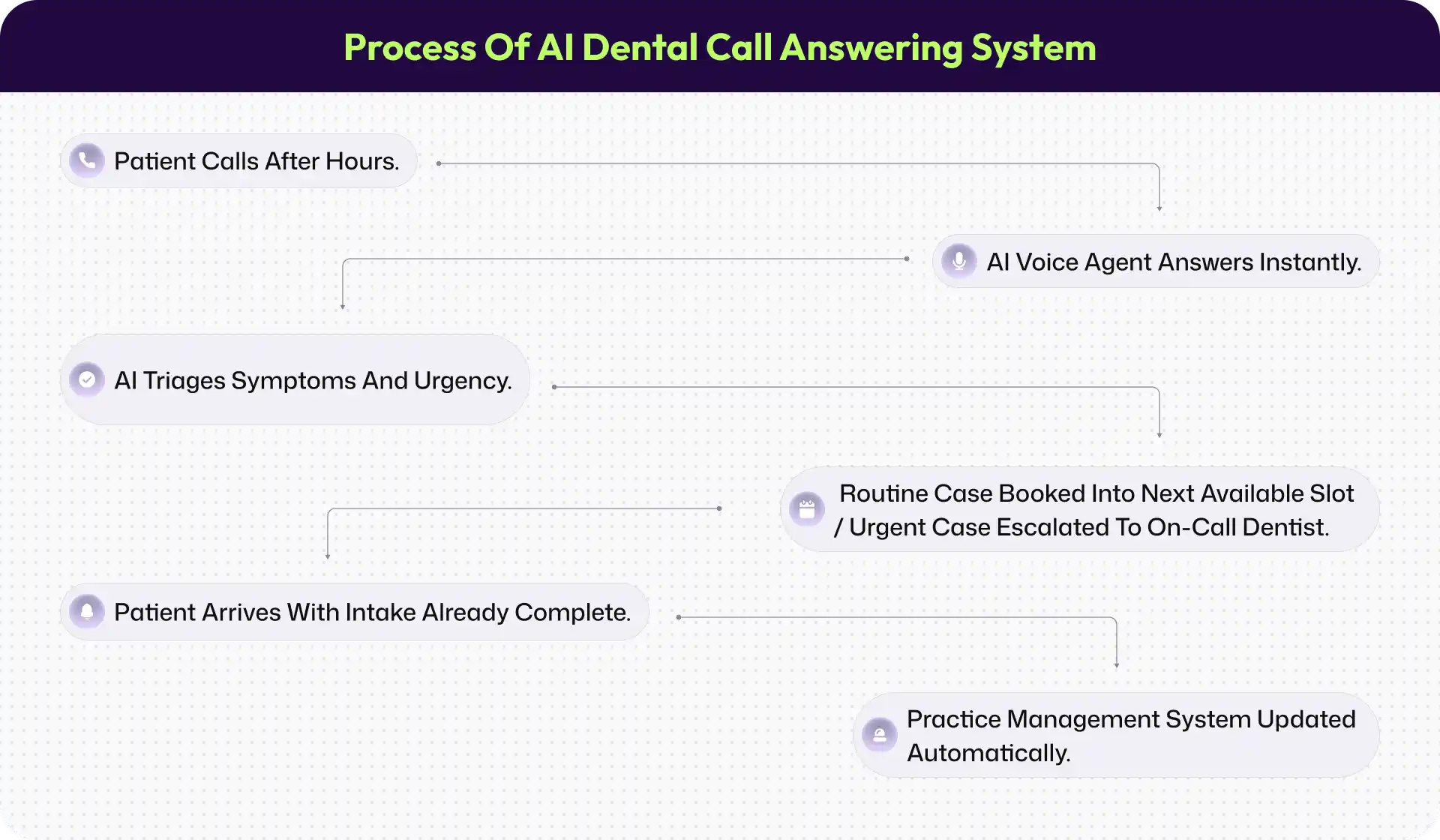
An AI voice agent for dental call answering is a system that picks up every call the moment it comes in, day or night, and handles it the way a well-trained front desk staffer would, without ever going to voicemail.
For a dentist or office manager without a technical background, think of it as a front desk that never clocks out. When a patient calls with a cracked tooth, a lost filling, or facial swelling, the AI voice agent asks the right triage questions, the same ones a trained coordinator would ask, to understand how serious the situation is. From there, the system checks real-time availability inside the practice's scheduling software, whether that is Dentrix, Eaglesoft, Open Dental, or Curve Dental, and either books the next available emergency slot or escalates the call immediately if the situation sounds urgent enough to require an on-call dentist.
Moreover, the AI voice agent does not simply take a message. It gathers the information the clinical team actually needs before the patient walks in: what happened, when it happened, current pain level, and any allergies or medical history flags. That means the first few minutes of the visit go straight to treatment instead of intake paperwork.
For practices with bilingual patient populations, particularly across Texas cities like Houston, San Antonio, and El Paso, the same AI voice agent can conduct that entire triage conversation in Spanish, so a language barrier never becomes the reason an emergency patient goes untreated.
Benefits of AI-Powered Dental Emergency Call Answering
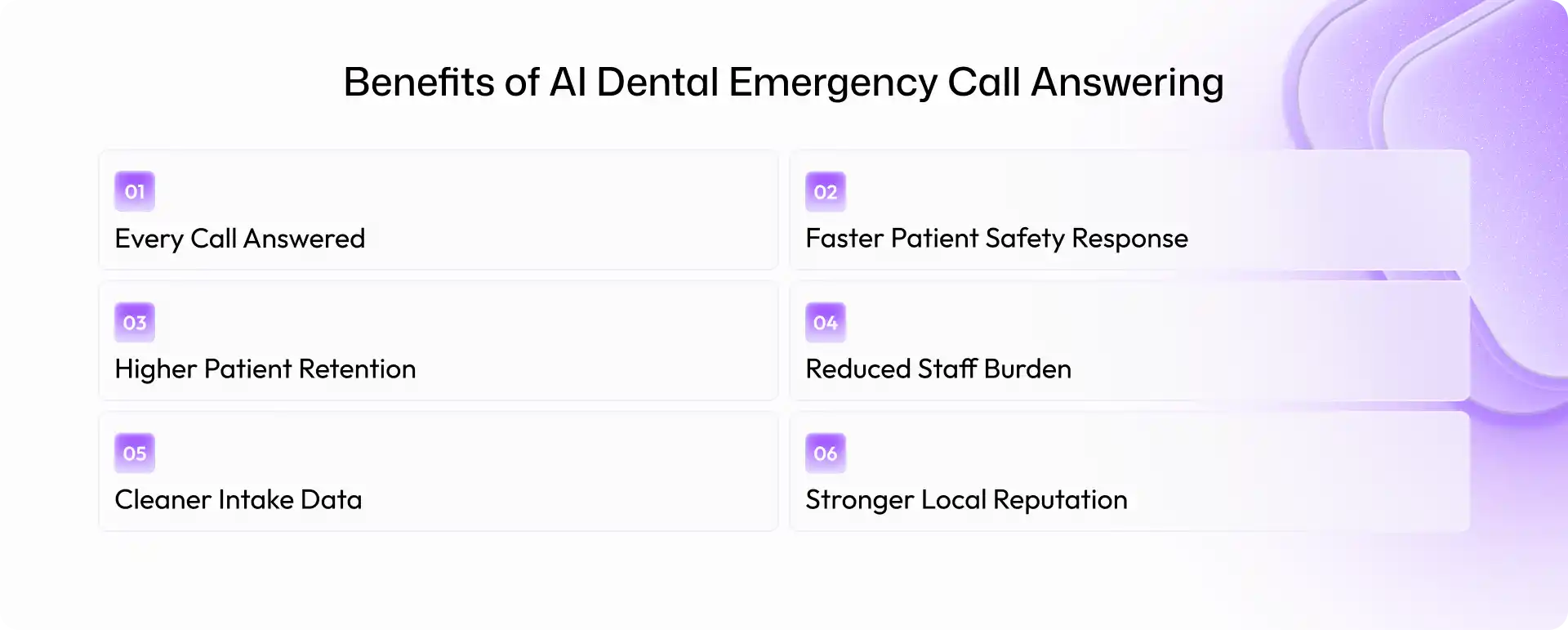
1. Answer Every Emergency Call 24/7
An AI voice agent eliminates the roughly 30% call-miss gap that Becker's Dental Review documented industry-wide. Every emergency caller reaches a live conversation instead of a voicemail greeting, regardless of the hour.
2. Respond Faster to Urgent Dental Patients
Dental emergencies like avulsed teeth or spreading infection are time-sensitive. Immediate triage guidance, delivered the moment a patient calls, can influence whether a tooth is saved and reduce the practice's exposure to delayed-care complaints.
3. Capture More Emergency Patients and Appointments
Emergency patients who are treated well often become long-term patients for the whole family. Answering that first call in real time, instead of losing the caller to a competitor, is one of the most direct ways a practice grows its active patient base.
4. Reduce the Front-Desk Workload
With hygiene and front-office recruitment described as very or extremely challenging by more than 90% of practices, an AI voice agent absorbs after-hours and overflow emergency calls without adding another position to a tight labor market.
5. Capture Complete Patient Intake Before Arrival
Because the AI voice agent captures symptoms, timeline, and history during the call, clinical staff walk into the appointment with the context they need, cutting down on redundant questions and speeding up same-day treatment.
6. Strengthen Patient Experience and Practice Reputation
Practices that reliably answer emergency calls build reputations for it, and that reputation shows up in reviews and referrals, particularly in competitive markets like Dallas, Austin, and Plano, where multiple practices compete for the same after-hours searches.
How Dental Practices Use AI Voice Agents for Emergency Calls
Solo practice: a single dentist in Plano
A solo practitioner in Plano cannot staff a night shift or answer calls during a procedure. An AI voice agent handles every emergency call that comes in while the dentist is chairside, triaging pain level and booking the next available slot without pulling a hygienist away from a patient.
Group practice: a multi-location office across Austin and Dallas
A group practice with locations across Austin and Dallas often routes after-hours calls to a single answering point. An AI voice agent applies the same triage protocol at every location, so a patient calling the Dallas office at 9 p.m. gets the same quality of response as one calling Austin at noon.
DSO: standardizing emergency response across dozens of sites
A dental service organization operating locations from Houston to El Paso needs consistency more than anything else. An AI voice agent applies one emergency triage script network-wide, giving DSO operations leaders visibility into every emergency call, how it was handled, and whether it converted into a booked appointment.
What to Look for in an AI Dental Emergency Call Answering System
Practices evaluating an AI dental receptionist for patient communication should look closely at how the system handles clinical urgency, not just scheduling.
1. Emergency Triage and Escalation
Ask any vendor how the AI is trained to distinguish a true emergency, like facial swelling or uncontrolled bleeding, from a routine same-day request, and what happens when a call needs a live dentist immediately.
2. Practice Management Software Integration
Integration matters just as much. Confirm the system connects directly with your practice management software, whether that is Dentrix, Eaglesoft, Open Dental, or Curve Dental, so emergency bookings appear on the real schedule instead of a separate inbox someone has to check manually.
3. On-Call Dentist Escalation
Ask about escalation paths. A strong system should be able to reach the on-call dentist directly for calls that cross a defined urgency threshold, rather than leaving a message in a queue.
4. HIPAA Compliance and Patient Data Security
Also confirm HIPAA compliance and whether the vendor will sign a Business Associate Agreement, since emergency intake involves protected health information from the first question.
5. Call Reporting and Performance Tracking
Finally, review reporting. Practices should be able to see call volume by hour, how many calls happened after hours, and how many converted into booked emergency visits, so the return on the system is measurable rather than assumed.
The Future of AI Voice Agents in Dental Emergency Care
Over the next 12 to 18 months, expect AI voice agents to get better at clinical triage nuance, distinguishing between urgency levels with more precision and adjusting scheduling recommendations accordingly instead of applying one-size-fits-all logic.
Integration will also deepen. Rather than simply booking into a practice management system, AI voice agents will increasingly pull patient history and insurance status in real time during the call, giving front-desk teams a fuller picture before the patient even arrives.
Finally, expect more DSOs and group practices to standardize emergency response across every location through a single AI voice agent platform, replacing the patchwork of individual office policies that currently make emergency care inconsistent from one site to the next, even within the same organization.
Why 24/7 Dental Emergency Call Answering Matters
Dental emergencies do not wait for business hours, and neither do the patients experiencing them. Every call that hits voicemail is a chance for a competitor's office to answer first, book the appointment, and keep that patient and their family for years to come.
Reliable dental AI call answering solves that problem directly. An AI dental receptionist picks up every call, triages urgency, books the right appointment, and gives clinical teams the information they need before the patient walks through the door, all without adding headcount to an already strained front desk.
As more patients search for care outside traditional office hours, the practices that answer immediately, in Austin, Dallas, Houston, San Antonio, El Paso, and every market in between, will be the ones that turn today's emergency into tomorrow's long-term patient.
Frequently Asked Questions (FAQs)
1. Can an AI voice agent replace an after-hours answering service?
Yes, and it typically does more than a traditional answering service. Instead of taking a message for a callback, an AI voice agent triages the call, checks real-time schedule availability, and books the appointment directly, or escalates to the on-call dentist when the situation warrants it, all within the same call.
2. How does AI know when to escalate a dental emergency?
The system is configured with defined clinical thresholds, such as reported bleeding that will not stop, facial swelling, or trauma involving a permanent tooth. When a caller's answers cross those thresholds, the AI voice agent immediately connects or pages the on-call provider instead of simply booking a next-day slot.
3. Is patient information shared during an emergency call kept HIPAA-compliant?
Yes, when the vendor is built for healthcare use. Alris AI operates under a signed Business Associate Agreement and handles all patient information, including symptoms and history gathered during emergency triage, in a HIPAA-compliant manner from the first point of contact.
4. Can AI voice agents integrate with dental practice software?
Alris AI integrates with Dentrix, Eaglesoft, Open Dental, and Curve Dental, so emergency bookings appear directly on your live schedule. There is no separate inbox or manual entry step between the call and the appointment showing up for your team.
5. Can AI handle Spanish-speaking dental emergency calls?
Yes. The same triage and booking conversation can run in Spanish, which matters most in Texas markets like Houston, San Antonio, and El Paso, where a meaningful share of emergency callers are more comfortable communicating in Spanish than in English.
6. How quickly can a practice implement AI emergency call answering?
Most practices can be live within a few weeks. Implementation involves connecting the AI voice agent to the practice management system, configuring emergency triage protocols and escalation rules with the clinical team, and testing call flows before switching on full after-hours coverage.
Sources & References:
1. American Dental Association. "Emergency Department Referrals." 2026
2. Becker's Dental Review. "AI in Dental Operations" 2026
3. Harvard Business Review. "The Short Life of Online Sales Leads."
4. American Dental Association Health Policy Institute. "Dental Hygienist Shortage." 2026
Shravan Rajpurohit
CEO & Co-Founder
Shravan Rajpurohit is the Co-Founder & CEO of The Intellify, a leading Custom Software Development company that empowers startups, product development teams, and Fortune 500 companies. With over 10 years of experience in marketing, sales, and customer success, Shravan has been driving digital innovation since 2018, leading a team of 50+ creative professionals. His mission is to bridge the gap between business ideas and reality through advanced tech solutions, aiming to make The Intellify a global leader. He focuses on delivering excellence, solving real-world problems, and pushing the limits of digital transformation.

Stay Updated
with AI Insights
Get the latest articles on AI, automation, and enterprise technology delivered to your inbox weekly.

500+ people have already subsribed!
No spam. Unsubscribe anytime.