
How Voice AI Is Solving Dental Front Desk Burnout [2026]



![How Voice AI Is Solving Dental Front Desk Burnout [2026]](https://alris-ai-cms.theintellify.net/uploads/Voice_AI_for_Solving_Dental_Front_Desk_Burnout_1x_4a5cd16d8f.webp)
Summary: Dental front desk burnout is a structural problem: the role is designed to be overwhelming at peak hours, with the phone competing for the same attention as in-office patients. This guide covers what burnout actually looks like at US dental practices, what it costs in staff turnover and missed revenue, and how dental voice AI removes the repetitive phone load that drives most of the stress. Includes implementation guidance for all five major US dental specialties and a platform selection checklist specific to US dental practice requirements.
Ask anyone who's worked the front desk at a US dental practice what the job is actually like, and they'll give you an honest answer pretty quickly. It's a lot. Not in a "busy but manageable" way, in a "phone ringing while a patient is standing in front of you, another one waiting to check out, and the insurance line on hold" kind of way.
The dental front desk is one of the most demanding administrative roles in healthcare. It's also one of the most underdiscussed when it comes to burnout. Most conversations about dental practice management focus on clinical productivity, chair utilization, or revenue cycle management. The front desk, the people actually holding the patient experience together from the moment someone calls to the moment they walk out, often gets treated as a background function.
The result is high turnover, constant understaffing, and practices that are losing new patients to missed calls while their existing team is stretched past a reasonable workload.
Voice AI is changing this. Not by replacing front desk staff, that's not what this is, but by removing the relentless phone volume that causes most of the burnout in the first place. This guide covers how dental front desk burnout actually develops, what it costs US dental practices, and how voice AI for clinics is making a practical difference.
What Dental Front Desk Burnout Actually Looks Like

The daily workload that breaks people
The dental front desk job description sounds manageable on paper. Answer phones, schedule appointments, check patients in and out, handle billing questions, process insurance. In practice, all of these things happen simultaneously, at volume, without breaks, across a nine-hour day.
The phone is the constant. It rings during patient check-in. It rings while someone is verifying insurance. It rings when the front desk person is dealing with a billing dispute at the window. Every call is a context switch, and every unanswered call is a potential new patient, a rescheduling request, or an existing patient with a question that doesn't get resolved.
Add to this the emotional labor of being the first and last face patients see, managing anxious new patients, handling complaints, navigating difficult insurance conversations, and you have a role that's structurally designed to exhaust people.
The staffing numbers behind the burnout
US dental practices typically run lean at the front desk. Many small to mid-sized practices have one or two front desk staff covering everything during business hours. When one person is out sick or leaves, the remaining team absorbs the full workload without reduction.
The turnover cost is high. Recruiting, onboarding, and training a new dental front desk employee in the US typically run between $5,000 and $15,000 when time, lost productivity, and training costs are factored in. And it's not a one-time problem; the cycle repeats. The remaining staff get more overwhelmed, which accelerates their own burnout, which drives more turnover.
What patients experience when the front desk is overwhelmed
When the dental front desk is at capacity, it shows in the patient experience long before anyone sits in a chair. Calls go to hold. New patient enquiries ring out. The person who finally answers sounds rushed and distracted. Scheduling mistakes happen because someone was managing four things at once.
For a US dental practice competing for new patients in a market where Google reviews drive a meaningful share of incoming calls, this kind of phone experience, or lack of one, has direct consequences on reputation and revenue.
Why the Dental Front Desk Phone Problem Is Worse Than Most Practices Realise
When most dental calls actually arrive
Dental practice call volume doesn't distribute evenly across the day. Two peaks dominate in most US practices: early morning, when patients call before work to book or confirm appointments, and the lunch hour, when people have a few minutes to deal with personal tasks.
These are also the two periods when the front desk is busiest with in-office patients' check-ins, check-outs, and treatment coordination. The phone and the front desk compete for the same attention at exactly the same time; every single after-hours hour is the other gap most practices underestimate. Patients who want to book a new appointment or reschedule often call in the evening or on weekends. Those calls hit voicemail. Most don't leave messages. The ones that do create a morning callback queue that the already-busy front desk has to work through before the clinical day even starts properly.
The appointment types that generate the most calls
Not all calls take the same time or carry the same revenue weight. New patient enquiries, which often involve explaining what the practice offers, confirming insurance acceptance, and walking through the first appointment process, are the most time-intensive and the most valuable. They're also frequently missed during peak hours when the front desk is stretched.
Rescheduling calls are high-volume and repetitive. Insurance and billing queries are time-consuming and often require pulling up patient records mid-call. Post-procedure follow-up calls add another layer of outbound work. Each category adds to the phone-handling burden on a front desk team that's already managing everything else.
What missed calls cost a US dental practice
A new patient in a US dental practice is worth significantly more than the value of a single appointment. Depending on the specialty and the patient's treatment needs, the lifetime value of a retained dental patient runs into the thousands of dollars over years of preventive care, restorative work, and referrals.
When a new patient calls a busy practice during the morning rush and nobody answers, they don't usually try again. They call the next practice on their Google search results. That lost patient isn't just a missed appointment; it's years of potential revenue that goes to a competitor because the front desk phone couldn't be answered at 8:45am.
What dental voice AI handles at the front desk
A properly configured dental voice AI platform covers the bulk of what drives front desk phone burnout:
Every inbound call answered instantly: new patient enquiries, appointment requests, general questions, without hold times or voicemail
Appointment scheduling and rescheduling with real-time calendar sync, so what the AI books immediately appears in the practice schedule
Automated appointment reminders via SMS and email, sent without any front desk involvement
After-hours call coverage: patients who call at 7pm or on Saturday morning get a response instead of voicemail
Insurance and billing query routing: routine questions answered, complex ones routed to the right staff member
Outbound recall outreach: patients overdue for cleanings or follow-ups are contacted automatically
Post-visit follow-up messages triggered after appointments
How Voice AI Reduces Dental Front Desk Burnout
Removing the phone from the front desk workload
The phone is the primary source of front desk interruption during peak hours. A staff member mid-conversation with a patient at the desk who also has to manage an incoming call isn't doing either job properly. The patient feels rushed. The caller feels like an inconvenience. Scheduling errors happen because the staff member was splitting attention.
Dental voice AI absorbs the inbound call volume. During a busy Tuesday morning when the waiting room has four patients and the phone would normally ring eight times in an hour, the AI handles those calls without pulling anyone away from the desk. Front desk staff stay focused on the patients in front of them.
Automating the repetitive tasks that drain energy
It's not just the phone calls themselves; it's the repetitive, low-judgment tasks that compound the workload. Appointment reminders that need to go out every day. Recall messages that need to be sent to patients overdue for their six-month cleaning. Post-visit satisfaction follow-ups. These tasks aren't difficult, but they take time and mental bandwidth that add up across a week.
AI front desk automation handles all of this without staff involvement. Reminders go out on schedule. Recall campaigns run automatically. Post-visit messages are sent the day after every appointment. None of it requires a front desk team member to initiate, track, or follow up on it.
Reducing scheduling errors and their aftermath
Rushed phone-based scheduling is one of the most common sources of front desk errors. A staff member managing a patient at the desk while simultaneously booking a phone appointment is more likely to select the wrong provider, the wrong time slot, or miss a note about the patient's insurance. Fixing these errors takes time and creates friction with patients.
Voice AI confirms appointment details back to the caller before booking. The caller hears exactly what's been scheduled and can correct anything before it goes into the system. The error rate drops, and with it, the time spent fixing mistakes and managing frustrated patients.
Supporting after-hours coverage without overtime
The morning callback backlog is one of the more demoralising parts of a dental front desk job. Arrive at work, log in, and immediately face fifteen voicemails that all need to be returned before the day's appointments start pulling attention elsewhere. It sets a stressful tone for the entire day before the first patient has even walked in.
Voice AI for clinics eliminates this. Calls that arrive after hours get answered and, where possible, resolved; appointments booked, questions answered, enquiries captured with follow-up triggered automatically. The front desk team arrives at a clean slate rather than a callback queue.
The Real Cost of Dental Front Desk Burnout And What Voice AI Recovers
Staff replacement costs
The revolving door at the dental front desk is expensive. Recruiting costs time and money. Training a new hire to the point where they can independently manage the full front desk workload takes weeks. During that onboarding period, the remaining team carries more than their share of the load, which accelerates their own burnout and increases the risk of losing them too.
Dental AI front desk solutions that materially reduce the phone-handling burden make the front desk job more sustainable. A team that isn't constantly overwhelmed stays longer. Lower turnover means lower recruitment costs, fewer training cycles, and a more experienced, higher-performing front desk team over time.
Revenue lost to missed calls and scheduling gaps
Every missed new patient call during a morning rush is a real revenue loss. Every recall patient who wasn't contacted and found another practice represents years of lost revenue. Every no-show appointment that wasn't confirmed and couldn't be backfilled is a gap in the schedule that generates no revenue at all.
Dental voice AI recovers across all three categories. New patient calls get answered during peak hours. Recall outreach runs automatically, reaching patients who would otherwise fall out of the practice's active base. Appointment reminders reduce no-shows, and when a patient does cancel, the system can trigger a waitlist notification to backfill the slot.
The indirect costs - reviews and reputation
US dental patients increasingly choose practices based on Google reviews. The connection between front desk phone experience and online ratings is real: patients who can't get through, who are put on hold repeatedly, or who feel rushed during a call are more likely to express that frustration publicly.
Over time, consistent phone accessibility and professional interactions, the kind that voice AI for clinics delivers automatically, show up in the practice's ratings. A practice that answers every call promptly, confirms appointments reliably, and follows up after visits builds a reputation that feeds new patient acquisition without additional marketing spend.
Voice AI for Dental Practices Across Specialties
General Dentistry
General dental practices typically have the highest call volume of any dental specialty. Routine scheduling, hygiene appointments, emergency enquiries, new patient calls, and billing questions all flow through the same front desk. Dental voice AI handles the bulk of this volume automatically, with recall automation ensuring the large patient base gets contacted at appropriate intervals without staff manually working through a recall list.
Orthodontics
Orthodontic practices manage long treatment timelines. Patients in active treatment for 18 to 24 months require regular appointments and frequent communication. Parent communication adds another layer for pediatric orthodontic patients. Voice AI handles appointment reminders, rescheduling requests, and progress update calls automatically, reducing the outbound communication burden on the front desk across a patient base that's in regular contact throughout treatment.
Oral Surgery
Oral surgery patients need clear pre- and post-operative communication. Missing a pre-operative instruction call or a post-procedure follow-up creates clinical risk and patient dissatisfaction. Voice AI for clinics handles these calls consistently: every pre-op patient reached, every post-procedure follow-up sent, without relying on front desk availability to initiate each one. After-hours calls from patients with post-procedure concerns get answered and appropriately routed.
Pediatric Dentistry
Pediatric dental practices deal with high volumes of parent communication, appointment reminders, rescheduling requests, questions about a child's dental development, and concerns about upcoming procedures. Recall automation is particularly valuable here, ensuring every child patient gets contacted at appropriate intervals for their six-month check-ups without the front desk manually managing the recall list.
Periodontics and Specialty Practices
Periodontal practices manage a referral-heavy patient flow, often coordinating with multiple general dental practices across a market. Scheduling referral patients, managing insurance pre-authorisation queries, and handling post-treatment periodontal maintenance follow-ups all add to the front desk workload. Voice AI routes the routine queries, handles scheduling, and frees the team for the coordination work that requires clinical knowledge and judgment.
How to Implement Voice AI at Your Dental Practice
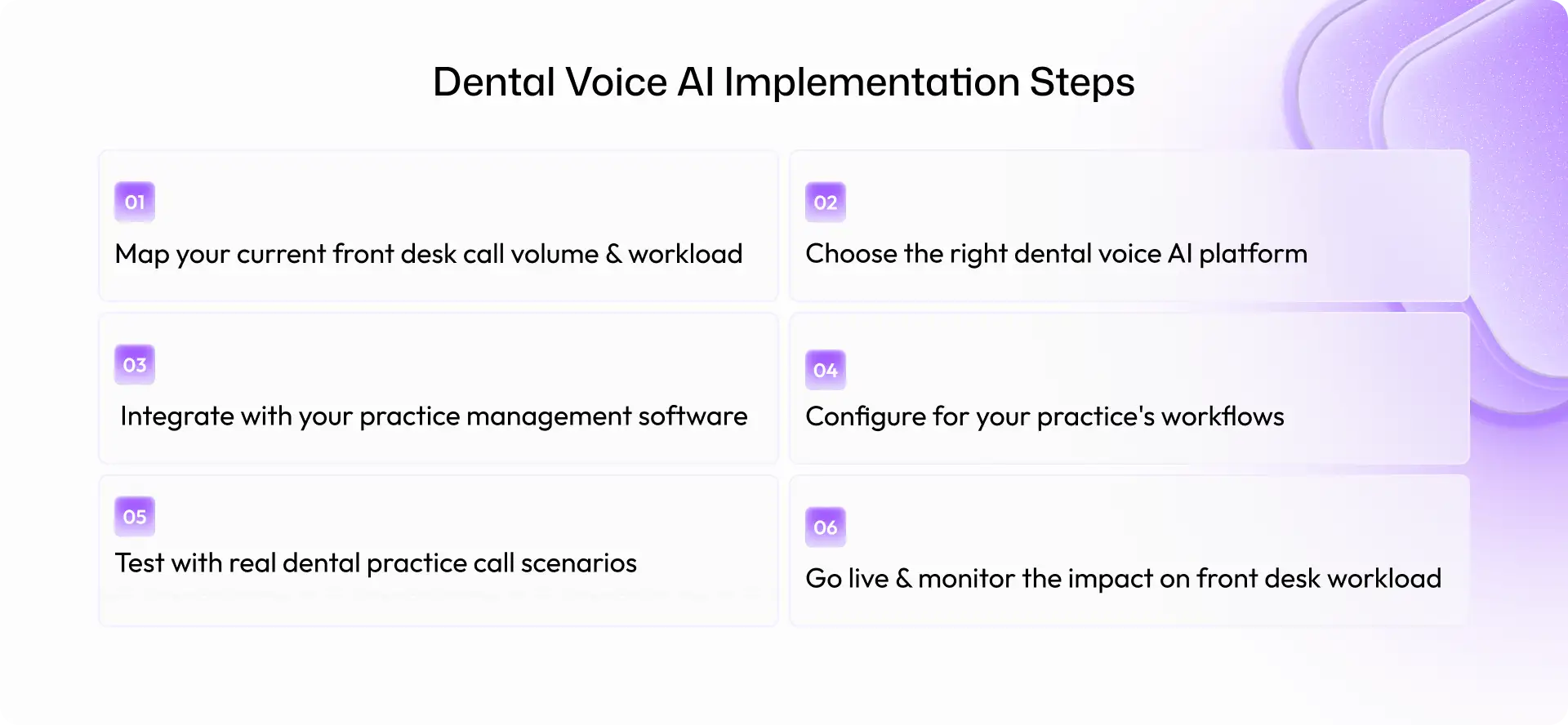
Step 1: Map your current front desk call volume and workload
Before selecting a platform, understand what's actually happening at your practice. How many calls come in per day, and when do they peak? What types of calls consume the most front desk time? Where are calls being missed during morning appointments, at lunch, or after hours?
This data becomes the foundation for how the system gets configured and gives you a baseline to measure against after implementation.
Step 2: Choose the right dental voice AI platform
The platform needs to be built for dental practices, not adapted from a generic business tool. Dental-specific configuration, appointment types, insurance terminology, and recall protocols matter for how accurately the system handles real patient calls.
Key questions before committing: Is a HIPAA Business Associate Agreement available? What dental practice management software does it integrate with? How does after-hours call handling work? What does the setup process actually involve?
Step 3: Integrate with your practice management software
Connecting dental voice AI with your practice management system, Dentrix, Eaglesoft, Open Dental, Curve Dental, or equivalent, is what makes real-time scheduling possible. Without this integration, appointments booked by the AI live in a separate system that staff have to manually reconcile with the practice schedule. That's more work, not less.
Confirm the integration works with your specific PMS before selecting a platform.
Step 4: Configure for your practice's workflows
Set up appointment types, scheduling logic, availability windows, and provider preferences. Configure the recall outreach cadence: how often overdue patients get contacted and through which channels. Set clear escalation paths for calls that need a human: clinical questions, financial arrangement discussions, complex insurance situations.
Take the time to get this right. A well-configured system handles real patient calls accurately from day one. A poorly configured one gives patients wrong information and creates more work for the front desk.
Step 5: Test with real dental practice call scenarios
Before going live, run the system through the calls your practice actually receives. New patient enquiries. Appointment rescheduling. After-hours calls. Insurance questions. Bilingual calls for practices serving Spanish-speaking patient populations in the US.
If the system handles all of these accurately, you're ready. If it struggles with any of them, adjust the configuration before patients encounter it.
Step 6: Go live and monitor the impact on the front desk workload
Launch with active monitoring. Track calls answered, appointments booked, and after-hours calls captured in the first few weeks. Ask the front desk team directly whether the phone load has changed. Measure no-show rates before and after automated reminder implementation.
Most practices see the impact on front desk workload quickly: fewer callback queues in the morning, fewer phone interruptions during peak hours, and a front desk team that's handling fewer repetitive calls and more patient-facing work.
What to Look for in a Dental Voice AI Platform
1. HIPAA compliance with BAA availability
Non-negotiable for any US dental practice. Any platform handling patient information over the phone, HIPAA-compliant, and willing to sign a Business Associate Agreement.
2. Real-time practice management integration
Dentrix, Eaglesoft, Open Dental, Curve Dental. Appointments must sync directly into the practice schedule without manual transfer.
3. Natural conversation quality
Dental patients should feel they're speaking with a professional, not navigating a phone menu. Test with real call scenarios before committing.
4. True 24/7 after-hours coverage
Full capability outside business hours, not a reduced-function mode. After-hours is when the highest-value missed calls happen.
5. SMS and email appointment reminders
Sent automatically after every booking, without front desk involvement. This is the single most direct driver of no-show reduction.
6. Recall automation
Outbound patient reactivation for overdue hygiene appointments and follow-ups is running without staff manual effort.
7. Bilingual support
English and Spanish for US dental practices serving diverse patient populations. Particularly relevant for practices in California, Texas, Florida, New York, and other states with large Spanish-speaking communities.
8. Omnichannel capability
Voice, SMS, and email from one platform. Voice AI alone leaves the post-call communication layer to the team.
9. Analytics and reporting
Calls answered, appointments booked, no-show rates, recall conversion. You need this to measure whether the system is working.
10. BAA documentation
Confirm this is available and review it before going live.

Conclusion
Dental front desk burnout isn't a motivation problem or a staffing problem at its core. It's a design problem. The role is structured to be overwhelming, with high call volume arriving at the exact moments when in-office patient demand is also at its peak, with a lean team expected to manage both simultaneously.
Dental Voice AI removes the most disruptive part of that workload. The phone stops being a constant interruption. The morning callback backlog disappears. Recall outreach and appointment reminders run without anyone initiating them. The front desk team gets back the capacity to do the parts of their job that actually require them, and they stay longer because the job becomes manageable.
For US dental practices losing new patients to missed calls, struggling with front desk turnover, and watching no-show rates eat into schedule productivity, this is a practical fix grounded in how the problem actually works.
Shravan Rajpurohit
CEO & Co-Founder
Shravan Rajpurohit is the Co-Founder & CEO of The Intellify, a leading Custom Software Development company that empowers startups, product development teams, and Fortune 500 companies. With over 10 years of experience in marketing, sales, and customer success, Shravan has been driving digital innovation since 2018, leading a team of 50+ creative professionals. His mission is to bridge the gap between business ideas and reality through advanced tech solutions, aiming to make The Intellify a global leader. He focuses on delivering excellence, solving real-world problems, and pushing the limits of digital transformation.

Stay Updated
with AI Insights
Get the latest articles on AI, automation, and enterprise technology delivered to your inbox weekly.

500+ people have already subsribed!
No spam. Unsubscribe anytime.