
How AI Is Solving the Dental Staffing Shortage in 2026



Summary: The dental staffing shortage is making it harder for practices to answer calls, schedule patients, and maintain growth. This blog explores how AI voice agents help dental practices overcome staffing challenges by automating front desk tasks, reducing missed opportunities, and improving patient experience without adding headcount. You'll also learn the key benefits, must-have features, and how AI enables practices to operate more efficiently while supporting long-term growth in an increasingly competitive market.
It is 9:15 on a Tuesday morning. Your hygienist's chair is empty because your hygienist gave two weeks' notice last month, and you have not been able to replace her. Your front desk coordinator is managing a waiting room, a ringing phone, and an insurance verification question all at the same time. The phone rings a fourth time and goes unanswered. The patient on the other end hangs up.
This is not a worst-case scenario for most dental practices in 2026. It is a typical Tuesday. The dental staffing shortage has reshaped how practices operate, how patients are served, and what sustainable growth looks like for solo practitioners and group practices alike.
According to the ADA Health Policy Institute, 62% of dentists identify staffing as their single biggest business concern heading into 2026. In Texas alone, where more than 11,000 active dental practices compete across rapidly growing metro areas, the pressure is acute. Practices in Austin, Dallas, and Houston face hiring timelines that stretch 45 to 60 days for a single front desk opening, more than double what they were before 2020.
The practices of finding a way through this environment are not doing it by paying higher signing bonuses or hoping the pipeline improves. They are using AI to absorb the highest-volume, most repeatable front desk tasks, and in doing so, they are running leaner teams without sacrificing patient experience or production.
The Dental Staffing Shortage Is Worse Than Most Owners Realize
Most dentists know they have a staffing problem. Fewer of them know how widespread the problem actually is across the industry.
The ADA Health Policy Institute reports that only 60% of dentists have an adequate number of dental hygienists on staff. Among dentists who were actively recruiting a hygienist, 91% described the process as very or extremely challenging. These are not small practices in rural markets. These numbers reflect practices of every size, in every region of the country.
The data for front desk and administrative roles tells a similar story:
78% of dental practices report at least one unfilled position as of 2026 (Mayday Dental Staffing, 2026)
Front desk positions now carry a 42% vacancy rate across the industry, with average fill times of 45 to 60 days
37% of practices have already reduced patient appointment availability due to staffing shortages
22% have reduced operating hours
The Bureau of Labor Statistics projects dental hygienist employment will grow 7% from 2024 to 2034, with approximately 15,300 openings per year. The challenge is that this growth rate represents a steep deceleration from earlier projections, and the existing pipeline of new graduates is not keeping pace with demand, particularly in suburban and rural markets where recruiting competition is intense.
Moreover, the problem is not just about filling seats. Staff turnover is accelerating. The average tenure for dental administrative staff declined from 3 to 4 years before 2020 to 1.5 to 2.5 years today. Every departure costs a practice weeks of lost productivity, training time, and recruiting expense before a single patient call is answered by the new hire.
What the Dental Staffing Shortage Is Actually Costing Your Practice
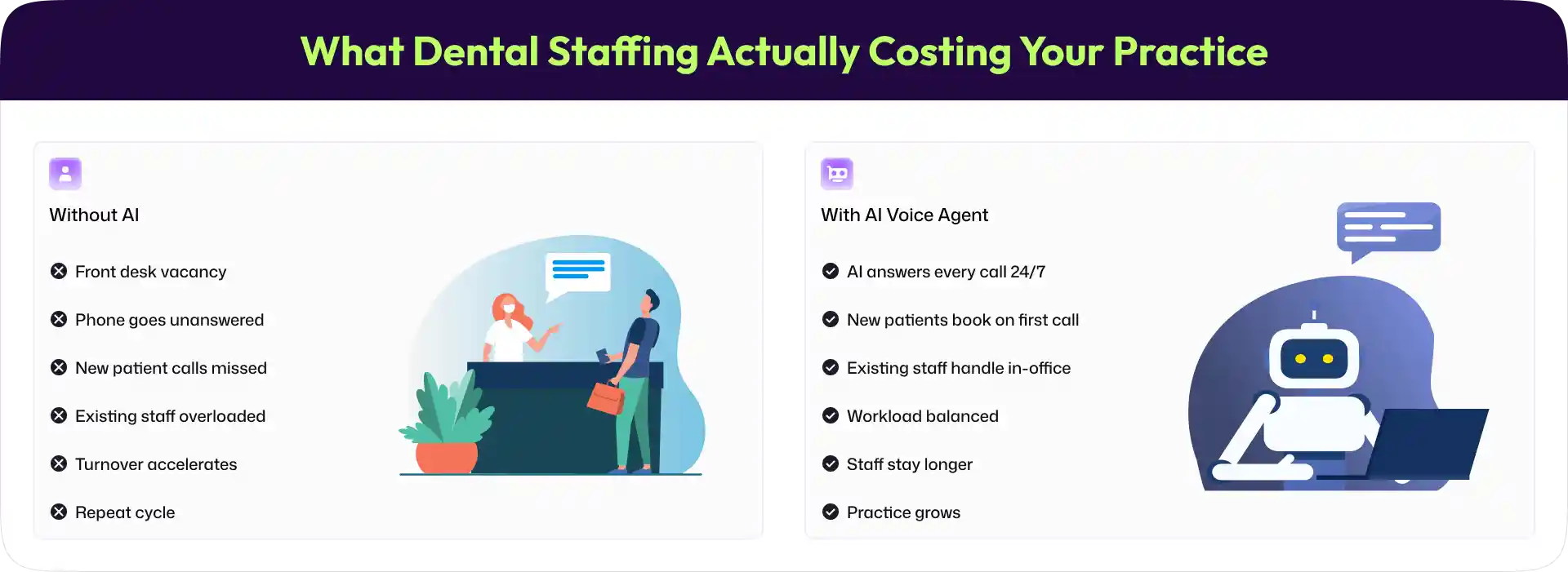
The staffing crisis shows up in production numbers, not just HR headaches. When a front desk position sits open for 45 days, every unanswered call during that window is a patient who did not book. When a hygienist chair runs at 70% capacity because a second hygienist has not been replaced, that gap compounds weekly.
In addition, practices carrying short-staffed front desk teams place an unfair burden on the people who are there. Overloaded staff make more errors, burn out faster, and leave sooner, feeding the cycle that created the shortage in the first place.
According to PracticeCFO's 2026 Dentistry Report, practices with persistent staffing gaps report average annual production losses in the range of $80,000 to $120,000, driven primarily by missed new patient calls, reduced scheduling efficiency, and recall gaps that accumulate when outreach cannot be consistently staffed.
AI dental front desk automation directly addresses the highest-impact layer of this problem: the phone. And it does so without requiring a hire, a training period, or a benefits package.
How AI Addresses the Dental Staffing Shortage Without Adding Headcount
An AI voice agent for dental practices is a phone-based system that answers inbound calls, completes patient intake, books appointments directly into the practice management system, and handles routine patient questions, all without any front desk involvement.
This is not a phone tree or an automated attendant. The AI conducts a real conversation. It collects the patient's name, reason for visit, insurance information, and preferred appointment time. It checks live availability in the practice calendar. It books the appointment, confirms it, and sends a reminder before the patient hangs up.
For a dental practice running short-staffed, this capability does two things simultaneously. First, it ensures that no inbound call goes unanswered, regardless of how busy the front desk is or what time of day it is. Second, it removes the highest-volume repeatable task from the front desk team's plate, freeing them to focus on patients who are physically in the office.
According to Zentist's 2026 Dental RCM Trends and Insights Report, 58% of dental practices have adopted or plan to adopt AI and automation tools in 2026. The concentration of that investment is in exactly these high-volume front desk workflows: eligibility verification, appointment scheduling, and patient communication. Practices that have made this shift are running effectively with one fewer front desk team member than they needed before, without any reduction in patient-facing capacity.
Business Benefits of Using AI to Close the Staffing Gap
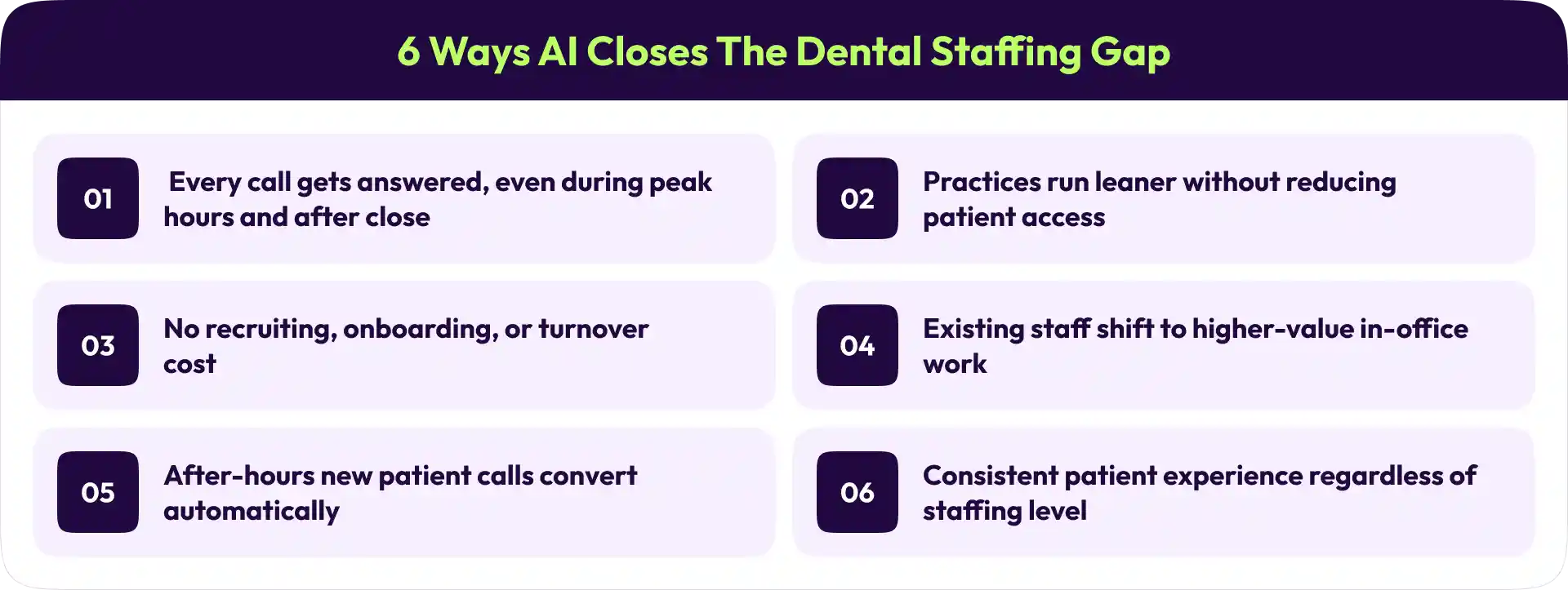
1. Every call gets answered, even during peak hours and after close
When the front desk is managing a check-in, a billing question, and a provider communication at once, the phone gets missed. An AI voice agent handles any number of simultaneous calls at the same level of quality, with no hold times and no dropped calls. Patients calling at 8 PM get the same response speed as patients calling at 10 AM. Furthermore, 41% of patient calls to medical and dental practices arrive outside standard business hours, according to the Relatient Communications Study, 2025. AI closes that window completely.
2. Practices run leaner without reducing patient access
A well-implemented AI voice agent handles the call volume equivalent of one to two full-time front desk staff. This does not mean eliminating the team. It means the practice no longer needs to backfill every vacancy at full staffing levels to maintain patient access. In markets like Dallas, Houston, and San Antonio, where signing bonuses and hourly rates for front desk coordinators are rising sharply, this operational flexibility is significant.
3. No onboarding, no turnover, no recruiting cycles
The average dental practice spends 45 to 60 days recruiting a front desk replacement and another 30 to 60 days bringing them to full productivity. During that window, the team absorbs additional load and patients experience service gaps. An AI voice agent is live in 1 to 3 business days, requires no training, does not resign, and does not call in sick. As a result, the staffing gap that would have cost three to four months of reduced capacity costs nothing in transition time.
4. Existing staff shift to higher-value work
When AI handles inbound calls and routine scheduling, the front desk team stops spending their morning returning overnight voicemails and chasing insurance verifications. That time, typically 30 to 90 minutes per team member per day, shifts to treatment plan follow-ups, in-office patient experience, and care coordination. Staff who are less overwhelmed stay longer, which directly reduces the turnover that feeds the shortage cycle.
5. After-hours new patient acquisition becomes automatic
New patients searching for a dentist in Austin or Plano in the evening are high-intent callers. They have already made a decision. When they call and the AI answers, books them, and sends a confirmation, that patient is in the schedule. When they call and reach voicemail, most of them do not call back. AI converts after-hours new patient calls that would otherwise be lost, without requiring any extended staffing hours.
6. Consistent patient experience regardless of staffing level
A short-staffed front desk produces inconsistent patient experiences. Some calls get full attention. Others get rushed. AI delivers identical quality on every call, every time, which protects the patient experience independent of how many people happen to be working that day.
Which Dental Practices See the Most Impact
Solo practitioners managing without a dedicated front desk coordinator
In many solo practices, the dentist or a clinical team member covers the phone between patients. This is not a staffing strategy. It is a gap-filling habit that costs clinical productivity and patient experience simultaneously. AI handles the inbound call volume that the solo practice cannot reliably staff, answering every call and booking new patients without pulling clinical staff away from chairside work. Practices in suburban Texas markets, including Plano, Sugar Land, and Round Rock, running solo or with minimal administrative staff, are seeing the most immediate impact from this shift.
Group practices managing multiple locations with uneven staffing
A two- or three-location group practice rarely has perfectly matched staffing across sites. One location may be fully staffed while another is operating with a vacancy. AI voice agents handle call overflow and after-hours volume at every location from a single system, routing patients to the right site based on their ZIP code or provider preference without manual coordination. As a result, a staffing gap at one location does not create a patient access gap.
Practices in high-growth Texas markets competing for the same candidates
In Austin, Dallas-Fort Worth, and Houston, dental practices, DSOs, and specialty groups are all recruiting from the same limited candidate pool. Signing bonuses, flexible scheduling offers, and benefits competitions drive up labor costs without resolving the underlying shortage. Practices that reduce their front desk headcount dependency through AI are less exposed to this competition. They need fewer people and can be more selective about the hires they do make.
What to Look for in a Dental AI Voice Agent
Not all AI dental front desk platforms are equivalent. Before committing to any solution, confirm these specific capabilities:
1. Real-time PMS integration with two-way write-back
The AI must be able to write confirmed appointments directly into your practice management system, whether Dentrix, Eaglesoft, Open Dental, or Curve Dental, in real time. A system that only reads availability and sends a message to your team to book manually is not solving your staffing problem. It is creating a new step.
2. HIPAA compliance with a signed Business Associate Agreement
Any platform handling patient intake information over the phone is touching Protected Health Information. The vendor must provide a signed BAA before go-live, not upon request after implementation.
3. Bilingual English and Spanish call handling
In Texas, 28.5% of residents speak Spanish at home, per the US Census Bureau. Practices in San Antonio, El Paso, Houston's east side, and the Rio Grande Valley serve a large Spanish-speaking patient population. An AI voice agent that cannot complete a full intake in Spanish is not a complete solution for these markets.
4. Emergency escalation protocol
Confirm how the system handles urgent calls, including tooth pain, broken teeth, and significant swelling. The escalation path should route immediately to an on-call team member with full call context already captured, so the patient does not repeat their information.
Where Dental Front Desk AI Is Heading Next
The AI systems available to dental practices in 2026 are already meaningfully more capable than those that existed two years ago. Three developments are coming into wider deployment over the next 12 to 18 months that will extend the staffing relief further.
Real-time insurance eligibility verification during the intake call
Rather than verifying insurance the following morning, AI voice agents will confirm basic coverage eligibility before the patient ends the call. For practices managing a mix of Medicaid, PPO, and HMO dental plans in Texas, this will reduce morning verification workload and cut same-day cancellations driven by coverage confusion.
Proactive outbound recall and reactivation
The same AI handling inbound calls will reach out to patients overdue for hygiene appointments or with open treatment plans. Dental practices lose 20 to 30% of their active patient base to attrition each year. AI-powered outbound recall can reactivate a significant share of those patients within 90 days without adding any outreach staff.
Integrated patient financing pre-qualification
Patients who call to ask about a treatment they cannot immediately afford often go unscheduled. AI systems are beginning to integrate with dental financing platforms to present pre-qualification options during the intake call, converting inquiries into scheduled consultations that would otherwise have fallen through.

Conclusion
The dental staffing shortage is not resolving quickly. The pipeline of trained hygienists, dental assistants, and front desk coordinators is not growing fast enough to meet demand, and in the markets where that shortage is most acute, Texas among them, practices cannot recruit or spend their way to a durable solution.
The practices that are growing despite the shortage are not doing it by outbidding competitors for candidates. They are reducing their dependency on headcount for the workflows that AI handles better, faster, and at lower cost than a person can, specifically the phone. Dental front desk automation does not replace the team. It covers the gaps the team cannot fill: after-hours calls, simultaneous call volume, consistent new patient intake, and recall outreach that would otherwise fall through a short-staffed schedule.
For any dental practice carrying an open front desk position, running short-staffed through a busy season, or simply tired of the recruiting cycle, an AI voice agent is the most direct path through the dental staffing shortage to a practice that operates consistently, regardless of who called in sick or whose last day was last Friday.
Frequently Asked Questions
1. How bad is the dental staffing shortage in 2026?
The ADA Health Policy Institute reports that 62% of dentists identify staffing as their number one business concern in 2026, with 78% of practices reporting at least one unfilled position. Among dentists actively recruiting a hygienist, 91% describe the process as very or extremely challenging. Front desk positions are averaging 45 to 60 days to fill, more than double pre-2020 timelines. The shortage affects solo practices, group practices, and DSOs across every US region.
2. Can AI really replace a dental front desk coordinator?
AI does not replace a front desk coordinator. It handles the highest-volume repeatable tasks that consume most of a coordinator's time: answering inbound calls, booking appointments, completing patient intake, and sending reminders. This allows a practice to operate with a smaller team without reducing patient access or experience. A well-implemented AI voice agent handles the call volume equivalent of one to two full-time staff, running 24/7 at a fraction of the cost of an additional hire.
3. How long does it take to implement an AI dental receptionist?
Most dental AI voice agent implementations go live in 1 to 3 business days. Setup includes configuring the practice's services, accepted insurance plans, provider schedules, and appointment types. Practice management software integration is tested before go-live. The front desk team is briefed on how AI-booked appointments appear in the PMS. No custom scripting is required, and there is no disruption to daily operations during the process.
4. Does AI handle dental emergencies when the office is closed?
Yes, when configured correctly. During setup, practices define their emergency call protocols. When a patient describes severe pain, trauma, or significant swelling, the AI immediately routes the call according to those protocols, alerting an on-call team member, providing emergency dental resources, or following a custom escalation path. The specific protocol is set by the practice before go-live and can be updated at any time.
5. What dental practice management software does AI integrate with?
Leading AI dental voice agents integrate directly with Dentrix, Eaglesoft, Open Dental, and Curve Dental. The key capability to verify is two-way write-back, meaning the AI writes confirmed appointments into the PMS in real time, not read-only access that still requires manual booking. Ask any vendor to confirm their integration approach before committing to a platform.
6. How does AI help with the dental staffing shortage specifically for Texas practices?
Texas dental practices face double pressure: a national staffing shortage and one of the most competitive recruiting environments in the country. Markets like Austin, Dallas, Houston, and San Antonio have high demand for front desk coordinators and hygienists, with rising wages and signing bonuses that smaller practices cannot always match. AI reduces the number of front desk staff a Texas practice needs to operate fully, lowering exposure to the recruiting competition and creating a more sustainable staffing model regardless of market conditions.
Sources & References:
Sources (Verified: June 2026)
1. American Dental Association (ADA), Health Policy Institute
2. American Dental Association (ADA) News
3. U.S. Bureau of Labor Statistics. Dental Hygienists. 2025
Shravan Rajpurohit
CEO & Co-Founder
Shravan Rajpurohit is the Co-Founder & CEO of The Intellify, a leading Custom Software Development company that empowers startups, product development teams, and Fortune 500 companies. With over 10 years of experience in marketing, sales, and customer success, Shravan has been driving digital innovation since 2018, leading a team of 50+ creative professionals. His mission is to bridge the gap between business ideas and reality through advanced tech solutions, aiming to make The Intellify a global leader. He focuses on delivering excellence, solving real-world problems, and pushing the limits of digital transformation.

Stay Updated
with AI Insights
Get the latest articles on AI, automation, and enterprise technology delivered to your inbox weekly.

500+ people have already subsribed!
No spam. Unsubscribe anytime.