
Restaurant Automation for Front-of-House (FOH) Operations: A Complete Guide [2026]



![Restaurant Automation for Front-of-House (FOH) Operations: A Complete Guide [2026]](https://alris-ai-cms.theintellify.net/uploads/Restaurant_Automation_for_Front_of_House_FOH_13d4b6bbe8.webp)
TL;DR
Restaurant automation uses software, AI, and connected systems to reduce repetitive front-of-house work.
Restaurants can automate phone calls, reservations, ordering, guest FAQs, waitlists, notifications, and call routing.
AI voice agents can handle routine guest conversations and trigger defined restaurant workflows.
The best automation works with existing POS, reservation, ordering, and phone systems rather than operating separately.
Restaurants should start with one high-volume workflow, test it, and expand gradually.
Not every task should be automated. Complaints, complex requests, service recovery, and sensitive situations still need human involvement.
The goal is not to replace hospitality; it is to reduce repetitive work, so FOH teams can spend more time with guests.
Running a restaurant means dealing with a constant stream of small tasks. A host seats a party, answers the phone, checks a reservation, updates a waitlist, and answers another guest's question all within a few minutes. During a busy Friday night, those interruptions can pile up fast.
This is where restaurant automation can help.
It does not mean replacing the people who make a restaurant feel welcoming. It means using software, AI, and connected systems to handle repetitive work that does not always require a staff member.
For front-of-house (FOH) operations, these can include phone calls, reservations, ordering, guest questions, notifications, and call routing.
This guide looks at what restaurants can automate, where AI fits, which tasks should remain human, how to choose restaurant automation software in 2026, and how to introduce it without making the guest experience feel impersonal.
What Is Restaurant Automation?
Restaurant automation is the use of technology to perform specific restaurant tasks or workflows with less manual involvement.
That technology can include traditional software, integrations, workflow tools, AI, and voice-based systems. The important point is that restaurant automation does not mean automating the entire restaurant. It is usually about individual processes.
For example, instead of having an employee answer every call asking about business hours, an automated system can handle routine questions. Instead of manually sending every reservation reminder, software can send those messages automatically.
Automation can take care of predictable interactions such as:
Restaurant hours
Location and parking
Reservation requests
Reservation changes
Cancellations
Menu-related questions
Ordering
Waitlist updates
Basic guest notifications
Call routing
The best use of automation is usually not the most complicated one. It is a task that happens often, follows a clear process, and takes employees away from more important work.
Why Front-of-House Operations Are a Strong Opportunity for Restaurant Automation
FOH employees deal directly with guests, which makes their work valuable but also interruption-heavy. A single shift can involve hundreds of small interactions.
FOH employees constantly switch between tasks
A host might:
Seating guests
Answering phone calls
Managing reservations
Checking table availability
Updating a waitlist
Answering guest questions
Coordinating with servers
Then the phone rings again. The issue is not necessarily that any individual task is difficult. It is the constant switching between them.
When employees are interrupted repeatedly, even simple tasks can become frustrating and harder to manage during busy periods.
Phone calls compete with in-person service
This is one of the clearest opportunities for automation. Imagine a restaurant is full on a Saturday evening. A host is helping a guest who has just arrived when the phone rings. The caller wants to know whether the restaurant has a table available later that night.
Now the host has two guests competing for attention. Automating routine phone interactions can reduce that conflict.
An AI voice system can handle defined questions and workflows while employees continue serving guests in front of them. It can also provide a way to handle routine inquiries outside normal staffed hours.
Repetitive interactions consume valuable staff time
Restaurants receive many questions that are predictable:
"Are you open today?"
"Do you take reservations?"
"Where are you located?"
"Do you have parking?"
"Can I change my reservation?"
"Do you offer takeout?"
"Can I place an order by phone?"
Employees should still be available for requests that need judgment or personal attention. But there is little operational value in forcing staff to manually answer every routine question if technology can handle it accurately.
What Front-of-House Operations Can Restaurants Automate?
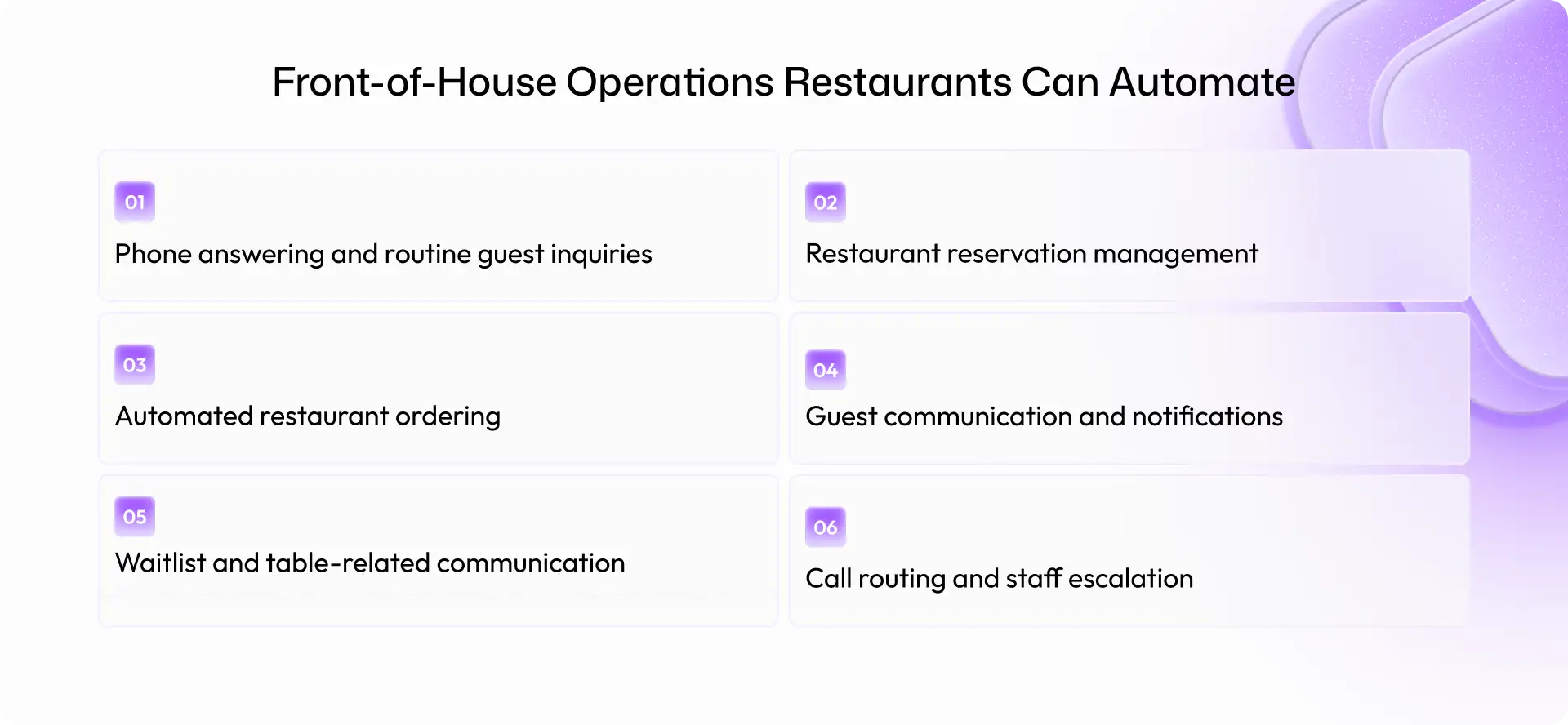
Not every restaurant needs the same level of automation. A full-service restaurant may benefit most from reservation and phone automation. A fast-casual operation may get more value from ordering and pickup workflows. A multi-location group may care more about consistency and centralized control.
Here are some of the most practical FOH opportunities.
Phone answering and routine guest inquiries
Restaurants can automate the first layer of phone support for common questions.
Examples include:
"What time do you close?"
"Do you take reservations?"
"Where are you located?"
"Do you have parking?"
"Can I change my reservation?"
"Do you offer takeout?"
"Do you have private dining?"
The system can answer straightforward questions and route more complicated calls to employees. This is especially useful during lunch and dinner rushes, when answering the phone may mean interrupting another guest interaction.
Restaurant reservation management
Reservation workflows are another practical use case. Depending on the restaurant's reservation technology, automation can assist with:
New reservation requests
Reservation confirmations
Cancellations
Rescheduling
Availability questions
Waitlist communication
Reservation-related phone calls
The exact workflow depends on the reservation platform and integrations being used. That integration point is important. A voice assistant that can talk about reservations but cannot actually interact with the reservation workflow has limited value.
Automated restaurant ordering
Ordering is another area where automation can reduce manual work. An automated ordering system for restaurants may support online ordering, phone ordering, kiosks, or other digital channels. For phone-based ordering, a workflow might:
Understand why the customer is calling.
Capture the order.
Confirm the details.
Handle supported modifications.
Pass the order into the appropriate system.
Escalate exceptions to staff.
The important word is supported. Restaurants should not expect automation to handle every possible request. Complicated modifications, payment problems, unavailable items, or sensitive food-related questions may require human involvement. The goal is reliable automation, not automation for its own sake.
Guest communication and notifications
Restaurants can also automate routine communication. Examples include:
Reservation confirmations
Reminders
Cancellation updates
Waitlist notifications
Order updates
Basic follow-ups
These workflows are repetitive and time-sensitive, which makes them good candidates for automation.
Waitlist and table-related communication
Waitlists can create a steady stream of questions for hosts. Guests want to know whether their table is ready, how long they may need to wait, or whether anything has changed.
Automated notifications can handle some of those updates without requiring the host to repeatedly stop what they are doing. That frees staff to focus on guests who actually need personal assistance.
Call routing and staff escalation
Not every call should be handled entirely by automation. A useful system should recognize when a call needs a person.
For example:
"What time do you close?"
→ Automation handles it.
"Can I make a reservation for four?"
→ Automation follows the reservation workflow.
"I had a serious problem during my last visit and need to speak with a manager."
→ Route to the appropriate employee.
That human escalation path is not a weakness. It is part of good automation design.
Key Benefits of Restaurant Automation
The benefits are less about replacing people and more about using their time better.
1. Reduce the number of routine calls staff handle manually
When technology handles basic questions, employees have fewer repetitive calls competing for their attention. That can be especially helpful during peak service. Improve responsiveness during peak service hours
A busy restaurant cannot always answer every call immediately. Automation provides another way to handle routine inquiries when employees are already occupied. Instead of leaving every caller waiting, the restaurant can use automation for requests that do not require staff involvement.
2. Capture guest inquiries outside normal operating hours
Restaurants receive calls outside their staffed hours. Guests may want to know tomorrow's opening time, ask about reservations, or get basic information before deciding when to visit.
Depending on the setup, automation can continue handling defined requests after hours.
3. Reduce interruptions for hosts, servers, and managers
This is often one of the most practical benefits. The value is not only the time spent completing a task. It is the interruption that never happens.
If a host does not have to stop serving a guest every time the phone rings, the whole shift can run more smoothly.
4. Create more consistent guest communication
Employees may answer the same question in slightly different ways. Automated workflows can provide consistent responses for information that has been clearly defined.
Of course, the information must be kept accurate. An automated system repeating outdated information 24/7 is not exactly progress.
5. Support higher call and inquiry volumes without adding equivalent staffing
Automation can help restaurants manage more routine interactions without requiring an employee to handle every one manually. This can be particularly useful for growing restaurants and multi-location operators.
6. Give FOH employees more time for in-person hospitality
This is arguably the most important benefit. Guests come to restaurants for an experience, not just a transaction.
If automation can handle repetitive phone calls, routine questions, or notifications, employees have more time to focus on the people in front of them.
Restaurant Automation Examples by FOH Function
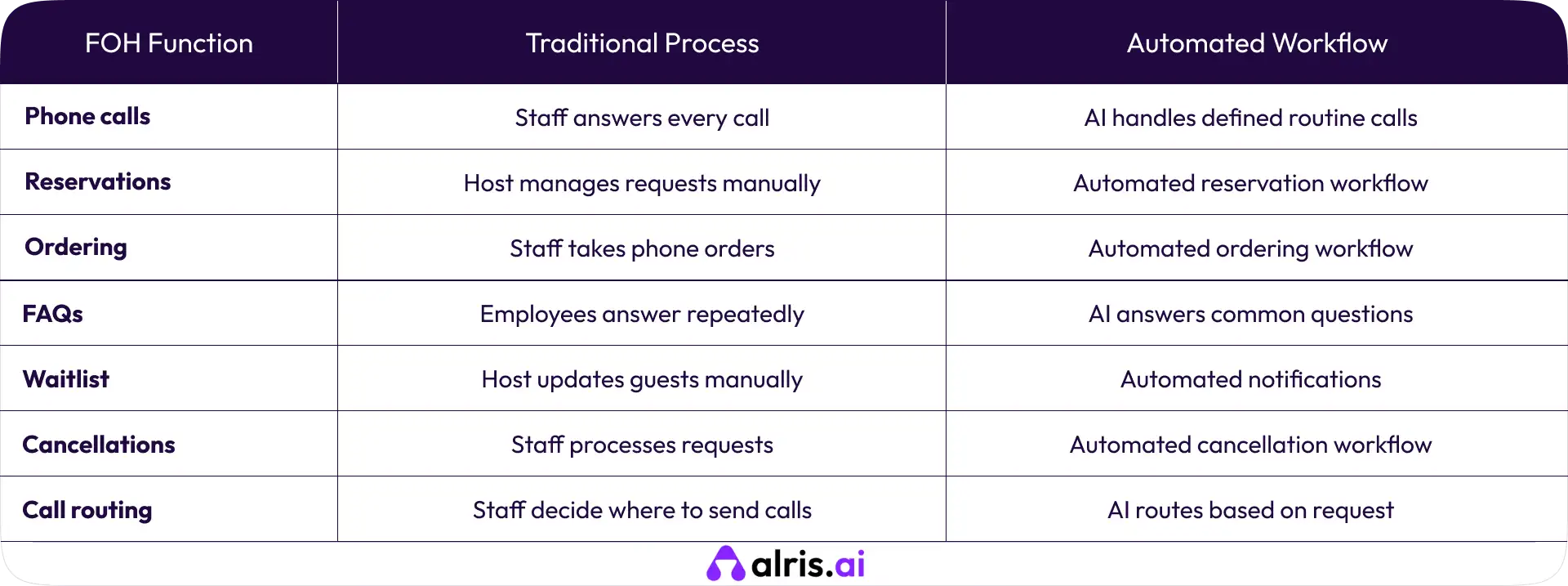
The pattern is simple: repetitive work is automated, while situations requiring judgment stay with people.
How AI Is Changing Restaurant Automation in 2026
Traditional automation generally follows predefined rules. AI makes it possible to build more conversational workflows.
From rule-based automation to conversational AI
Consider a traditional phone menu: "Press 1 for reservations. Press 2 for hours. Press 3 for directions."
It can work, but guests still have to navigate the menu.
Conversational AI can allow a guest to simply explain what they need.
For example: "I'd like to move my reservation from Saturday to Sunday."
The system can identify the request and move into the relevant workflow. That does not mean AI understands everything perfectly. It doesn't. The quality depends on how well the system is configured, what information it can access, and how clearly its workflows are designed.
Voice AI for restaurant phone operations
Voice AI is especially relevant to restaurants because the phone remains an important guest communication channel. A voice AI for restaurant system can be configured to handle defined interactions involving:
Restaurant information
Reservations
Reservation changes
Ordering
Common questions
Call routing
Guest requests
The difference from a traditional phone tree is the conversational interface. Instead of forcing guests through a series of numbered options, the system can understand what they are trying to accomplish.
AI can connect conversations with restaurant workflows
This is where the distinction between an AI assistant and a restaurant automation platform becomes important. There is a difference between:
AI that answers a question and AI that can take action through a connected workflow.
For example, telling a guest that reservations are available is one thing. Helping the guest complete a reservation is another. The same applies to ordering, call routing, and other FOH processes.
In practical terms, the strongest automation combines: Conversation + workflow + integration
How Restaurant Automation Works With Existing Technology
Restaurants already use a mix of technology. A typical operation may have a POS, reservation system, online ordering platform, phone system, payment tools, and guest communication software.
Restaurant automation should ideally work with that environment rather than forcing operators to rebuild everything.
POS systems
The POS often sits at the center of restaurant operations. When evaluating automation, understand what information the platform can access and what actions it can perform through the POS or related systems. Capabilities vary between providers.
Reservation and booking platforms
Reservation automation depends heavily on the reservation technology underneath it. If an automated system cannot interact with the relevant reservation workflow, staff may still have to complete the task manually.
Online ordering systems
Ordering automation also needs to connect with the systems that receive and process orders. Before implementation, understand where an automated order goes, how it is confirmed, and what happens when an item is unavailable.
Restaurant phone systems
For voice automation, restaurants should consider:
Existing phone numbers
Call routing
Transfers
Business hours
After-hours behavior
Human escalation
These details can have a bigger impact on the actual experience than the AI demo.
CRM and guest communication tools
Larger restaurant groups may also use CRM and communication platforms. Connecting automation to those tools can create a more consistent guest workflow instead of adding another isolated system.
APIs and integrations
This part is not particularly exciting. It is still one of the most important. Before choosing a platform, ask what it integrates with, what data it can access, what actions it can perform, and what happens when an integration fails.
How to Choose the Right Restaurant Automation Platform in 2026
There are plenty of restaurant technology products available now. The challenge is not finding software. It's choosing something that solves an actual operational problem.
Start with the problems you want to automate
Before comparing platforms, write down the pain points. For example:
Too many missed calls
Employees are spending too much time answering routine questions
Reservation requests are piling up during service
High phone-order volume
After-hours inquiries
Repetitive guest communication
Staff interruptions
Then rank those problems. Start with the one that causes the most friction.
Evaluate the platform's automation capabilities
Depending on your needs, look for capabilities such as:
Voice AI
Natural-language understanding
Reservation handling
Ordering workflows
Call routing
Human escalation
Guest notifications
Reporting
Workflow configuration
Don't assume that a long feature list means the platform is a better fit. A simple system that reliably handles three important workflows may be more useful than one that claims to automate twenty.
Check integrations with your restaurant technology
This should be part of the evaluation, not an afterthought. Ask:
Does it integrate with our reservation platform?
Can it work with our POS or ordering system?
How are calls transferred?
What happens when the connected system is unavailable?
Can our staff intervene?
Can location-specific information be managed?
The answers will tell you much more than a product demo.
Evaluate reliability and handling of edge cases
AI will encounter situations that were not part of the demo. That is normal. The question is what happens next. Ask:
What happens when AI does not understand the guest?
Can it ask a clarification question?
Can the guest reach a person?
Can staff take over?
How are unusual requests handled?
How are errors logged?
How can the workflow be updated?
A good automation platform needs a sensible failure path.
Consider scalability across multiple locations
Multi-location restaurants have another challenge: consistency. Each location may have different:
Hours
Menus
Reservation rules
Parking information
Services
Policies
The platform should be able to manage shared workflows while keeping location-specific information accurate.
Look beyond the demo
A smooth demo is not enough. Test the platform with real scenarios. Try ask:
A simple question
An unclear question
A reservation change
A cancellation
An unusual request
A request for a human
A noisy call
An after-hours call
Then see what happens. That's much more revealing than watching a perfectly prepared demonstration.
Common Mistakes Restaurants Make When Automating FOH Operations
Automation can help a lot. It can also create a headache if implemented badly.
1. Automating everything at once
Trying to automate the entire FOH operation can create unnecessary complexity. Start with one workflow and expand from there.
2. Choosing technology before identifying the problem
"Let's add AI" is not a strategy. "Staff miss calls during peak hours" is a problem you can actually solve.
3. Treating AI as a replacement for hospitality
Restaurant automation should support employees, not remove the human element from hospitality. The technology should handle repetitive work so staff can focus on guests.
4. Ignoring human escalation
Guests should not be trapped inside an automated system. If someone needs a person, there should be a clear way to reach one.
5. Using automation without integrations
An AI system that can answer questions but cannot complete important workflows may simply move the work somewhere else. Understand the integration capabilities before choosing a platform.
6. Failing to monitor real-world performance
Automation needs ongoing review. Look for:
Misunderstood questions
Failed workflows
Frequent transfers
Guest complaints
Information that needs updating
The system should improve as you learn how guests actually use it.
7. Creating a poor guest experience with overly rigid automation
If a guest has to repeat themselves several times just to reach the right person, the automation is creating more work, not less. The technology should make the interaction easier.
Restaurant Automation for Different Types of U.S. Restaurants
There is no single restaurant automation strategy. The right approach depends on the business model.
Full-service restaurants
Full-service restaurants often have significant opportunities around:
Reservations
Phone calls
Waitlists
Guest questions
Table-related communication
The main objective is often to reduce FOH interruptions while keeping the guest experience personal.
Fast-casual restaurants
Fast-casual operations may benefit more from:
Ordering
Pickup questions
Hours and location information
High-volume phone inquiries
Guest notifications
Automation can help absorb repetitive interactions without adding more manual steps to already fast-moving operations.
QSRs
Quick-service restaurants operate around speed and volume. Potential automation areas include:
Ordering
Location inquiries
Customer questions
High-volume interactions
Order-related communication
The focus should be on reducing friction, not adding another layer between the guest and the restaurant.
Restaurant groups and multi-location operators
For larger groups, consistency becomes a major consideration.
Different locations can have different hours, menus, policies, and services.
A scalable automation platform should allow shared workflows while keeping each location's information accurate.
Final Takeaway: Automate the Work, Not the Hospitality
Restaurant automation should reduce repetitive FOH work, not replace the human side of hospitality. By automating routine calls, reservations, ordering, guest questions, and notifications, restaurants can reduce interruptions and give staff more time to focus on guests.
The goal is simple: automate repetitive work, keep people involved where judgment and hospitality matter.
Frequently Asked Questions About Restaurant Automation
1. What can restaurants automate?
Restaurants can automate repetitive and predictable processes such as routine phone calls, reservation workflows, ordering, FAQs, waitlist notifications, and guest communication.
2. What is an automated restaurant ordering system?
An automated restaurant ordering system uses software or AI to capture and process customer orders with less manual involvement. Depending on the setup, it can support online, phone, kiosk, or other ordering channels.
3. Can restaurants automate phone calls?
Yes. Restaurants can use voice AI to handle defined phone interactions, including routine questions, reservations, ordering, and call routing. More complex requests can be transferred to employees.
4. Can AI take restaurant reservations?
AI can support reservation workflows when it is connected to a compatible reservation system and configured with the restaurant's rules. Depending on the setup, it can assist with new reservations, changes, cancellations, and related questions.
5. Does restaurant automation replace employees?
Not necessarily. The most practical use of FOH automation is often to handle repetitive tasks while employees focus on hospitality, complex requests, exceptions, and guest situations that need human judgment.
6. What should restaurants automate first?
Start with a high-volume, repetitive process that creates measurable friction. Common examples include routine phone calls, reservation inquiries, ordering calls, FAQs, or guest notifications.
7. How do I choose a restaurant automation platform?
Start by identifying the operational problem. Then evaluate the platform's automation capabilities, integrations, reliability, human escalation, reporting, scalability, and support. Test real scenarios before committing.
Sources & References:
Shravan Rajpurohit
CEO & Co-Founder
Shravan Rajpurohit is the Co-Founder & CEO of The Intellify, a leading Custom Software Development company that empowers startups, product development teams, and Fortune 500 companies. With over 10 years of experience in marketing, sales, and customer success, Shravan has been driving digital innovation since 2018, leading a team of 50+ creative professionals. His mission is to bridge the gap between business ideas and reality through advanced tech solutions, aiming to make The Intellify a global leader. He focuses on delivering excellence, solving real-world problems, and pushing the limits of digital transformation.

Stay Updated
with AI Insights
Get the latest articles on AI, automation, and enterprise technology delivered to your inbox weekly.

500+ people have already subsribed!
No spam. Unsubscribe anytime.