
Healthcare Workflow Automation: The Future of AI-Driven Hospital Operations



Why Hospitals Can’t Run on Manual Processes Anymore
Healthcare systems across the world, especially in the USA, are under pressure like never before. Patient volumes are rising, yet hospitals are struggling with staffing shortages, operational inefficiencies, and increasing costs. Behind the scenes, a large part of the problem lies in outdated, manual workflows. Doctors and nurses spend hours on administrative tasks instead of patient care. Departments operate in silos, leading to delays, miscommunication, and errors. From scheduling appointments to processing claims, too many processes still rely on human intervention.
At the same time, expectations are changing. Patients want faster service, seamless communication, and better experiences. Healthcare providers are expected to deliver high-quality outcomes while reducing operational costs. This is where healthcare workflow automation comes into play. But today, automation is no longer just about digitizing forms or adding software tools. The shift is toward AI workflow automation, where intelligent systems and AI agents manage, coordinate, and optimize entire hospital operations.
In simple terms, hospitals don’t just need tools anymore. They need connected and intelligent workflows that run end-to-end.
What is Workflow Automation in Healthcare?
Healthcare workflow automation refers to the use of technology to streamline and automate routine processes across hospital operations. These workflows include:
Appointment scheduling
Patient registration
Insurance verification
Clinical documentation
Billing and claims processing
Follow-up communication
Traditionally, automation meant rule-based systems performing repetitive tasks. But with healthcare AI automation, things have evolved.
AI-powered systems can now:
Understand data patterns
Make real-time decisions
Coordinate across departments
Predict outcomes and risks
This is what makes AI automation in healthcare operations truly transformative. It doesn’t just speed up processes, it improves how hospitals function as a whole.
Why Traditional Hospital Workflows Break Down
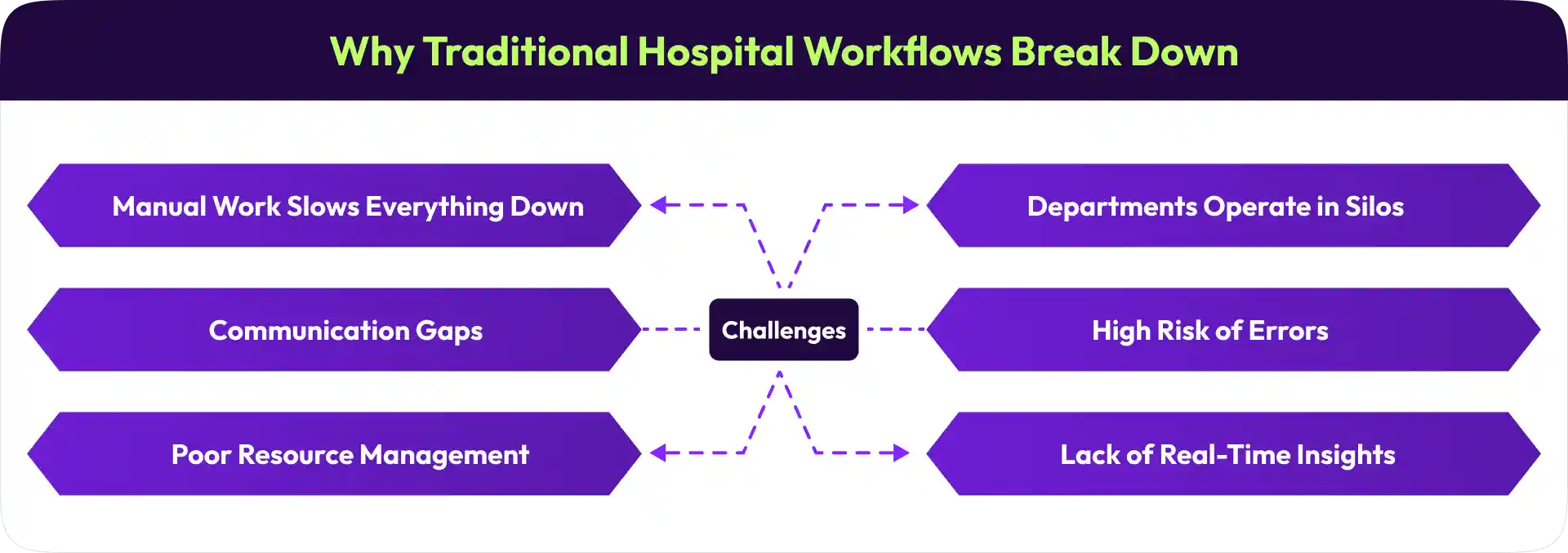
Most hospitals today operate on a mix of legacy systems and disconnected processes. While this may have worked in the past, it creates serious challenges in modern healthcare environments.
Manual Work Slows Everything Down
Staff still handle large amounts of paperwork and repetitive data entry. This increases workload and reduces efficiency.
Departments Operate in Silos
Billing, diagnostics, pharmacy, and administration often work independently. This lack of coordination leads to delays and confusion.
Communication Gaps
Important information doesn’t always flow smoothly between teams. This can impact both operations and patient care.
High Risk of Errors
Manual processes increase the chances of mistakes, especially in billing, documentation, and scheduling.
Poor Resource Management
Without real-time visibility, hospitals struggle to allocate beds, staff, and equipment efficiently.
Lack of Real-Time Insights
Decision-making is often reactive instead of proactive because data isn’t unified or analyzed effectively.
The result? Delays, higher costs, staff burnout, and poor patient experiences. This is why healthcare automation is necessary.
How AI Agents Automate Hospital Operations End-to-End
The real power of automation comes when it covers the entire patient journey from before the visit to after discharge.
Before the Visit
AI systems simplify and optimize pre-visit processes:
Intelligent appointment scheduling based on availability and urgency
Automated insurance verification
Digital form completion before arrival
Appointment reminders to reduce no-shows
This reduces administrative burden and ensures smoother patient intake.
During Care Delivery
This is where AI workflow automation truly shines:
Clinical documentation support using voice or structured inputs
Coordination between departments (lab, radiology, pharmacy)
Smart routing of tests and procedures
Real-time alerts for delays or patient risks
AI acts like an invisible coordinator, ensuring everything runs smoothly.
After the Visit
Post-care workflows are often overlooked, but they are critical:
Automated billing and claims submission
Follow-up appointment scheduling
Patient communication via messages or calls
Outcome tracking and reporting
The result is a fully connected system where nothing falls through the cracks.
High-Impact Use Cases Across Hospital Departments
Let’s look at how healthcare workflow automation delivers real value across different hospital functions.
Emergency Department Optimization: AI helps manage patient inflow, prioritize cases, and reduce waiting times.
Operating Room Scheduling: Automation ensures optimal use of operating rooms by aligning staff, equipment, and patient schedules.
Inpatient Bed Management: AI tracks bed availability and predicts discharge times for better planning.
Radiology Workflow Coordination: Automated scheduling and reporting improve turnaround times.
Pharmacy Operations: From prescription validation to medication fulfillment, workflows become faster and more accurate.
Revenue Cycle Automation: Claims processing, coding, and billing are streamlined, reducing errors and speeding up reimbursements.
Benefits of AI Automation in Healthcare Operations
When implemented correctly, healthcare AI automation delivers measurable outcomes across multiple areas.
Operational Efficiency
Faster workflows
Reduced bottlenecks
Better utilization of resources
Financial Impact
Lower administrative costs
Fewer billing errors
Faster reimbursements
Staff Experience
Reduced burnout
Less repetitive work
More focus on patient care
Patient Experience
Shorter wait times
Seamless care journey
Improved communication
In short, automation improves both the business side and the human side of healthcare.
Real-Time Decision Making with Intelligent Workflows
One of the biggest advantages of AI automation in healthcare operations is real-time intelligence. AI systems continuously monitor hospital activity and provide actionable insights. They can:
Predict patient surges in emergency departments
Identify operational bottlenecks early
Adjust schedules dynamically
Alert teams about potential risks
Instead of reacting to problems, hospitals can act proactively. This shift from reactive to data-driven operations is what defines modern healthcare systems.
Security, Compliance, and Trust in Automated Healthcare Systems
Healthcare organizations handle highly sensitive patient data, so security is critical. Modern healthcare workflow automation solutions are designed with compliance in mind.
Key Considerations:
Strong data encryption and access controls
Compliance with frameworks like HIPAA
Transparent audit trails
Human oversight in AI decision-making
Ethical and responsible use of automation
Trust is essential. Without it, automation cannot scale in healthcare environments.
Why Healthcare Organizations Are Moving Toward AI-Driven Operations Now
The shift toward healthcare automation is not just about innovation, it’s driven by real challenges.
Workforce Shortages: Hospitals are struggling to manage growing workloads with limited staff.
Rising Costs: Operational expenses continue to increase, putting pressure on margins.
Demand for Better Experiences: Patients expect faster, more personalized care.
Competitive Pressure: Healthcare providers must innovate to stay relevant.
Value-Based Care Models: Outcomes matter more than ever, requiring better coordination and efficiency.
AI-driven operations are becoming the only viable way forward.
Implementing Healthcare Operations Automation Successfully
Adopting AI workflow automation doesn’t have to be overwhelming. The key is to start smart and scale gradually.
Start with High-Impact Areas: Focus on workflows that deliver immediate value, like scheduling or billing.
Integrate with Existing Systems: Ensure automation works with the current hospital infrastructure.
Train Staff: Help teams understand how to work alongside AI systems.
Measure Performance: Track improvements in efficiency, cost, and patient outcomes.
Scale Gradually: Expand automation across departments step by step.
Choosing the Right Partner for Healthcare Workflow Automation
When hospitals plan large-scale automation, technology alone isn’t enough. The real success depends on choosing the right partner. Look for providers who:
Understand real hospital workflows, not just software
Can integrate seamlessly with existing systems
Prioritize data security and compliance
Build solutions that support staff, not replace them
Offer scalable, future-ready approaches
Provide ongoing support and optimization
Experienced AI solution providers like Alris AI focus on practical, human-centered automation. Their approach ensures that hospitals can adopt AI smoothly while maintaining trust, safety, and operational continuity. The right partner turns automation from a tool into a long-term advantage.
Final Thought
Healthcare is entering a new phase, one where operations are driven by data, intelligence, and automation. Hospitals are evolving into connected ecosystems where:
Processes run seamlessly across departments
AI supports decision-making in real time
Staff focus more on patient care than coordination
Early adopters of healthcare workflow automation will gain a significant competitive edge, improving efficiency, reducing costs, and delivering better patient outcomes. The future of healthcare is not just digital, it’s intelligent. And AI automation in healthcare operations is quickly becoming the foundation of that future.
Shravan Rajpurohit
CEO & Co-Founder
Shravan Rajpurohit is the Co-Founder & CEO of The Intellify, a leading Custom Software Development company that empowers startups, product development teams, and Fortune 500 companies. With over 10 years of experience in marketing, sales, and customer success, Shravan has been driving digital innovation since 2018, leading a team of 50+ creative professionals. His mission is to bridge the gap between business ideas and reality through advanced tech solutions, aiming to make The Intellify a global leader. He focuses on delivering excellence, solving real-world problems, and pushing the limits of digital transformation.

Stay Updated
with AI Insights
Get the latest articles on AI, automation, and enterprise technology delivered to your inbox weekly.

500+ people have already subsribed!
No spam. Unsubscribe anytime.