
HIPAA-Compliant AI Receptionist: What Every Dental Practice Needs to Know in 2026



It is a Thursday afternoon at a growing practice in Plano, and the office manager just got off the phone with a prospective AI vendor. The pitch sounded great: 24/7 call answering, automatic booking, no more missed calls. Then she asked one question: "Will you sign a Business Associate Agreement?" The rep went quiet, then said their legal team would "circle back."
That single question is the difference between a HIPAA dental AI receptionist and a liability waiting to happen. Every dental practice that answers phones, books appointments, or discusses treatment handles protected health information, and any vendor touching that data becomes a business associate under federal law, whether the sales deck mentions it or not.
In 2026, as more practices in Austin, Dallas, Houston, San Antonio, El Paso, and Plano adopt AI voice agents to solve staffing gaps and after-hours coverage, the compliance stakes have only grown. Enforcement is tightening, penalties are rising, and patients are paying closer attention to who handles their data. This guide explains exactly what HIPAA compliance means for an AI receptionist, what questions to ask before you sign a contract, and how a properly built system protects your practice instead of exposing it.
Why HIPAA Compliance Is a Bigger Risk Than Most Practices Realize
Most dentists assume HIPAA is a paperwork problem handled once a year during a staff training session. In reality, it is an operational risk that grows every time a new system touches patient data, and AI tools are no exception.
The financial exposure has never been higher. Effective January 28, 2026, HHS raised its civil penalty tiers so that willful neglect violations that go uncorrected can now cost between $73,011 and $2,190,294 per violation category, per year. A single mishandled phone call transcript, multiplied across a patient list, can qualify as more than one violation.
Healthcare recorded 772 large data breaches in 2025, the worst year on record, exposing protected health information belonging to more than 139.7 million people (HIPAA Journal, 2026).
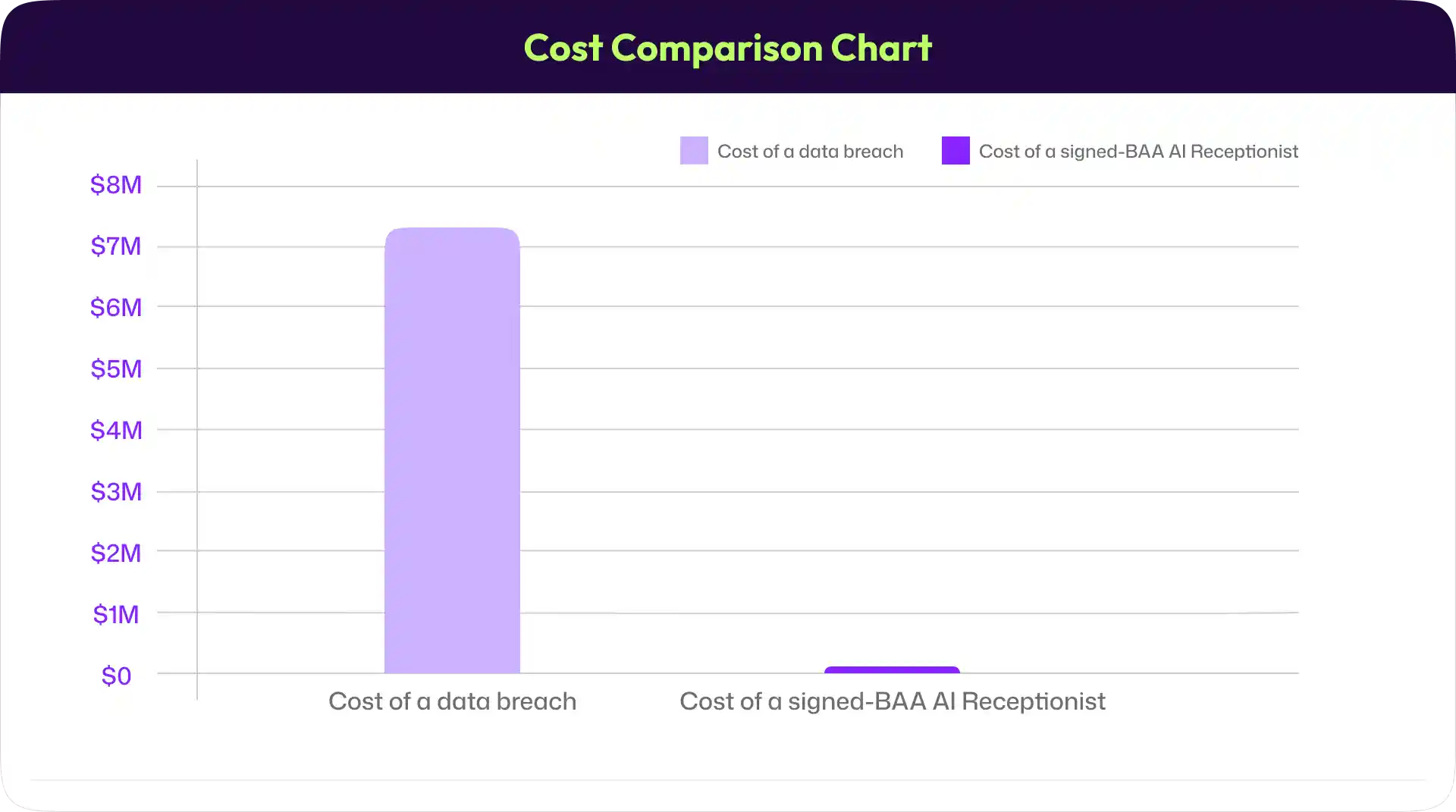
The average healthcare data breach now costs $7.42 million and takes 279 days to identify and contain, longer than any other industry IBM tracks (IBM Cost of a Data Breach Report, 2025).
A single ransomware incident tied to a dental scheduling vendor, DDS Safe, potentially affected roughly 432 dental practices in one event (American Dental Association).
Moreover, small practices are not exempt just because they are small. There is no size threshold in the HIPAA Security Rule, and a solo dentist with three employees carries the same legal obligations as a 40-location DSO. As a result, the practices most likely to skip a signed BAA or skip an annual security risk assessment are often the ones least equipped to absorb a six-figure penalty.
What a HIPAA Dental AI Receptionist Actually Is
A HIPAA-compliant AI receptionist is an AI voice agent that answers calls, books appointments, and handles patient intake while meeting the same legal safeguards required of any staff member who touches protected health information. That means encryption, access controls, audit trails, and a signed BAA between your practice and the vendor.
For a busy dentist or practice manager, the easiest way to think about it is this: everything your front desk team is trained to protect, your AI voice agent must protect too, and it must be provable. Compliance is not a marketing claim. It has to be built into the architecture.
In practice, that means a few concrete things happen behind the scenes. Every call is encrypted in transit and at rest. Access to recordings and transcripts is limited to authorized staff on a minimum-necessary basis. The system logs who accessed what data and when, creating an audit trail your practice can produce during an OCR investigation. Furthermore, the vendor signs a BAA that legally obligates them to the same safeguards you are required to follow, and to notify you promptly if a breach ever occurs.
Alris AI is built around this standard from the ground up, with a signed BAA available to every practice, encrypted call handling, and integrations with Dental systems that keep patient data inside your existing compliance boundary rather than scattered across a new, unsecured system.
Benefits and Business Impact of a HIPAA-Compliant AI Receptionist
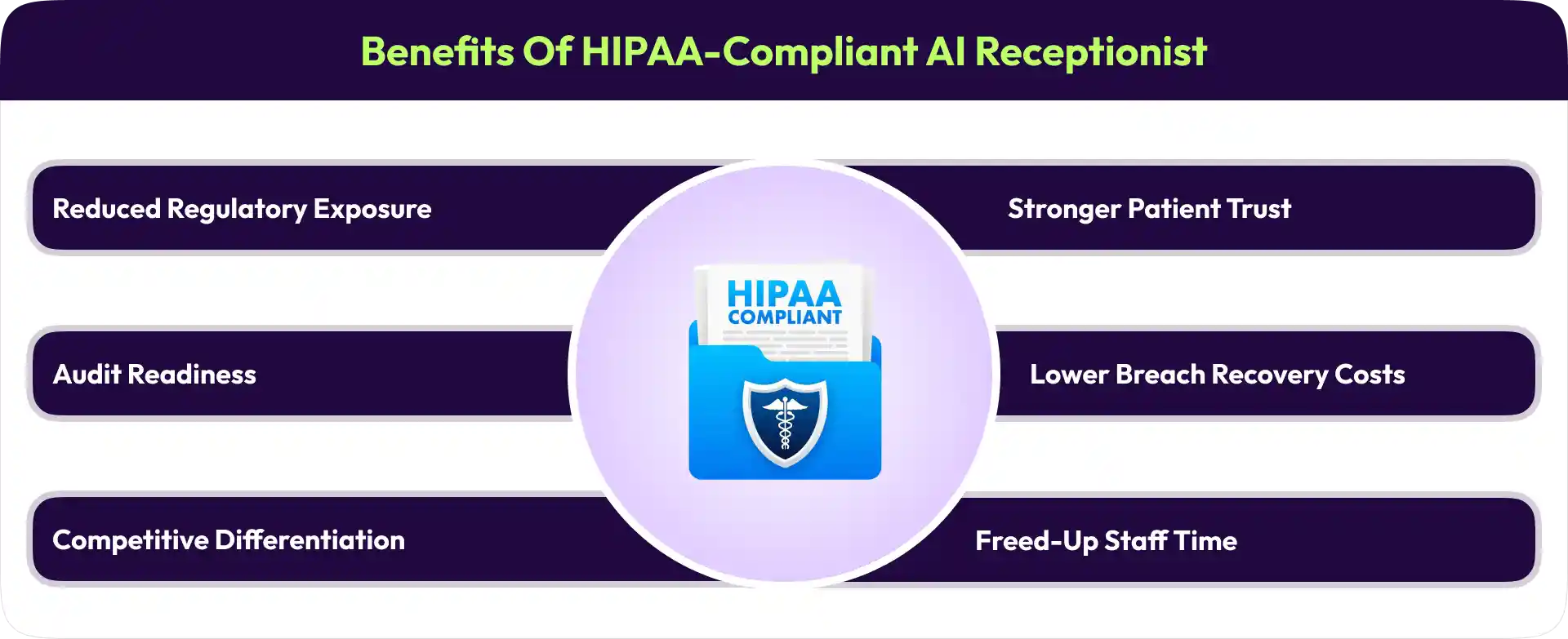
1. Reduced Regulatory and Financial Exposure
With Tier 4 penalties reaching $2,190,294 per violation category annually as of 2026, working with a vendor that signs a BAA and documents its safeguards materially lowers your practice's exposure if an incident ever occurs.
2. Stronger Patient Trust and Retention
Patients notice how their information is handled. In the 2025 Patient Confidence Index, 83% of patients said they trust their healthcare provider with the information they share, and 92% said they believe privacy is a right rather than a courtesy (PatientPoint, 2025). A compliant AI receptionist protects that trust instead of quietly eroding it.
3. Audit Readiness Without Extra Staff Time
Manual call logs and paper trails are hard to produce quickly during an OCR investigation. An AI receptionist with built-in audit logging generates that documentation automatically, saving hours of scrambling if your practice is ever audited.
4. Lower Breach Recovery Costs
Since the average healthcare breach now costs $7.42 million and 279 days to contain, prevention is far cheaper than remediation. Encrypted, access-controlled AI systems close off one of the most common entry points: unsecured call and messaging data.
5. Competitive Differentiation in a Crowded Market
As more practices in Texas metros adopt AI receptionists, being able to tell patients and referring providers that your systems are fully HIPAA-compliant, backed by a signed BAA, becomes a genuine differentiator rather than fine print.
6. Freed-Up Staff Time for Patient Care
When compliance is engineered into the system rather than bolted on afterward, front desk staff spend less time worrying about where call recordings live or who can access them, and more time on patients physically in the office.
Industry-Specific Use Cases for a HIPAA-Compliant AI Receptionist
1. Solo practice
A solo practice in Austin with one office manager and no dedicated IT staff cannot realistically run its own annual security risk assessment on a custom-built phone system. A HIPAA dental AI receptionist with a signed BAA and documented safeguards effectively outsources that burden to a vendor whose entire business depends on getting it right.
2. Multi-location group
A multi-location group practice spanning Houston and San Antonio faces a different challenge: keeping call handling, patient intake, and data access consistent across every location. Centralizing that through one compliant AI voice agent means every site follows the same encryption and access-control standards, instead of five different front desk habits.
3. Dental Service Organization (DSO)
A DSO expanding across Dallas, El Paso, and Plano needs compliance that scales with acquisitions. When a new practice joins the group, standardizing on a single HIPAA-compliant AI receptionist, already integrated with Dentrix, Eaglesoft, Open Dental, or Curve Dental, shortens the time it takes to bring that location's compliance posture up to group standards.
Implementation Considerations Before You Choose a Vendor
Not every AI vendor marketing itself to dental practices is actually built for HIPAA compliance. Before signing a contract, ask direct questions and get written answers.
Will the vendor sign a Business Associate Agreement, and is it available before you commit to a contract, not after?
How is data encrypted, both in transit and at rest, and what encryption standard do they use?
Who has access to call recordings and transcripts, and can that access be limited and logged?
What is the vendor's breach notification process, and how quickly are practices notified if an incident occurs?
Does the vendor use subcontractors, and do those subcontractors also operate under signed BAAs?
How long is patient data retained, and can it be deleted on request?
Furthermore, ask for documentation, not just verbal assurances. A vendor confident in its compliance posture will have a security overview, a standard BAA, and clear answers ready without hesitation.
Future Trends in Dental HIPAA Compliance
Three shifts are likely to reshape HIPAA compliance for dental practices over the next 12 to 18 months.
1. Proposed updates to the HIPAA Security Rule are expected to introduce mandatory encryption, multi-factor authentication, and faster breach notification timelines that will apply to every covered entity, including single-location dental practices, once finalized.
2. As generative AI tools move into clinical notes, patient messaging, and treatment summaries, expect closer scrutiny of how AI vendors handle protected health information, with practices increasingly asked to prove vendor compliance during audits, not just their own.
3. OCR enforcement activity is expected to keep climbing as breach volume grows. Practices that can quickly produce audit trails and a signed BAA will be far better positioned than those relying on informal assurances from a vendor.
Final Thought
The dental staffing shortage is pushing more practices toward AI voice agents to keep phones answered and schedules full, but speed cannot come at the expense of compliance. A HIPAA dental AI receptionist has to meet the same legal bar as your best-trained front desk employee: encrypted data, limited access, a documented audit trail, and a signed BAA.
Practices in Austin, Dallas, Houston, San Antonio, El Paso, and Plano that get this right protect themselves from six-figure penalties, protect patient trust, and free up staff time that used to go toward manual compliance tasks. As HIPAA enforcement tightens through 2026 and beyond, the practices that treat AI compliance as a baseline requirement, not an afterthought, will be the ones still standing when the rules get stricter.
Frequently Asked Questions (FAQs)
1. Is an AI receptionist for dental practices HIPAA compliant by default?
No. HIPAA compliance depends entirely on how a vendor builds and operates its system. A dental practice should never assume compliance; it should confirm a signed BAA, encryption standards, and access controls before adopting any AI voice agent that handles patient calls or scheduling.
2. Does Alris AI sign a Business Associate Agreement?
Yes. Alris AI signs a BAA with every dental practice it works with, formally committing to HIPAA-required safeguards for any protected health information the AI voice agent handles during calls, scheduling, and patient intake.
3. What happens if my AI receptionist vendor has a data breach?
Under a signed BAA, the vendor is legally required to notify your practice promptly so you can meet your own breach notification obligations to patients and, if the breach affects 500 or more people, to HHS. Vendors without a BAA carry no such legal obligation.
4. Is patient voice data protected under HIPAA the same way as written records?
Yes. Voice recordings and call transcripts that identify a patient and relate to their health or treatment are protected health information under HIPAA, just like paper charts or electronic health records, and must be encrypted, access-controlled, and covered by a BAA.
5. Do I still need a BAA if the AI only books appointments and does not discuss treatment?
Yes. Scheduling calls typically include the patient's name, contact information, and reason for the visit, which qualifies as protected health information. Any system that touches that data, even for scheduling alone, requires a signed BAA.
6. How does a bilingual AI receptionist handle HIPAA compliance for Spanish-language calls?
The same safeguards apply regardless of language. Encryption, access controls, and audit logging cover every call the AI voice agent handles, whether conducted in English or Spanish, so bilingual functionality does not create a separate compliance standard.
7. What is the difference between "HIPAA-compliant" and "HIPAA-certified"?
There is no official government HIPAA certification. When a vendor says "HIPAA-compliant," it should mean they have implemented required safeguards and will sign a BAA. Be cautious of any vendor claiming formal HIPAA certification, since HHS does not issue one.
Sources & References:
1. HIPAA Journal. "HIPAA Violation Fines: Updated for 2026."
2. HIPAA Journal. "Healthcare Data Breach Statistics: Updated for 2026."
3. IBM. "Cost of a Data Breach: The Healthcare Industry."
4. American Dental Association. "Protect Your Practice from Ransomware."
Shravan Rajpurohit
CEO & Co-Founder
Shravan Rajpurohit is the Co-Founder & CEO of The Intellify, a leading Custom Software Development company that empowers startups, product development teams, and Fortune 500 companies. With over 10 years of experience in marketing, sales, and customer success, Shravan has been driving digital innovation since 2018, leading a team of 50+ creative professionals. His mission is to bridge the gap between business ideas and reality through advanced tech solutions, aiming to make The Intellify a global leader. He focuses on delivering excellence, solving real-world problems, and pushing the limits of digital transformation.

Stay Updated
with AI Insights
Get the latest articles on AI, automation, and enterprise technology delivered to your inbox weekly.

500+ people have already subsribed!
No spam. Unsubscribe anytime.