
Insurance Workflow Automation: Complete Guide for Modern Insurers



Why Insurance Operations Need Automation Today
Every day, insurance companies handle huge volumes of information stretching from policy applications and underwriting assessments to claims processing and regulatory reporting. Yet many insurance operations are still reliant on manual reviews, paperwork, and disparate systems.
This traditional approach generates multiple challenges. In the last decade, customer expectations have evolved significantly. Policyholders expect speed in approval, communication, and visibility into the claims process. With slow manual processes, it is hard for insurers to meet these expectations.
Simultaneously, pressure is mounting on insurers operationally. They face soaring data volumes, need to comply with stringent requirements, and handle sophisticated underwriting information while still being accurate.
Manual workflows often lead to:
Processing delays
Higher operational costs
Repetitive administrative work
Limited visibility into process status
Poor customer experience
These obstacles are driving many organizations to adopt insurance workflow automation. Automating mundane processes and making data available across systems can help improve the efficiency of an insurer’s operations in underwriting, policy management, claims processing, and customer engagement.
New AI-powered automation platforms enable insurers to update certain workflows without having to displace systems already in place, balancing efficiency with operational control.
What is Insurance Workflow Automation?
Insurance workflow automation is the use of digital tools and intelligent systems to automate repetitive tasks, approvals, and data movement across various insurance processes.
In simple terms, it allows insurers to automate workflows and guide tasks through the steps that need automation from beginning to end.
Rather than more emails, spreadsheets, or manual document handling, automated workflows connect systems, data, and teams so your processes work the way you want them to. For instance, after a policy application is submitted, an automated workflow can:
Capture the applicant's data
Verify required documents
Route the application to underwriting
Perform risk validation checks
Generate the policy for approval
<br>All of this is done in a formal workflow without manual coordination between departments.
Basic Automation vs AI-Driven Workflow Automation
This is the basic automation that performs top cases. E.g., sending one routing document to another team or an automated alert.
Workflow automation that employs AI levels up by incorporating intelligence into processes. AI systems can read documents, extract information from forms, and detect missing details in them, as well as help with various decision-making tasks.
This combination enables insurance workflows to manage more challenging cases while maintaining human oversight when needed.
Tasks That Insurance Automation Can Handle
Insurance workflow automation can assist with numerous operational processes encompassing:
Application processing
Document verification
Underwriting support
Policy issuance
Claims routing and validation
Customer notifications and updates
And by integrating these tasks in automated workflows, insurers can guarantee that processes seamlessly flow between systems, teams, and customers.
Common Operational Challenges Faced by Insurers
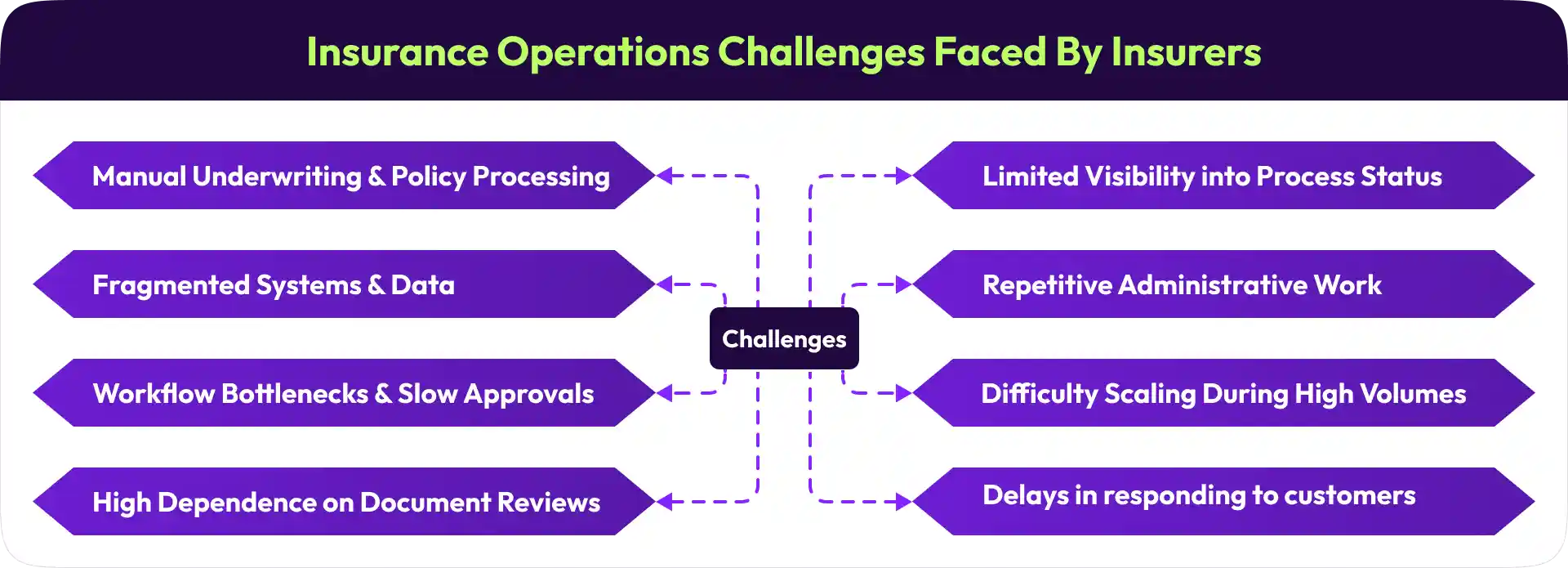
Insurance Companies operate in a highly regulated and data-intensive sector. But many organisations grapple with operational efficiencies that can inhibit mission-critical processes. Insurance operations are often fraught with several challenges:
Manual Underwriting and Policy Processing
Most underwriting teams still manually review applications. It often involves pulling information across systems, validating documents, and conducting risk checks manually. The outcome is a lengthy decision-making process and extended approval cycles.
Fragmented Systems and Disconnected Data
Many insurance companies have disparate legacy platforms that remain disconnected from one another. Employees are forced to flip from system to system for policy data, claims information, customer records, and more. This fragmentation increases operational complexity.
Workflow Bottlenecks and Slow Approvals
When processes have a high reliance on manual approvals, queued tasks await review. This leads to bottlenecks that slow down the issuance of policy and claims processing.
High Dependence on Document Reviews
The insurance business usually deals with multiple large-scale documents, i.e., applications, medical reports, financial statements, and claims documents, etc. Manual review of these documents is time-consuming and prone to human error.
Limited Visibility into Process Status
The majority of insurers do not have real-time visibility on where a particular task is in the workflow. Managers often have difficulties tracking delays, monitoring workloads, or spotting operational inefficiencies.
Repetitive Administrative Work
But insurance teams waste hours doing repetitive administrative work – data entry, sorting through documents, and verification.
Difficulty Scaling During High Volumes
During busy times like catastrophe claims or seasonal policy renewals, insurers may have difficulty dealing with increased workloads.
Delays in responding to customers & agents
Delayed responses to customers and agents due to slow internal processes, for example, affect her trust and satisfaction negatively.
These operational challenges have a direct impact on processing speed, operational efficiency, and customer experience, so for insurers seeking to modernize their operations, automation is a critical step.
Key Insurance Processes That Can Be Automated
For insurance companies, they can automate some of the key operational workflows to streamline their work and minimize manual effort.
Application Intake and Policy Administration
To apply for the policy, applicant data is collected, documents are verified, and a record of the policy is created. Automation can help by enabling:
Automation of Data Collection from Digital Applications
Verification of applicant information
Workflow-based policy creation and issuance
That reduces manual entry work and speeds application processing.
Underwriting Support
Underwriting teams routinely obtain data from many sources before they review the risk. Automation tools can assist with:
Data collection from internal and external systems in an automated way
AI-assisted risk evaluation
Automated eligibility validation checks
This allows underwriters to concentrate on difficult decisions instead of mundane work.
Claims Management
Claims processing is among the most resource-heavy areas in insurance. Automation simplifies claims workflows by:
Digital claim submission portals
Automated document verification
Which claims route to which teams
This has reduced claim processing times dramatically.
Compliance and Reporting
To comply with regulations, insurers process a high volume of detailed records. You can support compliance through automated workflows by:
Built-in regulatory checks
Automated audit logs
Compliance reporting workflows
This enhances transparency and lowers compliance risks.
Customer Interaction Workflows
Customer communication plays an important role throughout the insurance lifecycle. Automation helps insurers deliver timely updates such as:
Policy updates and notifications
Renewal reminders
Claim status updates
These workflows ensure policyholders get information in real time.
How AI Enables End-to-End Insurance Process Automation
AI techs have also played a critical role in enabling AI automation in insurance operations. If workflow automation organizes tasks and approvals, AI is the intelligence that helps systems understand data and assist in decision-making.
One of the most important AI capabilities in insurance is intelligent document processing. Insurance operations generate a high volume of documents such as applications, claim forms, invoices, and supporting records. AI tools can scan these documents, pull out important information, and automatically fill in systems.
Further AI capabilities enabling automation in insurance encompass:
Forms and documents for automated data capture
AI-assisted underwriting insights
Smart task routing across departments
Real-time workflow monitoring and alerts
Automated responses to customer queries
AI, when combined with workflow automation, allows insurers to drastically reduce manual work and keep human oversight only in necessary places.
This enables organizations to move from the physical/digital contact center model without eliminating humans from important workflows and decisions.
Practical Use Cases of Workflow Automation for Insurance Companies
In fact, numerous insurers automate workflow for insurance providers in several areas of operation. Below are several practical examples.
Automated Underwriting Workflows
Automation platforms can aggregate applicant data from multiple sources and perform eligibility checks before sending applications to underwriters. This enables underwriters to review applications more quickly and concentrate on complex cases.
Faster Policy Issuance
Once underwriting has been validated, automated workflows can create policy documents and push them through approval processes. It cuts the policy-issuing hours in half.
Digital Claims Processing
Claims can be filed electronically via online portals. Automated workflows then validate documents and route claims to the right teams. This helps speed up and ensure the efficiency of claims processing.
Automated Customer Communication
Workflow automation can automatically update customers with respect to policy changes, claims progress, and approvals. This increases transparency and trust in the business.
Policy Renewal Workflows
Policyholders receive timely notifications before expiration with automated renewal reminders. This allows insurers to increase retention and decrease missed renewals.
Benefits of Insurance Workflow Automation
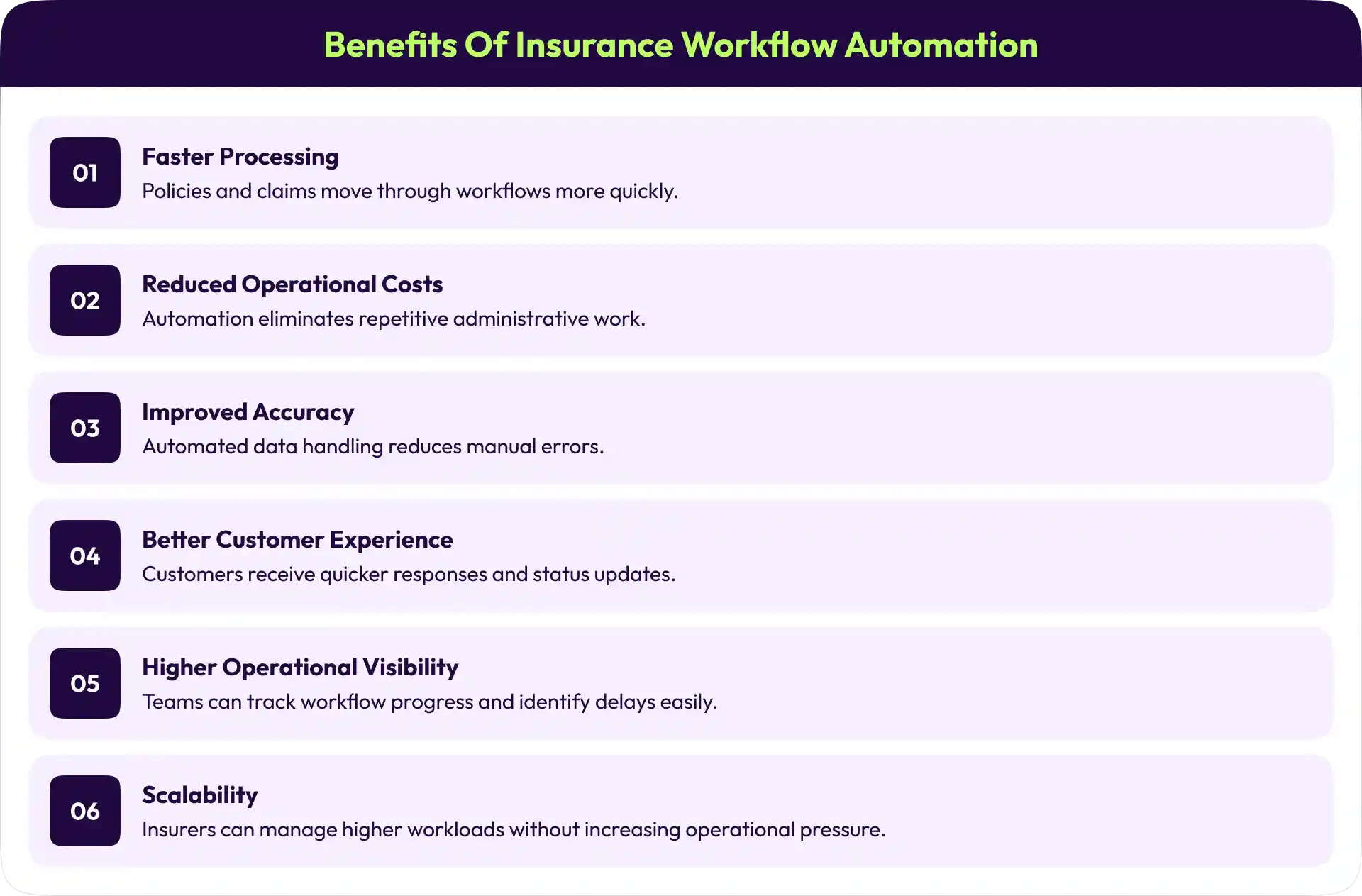
The insurance industry continuum, however, exists on a very large scale and supports many operational and business benefits when its workflow processes are automated also.
Faster Processing
It eliminates manual coordination between teams and thus reduces the delays that are often caused in inter-team communication. Policies and claims flow through systems more efficiently.
Reduced Operational Costs
Automation takes away repetitive administrative tasks, enabling insurers to become more efficient without needing to increase operational teams.
Improved Accuracy
Automated processing of data minimizes errors that are usually caused during the review of documents or when entering them manually.
Better Customer Experience
Customers benefit from quicker responses, real-time updates, and faster claim resolutions.
Higher Operational Visibility
Managers receive up-to-date information about the progress of work processes and easily see where there are bottlenecks in a process.
Scalability
Insurers can now manage higher workloads without needing to place operational strain on teams thanks to automation.
How Insurance Companies Can Implement Workflow Automation Successfully
Implementing automation is a complex process that must be well thought out and systematic. Here are some concrete steps that insurers can take.
Identify High-Impact Workflows
Beginning with processes that generate the most latency or manual labor, such as underwriting, claims processing, and policy administration.
Map Existing Processes
By understanding how each step works in current workflows, your organisation can identify bottlenecks and areas with significant potential for automation.
Prioritize Automation Opportunities
Consolidate high-volume workflows with the most significant efficiency gains.
Introduce AI-Powered Tools
Document processing, data validation, and workflow monitoring could be aided by AI tools.
Integrate with Existing Systems
Automation platforms need to integrate with policy administration systems, CRM platforms, and legacy insurance systems.
Start with Pilot Projects
Deploying small automation pilots allows insurers to test workflows and optimize processes before scaling across the enterprise.
Training Teams to Work with Automation
Employees should know how the automation is Yes, augmenting their work, not replacing the way they do it.
Monitor and Optimize Workflows
Ongoing monitoring enables insurers to continuously refine workflows and spot new automation opportunities.
Choosing the Right Automation Approach for Insurance Operations
Automation solutions can only be best if applied in complex insurance environments. Here are a few considerations insurers should take into account when assessing automation platforms.
Flexibility: Workflows need to be flexible so processes can change when the business changes.
Integration Capabilities: Automation tools need to be integrated with current insurance tech stacks and legacy systems.
AI Support: This is where solutions that enable AI-powered document processing and data extraction can enhance efficiency.
Scalability: Automation platforms have to cope with increasing levels of policy volumes and claims workloads.
Operational Visibility: Dashboards and reporting tools in real-time help teams monitor automated workflows.
The right approach ensures that automation enhances operations without disrupting business-as-usual.”
Future Trends in Insurance Workflow Automation
The world of insurance automation is only going to get smarter as AI technologies are developed further. Multiple trends are influencing the future of insurance operations:
AI-Driven Decision Support
We'll have AI tools that will increasingly help underwriters analyze risk patterns and analytics.
Predictive Claims Analytics
Predictive models will assist insurers in identifying fraud, estimating claim costs, and prioritizing claims handling.
Intelligent End-to-End Automation
Insurance workflows will intertwine further across underwriting, policy management, claims processing, and customer support.
AI Assistants for Agents and Customers
This will enable customers to get information in seconds, while AI assistants can not only provide info but also assist insurance agents by replying with data retrieval.
Deeper Technology Integration
Insurance platforms will be more tightly integrated with any automation technologies that will enable fully connected operations.
Early adopters of automation will have a considerable competitive advantage over other organisations.

Conclusion: Automate for Better Insurance Operations
Insurance operations are becoming more complex as companies manage increasing data volumes, evolving regulations, and growing customer expectations. Manual workflows and disconnected systems slow down critical processes across underwriting, claims handling, and policy management.
Insurance workflow automation provides a powerful solution to streamline operations by connecting tasks, systems, and teams through structured digital workflows. By adopting automation, insurers can improve operational efficiency, reduce costs, and deliver faster services to customers and partners.
As the insurance industry continues to evolve, automation will become a key foundation for building modern, scalable, and customer-focused insurance operations. Organizations that invest in automation today will be better positioned to compete in an increasingly digital insurance landscape.
Shravan Rajpurohit
CEO & Co-Founder
Shravan Rajpurohit is the Co-Founder & CEO of The Intellify, a leading Custom Software Development company that empowers startups, product development teams, and Fortune 500 companies. With over 10 years of experience in marketing, sales, and customer success, Shravan has been driving digital innovation since 2018, leading a team of 50+ creative professionals. His mission is to bridge the gap between business ideas and reality through advanced tech solutions, aiming to make The Intellify a global leader. He focuses on delivering excellence, solving real-world problems, and pushing the limits of digital transformation.

Stay Updated
with AI Insights
Get the latest articles on AI, automation, and enterprise technology delivered to your inbox weekly.

500+ people have already subsribed!
No spam. Unsubscribe anytime.