
How AI Automates Patient Appointment Scheduling for Healthcare Providers



Patient appointment scheduling looks simple on the surface, but inside a healthcare organization, it’s one of the most time-consuming and pressure-heavy tasks.
Front desk teams spend their day juggling calls, booking slots, confirming appointments, handling cancellations, and answering repetitive questions. It’s constant, it’s manual, and honestly, it’s exhausting. And when things get busy, problems show up quickly, missed calls, long wait times, double bookings, and frustrated patients.
This is where AI-powered patient appointment scheduling is changing the game.
Instead of relying entirely on human staff, healthcare providers are now using AI agents to automate scheduling workflows, handling calls, booking appointments, sending reminders, and even managing reschedules.
In this blog, we’ll break down how AI appointment scheduling works, the real challenges it solves, and why more hospitals and clinics are investing in it right now.
What Is AI-Powered Patient Scheduling?
AI-powered patient appointment scheduling uses intelligent software to handle bookings, confirmations, rescheduling, and reminders automatically without constant human effort.
These AI agents work across multiple channels like phone calls, chat, SMS, and patient portals, making it easy for patients to schedule appointments anytime.
Unlike traditional chatbots that follow fixed scripts, AI agents understand patient intent and can manage complete conversations. They also connect with EHRs, calendars, and practice systems to provide real-time availability and accurate scheduling.
Common Scheduling Challenges in Healthcare
Before understanding the value of AI, it helps to look at what’s broken today. Most healthcare providers deal with the same scheduling issues:
1. High call volumes: Front desks are constantly overwhelmed, especially during peak hours.
2. Missed calls = lost revenue: Every missed call is a potential appointment that never gets booked.
3. Manual, repetitive work: Staff spend hours entering data, checking availability, and confirming bookings.
4. Frequent cancellations and rescheduling: Patients change plans often, creating more workload.
5. Double bookings and errors: Human mistakes happen, especially when systems aren’t synced.
6. Staff burnout: Repetitive admin work leads to fatigue and low productivity.
7. Poor patient experience: Long hold times and delays frustrate patients and reduce trust.
These challenges aren’t small inefficiencies; they directly impact revenue, operational efficiency, and patient satisfaction.
How AI Agents Automate the Appointment Scheduling Process
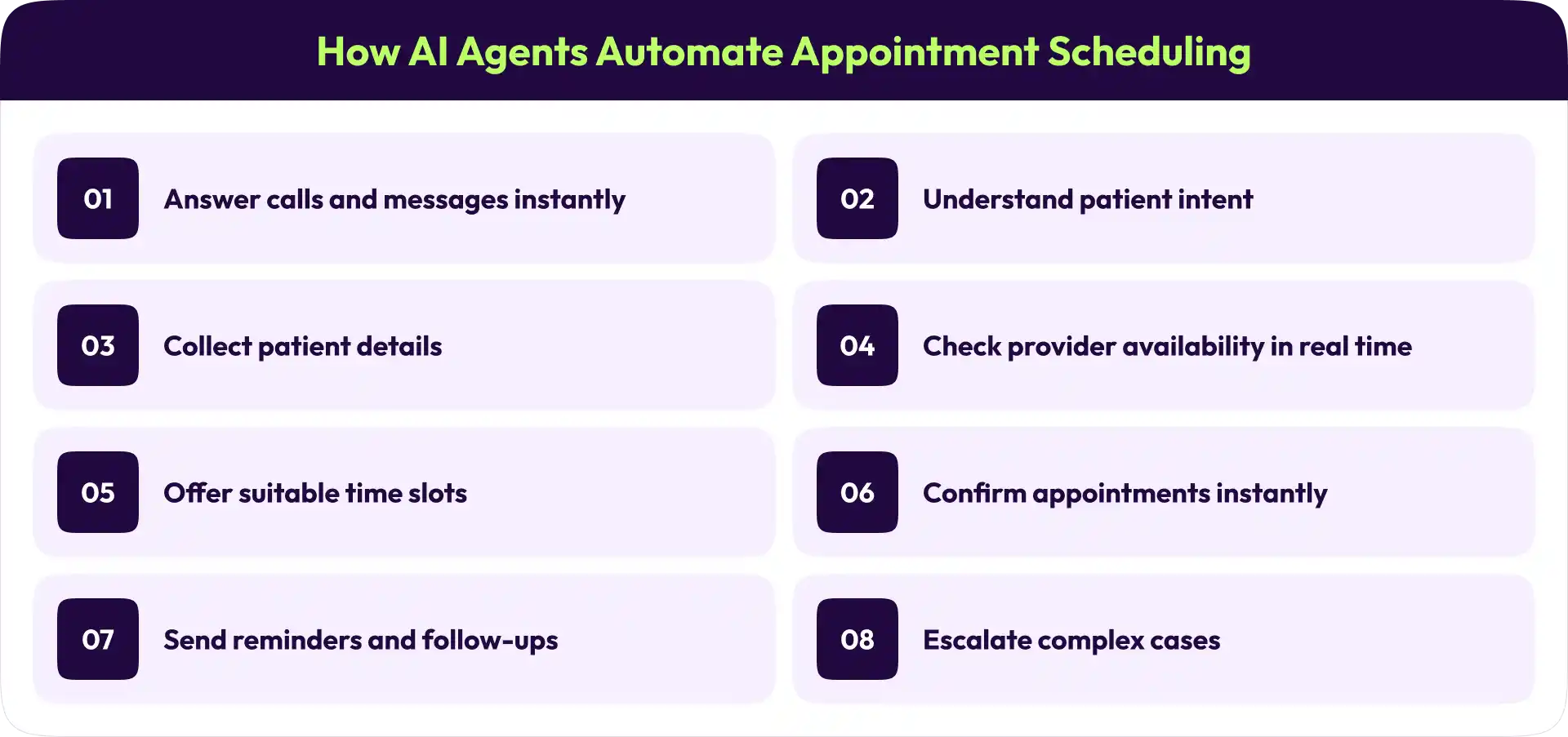
AI agents step in and take over the repetitive, high-volume parts of scheduling. Here’s how they typically work:
Answer calls and messages instantly: No waiting, no hold music, patients get immediate responses.
Understand patient intent: Whether it’s booking, canceling, or rescheduling, the AI identifies the request.
Collect patient details: Name, symptoms, preferred time, and insurance captured automatically.
Check provider availability in real time: Direct integration with calendars ensures accuracy.
Offer suitable time slots: Patients get options based on real availability.
Confirm appointments instantly: No manual intervention needed.
Send reminders and follow-ups: SMS, email, or call reminders reduce no-shows.
Escalate complex cases: If something unusual comes up, it’s passed to human staff.
The result? A faster, smoother, and far more reliable scheduling process.
Step-by-Step Workflow of AI Appointment Scheduling
To make it more practical, let’s walk through how a typical AI appointment scheduling system works in a real healthcare setting.
1. Patient initiates contact
A patient reaches out via phone, website chat, SMS, or a patient portal, whichever channel they prefer. Unlike traditional systems, there’s no waiting time or dependency on staff availability.
2. AI identifies the scheduling intent
The AI agent quickly understands the purpose of the interaction, whether the patient wants to book, reschedule, cancel, or inquire about an appointment. This happens through natural language understanding, not rigid scripts.
3. Patient details are collected automatically
The system gathers essential information such as:
Patient name
Reason for visit
Preferred date and time
Insurance or basic medical details (if required)
This eliminates repetitive questioning by staff and ensures consistent data capture.
4. Provider availability is checked in real time
The AI connects with integrated calendars, EHRs, or practice management systems to fetch up-to-date availability. This avoids conflicts, overlaps, or outdated slot information.
5. Available appointment slots are presented
Based on patient preferences and provider schedules, the AI suggests suitable time slots. In more advanced setups, it can also recommend providers based on specialty or urgency.
6. Patient selects a convenient slot
The patient simply chooses a time that works best for them. If none of the options fit, the AI can suggest alternatives or check nearby availability across locations.
7. Appointment is booked instantly
Once confirmed, the booking is completed in real time and recorded directly in the system, with no manual entry required.
8. Confirmation is sent across channels
Patients receive immediate confirmation via SMS, email, or even voice, depending on the communication channel used.
9. Automated reminders are scheduled
The system sends reminders before the appointment (e.g., 24 hours or a few hours prior), helping reduce no-shows and last-minute cancellations.
10. Easy rescheduling or cancellation support
If plans change, patients can reschedule or cancel through the same channels without needing to call and wait. The AI handles it instantly and updates the system.
11. Escalation when needed
If a request is complex (e.g., urgent cases, special instructions), the AI smoothly transfers the interaction to a human staff member with full context.
How AI Automation Reduces Front Desk Workload
This is where the real impact shows up. AI doesn’t just assist, it removes a significant portion of the workload.
Handles every appointment request automatically
Eliminates repetitive scheduling tasks
Reduces manual data entry
Prevents double bookings through system sync
Manages after-hours requests without staff
Sends confirmations and reminders automatically
Allows staff to focus on in-person patient care
Instead of being stuck on calls all day, front desk teams can focus on what actually matters to patients in front of them. And that shift makes a big difference in both efficiency and morale.
Benefits of Automated Scheduling for Healthcare Providers
Once AI-powered patient appointment scheduling is implemented, the impact is usually visible within a short time. It doesn’t just improve one area, it improves the entire scheduling experience for both staff and patients.
24/7 appointment booking
Patients can schedule appointments anytime, early morning, late night, or weekends without depending on office hours. This convenience alone increases booking rates significantly.
Faster response times
AI responds instantly to every request. Patients don’t have to wait on hold or for callbacks, which creates a smoother and more reliable experience.
Fewer missed calls
Every incoming call or message is handled. This means fewer lost opportunities and more appointments successfully captured.
Lower no-show rates
Automated reminders via SMS, email, or voice keep patients informed and prepared, reducing missed appointments and last-minute gaps in the schedule.
Better schedule utilization
AI can help fill empty slots faster by offering real-time availability and even suggesting earlier openings when cancellations happen.
Reduced operational costs
By automating repetitive front desk tasks, healthcare providers can reduce dependency on large administrative teams while maintaining efficiency.
Improved patient experience
Patients get quick, consistent, and hassle-free interactions with no long waits, no confusion, and no repeated questions.
More accurate scheduling
Since everything is system-driven and synced in real time, the chances of double bookings or manual errors are significantly reduced.
Scalability without added pressure
As patient demand grows, AI can handle increasing volumes without the need to hire and train additional staff.
Why AI Voice Agents Are Ideal for Patient Appointment Scheduling
Despite digital tools, many patients still prefer calling. That’s why AI voice agents for healthcare are becoming essential.
They can:
Answer every call instantly
Speak naturally and guide conversations
Handle high call volumes without delay
Work 24/7, including weekends and holidays
This means no missed opportunities. Even after hours, patients can call, book an appointment, and get confirmation without waiting for the next business day. For healthcare providers, this alone can significantly increase appointment conversions.
Real-World Use Cases Across Healthcare Organizations
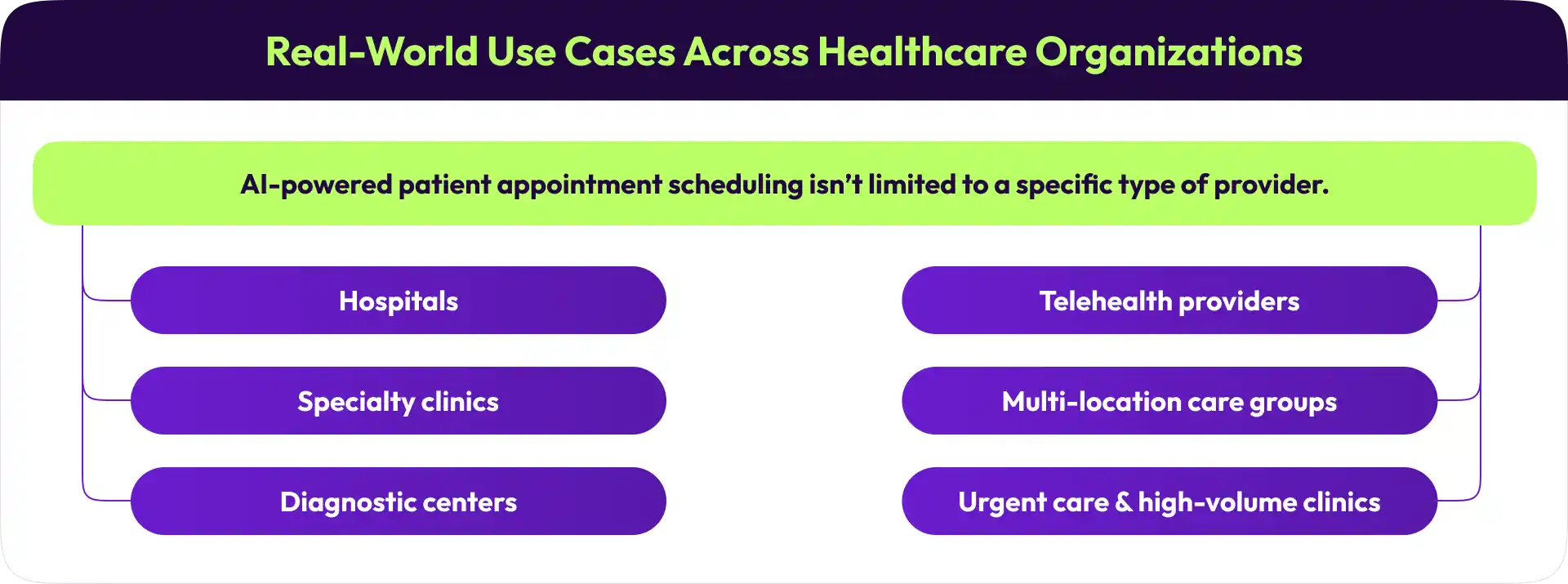
AI-powered appointment scheduling isn’t limited to a specific type of provider. It’s already being used across different healthcare settings, each with its own complexity and operational needs.
Hospitals
Large hospitals handle high volumes of patients across multiple departments like cardiology, orthopedics, radiology, and more. AI helps coordinate appointments across these departments, ensuring patients are scheduled with the right specialist while reducing internal scheduling conflicts.
Specialty clinics
Clinics focused on specific areas like dermatology, dental care, or physiotherapy often deal with appointment-specific requirements. AI can match patients with the right provider based on symptoms, treatment type, or urgency, making the scheduling process more precise.
Diagnostic centers
Labs and imaging centers rely heavily on timely scheduling for tests like MRIs, CT scans, and blood work. AI ensures proper slot allocation, avoids overbooking of equipment, and can even guide patients on preparation steps before their appointment.
Telehealth providers
For virtual consultations, speed and convenience are critical. AI automates the entire booking process, allowing patients to quickly schedule video consultations, receive links, and get reminders without any manual coordination.
Multi-location healthcare groups
Healthcare networks with multiple branches often struggle with centralized scheduling. AI systems can manage appointments across locations, suggest the nearest available provider, and balance patient load efficiently.
Urgent care and high-volume clinics
In fast-paced environments, AI helps handle sudden spikes in patient inquiries, especially during peak hours or seasonal demand. It ensures that no request goes unanswered, even when the staff is overwhelmed.
Key Features to Look for in a Scheduling Automation Solution
Not all AI scheduling tools are built the same. If you’re evaluating a solution, it’s important to focus on features that actually support your day-to-day operations, not just fancy add-ons.
Integration with EHR and practice management systems
The solution should connect seamlessly with your existing systems so appointments, patient data, and schedules stay updated in real time without manual effort.
HIPAA-compliant data handling
Since patient data is sensitive, the platform must follow strict security and compliance standards to ensure privacy and protection at all times.
Support for voice, chat, and SMS
Patients use different communication channels. A good system should work across calls, chat, and messaging to capture every appointment request.
Automated reminders and follow-ups
Built-in reminders help reduce no-shows, while follow-ups improve patient engagement without adding extra work for staff.
Multilingual communication support
In diverse patient environments, the ability to communicate in multiple languages can significantly improve accessibility and patient experience.
Easy human handoff when needed
Not every situation can be automated. The system should smoothly transfer complex or sensitive cases to staff without losing context.
Reporting and analytics dashboards
Insights into appointment volumes, no-show rates, and patient behavior help providers optimize scheduling and make better decisions over time.
How Alris AI Helps Healthcare Providers Automate Scheduling
Alris AI is built to simplify patient appointment scheduling in real healthcare environments where speed, accuracy, and patient experience matter.
With Alris, healthcare providers can:
Automate appointment booking, rescheduling, and cancellations
Use AI voice agents to handle patient calls instantly
Support scheduling across calls, chat, and messaging
Integrate with EHRs and existing systems in real time
Ensure secure, compliant patient communication
By handling repetitive front desk tasks, Alris AI reduces staff workload, minimizes missed calls, and improves overall scheduling efficiency. Instead of replacing your systems, it adds an intelligent layer of automation that helps you capture more appointments and deliver a smoother patient experience.
Conclusion
Patient appointment scheduling has always been a time-consuming task for healthcare teams, often leading to delays, missed calls, and added pressure on staff. AI is helping simplify this. By automating bookings, handling patient interactions, and managing reminders, it streamlines the entire scheduling process with minimal manual effort.
The result is a clear reduced workload, faster response times, and a better patient experience. At the same time, healthcare providers can scale operations without increasing administrative burden. As patient expectations continue to grow, adopting AI-powered scheduling is no longer optional, it’s becoming essential for delivering efficient, patient-first care.
Frequently Asked Questions (FAQs)
1. How do AI agents automate patient scheduling?
AI agents can answer calls or messages, collect patient information, check provider availability, and book appointments automatically. They can also send confirmations, reminders, and handle rescheduling without requiring front desk staff to do everything manually.
2. Can AI schedule appointments after office hours?
Yes. AI agents are available 24/7, so patients can book, reschedule, or cancel appointments at any time, including evenings, weekends, and holidays.
3. What types of healthcare providers can use AI for appointment scheduling?
Hospitals, specialty clinics, dental practices, diagnostic centers, telehealth providers, and multi-location healthcare groups can all use AI to streamline appointment scheduling and patient communication.
4. Can AI handle appointment cancellations and rescheduling?
Yes. AI agents can process cancellations, offer alternative time slots, and update schedules instantly, helping providers fill open appointments more efficiently.
5. How does AI patient scheduling help reduce no-show rates?
AI automatically sends appointment confirmations and reminders through calls, SMS, or email. Patients can confirm or reschedule in advance, which helps lower missed appointments.
6. Can AI integrate with EHR and scheduling systems?
Yes. Modern AI scheduling solutions can connect with EHRs, practice management software, and provider calendars to check availability and update appointments in real time.
7. Is AI patient scheduling secure for healthcare organizations?
Yes. Enterprise healthcare AI solutions are designed with HIPAA-compliant security measures to protect patient information and support secure communication.
Shravan Rajpurohit
CEO & Co-Founder
Shravan Rajpurohit is the Co-Founder & CEO of The Intellify, a leading Custom Software Development company that empowers startups, product development teams, and Fortune 500 companies. With over 10 years of experience in marketing, sales, and customer success, Shravan has been driving digital innovation since 2018, leading a team of 50+ creative professionals. His mission is to bridge the gap between business ideas and reality through advanced tech solutions, aiming to make The Intellify a global leader. He focuses on delivering excellence, solving real-world problems, and pushing the limits of digital transformation.

Stay Updated
with AI Insights
Get the latest articles on AI, automation, and enterprise technology delivered to your inbox weekly.

500+ people have already subsribed!
No spam. Unsubscribe anytime.