
How to Reduce Dental No-Shows by 30% or More with AI


Summary: Dental no-shows reduce revenue, waste chair time, and increase administrative workload. This guide explains why patients miss appointments, what research says about reducing no-shows, and how AI-powered voice agents help automate reminders, confirm appointments, answer calls 24/7, and instantly rebook cancellations. Learn how dental practices can reduce no-show rates by 30% or more, improve patient scheduling, ease front desk pressure, and deliver a better patient experience with AI-powered practice automation.
It is 8:05 on a Tuesday morning in a Plano dental office, and the 8:00 hygiene chair is empty. The patient never called to cancel. Two more gaps like this before lunch, and the day's production numbers are already underwater. Scenes like this repeat in dental offices across Texas and the rest of the country every single day, and they are the reason so many practice owners are searching for ways to reduce dental no-shows before the problem eats further into revenue.
The good news is that this is a solvable problem. Practices that cut missed dental appointments do not rely on luck or on front desk staff making one more phone call between patients. They rely on systems: automated reminders, real-time rebooking, and a receptionist who never clocks out. In 2026, that system increasingly means an AI voice agent that handles reminders, confirmations, and last-minute rescheduling around the clock.
This guide walks through why no-shows happen, what the research says about fixing them, and how AI-powered scheduling tools like Alris AI help practices in Austin, Dallas, Houston, San Antonio, El Paso, and beyond cut no-show rates by 30 percent or more. Moreover, it covers what to look for when evaluating a solution and what the next 12 to 18 months are likely to bring.
Why Dental Practices Lose Thousands to Patient No-Shows Every Year
Missed appointments are not a minor inconvenience. They represent lost chair time, wasted staff hours, and direct revenue that never gets recovered. A single no-show in a hygiene chair can cost a practice several hundred dollars in lost production, and the losses compound quickly across a busy schedule.
The research on this is consistent. A controlled study published in the British Dental Journal found that failed attendance dropped from 9.4 percent with no reminder to as low as 3 percent once any reminder, postal or telephone, was sent before the appointment. In a separate study published in The American Journal of Medicine, no-show rates measured 23.1 percent with no reminder system, 17.3 percent with an automated reminder, and 13.6 percent with a live clinic staff reminder. Meanwhile, a study in The Angle Orthodontist found that when patients chose their own reminder method, SMS text messages produced the lowest no-show rate of the three channels tested, at just 1.90 percent, compared to 2.68 percent for email and 3.49 percent for phone calls.
Put together, these findings point to a clear pattern: consistency and channel variety matter more than any single tactic. As a result, practices that combine reminders, confirmations, and an easy way for patients to reschedule see the steepest drop in missed appointments.
There is also a hidden cost that rarely shows up in these percentages: staff time. Every no-show still requires a front desk team member to notice the gap, try to reach the patient, and scramble to fill the slot on short notice. Furthermore, when that scramble fails, the chair sits empty for the rest of the day, since same-day rebooking without an automated waitlist system is genuinely difficult to pull off consistently.
How an AI Receptionist Reduces Dental No-Shows Automatically
An AI receptionist is a voice-based system that answers calls, sends reminders, and manages scheduling changes for a dental practice, without requiring a front desk team member to be on the line. It is a conversational AI voice agent that understands natural speech, checks the practice's real schedule, and takes action immediately, not a rigid script that only recognizes a few set phrases.
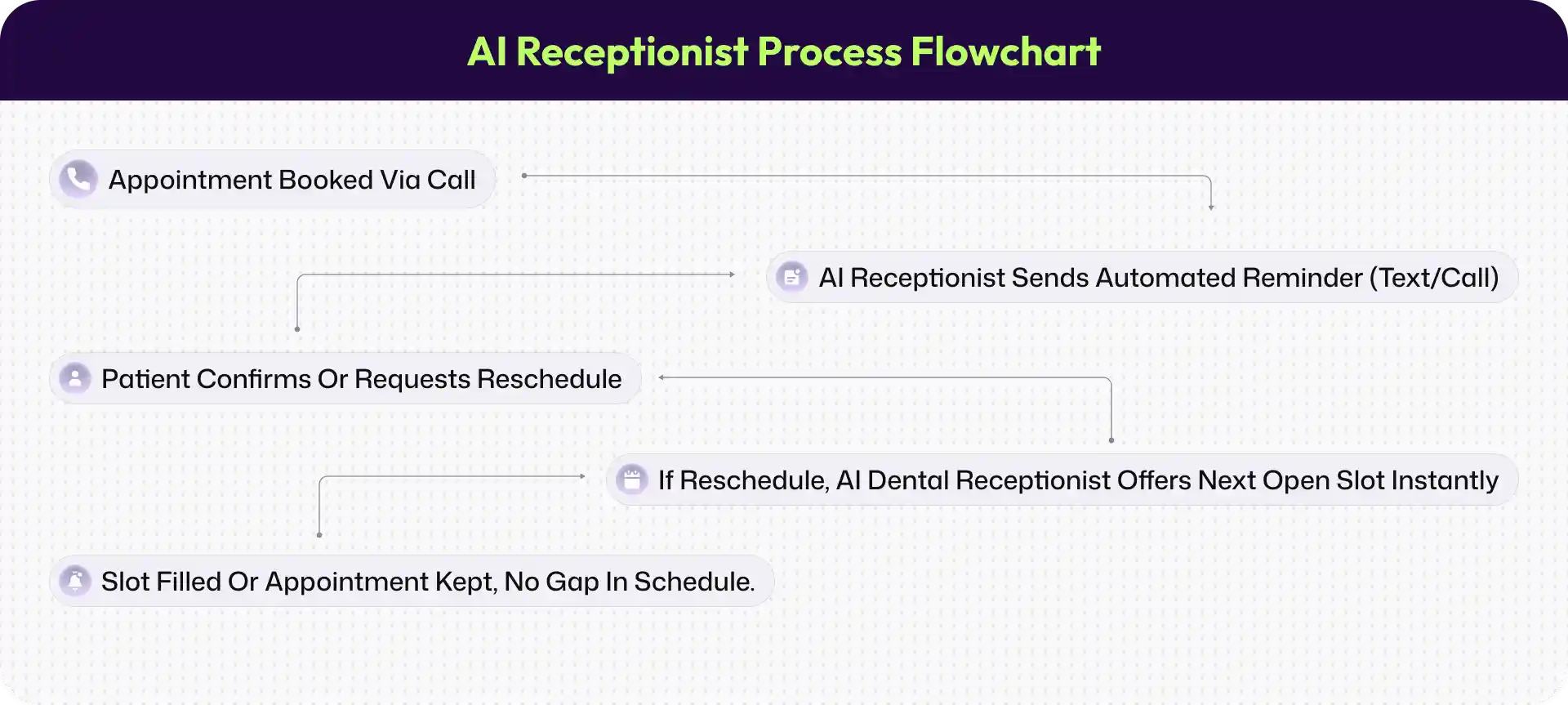
Here is how it works in practice. A few days before an appointment, the system reaches out by phone, text, or both to confirm the visit. If a patient wants to reschedule, the AI voice agent offers new times directly from the practice management system, whether that is Dentrix, Eaglesoft, Open Dental, or Curve Dental, and books the change on the spot.
For a busy dentist or practice manager, the appeal is simple. Reminders go out every time, at the right interval, without depending on a staff member remembering to make the call between patients. In addition, when a patient calls back to cancel at 9 p.m., the AI receptionist answers, offers the next open slot, and fills what would otherwise become an empty chair the next morning.
Benefits of AI for Dental Practices
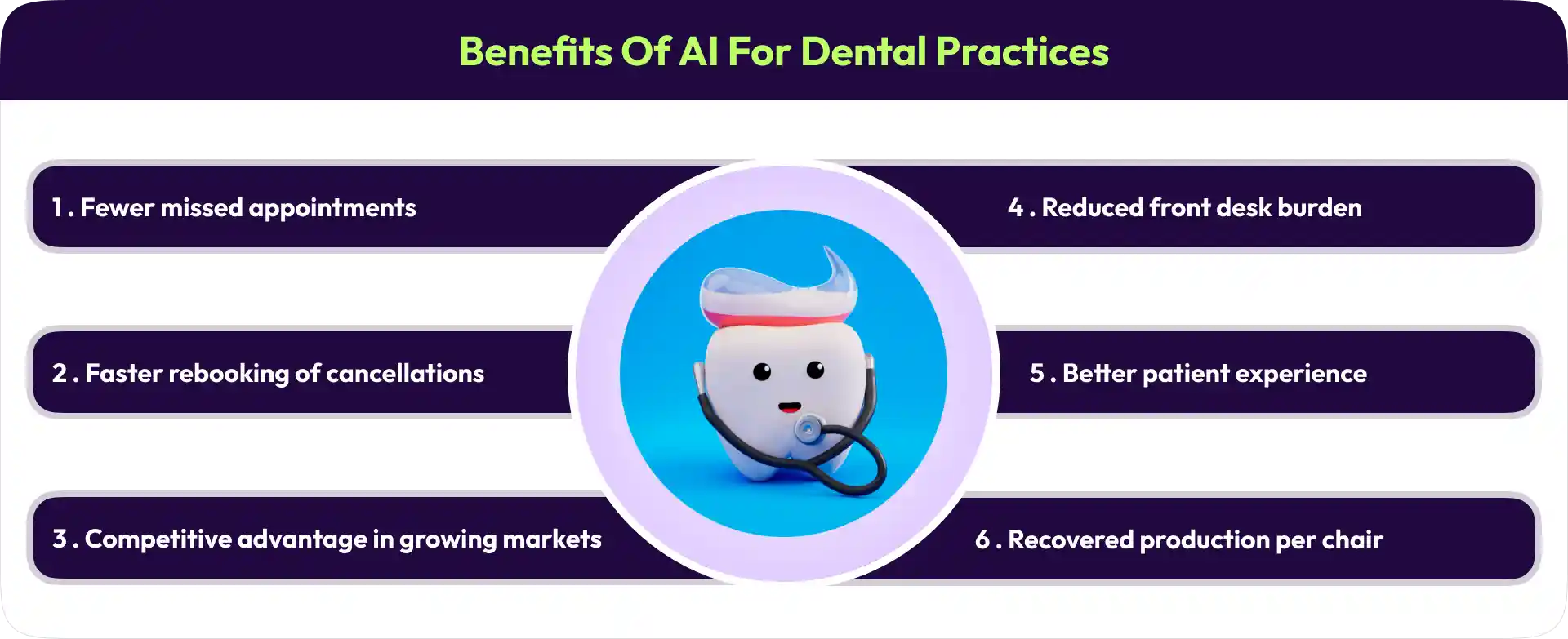
Practices that adopt AI-driven scheduling to lower their no-show rate typically see gains across several areas at once, not just in the no-show column. The ripple effects reach staffing, patient satisfaction, and how quickly a practice can absorb new patient growth.
1. Fewer missed appointments
Combining SMS, call, and confirmation touchpoints mirrors the research above, where any structured reminder system cut failed attendance by more than half compared to no reminder at all.
2. Faster rebooking of cancellations
When a patient cancels through an AI voice agent instead of leaving a voicemail after hours, the system can immediately offer the slot to someone on a waitlist, shrinking the gap between cancellation and rebooking from days to minutes.
3. Recovered production per chair
Every no-show that turns into a kept or rebooked appointment is production that would otherwise have been lost outright. Over a year, this adds up meaningfully for a practice running multiple operatories.
4. Reduced front desk burden
Reminder calls, confirmation texts, and rescheduling requests consume hours of staff time each week. Automating this work frees the front desk to focus on patients who are physically in the office.
5. Better patient experience
Patients get reminders in the format they prefer, whether that is a text, a call, or both, and can reschedule instantly rather than waiting on hold or getting a callback the next day.
6. Competitive advantage in growing markets
In fast-growing Texas metros, patient expectations for convenience are rising alongside the population. Practices that respond quickly and cut missed appointments keep more of the new patients moving into these cities, since a poor scheduling experience early on is a common reason new patients never come back for a second visit.
Industry-Specific AI Use Cases in Dentistry
A solo general dentist in Austin with one front desk person often loses the most ground during lunch hours and after 5 p.m., when no one is available to answer a rescheduling call. An AI receptionist covers those exact windows, catching cancellations and rebooking them before the next business day even starts.
A group practice with multiple providers in Houston faces a different challenge: coordinating reminders and rebooking across several schedules at once. An AI voice agent that reads live availability across every provider can offer a patient the next open slot with any dentist in the practice, not just the one they originally booked, which keeps chairs filled even when one provider's day is packed.
A multi-location DSO operating across San Antonio, El Paso, and Dallas needs consistency more than anything else. Automated, standardized reminders and confirmations across every location lower no-show rates uniformly, rather than depending on how well any single office manages its calls that week. Regional managers also gain visibility into which locations are seeing the steepest improvement, which makes it easier to spot a struggling front desk before it shows up in the monthly numbers.
Choosing an AI Dental Receptionist
Before adopting an AI dental receptionist to cut missed appointments, practices should look closely at a few specific things.
1. Confirm the system integrates directly with the practice management software already in use, whether that is Dentrix, Eaglesoft, Open Dental, or Curve Dental, so reminders and rebooking reflect real-time availability rather than a stale schedule.
2. Ask how the vendor handles Spanish-language calls. In Texas markets especially, a meaningful share of patients prefer to communicate in Spanish, and a bilingual AI receptionist keeps that population from falling through the cracks.
It also helps to ask how the system escalates true emergencies. A patient calling about a broken denture or a knocked-out tooth needs to reach a human quickly, so any AI receptionist worth considering should be able to recognize urgency and route that call accordingly rather than treating every call the same way.
3. Ask vendors directly about HIPAA compliance and whether they will sign a Business Associate Agreement, since any system handling patient scheduling data must meet these requirements.
4. Request a trial period or pilot with real call volume before committing, so the practice can see actual no-show reduction rather than projected numbers.
Future of AI-Powered Patient Scheduling
Over the next 12 to 18 months, expect three shifts in how practices lower their no-show rate.
1. Predictive no-show scoring will become more common, where AI systems flag which specific appointments are at the highest risk of a miss based on patient history, giving front desks a reason to follow up personally on just those cases.
2. Two-way conversational texting will replace one-way reminder blasts, letting patients reschedule with a simple reply instead of a phone call. Consequently, rebooking friction drops even further.
3. Deeper integration between AI receptionists and insurance verification systems will let practices confirm coverage automatically before a reminder goes out, reducing the number of cancellations that happen when a patient learns about a coverage issue at check-in.
Final Thought
No-shows are not an unavoidable cost of running a dental practice. As the research shows, structured reminders alone can cut failed attendance by more than half, and AI-driven systems extend that further by rebooking cancellations in real time instead of losing the slot entirely. For practices in Austin, Dallas, Houston, San Antonio, El Paso, Plano, and beyond, the path to reducing dental no-shows by 30 percent or more is no longer theoretical. It is an operational choice available today, and practices that make it now will keep more chairs filled through 2026 and beyond.
Frequently Asked Questions (FAQs)
1. What is a good no-show rate for a dental practice?
Well-run practices typically keep no-show rates in the low single digits, while practices with no structured reminder system often see rates far higher. Research on reminder systems shows failed attendance can run as high as 9.4 percent with no reminder at all, dropping to 3 percent or lower once reminders are introduced.
2. How much can AI reduce dental no-shows compared to manual reminders?
Published studies comparing reminder types show automated systems reduce no-shows meaningfully compared to no reminder, though live staff reminders can outperform basic automated calls. AI voice agents that combine text, call, and real-time rebooking aim to capture the benefits of both approaches at once.
3. Does an AI receptionist replace my front desk staff?
No. It handles repetitive tasks like reminders, confirmations, and after-hours rescheduling so front desk staff can focus on patients physically in the office, rather than replacing the team.
4. Can an AI voice agent send reminders in Spanish?
Yes. Alris AI offers Spanish-language support for reminders and scheduling calls, which matters in Texas markets with large Spanish-speaking patient populations.
5. Is an AI receptionist HIPAA compliant?
A properly built AI receptionist for dental practices should operate under a signed Business Associate Agreement and follow HIPAA safeguards for any patient scheduling or health information it handles. Always confirm this directly with a vendor before signing on.
6. How quickly can a practice see fewer no-shows after implementation?
Many practices see measurable improvement within the first few weeks, since reminder cadence and rebooking speed are the two levers most directly tied to no-show rates, and both take effect as soon as the system goes live.
Sources & References:
All sources were verified in June 2026.
1. Preventing Failed Appointments in General Dental Practice: A Comparison of Reminder Methods
3. Measuring the Effectiveness of Patient-Chosen Reminder Methods in a Private Orthodontic Practice
4. United States Census Bureau. Population Growth Reported Across Cities and Towns in All U.S. Regions
Shravan Rajpurohit
CEO & Co-Founder
Shravan Rajpurohit is the Co-Founder & CEO of The Intellify, a leading Custom Software Development company that empowers startups, product development teams, and Fortune 500 companies. With over 10 years of experience in marketing, sales, and customer success, Shravan has been driving digital innovation since 2018, leading a team of 50+ creative professionals. His mission is to bridge the gap between business ideas and reality through advanced tech solutions, aiming to make The Intellify a global leader. He focuses on delivering excellence, solving real-world problems, and pushing the limits of digital transformation.

Stay Updated
with AI Insights
Get the latest articles on AI, automation, and enterprise technology delivered to your inbox weekly.

500+ people have already subsribed!
No spam. Unsubscribe anytime.