
How Much Revenue Are Restaurants Losing to Missed Calls



Summary: Restaurants lose revenue to missed calls during peak hours when staff can't get to the phone, and after hours when nobody's there to answer. This guide breaks down what each type of missed call is actually worth, how to calculate your restaurant's specific revenue leak, and why the problem is structural rather than a staffing failure. Includes a step-by-step calculation framework using verified industry data.
It's 7:45 pm on a Friday. The dining room is at capacity, the kitchen is in the weeds, and the phone has been ringing on and off for the last twenty minutes. Nobody's answered it. There's nobody free to answer it.
Each one of those calls is probably a reservation, a takeaway order, or someone asking about the weekend specials. And each one that goes unanswered is revenue that doesn't happen quietly, without appearing on any report, without anyone tracking it.
Restaurant missed calls are one of those problems that everyone knows exists and almost nobody measures. It feels like a minor inconvenience. A few calls here and there. But when you actually calculate what each unanswered call is worth, multiply it by how many happen per service, per week, per year, the number tends to be larger than expected.
This guide breaks down how to quantify what missed calls are actually costing your restaurant, why the problem is structural rather than a staffing failure, and what it takes to fix it.
How Many Calls Do Restaurants Actually Miss?
The peak hour problem
Restaurant calls don't arrive evenly across the day. They cluster around the hours when customers are planning their next meal: late morning, early afternoon, and early evening. Those are also the hours when restaurants are busiest.
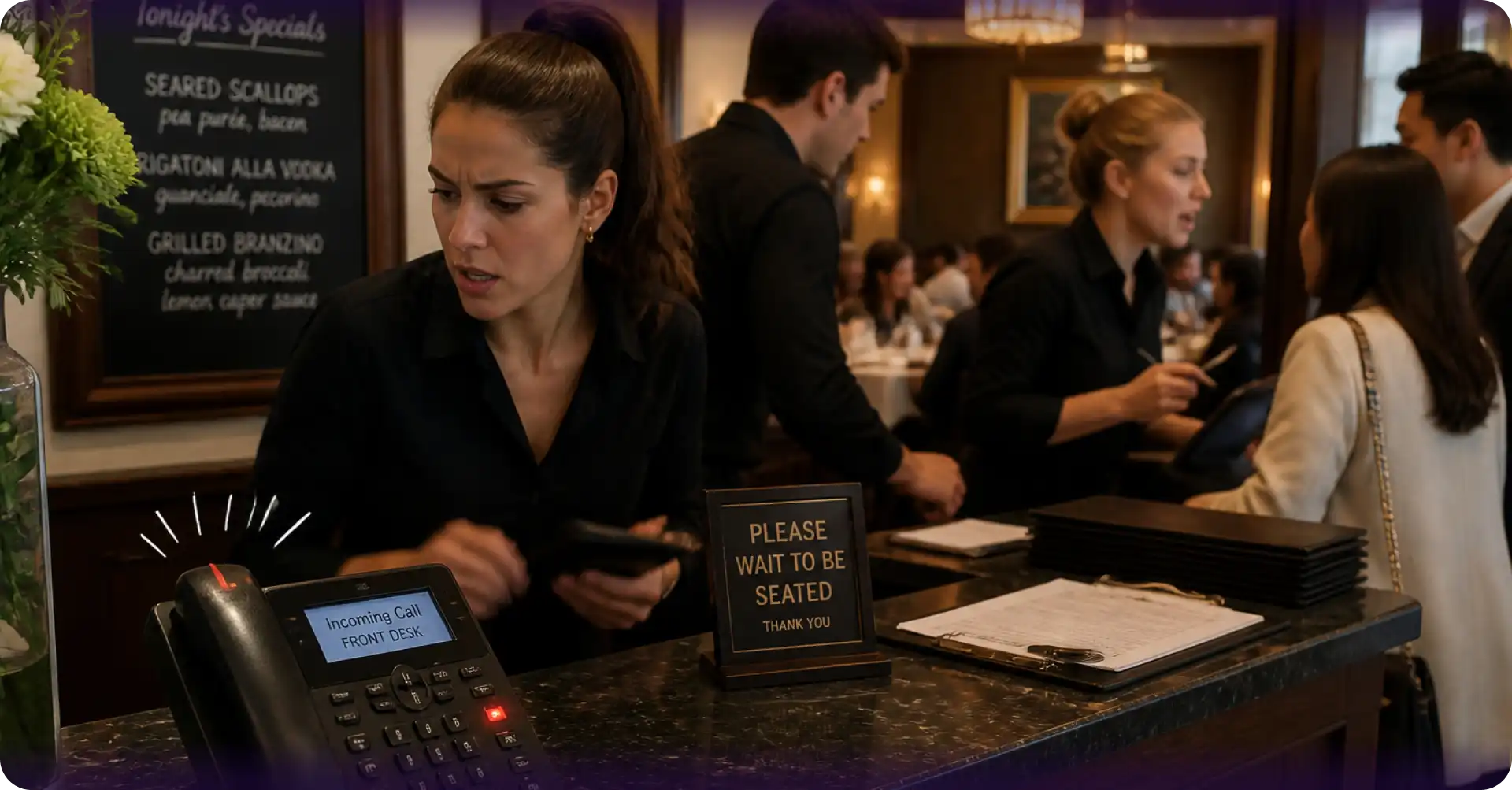
During a Friday dinner service, every staff member with access to the phone is occupied. The host is managing the door. Servers are on the floor. The manager is handling a kitchen issue. The phone rings. Nobody can get to it without abandoning something else.
The result: calls go unanswered at exactly the moments when demand is highest. Some restaurant data suggests 30-40% of restaurants can miss incoming calls during peak hours, leading to lost reservations, takeout orders, and catering enquiries. That's a meaningful share of inbound demand disappearing during the windows that matter most.
After-hours - the gap most restaurants don't measure
Peak hour is the visible part of the problem. After-hours is the invisible one.
Nearly 75% of restaurant traffic is now off-premises, according to the National Restaurant Association's 2025 Off-Premises Restaurant Trends report, and a meaningful share of reservation and order calls arrive in the evening when customers are home and planning ahead. Sunday evenings are particularly high-volume for bookings. Early mornings catch the business lunch crowd.
None of these calls arrive during the hours when a restaurant is staffed to answer them. Voicemail captures some, but most customers don't leave messages. They hang up and either try again later or, more commonly, find somewhere else that picks up.
The types of calls that go unanswered most often
Not all missed calls carry the same revenue weight. The ones that tend to go unanswered most often are also the ones with the highest individual value:
Reservation requests arriving during dinner service, when staff are least available
Phone orders during peak hour, when the kitchen and floor are both at capacity
Catering and large group enquiries, longer calls that nobody can commit to during service
After-hours booking calls arrive when nobody is there to answer
What Is a Missed Call Actually Worth?
The revenue value of a missed reservation call
The value of a missed reservation call depends on party size and average spend per cover. The calculation is straightforward:
Average party size × average spend per cover = value per missed reservation call
For a full-service restaurant with an average party of three and a spend of $54 per head, TouchBistro/Harris Poll's self-reported figure from their American Diner Trends Report each missed reservation call represents $162 in immediate revenue. That's before factoring in the possibility that the caller might have become a regular.
The revenue value of a missed phone order
Phone orders remain a live revenue channel. According to the TouchBistro/Harris Poll Diner Trends Report, 29% of diners who order takeout directly say they usually order by phone, rising to 38% among Baby Boomers. The average takeout order is approximately $38, per the same survey.
For a restaurant missing phone order calls during a busy service:
Average order value × missed order calls per service = revenue lost per service
Five missed phone order calls per service at $38 per order is $190 per service. Over four services per week, that's $760 weekly. Annualised, that's nearly $40,000 from five missed calls per service.
There's also a compounding cost for restaurants using third-party delivery platforms. Third-party commissions run 15-30% per order. DoorDash, Uber Eats, and Grubhub all publish their rate tiers. A phone order placed directly avoids that commission entirely. Every missed direct phone order that the customer places through a delivery app instead costs the restaurant twice: once in lost direct revenue, and again in commission paid on the replacement order.
The revenue value of a missed catering enquiry
Catering calls are the most expensive to miss. A single catering booking, a corporate lunch, a private dining event, or a family celebration can represent anywhere from $500 to several thousand dollars, depending on the restaurant and the event.
These calls often arrive during service when nobody can commit to a detailed conversation. They go to voicemail. Voicemail doesn't convert catering enquiries. Callers researching venues for an event aren't waiting for a callback when other restaurants are answering live.
The lifetime value calculation
The immediate booking value understates the real cost. When a first-time customer calls and doesn't get through, they don't just miss one visit; they potentially never become a customer.
The OpenTable no-show data gives useful context here: 28% of Americans said they had missed a restaurant reservation in the past year (OpenTable/YouGov survey). If even a fraction of those customers were influenced by inconvenient or unresponsive booking experiences, the lifetime value at stake is significant. A regular who visits twice a month at $60 per visit is worth $1,440 per year. Over three years, that's over $4,000 lost entirely from one unanswered first call.
How to Calculate Your Restaurant's Missed Call Revenue
This is worth doing with your actual numbers. Here's the framework:
Step 1: Estimate your average weekly inbound calls. If you don't have data, ask staff to count for one week.
Step 2: Estimate your missed call rate during peak hours. Third-party data suggests that 30-40% during busy service periods is a reasonable working figure for many restaurants.
Step 3: Split missed calls by type: reservations, phone orders, catering enquiries, general queries.
Step 4: Apply your actual average values per call type.
Step 5: Multiply weekly missed call revenue by 52 for the annual figure.
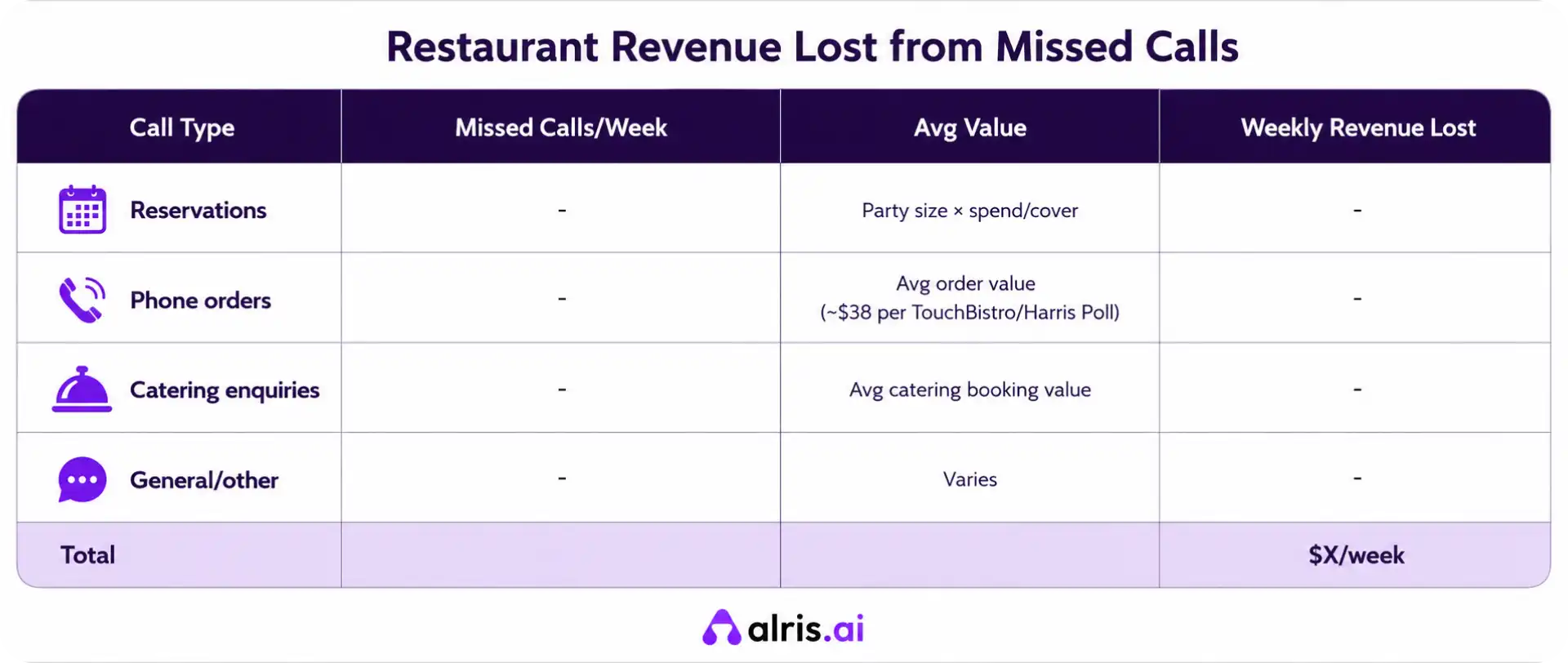
Fill in your numbers. For most restaurants handling meaningful call volume, the annual figure is not a rounding error. The calculation above uses your own operational data rather than industry averages, which means the result reflects your restaurant specifically, not a generic estimate.
Why Restaurants Keep Missing Calls
The structural problem - not a people problem
This is worth being direct about: missed calls at most restaurants aren't a failure of effort or attention. Staff isn't ignoring the phone. They're not answering because they genuinely can't; there's a table to seat, an order to take, a problem to handle.
The structural issue is that restaurant call volume peaks at exactly the moments when staff availability for phone handling is lowest. It's not a scheduling problem. It's a design problem. The restaurant model wasn't built to handle phones and floor service simultaneously at peak capacity.
This matters because it means the solution isn't trying harder or caring more. It's changing the infrastructure.
The labor context makes it worse
The National Restaurant Association's 2026 State of the Restaurant Industry report found that 42% of US restaurant operators were not profitable in 2025, up from 29% in 2024. Full-service restaurant labor (wages and benefits) ran a median of 36.5% of sales in 2024, with unprofitable operators hitting 42.9%. Full-service net margins are just 2.8% of sales.
In this environment, every hour of front-of-house time spent managing the phone during a rush is an hour not spent turning tables, upselling, or delivering the service quality that drives repeat visits and positive reviews. Phone handling during peak hours isn't just a missed call problem; it's a labor efficiency problem pulling from already thin margins.
Voicemail doesn't solve it
Voicemail feels like a safety net, but functionally isn't one for most restaurant call types. Most customers don't leave messages when a call goes unanswered. Of those who do, a significant share don't convert to a booking because they find somewhere else before the callback arrives.
For catering enquiries specifically, voicemail is particularly ineffective. A caller researching venues for a corporate event is calling multiple restaurants simultaneously. Whoever answers live gets the booking.
More staff doesn't always solve it either
The instinct when call coverage becomes a problem is to hire someone for the phone. That works to a point, but the economics rarely add up against margins running at 2.8% of sales.
A dedicated phone person costs real money: salary, training, management overhead. They cover the phone during their shifts and leave a gap when they don't. They can't handle multiple simultaneous calls. And during the busiest periods, which is where the problem is worst, a single person dedicated to the phone still isn't enough.
The missed call problem isn't primarily a headcount problem. It's a capacity and availability problem.
The Compounding Effect of Missed Calls
Lost first-time customers
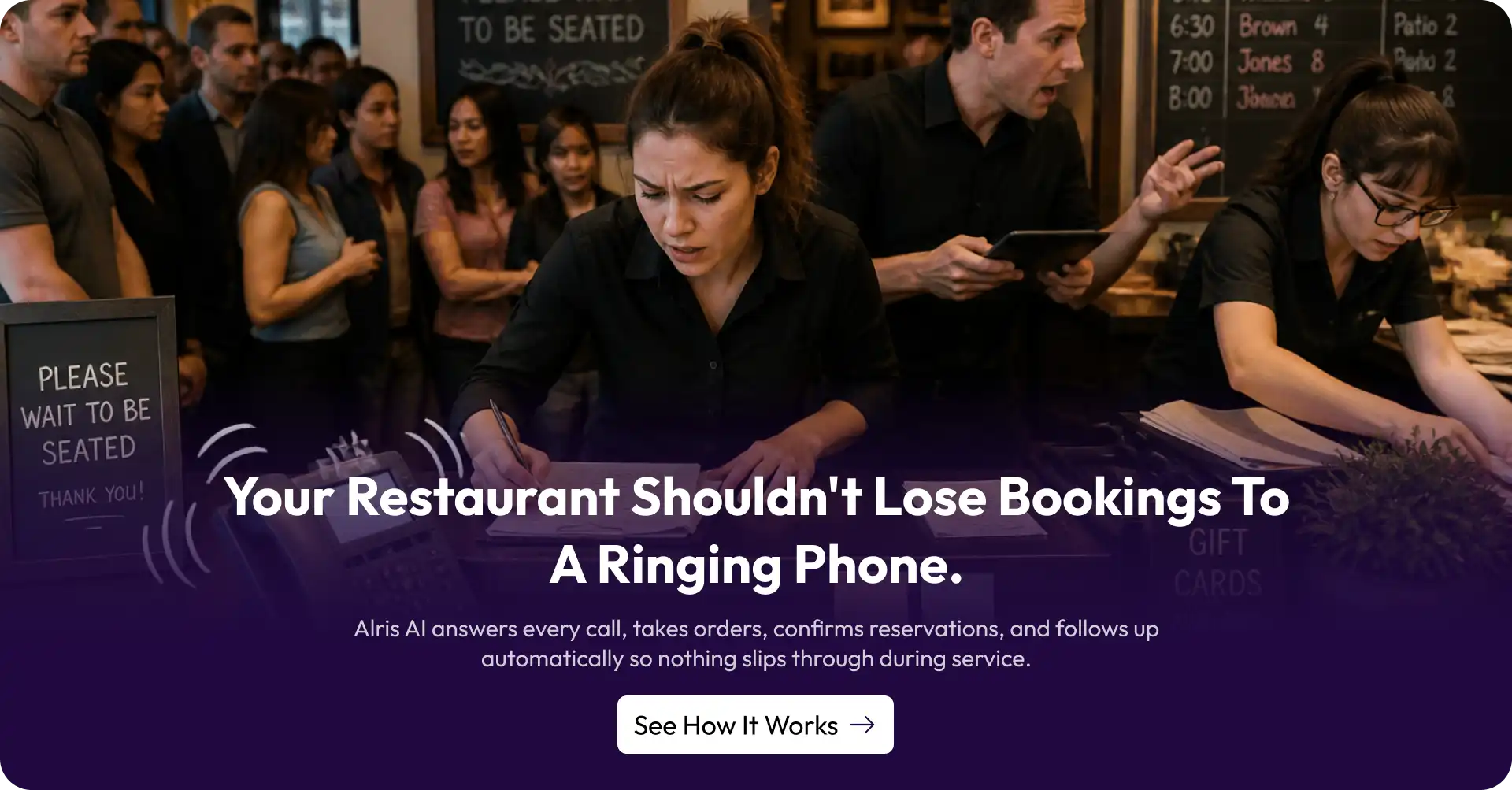
A first-time caller who doesn't get through rarely calls back. They find somewhere else, usually within minutes. The cost isn't just the missed booking. It's everything that would have followed: repeat visits, word-of-mouth recommendations, reviews.
No-shows compound the problem further
The no-show problem is related but distinct. OpenTable's primary data shows that 28% of Americans missed a restaurant reservation in the past year. Deposits, per OpenTable research, cut no-show rates by 57% on average and make guests 72% less likely to cancel late.
The connection to missed calls: when reservation management is manual and phone-dependent, the systems that would reduce no-shows, provide proactive reminders, enable easy rescheduling, and waitlist backfill rarely get implemented consistently. The result is double pressure on the booking: harder to capture in the first place, harder to protect once made.
Competitor advantage
Every call that goes unanswered at one restaurant gets answered somewhere else. In a competitive dining market, the restaurants that answer every call consistently capture a disproportionate share of first-time customers and high-value bookings.
This isn't abstract; it's arithmetic. Call answering rate is a competitive variable, and the restaurants treating it seriously have a real advantage over those that don't.
How Restaurants Stop Losing Revenue to Missed Calls
What the fix actually looks like
The core requirement is straightforward to state: every call gets answered, immediately, regardless of what's happening on the floor.
During a Friday dinner service, that means calls get answered while the host is seating a party, while the manager is in the kitchen, while every pair of hands is occupied. It means after-hours calls get answered when the restaurant is dark. It means a Sunday evening booking at 10 pm gets confirmed rather than going to voicemail.
Restaurant call automation, specifically AI phone answering, is the practical way to achieve consistent call coverage without the economics of dedicated staffing falling apart against 2.8% net margins.
What does AI phone answering do for restaurants
Voice AI for restaurants answers every inbound call instantly. It holds a natural conversation, understands what the caller needs, and handles it:
Phone orders taken conversationally with modifications captured accurately and sent to the POS, keeping the order on the direct channel and avoiding 15-30% third-party commissions
Reservations booked in real time with instant SMS confirmation
Catering enquiries captured with key details logged and follow-up triggered automatically
After-hours calls handled, bookings confirmed, orders placed, enquiries captured without voicemail
Simultaneous calls during peak service are managed in parallel, without quality dropping
The NRA's 2025 State of the Industry data shows that 74% of operators say technology augments rather than replaces labor. The 86% of operators who report being comfortable using AI (Toast 2025 survey, n=712) and the 81% planning to increase AI use are responding to exactly this kind of practical, margin-improving application.
The revenue recovery calculation
Using the same framework, if a restaurant is currently missing $760 in phone order revenue per week and recovers 80% of those calls through automated phone answering, the annual revenue recovery is approximately $31,600.
For restaurants with higher average checks, higher catering volume, or both, the numbers are larger. The calculation is worth doing with your actual figures.
Conclusion
Most restaurant owners know missed calls are a problem. Few have sat down and calculated what it's actually costing them. When they do, the number is rarely as small as it felt.
The revenue leak from missed calls is real and recurring. It compounds through lost first-time customers, missed catering clients, and the slow accumulation of competitive disadvantage against restaurants that pick up every call. And it happens against a backdrop of 42% of operators running unprofitably in 2025, with full-service net margins at just 2.8% of sales, where recovering even a fraction of missed call revenue makes a real difference to the bottom line.
The fix isn't complicated in principle: every call gets answered, immediately, regardless of what's happening on the floor. Achieving that consistently requires something beyond staff because the busiest moments are exactly when the phone is hardest to answer.
That's what voice AI for restaurants is built to solve. Alris AI answers every call, takes orders, books reservations, captures catering enquiries, and covers after-hours automatically, so the revenue that's currently walking out the door stays where it belongs.

Frequently Asked Questions (FAQs)
1. How many calls does the average restaurant miss per day?
There's no single verified industry-wide figure for missed restaurant call rates. Alris restaurant data suggests 30-40% of restaurants can miss incoming calls during peak hours; the exact number varies by restaurant type, staffing model, and time of day. After hours, missed call rates are effectively 100% for restaurants without automated answering.
2. What is the average value of a missed restaurant reservation call?
It depends on party size and average spend. Using the TouchBistro/Harris Poll self-reported dine-in check average as a reference, a party of three at $54 per head is $162 per missed reservation call. Multiply by missed reservation calls per week, and the weekly and annual figures become significant quickly, particularly when lifetime customer value is factored in.
3. How do missed calls affect a restaurant's online reputation?
Customers who can't get through by phone occasionally express that frustration in online reviews. Over time, comments about poor phone accessibility affect ratings and how the restaurant appears in search results. Phone availability isn't just a revenue issue; it accumulates as a reputation factor over months and years.
4. What is the best way for restaurants to stop missing calls?
The most effective solution is automated call-answering AI voice technology configured for restaurant use. It answers every call instantly regardless of what's happening on the floor, handles orders and reservations in real time, and covers after-hours without additional staffing costs.
5. Can AI answer restaurant phone calls?
Yes. Modern AI phone agents hold natural conversations, take orders with full modification logic, book reservations with real-time availability checks, capture catering enquiries, and send automatic SMS confirmations without staff involvement. The quality depends on how well the platform is configured for the specific restaurant's menu and workflows.
6. How quickly can a restaurant implement automated call answering?
Most straightforward single-location implementations go live within one to two weeks. The timeline depends on menu complexity, POS integration requirements, and configuration work upfront.
7. Is automated phone answering suitable for small restaurants?
Yes. Small restaurants are often most affected by missed calls; they're least able to dedicate staff to phone handling and most likely to lose calls during service. With full-service net margins at 2.8% of sales (NRA 2025), recovering even a modest number of missed bookings and orders per week has a meaningful proportional impact.
Shravan Rajpurohit
CEO & Co-Founder
Shravan Rajpurohit is the Co-Founder & CEO of The Intellify, a leading Custom Software Development company that empowers startups, product development teams, and Fortune 500 companies. With over 10 years of experience in marketing, sales, and customer success, Shravan has been driving digital innovation since 2018, leading a team of 50+ creative professionals. His mission is to bridge the gap between business ideas and reality through advanced tech solutions, aiming to make The Intellify a global leader. He focuses on delivering excellence, solving real-world problems, and pushing the limits of digital transformation.

Stay Updated
with AI Insights
Get the latest articles on AI, automation, and enterprise technology delivered to your inbox weekly.

500+ people have already subsribed!
No spam. Unsubscribe anytime.