
Restaurant Phone Answering Service: AI vs Human Operators [2026]



Summary: Missed calls can mean lost orders, empty tables, and frustrated customers. So, should your restaurant use AI or human phone answering services? Explore how both options compare, what AI can automate, where human support still matters, and how to choose the right restaurant phone answering solution in 2026.
It's Friday evening. Your restaurant is full, the kitchen is busy, and three customers are waiting at the counter. Meanwhile, the phone keeps ringing. Someone is calling to book a table. Another customer wants to place a takeout order. A third just wants to know whether you're still taking reservations.
Your staff has two choices: stop what they're doing to answer the phone or let it ring.
Neither is ideal. This is a familiar situation for restaurant owners across the United States. And it's one reason more businesses are looking at restaurant phone answering services.
Traditionally, these services relied on human operators who answered calls, took messages, and passed information to restaurant staff. Today, AI-powered systems offer another option. They can answer calls, handle common questions, take orders, book reservations, and send confirmations.
But does AI really do a better job than a human operator?
Not always. This guide compares both options, explains where each one works best, and looks at how restaurant owners can choose the right solution in 2026.
Why the Restaurant Phone Still Decides Revenue in the US
Restaurant owners spend a lot of time thinking about foot traffic, online visibility, delivery apps, and customer retention. But there's another customer touchpoint that's easy to overlook: the phone.
For many restaurants, phone calls still bring in direct orders and reservations. Consider a few industry findings:
Off-premises dining is significant: Nearly 75% of restaurant traffic in the US happens off-premises, including takeout, delivery, and drive-thru orders, according to the National Restaurant Association's 2025 Off-Premises Restaurant Trends report.
Phone ordering remains relevant: TouchBistro's 2024 Diner Trends Report found that 29% of diners usually place direct takeout orders by phone. The figure rises to 38% among Baby Boomers. This was vendor-commissioned research, so it should be viewed in that context. Profitability remains a challenge: The National Restaurant Association reported that 42% of restaurant operators said their businesses were not profitable in 2025.
Labor costs put pressure on margins: The Association's 2025 Operations Data Abstract reported median labor costs of 36.5% of sales for full-service restaurants. Median income before taxes was just 2.8% of sales.
These numbers explain why handling calls efficiently matters.
A missed call doesn't automatically mean a lost sale. A customer might call again or place an order online. Still, if someone wants to order directly and nobody answers, there's a good chance they'll try another restaurant.
Alris's restaurant data suggests that 30-40% of restaurants may miss calls during peak hours. This should be treated as an operational estimate, not a nationwide industry statistic.
The bigger point is simple: restaurants need a reliable way to handle incoming calls without pulling employees away from guests already inside.
How Human Answering Services Work (and Where They Fall Short)
A traditional human answering service works much like a remote front-desk employee. When a customer calls, an operator answers using the restaurant's name, listens to the request, and follows the instructions provided by the business.
For example, if someone wants to book a table, the operator might collect their name, preferred date, time, and party size. The restaurant then receives the information and confirms the reservation.
Where human operators work well:
They provide a familiar human voice.
They can use judgment when handling unusual requests.
They can communicate empathy when a customer is frustrated.
They may be more comfortable handling sensitive or emotional conversations.
These are genuine advantages. Some customers simply prefer speaking with another person, particularly when discussing special arrangements.
Where they fall short
The limitations usually come down to workflow and access.
An operator may be able to take a reservation request but might not have access to the restaurant's live booking system. They may collect an order without entering it directly into the POS. That creates another task for restaurant staff.
Other common limitations include:
Messages that require staff callbacks.
Limited knowledge of menu changes and item availability.
Difficulty handling several simultaneous calls.
Per-minute or per-call billing models, depending on the provider.
Limited reporting on why customers are calling.
Human answering services aren't necessarily unreliable. The issue is that taking a message and completing a transaction are two different things.
How an AI Answering Service for Restaurants Works
An AI answering service uses speech recognition and conversational AI to understand and respond to customer calls. Instead of simply collecting a message, a properly configured system can complete specific restaurant tasks.
Here's how a typical interaction works:
Customer calls → AI answers → Understands the request → Books a table, takes an order, or answers a question → Confirms the details → Updates the connected system → Sends an SMS confirmation.
For example, imagine someone calling a pizza restaurant. They ask for a large pepperoni pizza with extra cheese and a pickup time of 7:30 PM.
The AI can collect the order, confirm the size and toppings, check the supported ordering workflow, and send the order to the connected system. The customer receives confirmation rather than having to wait for someone to call back.
A few capabilities make these systems useful:
Simultaneous call handling: AI can handle multiple incoming conversations at the same time, subject to the provider's capacity and configuration.
Automated reservations: It can collect booking details and create reservations when connected to a supported reservation platform.
Order management: Restaurant-specific systems can take phone orders and send them to an integrated POS.
After-hours answering: Calls can be handled outside normal business hours, depending on the system's availability and configuration.
Follow-up communication: SMS confirmations, order updates, and reminders can reduce the need for manual communication.
There's also an advantage to using more than one communication channel. Some platforms, including Alris AI, bring voice conversations together with SMS, WhatsApp, and email workflows.
This means the customer interaction doesn't have to end when the phone call finishes. Of course, integration matters. An AI system without access to accurate menus, availability, and restaurant information can still give customers incorrect answers.
Where Human Operators Still Win
It's easy to focus on what AI can automate. But there are situations where having a human answer the phone is still the better choice.
1. Upset customers and complaints
A customer calling about a disappointing dining experience may want someone to listen, understand the problem, and offer a reasonable response. A human employee can use judgment that a predefined AI workflow may not handle well.
2. Sensitive situations
Consider an allergy-related emergency or an incident involving a guest. The system should follow a carefully defined escalation process rather than attempt to handle a potentially serious situation on its own.
3. Private dining and event negotiations
Large group bookings, weddings, corporate events, and private dining arrangements often involve several questions and custom requirements. A human team member may be better equipped to negotiate these details.
4. Customers who want a person
Not everyone wants to speak with AI. Some customers will specifically request a human, and restaurants should provide a clear way to transfer those calls.
AI should make the restaurant team more available, not make human support impossible.
Which Option Fits Which Restaurant?
The right choice depends on how your restaurant operates and what customers usually call about.
Full-service and fine dining restaurants
Reservations, large-party enquiries, special requests, and cancellation management are important here. Automated confirmations and reminders can help reduce administrative work.
OpenTable reports that deposits reduce reservation no-shows by 57% on average on its platform. That's a platform-reported result, not a guarantee for every restaurant.
Quick-service restaurants, pizza shops, and takeout businesses
These restaurants receive calls about menus, pickup times, modifications, and order status. AI can help handle repetitive enquiries and take orders through supported POS integrations.
Multi-location restaurant groups
Consistency becomes more difficult when several locations have different hours, menus, and operating rules. A centralized answering system can help maintain consistent information across locations.
Ghost kitchens and delivery-first concepts
Since these businesses rely heavily on off-premises orders, handling direct phone enquiries can be useful. An automated system can help capture orders without requiring a dedicated employee to answer every call.
Small independent restaurants
Smaller teams often have the least flexibility. One employee might be taking payments, serving guests, and answering calls at the same time.
An AI answering system can take some of that pressure off the team, particularly during busy periods.
How to Choose an AI Phone Answering System for Restaurants
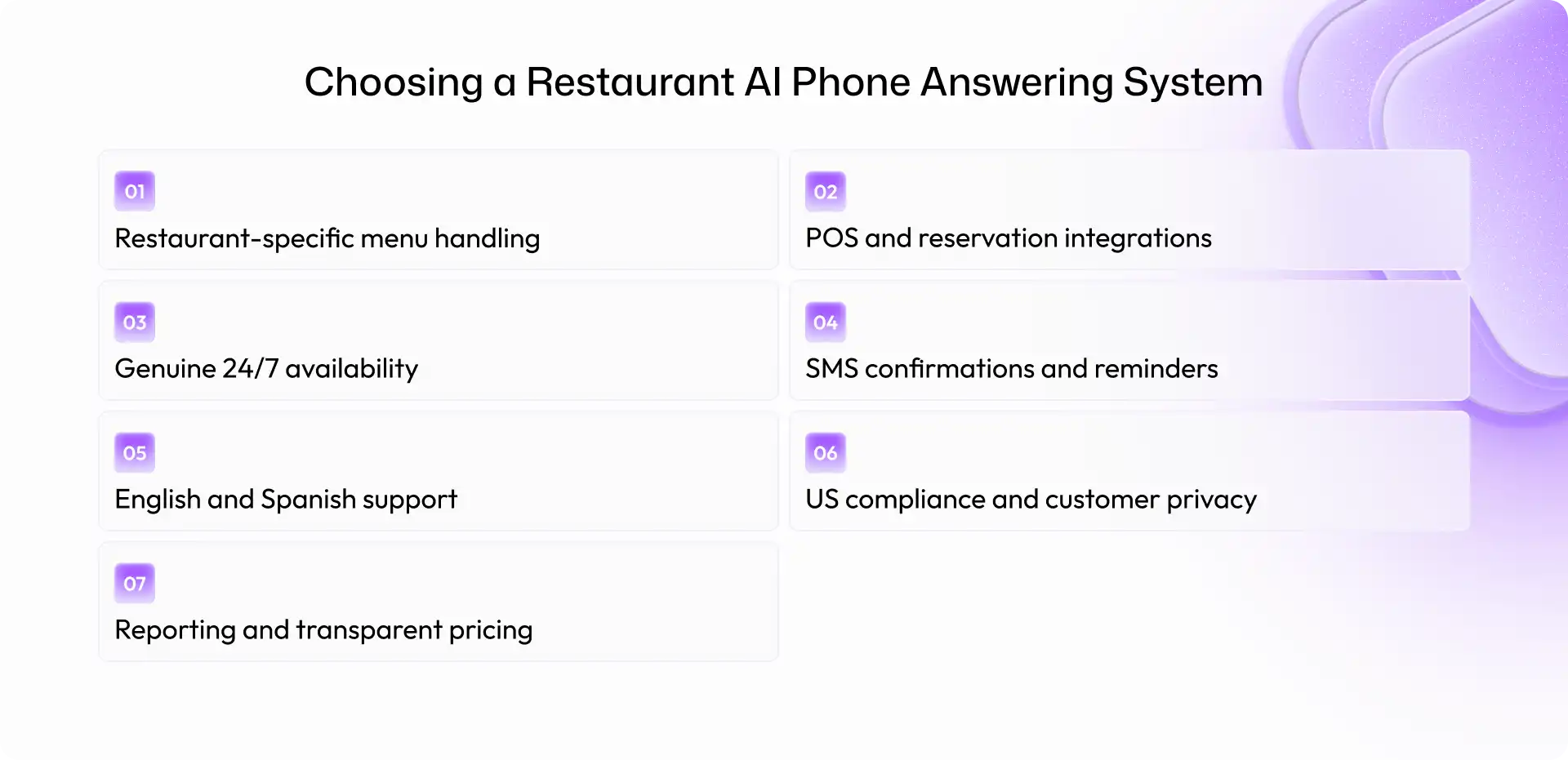
Not every AI phone answering system is designed for restaurant operations. Before choosing one, look beyond the basic promise of answering calls. Here are seven things worth checking.
1. Restaurant-specific menu handling
The system should understand menu items, sizes, toppings, modifiers, substitutions, and unavailable items. Test it with real customer requests.
2. POS and reservation integrations
Check whether it supports your existing systems, such as Toast, Square, or Clover. Also confirm whether reservations are created directly in your booking platform or simply collected as requests.
3. Genuine 24/7 availability
Ask whether after-hours calls are actually answered or whether the service only offers extended support hours.
4. SMS confirmations and reminders
Customers should receive useful updates after placing an order or booking a table. Check whether the system can send confirmations and reminders automatically.
5. English and Spanish support
For restaurants serving diverse US communities, language support can improve accessibility. Don't rely on a feature list alone. Test the system with real conversations and different accents.
6. US compliance and customer privacy
Check call-recording consent requirements in the states where your restaurant operates. AI disclosure requirements and privacy obligations can also vary by jurisdiction. Review the provider's data-handling practices and seek legal guidance where necessary.
7. Reporting and transparent pricing
Look for call logs, missed-call reports, order summaries, escalation records, and clear usage charges. Understand what happens when you exceed your monthly call allowance.
A good system should make restaurant operations easier to manage, not introduce another complicated process.
How to Switch Without Disrupting Service
Changing your restaurant's phone answering process doesn't need to be complicated. But switching everything at once can create unnecessary problems.
A gradual rollout is safer.
Step 1: Audit your current calls
Review when customers call, what they usually ask, and when your team struggles to answer. Identify whether the biggest issue is missed orders, reservation requests, or repetitive questions.
Step 2: Run the new system in parallel
Test the AI system before making it the primary answering option. Use a test number or a controlled call-routing setup where possible.
Step 3: Configure restaurant information
Add your current menu, prices, opening hours, location details, ordering rules, reservation policies, and escalation instructions.
Step 4: Test busy-hour and after-hours scenarios
Try multiple calls, complicated orders, menu modifications, reservation changes, and requests that should go to a human.
Step 5: Monitor the first two weeks
Review call logs, incorrect responses, abandoned conversations, order accuracy, and customer feedback. Make adjustments before expanding the system's responsibilities.
The goal isn't simply to launch AI. It's to make sure customers receive the same level of service, or better, after the change.
Conclusion
A restaurant phone answering service is no longer just about having someone pick up the phone. It's about making sure customer enquiries turn into completed actions.
Human operators still have an important role, especially when a situation requires empathy, judgment, or negotiation. But for repetitive calls, direct orders, reservations, and after-hours enquiries, AI can offer a more scalable approach.
For many US restaurants, the best option may be a combination of both: let AI handle the routine work and keep people available when customers need them.
If you're exploring this approach, Alris AI brings voice agents and communication workflows together to help restaurants manage calls, reservations, and customer interactions.
Explore Alris AI's restaurant automation capabilities to see how AI-powered communication could fit into your restaurant's daily operations.
The aim isn't to replace good hospitality. It's to make sure a ringing phone doesn't get in the way of delivering it.
Source & References:
National Restaurant Association - 2025 Off-Premises Restaurant Trends
National Restaurant Association - 2026 State of the Industry
National Restaurant Association - 2025 Operations Data Abstract
TouchBistro - 2024 Diner Trends Report
Toast - 2025 Voice of the Restaurant Industry
OpenTable - Restaurant Reservation and No-Show Research
Shravan Rajpurohit
CEO & Co-Founder
Shravan Rajpurohit is the Co-Founder & CEO of The Intellify, a leading Custom Software Development company that empowers startups, product development teams, and Fortune 500 companies. With over 10 years of experience in marketing, sales, and customer success, Shravan has been driving digital innovation since 2018, leading a team of 50+ creative professionals. His mission is to bridge the gap between business ideas and reality through advanced tech solutions, aiming to make The Intellify a global leader. He focuses on delivering excellence, solving real-world problems, and pushing the limits of digital transformation.

Stay Updated
with AI Insights
Get the latest articles on AI, automation, and enterprise technology delivered to your inbox weekly.

500+ people have already subsribed!
No spam. Unsubscribe anytime.