
Restaurant Voice AI vs Restaurant Management Software: What's the Difference and Which Do You Need?



Summary: Restaurant management software helps run core operations such as orders, payments, inventory, tables, and reporting. Restaurant Voice AI handles customer conversations, including calls, reservations, questions, and phone orders. They serve different purposes and can work together, allowing restaurants to automate customer interactions without replacing the systems they already use.
A restaurant can have great food, a strong team, and a busy dining room and still lose customers because nobody picked up the phone.
That is one reason restaurant technology has moved beyond POS systems and online ordering. In 2026, US restaurant operators are looking at automation, AI, and connected software to improve efficiency and stay responsive without putting more pressure on already busy teams. The National Restaurant Association says operators are planning technology investments that improve efficiency and strengthen guest connections.
Two technologies often come up in these conversations: restaurant management software and restaurant Voice AI.
They sound like competitors, but they solve different problems. Restaurant management software helps run the operation: orders, payments, inventory, tables, reporting, and other workflows.
Restaurant Voice AI focuses on customer conversations. It can answer calls, handle common questions, take orders or reservation requests, and trigger follow-up actions.
So, which one does a restaurant actually need?
The answer depends on what is slowing the business down. And for many restaurants, the answer may be both.
What Is Restaurant Management Software?
Restaurant management software is the technology used to manage the day-to-day operation of a restaurant. Depending on the platform, it can include:
Point-of-sale (POS)
Order management
Payment processing
Menu management
Table and floor management
Inventory tracking
Employee scheduling
Reservations
Customer data
Loyalty programs
Reporting and analytics
For example, a restaurant manager might use the system to review sales, check inventory, update menu items, manage tables, or see how the business performed during a particular shift.
In simple terms, restaurant management software helps the restaurant manage its internal operations.
It is usually a core part of the technology stack. But there is a gap it may not completely solve: real-time conversations with customers.
A POS can record an order. A reservation system can store a booking. But somebody still needs to answer the customer who calls during the dinner rush and asks, “Do you have a table for four tonight?”
That is where Voice AI comes in.
What Is Restaurant Voice AI?
Restaurant Voice AI uses conversational artificial intelligence to handle phone interactions with customers.
Instead of relying entirely on employees to answer every call, an AI voice agent can have a conversation, understand the customer's request, and take the appropriate action based on its configuration and integrations. Common use cases include:
Answering inbound calls
Taking phone orders
Answering menu questions
Handling reservation requests
Confirming or modifying bookings
Answering hours and location questions
Handling catering inquiries
Sending SMS confirmations
Following up with customers
Routing calls to employees when human help is needed
Providing after-hours coverage
This is different from a traditional automated phone menu. The main interface is the conversation itself.
That distinction matters during busy periods. OpenTable, for example, now supports integrations with Voice AI solutions that can handle reservations and guest inquiries around the clock. Its restaurant reservation platform specifically describes automated phone bookings as a way to let AI handle calls while staff focus on guests in the restaurant.
And adoption is no longer just theoretical. Toast's 2026 survey of 676 US restaurant operators found that 87% were comfortable using AI and nearly nine in ten were experimenting with it.
Restaurant Voice AI vs Restaurant Management Software: What's the Difference?
The easiest way to understand the difference is to look at the job each technology is designed to perform.
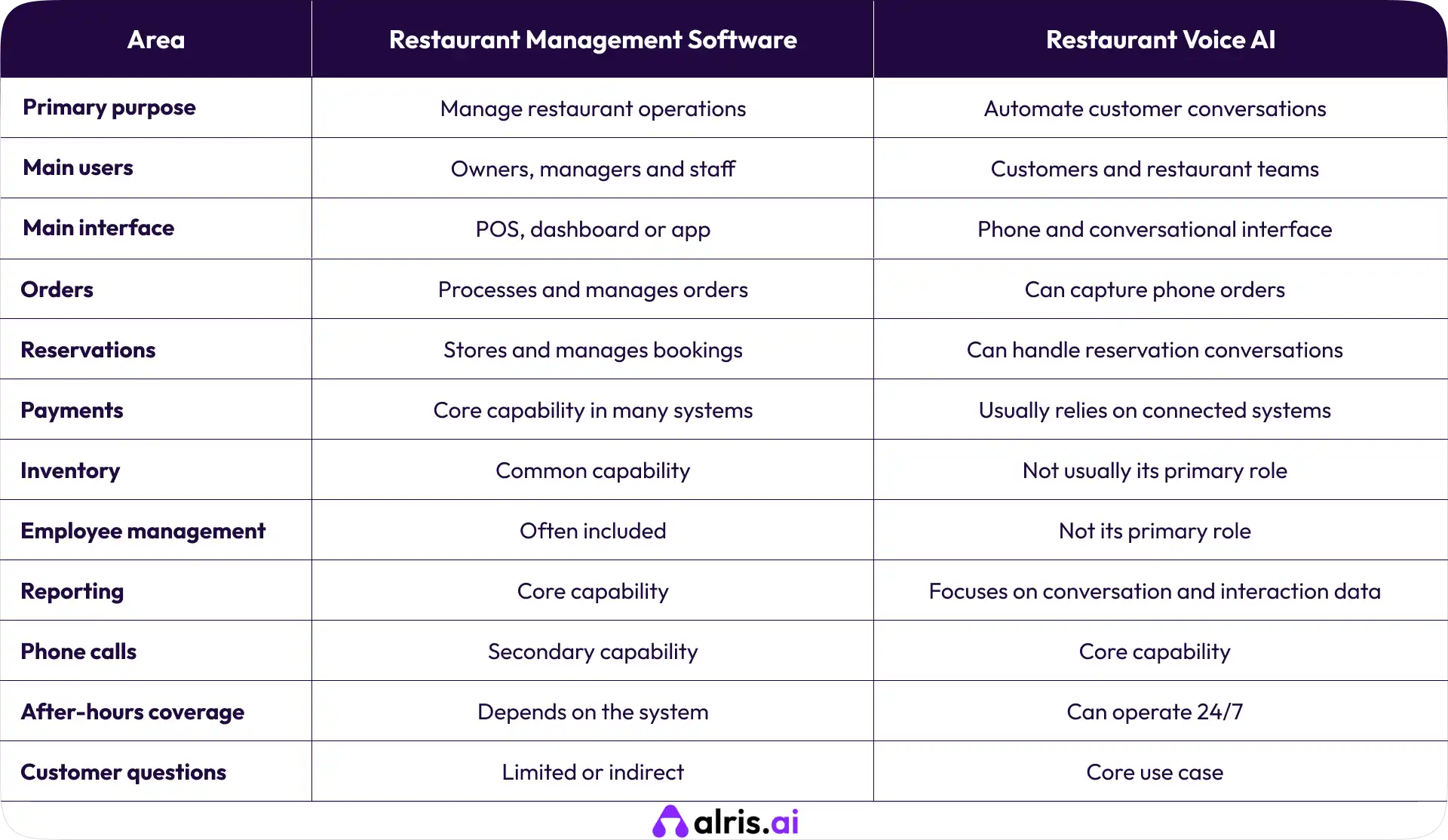
Consider a simple example.
A customer calls at 7 PM and says: “Can I book a table for six at 8:30, and do you have vegetarian options?”
The restaurant's management or reservation system can manage the booking. Voice AI can handle the conversation that leads to the booking.
It can ask for the required details, answer supported questions, check connected information, and complete or initiate the relevant workflow. So the difference is not simply software versus AI. It is operations versus customer interaction.
Can Restaurant Voice AI Replace Restaurant Management Software?
Usually, no. And that is not really what Voice AI needs to do.
A restaurant still needs systems for POS transactions, payments, inventory, menus, reporting, staff workflows, and other operational functions. Replacing all of those systems with a voice agent would not solve the underlying problem.
A better way to think about it is:
Restaurant management software = operational infrastructure
Restaurant Voice AI = conversational automation layer
Voice AI can connect with the systems a restaurant already uses, depending on the provider and available integrations. That means a restaurant can automate a specific bottleneck without replacing its entire technology stack.
If missed calls are the problem, automate the calls. If repetitive reservation requests are consuming the host team's time, automate those conversations. If staff is constantly answering the same basic questions, let an AI agent handle supported questions and send more complex requests to employees.
That is a much more practical approach than replacing working software just to add AI.
Can Restaurant Management Software Replace Voice AI?
Sometimes, but not always. Many restaurant platforms already handle online ordering, reservations, customer information, automated confirmations, and other digital workflows.
That can be enough for restaurants with relatively low phone volume. But a phone call is different from an online interaction. A customer may simply prefer to call.
They may want to ask about allergens, parking, private dining, catering, reservations, menu availability, or a previous order. They may not want to search through a website to find the answer.
That is where Voice AI can fill a different role.
A management platform may know that a table is available.
Voice AI can speak with the person who wants to book it.
A management platform may contain menu information.
Voice AI can answer the caller asking about that menu.
A management platform may store an order.
Voice AI can capture a phone order and, where supported, pass it into the connected ordering workflow.
So the real question is not, “Which technology is better?”
It is: “Where is the operational or communication gap in my restaurant?”
When Should a Restaurant Use Voice AI?
Voice AI makes the most sense when phone conversations are creating work, missed opportunities, or inconsistent customer service.
When your restaurant misses calls
This is one of the clearest use cases. The restaurant gets busy. The phone rings. The host is helping a table. Nobody answers. The caller hangs up. Maybe it was a reservation. Maybe it was a takeout order. Maybe it was a catering inquiry. You may never know. Voice AI can answer calls while employees are occupied.
OpenTable currently highlights this exact operational problem, noting that 63% of restaurants struggle to answer calls during busy periods and positioning Voice AI integrations as a way to handle calls and reservations around the clock.
When staff answer the same questions repeatedly
Restaurants receive plenty of routine questions:
What time do you close?
Do you take reservations?
Do you offer takeout?
Do you have outdoor seating?
Do you cater?
Where are you located?
These questions are simple, but answering them still takes someone's time. AI can handle supported routine questions while employees focus on guests in front of them.
When phone reservations are important
If customers frequently make reservations by phone, Voice AI can help collect booking details and connect the conversation to a reservation system where the integration supports it.
OpenTable's current documentation also shows that voice-based reservation workflows can be connected to its table-management infrastructure through its Voice AI API.
When your restaurant needs after-hours coverage
Your restaurant may close at 10 PM. Your customers don't necessarily stop calling at 10 PM.
An AI agent can provide a way to handle supported questions, reservation requests, and follow-ups outside normal staff hours.
When phone orders matter
For restaurants that still receive a meaningful volume of phone orders, Voice AI can help keep that channel available without requiring an employee to answer every call manually.
The technology is already moving into integrated ordering workflows. Toast, for example, documents integrations that allow AI systems to take restaurant guest orders by phone and connect them to Toast workflows.
When Is Restaurant Management Software Enough?
Not every restaurant needs Voice AI. If your restaurant receives very few calls, staff answer them easily, and your current systems handle reservations and ordering without creating extra work, another tool may not add much value.
Management software may be enough when:
Phone volume is low
Staff can comfortably handle calls
Most customers order online
Reservations are already automated
Customer questions are manageable
Existing workflows work well
There is little after-hours demand
This is worth saying because AI should not be added simply because everyone is talking about it. Start with the problem. Then choose the technology.
What Is the ROI of Restaurant Voice AI vs Management Software?
ROI depends on the problem being solved. Restaurant management software can create value through better control over orders, payments, inventory, staffing, reporting, and other operations.
Voice AI has a different ROI model. Its potential value can come from:
More calls answered
More reservations captured
More phone orders handled
Less staff time spent on repetitive calls
Better after-hours coverage
Faster customer responses
Automated confirmations and follow-ups
A restaurant can start with its own numbers.
For example: Missed calls × estimated conversion rate × average customer value = potential opportunity
You can also calculate how much staff time is spent answering repetitive calls each week. Then compare the cost of automation with the value of the time or business opportunity it could recover. The point is not to claim that Voice AI automatically produces a specific ROI. It doesn't.
The economics depend on call volume, customer behavior, restaurant size, integrations, pricing, and how much work is actually automated.
Can Restaurant Voice AI and Management Software Work Together?
Yes, and this is where the comparison becomes much more interesting. Voice AI for restaurants does not have to operate as a standalone system. It can act as a conversational layer connected to the software already running the restaurant.
A typical workflow could look like this:
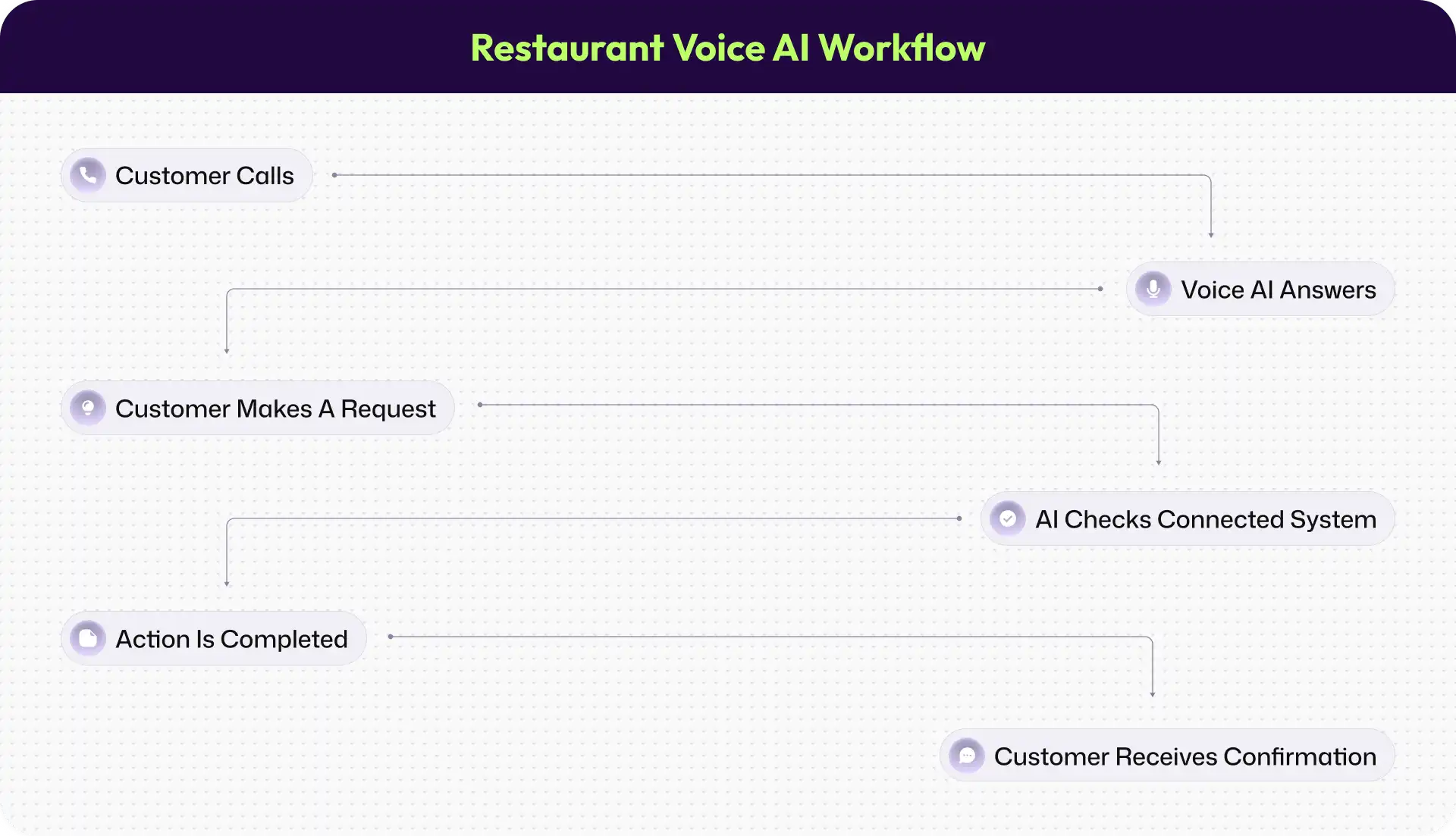
The restaurant management platform remains responsible for the underlying operational record. Voice AI handles the conversation around it. That can involve integrations with:
POS systems
Reservation platforms
Ordering systems
CRM
Calendars
Customer records
Messaging platforms
The exact capabilities vary by provider, so restaurants should check integrations before making a decision.
Ask:
Does it connect with our POS?
Can it access real-time reservation information?
Can it handle our menu and order structure?
Can it transfer calls to staff?
Can it send SMS confirmations?
What happens when the AI cannot answer?
Can staff review conversations or transcripts?
How is customer data handled?
A convincing demo is nice. A reliable integration is better.
How to Choose the Right Technology for Your Restaurant
The right technology depends on the problem you are trying to solve. If you need to manage POS, inventory, payments, tables, reporting, menus, or staff workflows, restaurant management software is essential.
If you need to answer more calls, handle customer questions, manage phone reservations, take orders, or automate follow-ups, Voice AI may be worth evaluating. And if you need both, there is no reason they cannot work together.
Choose restaurant management software when you need to:
Manage core restaurant operations
Process orders and payments
Track inventory
Manage tables
Handle staff workflows
Review business performance
Consider Voice AI when you need to:
Answer more customer calls
Handle repetitive questions
Take phone orders
Handle reservation conversations
Provide after-hours coverage
Automate customer follow-ups
Reduce interruptions for restaurant staff
Consider both when you need to:
Keep your existing operational systems
Automate customer conversations
Connect phone interactions to existing workflows
Reduce manual data entry
Give staff fewer repetitive tasks
Where Alris AI Fits
Alris AI takes the second approach. It is designed to work across customer communication channels rather than asking restaurants to replace their core operational software. Its platform currently supports voice, SMS, email, and CRM updates within a unified agent.
For a restaurant, that means a conversation does not necessarily have to end when the phone call ends.
A customer might call about a reservation and receive an SMS confirmation. Someone might ask about an order and continue the conversation through text. A catering inquiry might require a follow-up email.
The goal is to connect these interactions instead of forcing staff to manually move information from one channel to another.
That makes the more useful question:
“Where can AI take repetitive customer communication and connect it to the systems we already use?”
Not: “Should we replace our restaurant management software with AI?”
For restaurants already using a POS, reservation platform, or other management tools, that distinction matters.
Final Takeaway
Restaurant Voice AI and restaurant management software are not necessarily competing technologies. Management software helps run the restaurant. Voice AI helps manage conversations with the people trying to interact with it.
For some restaurants, existing management software may be enough. For others, missed calls, phone orders, reservation requests, and repetitive questions create a communication gap that operational software alone does not solve. And when both problems exist, the two technologies can work together.
The goal is not to add another tool just because it has AI in the name. The goal is to identify where your restaurant is losing time, missing customer interactions, or creating unnecessary manual work and then choose the technology that addresses that specific problem.
Frequently Asked Questions (FAQs)
1. Is restaurant Voice AI the same as restaurant management software?
No. Restaurant management software manages operational functions such as orders, payments, inventory, tables, and reporting. Voice AI focuses on customer conversations, including calls, questions, reservations, and supported ordering workflows.
2. Can restaurant Voice AI integrate with POS systems?
Some Voice AI platforms can integrate with POS systems. Capabilities vary by provider and POS, so restaurants should verify the exact integration before purchasing.
3. Can Voice AI take restaurant orders?
Yes, some Voice AI systems can take orders by phone and connect them with restaurant ordering or POS systems. The actual capabilities depend on the platform, menu complexity, and integration.
4. Can Voice AI handle restaurant reservations?
Yes. Depending on the integration, a Voice AI agent can collect reservation details, check availability, create or modify bookings, and send confirmations.
5. Does Voice AI replace restaurant employees?
Voice AI can automate repetitive customer interactions, but it does not have to replace employees. Restaurants can use human handoff for situations that require judgment, exceptions, or personal assistance.
6. Is Voice AI useful for small restaurants?
It can be, particularly when a small team receives more calls than it can comfortably answer. But restaurants with low call volume may not have enough repetitive work to justify adding Voice AI.
7. Should a restaurant use Voice AI and management software together?
They can. Management software can remain the operational system while Voice AI handles customer conversations and connects those conversations to relevant workflows.
Shravan Rajpurohit
CEO & Co-Founder
Shravan Rajpurohit is the Co-Founder & CEO of The Intellify, a leading Custom Software Development company that empowers startups, product development teams, and Fortune 500 companies. With over 10 years of experience in marketing, sales, and customer success, Shravan has been driving digital innovation since 2018, leading a team of 50+ creative professionals. His mission is to bridge the gap between business ideas and reality through advanced tech solutions, aiming to make The Intellify a global leader. He focuses on delivering excellence, solving real-world problems, and pushing the limits of digital transformation.

Stay Updated
with AI Insights
Get the latest articles on AI, automation, and enterprise technology delivered to your inbox weekly.

500+ people have already subsribed!
No spam. Unsubscribe anytime.