
Voice AI for Italian Restaurants: Handle More Calls, Take More Orders in 2026



Summary: Italian restaurants lose more revenue to missed calls than most formats; higher checks, complex orders, and catering enquiries make every unanswered call expensive. This guide covers how voice AI works specifically for Italian restaurants, the scenarios it handles best, and what to test before choosing a platform, from menu modification logic and bilingual support to POS integration and after-hours coverage.
Saturday night at 7pm. The dining room is full, the kitchen is firing on all cylinders, and the phone hasn't stopped ringing since 6. The host is managing a walk-in waitlist. The server closest to the phone is mid-order. Nobody picks up.
That call was probably a reservation for four. Maybe a catering enquiry for a corporate lunch next Friday. At an average Italian restaurant, check, that's real money walking out the door quietly, every service, without anyone tracking it.
Italian restaurants have a phone problem that's more expensive than most operators calculate. The cuisine attracts higher average checks, larger group bookings, and more complex orders than most restaurant formats. Regulars prefer to call. Catering clients call. Families booking for Sunday lunch call. And during service, when all those calls arrive, there's rarely anyone free to answer them properly.
Voice AI changes this. It answers the phone, takes the order with all the modifications, books the reservation, captures the catering enquiry, and handles the call in English or Spanish without pulling a staff member off the floor.
Why Italian Restaurants Have a Unique Phone Problem
Higher average checks mean missed calls cost more
A missed call at a quick service spot might mean a lost $15 order. At a mid-range Italian restaurant, the same missed call could be a table of six celebrating a birthday, $400 in a single booking. Italian restaurants also attract the kind of customer who still picks up the phone: the regular who always calls ahead, the corporate client booking a team dinner, the family coordinating Sunday lunch for twelve. These are planned occasions, and when the phone isn't answered, the occasion gets planned somewhere else.
Catering and large group inquiries
Catering is where the phone problem gets most expensive. A family catering a graduation, a company booking a private room, a couple planning a rehearsal dinner, these start with a phone call and represent high-value bookings. During a busy service, these calls arrive and disappear into voicemail. By the time someone calls back the next afternoon, the client has already booked elsewhere.
Seasonal menus and complex order logic
Italian cuisine involves order complexity most other formats don't deal with. Pasta preparations, sauce substitutions, protein additions, dietary modifications: "the tagliatelle but with the tomato sauce from the puttanesca, and can you do gluten-free pasta for that?" is a completely normal request. When specials change weekly, the volume of "what's on tonight?" calls spikes. Staff managing a full dining room during service aren't in a great position to handle these calls thoughtfully.
Bilingual caller needs
In many US markets, Italian restaurants serve communities where Spanish is the first language for a meaningful share of customers. Managing multilingual calls with a single front-of-house team during service is genuinely hard. When the bilingual server is on the floor, the Spanish-speaking caller who can't get through doesn't wait; they call somewhere else.
What Is Voice AI for Italian Restaurants?

Voice AI for restaurant answers inbound calls, understands what the caller is asking, and handles the request, taking an order, booking a table, or capturing a catering enquiry in a natural, conversational way. It's not a phone menu. Italian restaurant customers find IVR frustrating and impersonal, particularly regulars who expect a certain standard from the first point of contact. Voice AI holds a real conversation and resolves the call the same way a well-trained staff member would.
It's also not the same as an online booking widget. A widget captures customers already on your website. Voice AI captures the ones who pick up the phone, which, for Italian restaurants, is still the dominant channel for reservations, orders, and high-value enquiries.
What it handles in an Italian restaurant setting
A properly configured voice AI platform for an Italian restaurant covers:
Every inbound call answered instantly, regardless of time or call volume
Phone orders with full modifier and preparation logic substitutions, dietary requirements, specific preparations
Reservation booking with real-time availability and instant SMS confirmation
After-hours call coverage without voicemail or overtime
Catering enquiry capture before escalating to a human for the details
Outbound reminders to reduce no-shows for large bookings
Bilingual call handling in English, Spanish, and basic Italian where relevant
How Voice AI Works in an Italian Restaurant
The end-to-end flow is cleaner than most operators expect:
Customer calls - phone, any time of day
↓
Voice AI Answers Instantly - natural greeting, no hold music, no menu
↓
Identifies the Request - order, reservation, catering enquiry, question
↓
Handles the Request - takes the order with modifications, books the table, captures catering details
↓
Confirms with the Caller - reads back order or booking details before finalising
↓
POS / Reservation System Updated - automatically, no manual entry
↓
SMS Confirmation Sent - within seconds of the call ending
↓
Follow-up or Reminder Triggered - reminder before the reservation, follow-up on a catering enquiry
How it handles pasta modifications and Italian-specific complexity
This is where generic voice AI tools fall apart, and restaurant-specific platforms earn their keep. When a caller asks for "the spaghetti carbonara but with guanciale instead of pancetta and no egg yolk because I'm allergic," a well-configured system captures all of that accurately, confirms it back, and logs it to the kitchen.
The configuration matters enormously. A platform that's been properly set up with the full menu preparations, modifiers, substitutions, and allergy protocols handles these calls reliably. One that's been given a basic menu description and left to figure out the rest gets things wrong.
How it manages simultaneous calls during service
Five calls arriving during Saturday service are handled simultaneously. No queue, no hold music, no missed connections because the previous call is still running. Each caller gets immediate, individual attention regardless of what's happening on the floor.
How it escalates for complex catering calls
When a call involves a multi-course private dining enquiry, a large corporate booking with specific requirements, or anything that genuinely needs a human decision, the system captures the initial details and transfers them to a staff member with context already gathered. The client doesn't have to repeat themselves. The staff member has what they need to take it forward.
The Italian Restaurant Phone Scenarios Voice AI Handles Best
Phone orders with complex modifications
"The linguine aglio e olio with butter instead of olive oil, gluten-free pasta, and extra chili." Voice AI takes the full order, repeats it back, and sends it to the POS with every modifier intact. For takeaway-heavy Italian restaurants, this is where the improvement in order accuracy is most immediate.
Reservation calls for large groups
A party of fourteen calling for Saturday night needs confirmation of the table arrangement, clarity on the menu, and a reminder message before they arrive. Voice AI captures the full details, confirms the booking, sends a confirmation text immediately, and schedules the reminder automatically.
Catering and private event enquiries
A caller wants to discuss a rehearsal dinner for sixty people. During service, that call goes to voicemail. Voice AI captures the key details: date, guest count, occasion, dietary requirements, and contact, and lets the caller know someone will follow up. The lead doesn't disappear.
After-hours bookings and orders
Sunday evenings, people plan dinner. Late on weeknights, they're looking at the menu and deciding where to order. Without voice AI, these calls go unanswered. With it, every reservation gets confirmed, and every order gets captured around the clock.
Bilingual call handling
A Spanish-speaking caller gets the same quality of service as an English-speaking one. The system detects the language and responds accordingly, with no awkward pause, no transfer to a staff member who may not be available.
How to Choose the Best AI Voice Agent for Your Italian Restaurant
Does it understand Italian restaurant order complexity?
Test with a real Italian menu scenario during the demo, not a simple pizza order. Something like: "The fettuccine alfredo with shrimp instead of chicken, gluten-free pasta for one of them, and the sauce on the side." If the system handles that accurately and confirms it back correctly, continue the conversation. If it stumbles or misses a modifier, it's not configured for Italian restaurant complexity.
POS and reservation system integration
For phone orders to reduce labor rather than move where the work happens, orders need to fire directly to the POS. Confirm direct integration with your specific system, not "we integrate with most major POS platforms" but your exact setup. Ask to see it working before committing.
Bilingual support quality
Test it properly. Call the demo line and place an order in Spanish with a modifier or two. See how accurately the system captures and repeats back the order. For restaurants where Spanish-speaking customers are a meaningful share of business, this test matters more than almost any other.
After-hours and 24/7 coverage
Call the demo line outside business hours. If it falls back to a standard voicemail, the after-hours coverage isn't what it appears to be. True 24/7 means a catering enquiry at 10 pm gets captured and followed up, not sent to voicemail.
Omnichannel follow-up beyond just the call
A reservation confirmed with no follow-up text generates a "Did my booking go through?" callback. SMS confirmation within seconds of the call ending is table stakes. Look also for automatic reminders before reservations and follow-up messages after catering enquiries. Voice-only platforms leave this entire layer to the team.
Pricing models for high call volume operations
Italian restaurants with strong phone traffic can generate significant call volumes. Per-minute pricing becomes expensive at that volume. Flat-rate pricing is predictable and doesn't create a situation where the busier the restaurant gets, the more it pays for the tool.
Setup time and ease of menu configuration
Ask how long setup realistically takes and how menu updates are handled when specials change. A platform that requires a support ticket to update the specials is going to have outdated information on live calls within a week.
Why Alris AI Works for Italian Restaurants
Most voice AI platforms for restaurants handle phone calls and stop there. The call ends, and whatever follows - confirmation, reminder, follow-up - falls back to the team. For Italian restaurants handling high-value group bookings and catering enquiries, that gap is significant.
Alris AI is an restaurant automation platform. Voice calls, email, and SMS all run from the same system. When a reservation is booked over the phone, the confirmation text goes out automatically. When a catering enquiry comes in after hours, the follow-up gets queued for the morning without anyone on the team initiating it.
Handling Italian restaurant order complexity
Alris AI is configured to handle modifier-heavy menus. Sauce substitutions, preparation variations, and dietary requirement combinations are captured accurately and confirmed back before logging to the POS.
Bilingual capability
English and Spanish handled natively. For Italian restaurants in diverse US markets, the Spanish-speaking caller who previously got a rushed or missed interaction gets the same quality of service as any other customer.
After-hours coverage that actually works
Every call, any time. Sunday evening reservation calls get confirmed. Late-night catering enquiries get captured. The restaurant is effectively available for bookings and orders around the clock.
Predictable pricing at any call volume
Flat-rate regardless of call volume. The busiest months, Valentine's Day, Christmas, and Mother's Day, don't generate a higher AI bill alongside higher call volume.
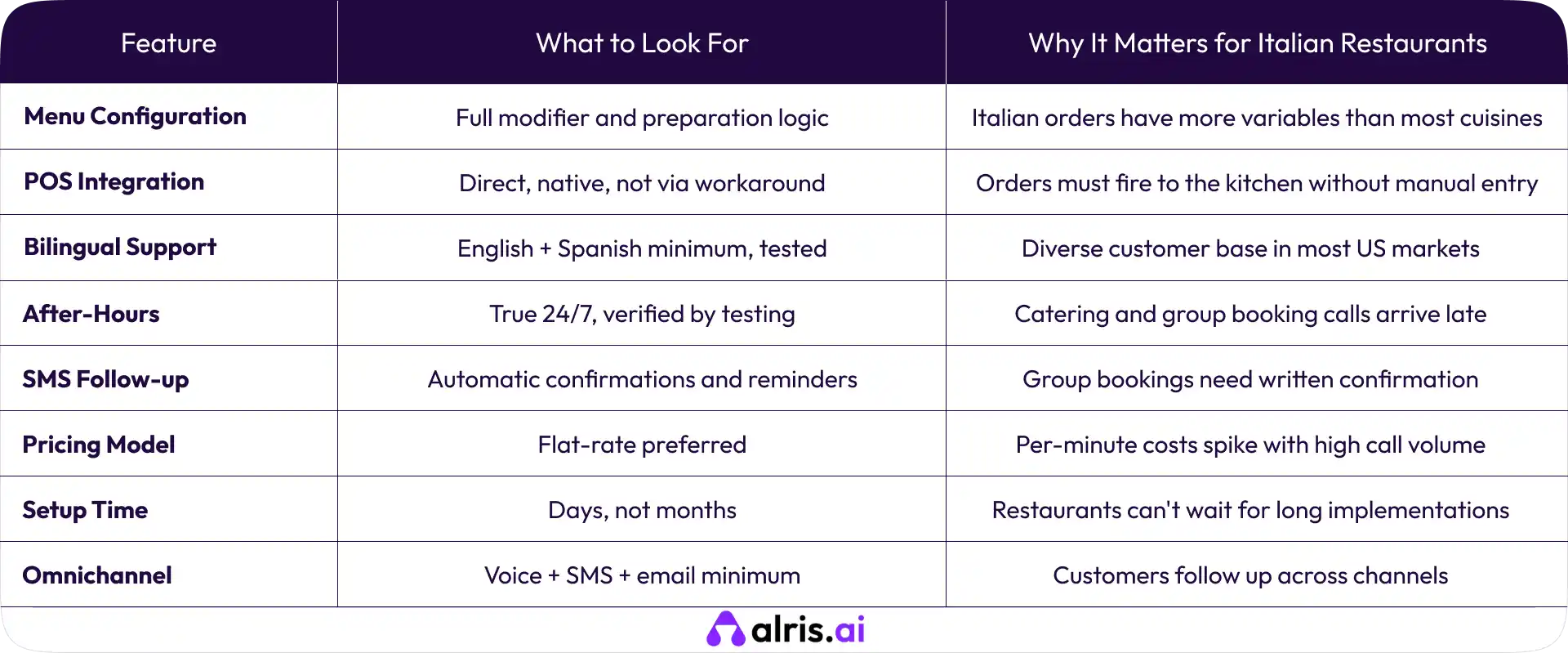
Voice AI Comparison: What to Look for Across Platforms
When evaluating platforms specifically for an Italian restaurant, these are the criteria that actually differentiate:
How to Implement Voice AI at Your Italian Restaurant
Step 1: Map your call types and volume
What percentage are orders vs reservations vs catering vs FAQs? When do most calls arrive, and how many go unanswered during service? This data shapes the configuration and gives you a baseline to measure against.
Step 2: Configure your menu and booking logic
Provide the full menu with all preparations, modifiers, and common substitutions. Set up reservation windows, party size limits, and special occasion handling. Configure catering enquiry capture and escalation paths. Get this right: a poorly configured system that gets Italian menu orders wrong is worse than no system at all.
Step 3: Test with real Italian restaurant scenarios
A caller asking if the arancini are gluten-free. A group of eighteen for Saturday. A Spanish-speaking caller placing a takeaway order with modifications. An after-hours catering enquiry. If the system handles all of these accurately, go live. If not, adjust first.
Step 4: Integrate with POS and reservation system
Place a test order and follow it all the way to the kitchen display. Make a test reservation and confirm it appears in the booking system immediately. This step is non-negotiable.
Step 5: Go live and monitor
Listen to call recordings in the first two weeks. Track missed call rate, order accuracy, and reservation conversion. Adjust configuration based on what the data shows.
Conclusion
Italian restaurants lose reservation revenue, catering clients, and regular customers to unanswered calls every service. The cuisine's higher average check, complex order logic, and reliance on phone bookings make this more expensive than in most other restaurant formats, and it compounds over time.
Voice AI for restaurant addresses the core problem. Every call gets answered. Orders with modifications are taken accurately. Catering enquiries get captured instead of lost to voicemail. After-hours calls become bookings instead of missed opportunities.
Choosing the right platform means testing for Italian-specific scenarios, not just general voice AI capability. Confirm bilingual support with actual Spanish-language call tests. Verify POS integration works before going live. And look for a platform that handles communication after the call, confirmations, reminders, follow-ups, not just the call itself.
That's the difference between a tool that answers your phone and one that actually supports how an Italian restaurant operates.
Frequently Asked Questions (FAQs)
1. What is voice AI for Italian restaurants?
Software that answers inbound calls, understands the caller's request, and handles it order, reservation, catering enquiry automatically, in natural conversation, configured specifically for the restaurant's menu, order complexity, and booking requirements.
2. Can voice AI handle complex Italian menu modifications?
Yes, when properly configured with the full menu, including all modifiers, preparations, and substitution options. The quality of the initial setup determines accuracy: a well-configured system handles complex Italian orders reliably; a generic tool without restaurant-specific configuration struggles.
3. Does voice AI work for catering and large group bookings?
Yes. It captures the initial details of a catering enquiry: date, guest count, occasion, dietary requirements, contact information, and either books directly for standard reservations or escalates to a staff member with full context for larger, more complex arrangements.
4. Can voice AI handle bilingual calls at my Italian restaurant?
Most restaurant-specific platforms support English and Spanish. Language detection is typically automatic. Test with real Spanish-language call scenarios, including modifications before committing to a platform.
5. How does voice AI integrate with my POS system?
Direct integration means orders fire into the POS the same way as a manually entered order; the kitchen ticket appears without anyone re-entering it. Confirm integration with your specific POS system before selecting a platform.
6. Is voice AI suitable for a small family-owned Italian restaurant?
Yes. Small Italian restaurants often benefit most; they're least able to dedicate staff to phone handling and most likely to miss calls during service. The platform cost is typically offset quickly by recovered orders and bookings.
7. How long does it take to set up voice AI at an Italian restaurant?
Single-location setups with standard POS integration typically go live within one to two weeks. The timeline depends on menu complexity and how much configuration work the platform requires upfront.
8. What happens when the AI can't handle a call?
It escalates to a staff member with full context from the conversation already captured. The caller doesn't repeat themselves, and the staff member has what they need to complete the call or follow up.
Shravan Rajpurohit
CEO & Co-Founder
Shravan Rajpurohit is the Co-Founder & CEO of The Intellify, a leading Custom Software Development company that empowers startups, product development teams, and Fortune 500 companies. With over 10 years of experience in marketing, sales, and customer success, Shravan has been driving digital innovation since 2018, leading a team of 50+ creative professionals. His mission is to bridge the gap between business ideas and reality through advanced tech solutions, aiming to make The Intellify a global leader. He focuses on delivering excellence, solving real-world problems, and pushing the limits of digital transformation.

Stay Updated
with AI Insights
Get the latest articles on AI, automation, and enterprise technology delivered to your inbox weekly.

500+ people have already subsribed!
No spam. Unsubscribe anytime.