
Voice AI for Restaurant Ordering: How to Choose the Right Platform



There's no shortage of voice AI platforms promising to fix your restaurant's phone problem. The demos look good, the pricing sounds reasonable, and the sales pitch is convincing. Then you go live, a customer calls to place an order with a modification, and the whole thing falls apart.
Choosing the wrong platform doesn't just waste money; it creates new problems. Orders get logged incorrectly. Reservations fall through. Customers who called expecting a smooth experience get a frustrating one instead. And your team ends up manually fixing what the AI was supposed to handle.
Most restaurants are dealing with the same three things: calls going unanswered during service, phone orders with too many errors, and reservation no-shows that could have been avoided with a simple reminder. Voice AI can genuinely solve all three, but only if the platform is actually built for how restaurants work.
This guide is for restaurant owners and managers who are actively evaluating voice AI. Not a general overview of the technology, but a practical breakdown of what to look for, what to avoid, and what questions to ask before you sign anything.
Why Restaurants Need Voice AI in 2026
The missed call problem and what it costs
During a Saturday dinner service, the phone doesn't stop. Neither does everything else. Tables need seating, orders need taking, and there are exactly zero moments when a staff member can step away to answer a call properly.
So calls get missed. Or answered in a rush and handled badly. Or sent to voicemail, which most customers don't bother leaving a message on anymore.
The revenue impact adds up faster than most owners calculate. A missed reservation for a table of four, at an average spend of £60-£80 per head, is £240-£320 that didn't happen. Miss five calls on a Friday night and you're looking at a significant loss before you've even factored in the customer who won't try again.
Staff bandwidth and the phone problem
This isn't about lazy staff. It's about a structural mismatch between what front-of-house teams are expected to do and what's actually possible during a busy service.
One person cannot seat a guest, take a drinks order, manage a complaint at table six, and answer the phone simultaneously. Something gives. Nine times out of ten, it's the phone.
Pulling someone off the floor specifically to handle calls isn't a solution either it just moves the problem. The floor gets thinner, service slows down, and you've spent money on coverage that still doesn't scale during peak hours.
Customer expectations have changed
Customers in 2026 don't expect to wait on hold or leave voicemails. They expect their call to be answered, their question to be addressed, and their booking or order to be confirmed immediately. If that doesn't happen, they don't give it another shot. They book elsewhere, or order from somewhere that picks up.
After-hours is where this really bites. A chunk of reservation calls come in between 8 pm and 10 pm, people planning ahead after dinner, or calling during their lunch break when they've got a moment. If your restaurant closes at 10 and the phone goes unanswered from 9:30 onwards, those calls are gone.
What Is Voice AI for Restaurants?
Voice AI for restaurants is software that answers your phone line, understands what the caller is asking, and handles it, taking a food order, booking a table, answering a question about the menu in a natural, conversational way. No menus, no button presses, no "your call is important to us."
It's not a phone tree. It doesn't work from a fixed list of options the caller has to match. It listens to natural speech, figures out what the person needs, and responds accordingly.
Where it fits in a restaurant's overall communication setup
Voice AI sits at the front of your phone line. It handles the inbound volume so your team doesn't have to. It connects with your POS and reservation system so the data flows through automatically. And it integrates with SMS so confirmations go out without anyone pressing send.
What restaurant voice AI handles
The core functions a good platform covers:
Answering every inbound call instantly, any time of day
Taking phone orders conversationally and logging them to the POS
Booking, rescheduling, and cancelling reservations in real time
Handling FAQ queries: hours, menu, allergens, location, parking
Managing after-hours calls without voicemail
Sending outbound reminders and follow-ups automatically
Restaurant Answering Service vs Voice AI: What's the Difference?
Worth clarifying because the two get confused, and they're not the same thing.
A traditional restaurant answering service uses human operators to pick up calls on your behalf, usually outside opening hours. They take a message, note the details, and pass them on. They generally don't take orders, can't book directly into your reservation system, and don't send SMS confirmations.
Voice AI does all of that automatically, around the clock, at a lower cost per interaction.
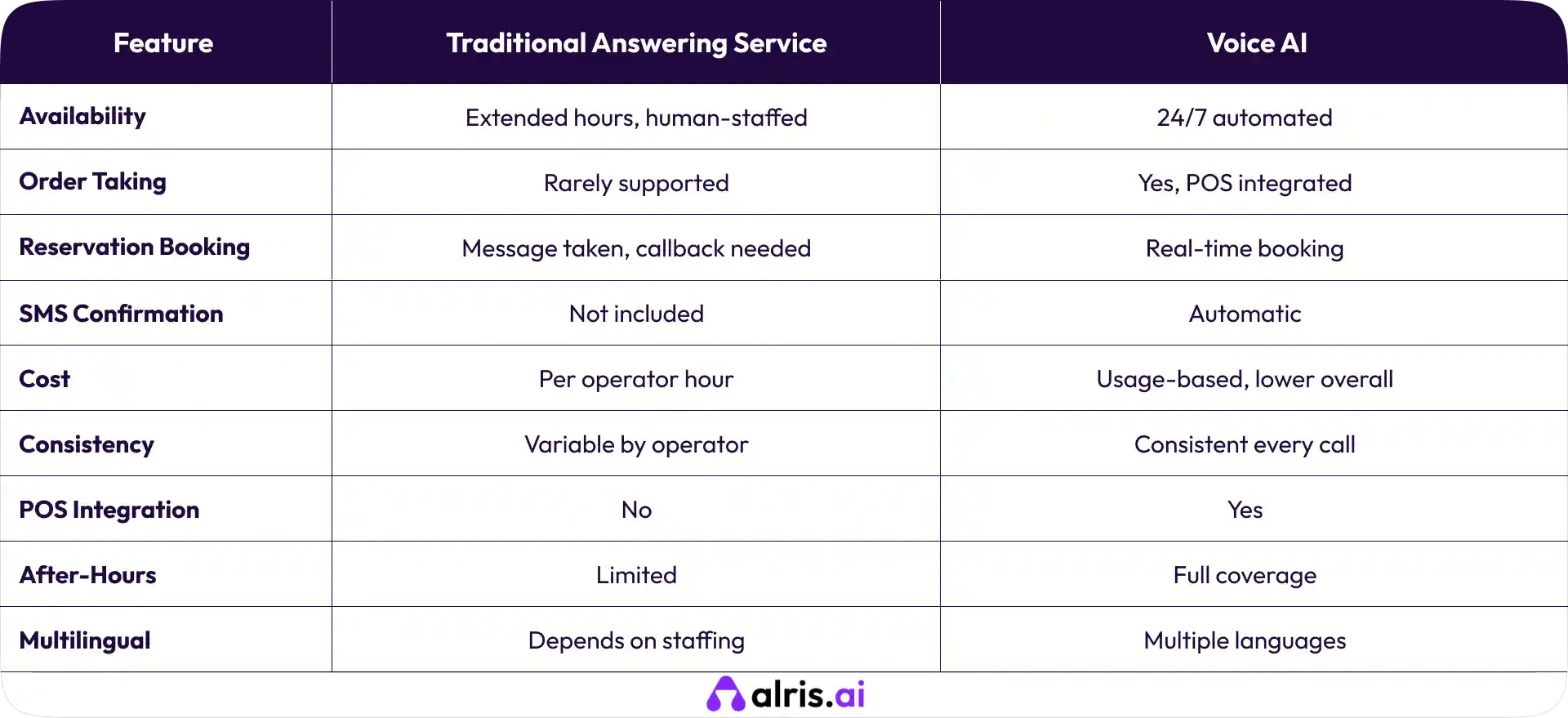
The traditional answering service has its place primarily for restaurants that need a human voice for sensitive or complex calls outside hours. But for the majority of what restaurants actually need answered, voice AI handles it more completely and more consistently.
Key Use Cases for Voice AI in Restaurants
1. Restaurant Phone Answering Service
The most immediate use case. Every inbound call gets answered instantly, regardless of what's happening on the floor or what time it is.
During a Friday dinner service, five calls might come in within twenty minutes. Voice AI handles all five simultaneously without any drop in quality. Each caller gets the same prompt, professional response. No one waits, no one gets sent to voicemail, no one hangs up frustrated.
For restaurants that currently rely on staff to cover the phone during service, this is usually where the clearest immediate value shows up.
2. Voice AI for Restaurant Ordering
Taking phone orders accurately is harder than it looks. Modifications, dietary requirements, half-portions, extra sauces, swapped sides the margin for error is significant, and the consequences show up in the kitchen and on the customer's plate.
Conversational voice AI takes the order conversationally, handles modifications as they come up, confirms the full order back to the customer before logging it, and sends it directly to the POS. No re-entry, no miscommunication between the phone and the kitchen ticket.
For restaurants doing meaningful phone order volume takeaways, this is where the accuracy improvement is most measurable.
3. Reservation Management
Real-time availability checks, instant booking confirmation, automatic SMS reminders, and self-service cancellation and rescheduling are all handled during the call without any staff involvement.
The no-show reduction from automated reminders alone tends to justify the cost for most restaurants. A reminder message the day before, with a simple "reply to confirm or reschedule," consistently moves the needle on attendance rates.
4. After-Hours Call Handling
This one surprises most restaurant owners when they look at the data. A meaningful share of reservation and enquiry calls arrive outside opening hours. Not just late sometimes during the gap between lunch and dinner service, or early morning when the team hasn't arrived yet.
Voice AI captures these calls, handles what it can, and logs everything for the morning. Reservations get booked. Orders (for later collection) get placed. Questions get answered. Nothing sits in a voicemail queue waiting for someone to listen to it.
5. Outbound Reminders and Follow-Ups
The system doesn't just receive; it also reaches out. Reservation reminders go out automatically the day before. Post-visit feedback requests go out after the booking date. For restaurants with a loyalty angle, returning customer outreach can be triggered by visit history.
This is the part that moves the needle on no-shows and repeat visits, and it runs without anyone on the team initiating it.
How Voice AI for Restaurants Works
Here's the end-to-end flow for a typical interaction:
Customer Calls - the phone rings
↓
Voice AI Answers Instantly - no hold, no menu, just a natural greeting
↓
Identifies the Request - reservation, order, question, or something else
↓
Handles the Request - books the table, takes the order, answers the query
↓
Confirms with the Customer - reads back the order or booking details before finalising
↓
Updates POS / Reservation System Automatically - data goes straight in, no manual entry
↓
SMS Confirmation Sent - customer receives confirmation within seconds
↓
Follow-up Triggered - reminder before the reservation, feedback request after the visit
How it manages simultaneous calls during peak service
Multiple calls arriving at once get handled in parallel. The system doesn't queue them; it handles each one independently and simultaneously. Ten calls during the Saturday rush get ten simultaneous responses.
How it escalates to staff when needed
When something genuinely needs a person, the AI hands off cleanly. The staff member picks up with a brief summary of what the caller said and what was attempted so the customer doesn't have to repeat themselves from scratch.
Voice AI for Different Restaurant Types
Full-Service and Fine Dining
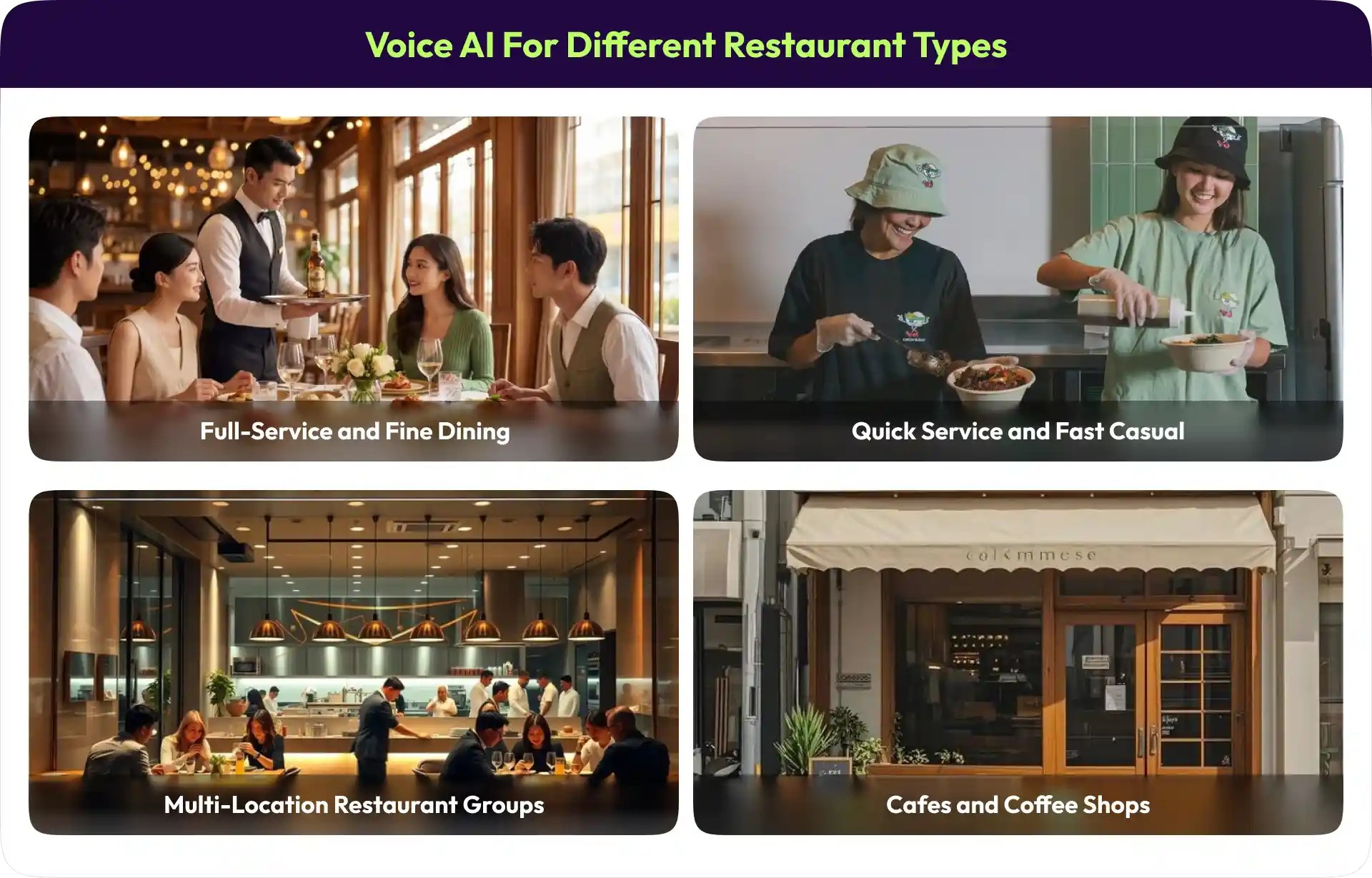
The priority here is reservation management, large group bookings, special occasion handling, and dietary requirements for the whole table. These calls tend to be longer and more detailed, so conversation quality matters more than raw speed.
When evaluating platforms, prioritise natural-sounding dialogue, the ability to capture multi-step reservation details accurately, and SMS confirmation with all the relevant information included.
Quick Service and Fast Casual
Phone order taking and peak hour call management are the main use cases. Speed and accuracy matter most; the AI needs to handle a straightforward order quickly and correctly, including common modifications, and get it into the POS without delay.
Test order accuracy thoroughly, especially for menu items with multiple customisation options. Integration speed with the POS is also worth checking: how quickly does the order appear after the call ends?
Cafes and Coffee Shops
Click-and-collect orders, catering enquiries, and FAQ handling tend to be the primary needs. Volume is often lower, but the calls can be more varied. Multi-item orders with specific preparation notes "oat milk, extra shot, no sugar") need to be captured accurately.
Look for platforms that handle compound orders cleanly and can manage simple catering enquiries before escalating to a human for the details.
Multi-Location Restaurant Groups
Consistent call handling across all locations from a single system, with per-location configuration for menus, hours, and availability. Centralised reporting that shows performance across sites. Per-location pricing that scales reasonably.
For groups, the management overhead of the platform matters as much as the call quality. If updating the menu at one location requires separate work for each site, it gets unwieldy fast. Look for platforms with centralised management and location-level customisation.
How to Choose the Best Voice AI for Your Restaurant
1. Conversation Quality: Does It Sound Natural?
This is the first thing to test and the one that matters most for customer experience. If the AI sounds robotic, rushes through responses, or handles pauses badly, customers will ask for a human or simply hang up.
Ask for a live demo with real call scenarios, not a polished recording. Test it with the kinds of calls you actually receive: a caller who changes their order mid-conversation, someone who asks three questions before getting to what they actually want, a non-native speaker with a strong accent. How the platform handles these tells you more than any feature list.
2. POS and Reservation System Integration
Non-negotiable for order-taking use cases. If orders taken by the AI don't flow directly into your POS, someone still has to manually enter them, which defeats the purpose and adds a new point of error.
Before evaluating anything else, confirm which POS and reservation platforms the AI integrates with. If yours isn't on the list, ask specifically how that integration works and what it involves. "We can integrate" and "we have a native integration" are very different things.
3. Omnichannel Capability Beyond Just Voice
A call that ends with no confirmation sent is a call that might generate a "did my booking go through?" follow-up the next day. SMS confirmation after every interaction should be a baseline feature, not an add-on.
Beyond SMS, it's worth checking whether the platform handles email and WhatsApp as well, not because every restaurant needs all of these on day one, but because customer communication preferences vary and you don't want to rebuild the whole setup in a year.
4. After-Hours and 24/7 Coverage
"After-hours capable" can mean different things. Some platforms offer genuine 24/7 coverage. Others have extended hours with certain limitations, fewer features available outside business hours, or a different routing for after-hours calls.
Test it yourself. Call the demo line at 11 pm and see what happens. Ask specifically: what can the AI do at 2 am that it can do at 2 pm? If the answer is "everything," that's what you want. If there are caveats, understand exactly what they are before committing.
5. Multilingual Support
Depends heavily on your customer base. If a significant share of your customers speak a language other than English, multilingual capability moves from "nice to have" to "essential." Test the quality in the relevant language, not just whether the platform claims to support it.
6. Customisation and Menu Configuration
Your menu changes. Seasonal specials come and go, prices update, items get 86'd mid-service. The platform needs to reflect that accurately, and updating it should be straightforward enough that it actually gets done promptly.
Ask how menu updates work. Is it self-service or does it require contacting support? How quickly do changes take effect? A platform where updating the menu requires a support ticket is going to cause problems.
7. Analytics and Reporting
At minimum, you want to see call volumes by time of day, booking conversion rates, order accuracy rates, and call abandonment data. These tell you whether the system is working and where it's falling short.
Some platforms provide more granular data: sentiment analysis, call recordings, query type breakdowns. More is generally better, as long as the data is actually easy to access and interpret.
8. Setup Time and Ease of Deployment
A platform that takes three months to configure isn't practical. Most restaurants need to be live within a few weeks at most.
Ask for a realistic onboarding timeline based on your specific setup: a single location, your POS system, and your reservation platform. Get it in writing if possible. Vague answers about "it depends" are a warning sign.
9. Pricing Models: What to Watch Out For
Voice AI pricing varies significantly. Per-minute, per-call, monthly subscription, and usage tiers are all common. What matters is understanding the total cost at your actual call volume, not just the headline rate.
Watch for setup fees, per-location charges if you have multiple sites, integration fees for connecting with your POS, and costs for features that sound standard but are actually add-ons. Ask for a full cost breakdown based on your estimated monthly call volume before committing.
The ROI calculation is usually straightforward: if the platform costs £X per month and captures Y additional reservations or orders that would have otherwise been missed, at your average spend per cover, how long until it pays for itself?
Conclusion
The right voice AI platform removes three problems at once: calls going unanswered during service, orders getting logged incorrectly, and reservations falling through because nobody sent a reminder.
Choosing well means going beyond the demo. Test conversation quality with real, difficult call scenarios. Confirm POS integration before anything else. Verify that after-hours capability is genuine, not a variation of "extended hours." And understand the full cost at your actual call volume before signing.
The restaurants getting the most out of this technology aren't just answering more calls; they're connecting voice AI with their POS, reservation system, and SMS follow-ups so the entire workflow runs automatically. That's where the real operational improvement happens, not just in picking up the phone.
Frequently Asked Questions (FAQs)
1. Can voice AI take food orders accurately?
Yes, when properly configured and integrated with the POS system. The AI takes the order conversationally, handles modifications, confirms the full order back to the customer, and logs it directly into the system. Accuracy depends on how well the menu and modification options are set up during configuration.
2. How does voice AI handle reservation bookings?
It checks real-time availability during the call, confirms a slot, books it directly into the reservation system, and sends an SMS confirmation immediately. Reminders and rescheduling are also handled automatically.
3. Does voice AI integrate with restaurant POS systems?
Most modern platforms integrate with common POS systems. This should be one of the first things confirmed during evaluation. Without POS integration, phone orders still require manual entry, which limits the value significantly.
4. Can voice AI handle calls in multiple languages?
Many platforms support multiple languages. Quality in the relevant language should be tested with real call scenarios before committing, not just verified as a feature on a spec sheet.
5. What happens when voice AI can't answer a question?
A well-configured system transfers the call to a staff member with context already captured, so the customer doesn't have to repeat themselves. The escalation path should be tested during evaluation, not assumed.
6. Is voice AI suitable for small independent restaurants?
Yes. Small restaurants often benefit most because they're least able to afford dedicated phone staff and most likely to miss calls during service. The ROI calculation is usually straightforward: missed reservations recovered quickly cover the platform cost.
Shravan Rajpurohit
CEO & Co-Founder
Shravan Rajpurohit is the Co-Founder & CEO of The Intellify, a leading Custom Software Development company that empowers startups, product development teams, and Fortune 500 companies. With over 10 years of experience in marketing, sales, and customer success, Shravan has been driving digital innovation since 2018, leading a team of 50+ creative professionals. His mission is to bridge the gap between business ideas and reality through advanced tech solutions, aiming to make The Intellify a global leader. He focuses on delivering excellence, solving real-world problems, and pushing the limits of digital transformation.

Stay Updated
with AI Insights
Get the latest articles on AI, automation, and enterprise technology delivered to your inbox weekly.

500+ people have already subsribed!
No spam. Unsubscribe anytime.