
How Voice AI Improves Customer Service in Restaurants



Summary: Restaurant customer service can improve significantly when AI supports guest interactions across calls, reservations, and follow-ups. This guide explains how Voice AI helps restaurants provide 24/7 support, answer routine questions, reduce missed interactions, ease staff workload, and create a faster, more consistent guest experience.
A restaurant's customer service starts before a guest walks through the door.
It may begin with a quick phone call: “Are you open tonight?” “Can I make a reservation?” or “Do you have outdoor seating?” These questions are simple, but when nobody answers the phone, the experience can go downhill fast.
That is where Voice AI for restaurants can help. An AI voice agent can answer routine questions, assist with reservations, provide restaurant information, and support guests outside regular business hours. More importantly, it can take some pressure off busy staff without taking the human side out of hospitality.
Because restaurant customer service is not just about what happens at the table. It is the entire journey, from the first question to the follow-up after the visit.
Why Delivering Great Restaurant Customer Service Is Challenging
Restaurant teams constantly balance phone calls, reservations, orders, walk-ins, and guests already sitting in front of them.
During a busy service, answering every call simply isn't realistic. And when a call goes unanswered, the guest may not try again.
Guests Need Answers When Staff Are Already Busy
A server may be carrying food. A host may be checking in a large party. A manager may be dealing with an issue in the dining room. Meanwhile, the phone rings. For the guest, none of that context is visible. They simply called and didn't get an answer.
Voice AI can provide another layer of support by handling routine calls while employees stay focused on in-person guests.
Simple Questions Can Still Cost You a Guest
Many calls involve questions such as:
Are you open tonight?
Do you take reservations?
Do you have outdoor seating?
Can you accommodate dietary restrictions?
Is parking available?
Can I change my reservation?
The questions are easy. Getting someone available to answer them is often the harder part.
Inconsistent Responses Can Hurt the Guest Experience
Customers also expect consistent information. If one employee gives a different answer about reservation policies, operating hours, or dining options than another, confusion follows.
A properly configured AI voice agent can provide approved restaurant information consistently, as long as that information is kept current.
How Voice AI Changes the Restaurant Guest Experience
The easiest way to understand AI voice agents for restaurants is to look at the guest journey:
Discover → Ask → Reserve → Prepare → Visit → Follow Up
Voice AI can support several of these stages, helping remove friction before, during, and after a restaurant visit.
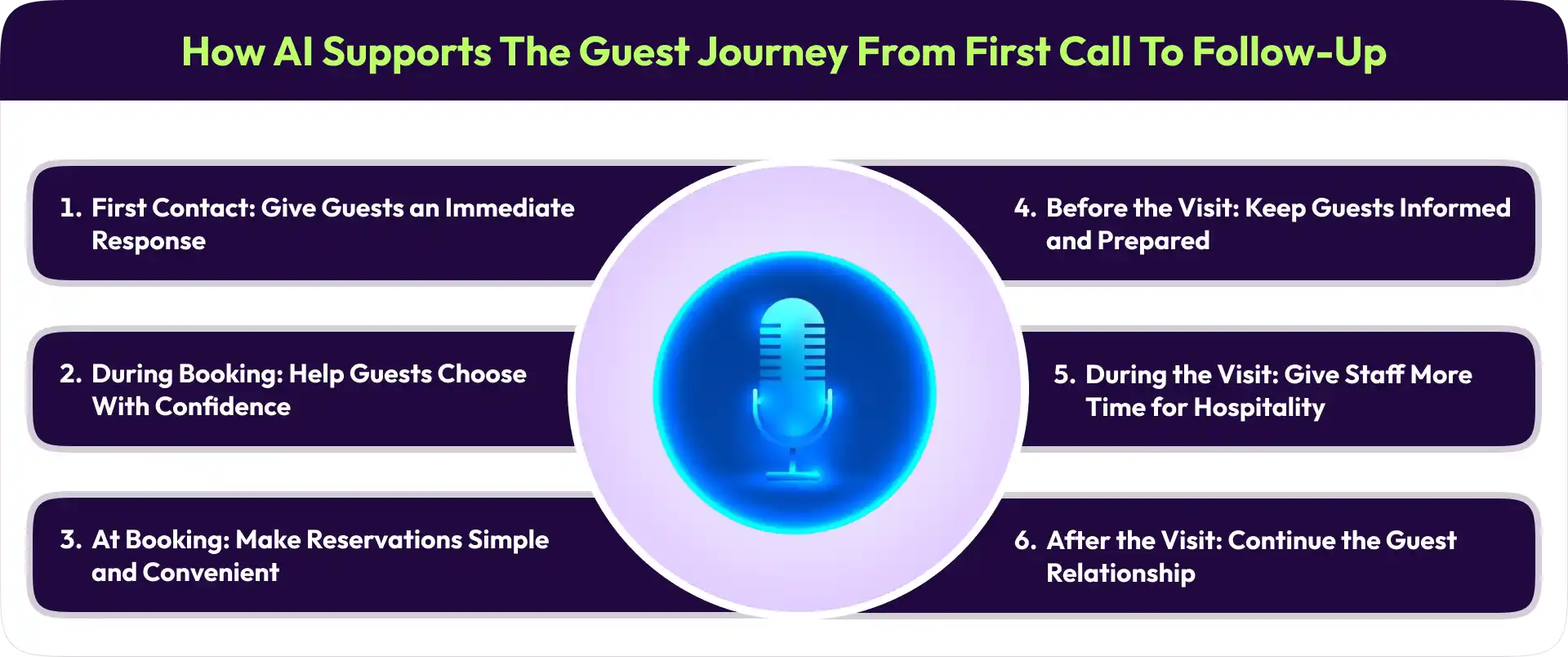
1. First Contact: Give Guests an Immediate Response
The first phone interaction can shape a guest's impression of the restaurant. A quick, useful response creates a much better starting point than endless ringing or voicemail.
Answer Calls Without Making Guests Wait
Guests don't usually care why their call wasn't answered. They just knew they couldn't reach the restaurant.
Voice AI can answer incoming calls immediately and handle approved routine requests without requiring an employee to pick up every time. That is particularly useful during lunch and dinner rushes, when staff have little time to step away.
Provide Consistent Answers to Common Questions
A restaurant can configure its AI phone agent to answer common questions about:
Hours
Location
Parking
Menu information
Reservations
Dining options
Restaurant policies
Private events
The important part is accuracy. The system should work from information the restaurant has approved rather than guessing when it doesn't know something.
Make the Restaurant Available Beyond Business Hours
Customers don't always call during convenient hours. Someone planning a Friday dinner may have a question late at night. Another guest may want to make plans early in the morning.
With Voice AI for restaurants, basic customer support can remain available 24/7, giving guests a way to get information even when the restaurant team is offline.
2. During Booking: Help Guests Choose With Confidence
A guest may already be considering a restaurant but still have one question holding them back. That question could be about dietary options, children, group dining, outdoor seating, or private events. A quick answer can turn uncertainty into a booking.
Answer Questions That Influence Booking Decisions
Guests might ask:
“Do you have vegetarian options?”
“Can I bring my children?”
“Do you have a private room?”
“Can you accommodate a large group?”
“Is outdoor seating available?”
These aren't complicated questions, but they can influence where someone chooses to dine.
Turn Guest Questions Into Reservations
The ideal journey is simple:
Question → Confidence → Reservation
But when a guest can't reach anyone, it can become:
Question → Wait → Give up → Choose another restaurant
Voice AI can shorten that gap by providing immediate answers and, where supported, helping the guest move directly into the reservation process.
3. At Booking: Make Reservations Simple and Convenient
Once a guest decides to visit, booking should be simple. Waiting on hold or calling repeatedly adds unnecessary friction to what should be an easy step.
Let Guests Book Without Waiting for Staff
Depending on the restaurant's systems and integrations, an AI voice agent can assist with reservation workflows. It can collect details such as:
Date
Time
Party size
Guest name
Contact information
Special requests
It can then follow the restaurant's defined process for confirming or completing the reservation.
Remove the Friction From Reservation Calls
A conversational booking experience can be easier than waiting for an employee during a busy service. This matters because reservation problems don't always stay small.
OpenTable has reported that 28% of Americans have missed a reservation. Clear communication and reminders can help make the process easier for guests.
Keep Reservation Details Clear and Consistent
A reservation may also involve policies, confirmation details, or arrival information. Having a consistent process helps guests know what to expect instead of relying on whichever employee happens to answer the phone.
4. Before the Visit: Keep Guests Informed and Prepared
The time between booking and arrival is another opportunity to improve the guest experience. A guest may forget the reservation time, wonder where to park, or need to check a restaurant policy.
Send Timely Reservation Reminders
Reminders can help guests remember their reservation, particularly when it was made days or weeks in advance. It is a small touch, but it can prevent an avoidable problem.
Give Guests Important Information Before They Arrive
Depending on the restaurant, pre-visit communication can include:
Reservation details
Parking instructions
Arrival information
Restaurant policies
Event information
Guests don't have to search through old messages or call again for basic details.
Help Reduce No-Shows Without Creating More Work for Staff
No-shows create operational problems for restaurants and can leave other guests without tables.
OpenTable has reported that deposits can reduce no-shows by 57%. That statistic relates specifically to deposits, not Voice AI, but it illustrates the broader value of structured reservation processes.
Technology can help restaurants manage these processes without adding more manual work for staff.
5. During the Visit: Give Staff More Time for Hospitality
Voice AI can also improve the experience indirectly by reducing interruptions for employees.
Reduce Interruptions for Restaurant Staff
During peak service, every phone call creates a choice: answer it, ignore it, or ask someone else to handle it. Routine calls can pull employees away from guests who are already in the restaurant.
An AI voice agent can handle suitable requests in the background, allowing staff to stay focused on service.
Let Employees Focus on High-Value Guest Interactions
Hospitality is still human. AI can answer a question about opening hours. It cannot replace the value of a server helping a guest, a host welcoming someone, or a manager resolving a sensitive complaint.
The practical model is simple: AI handles repetitive communication → Staff focus on human hospitality
The National Restaurant Association reports that 74% of operators say technology augments rather than replaces labor.
That is an important distinction. The purpose is not to remove people from hospitality. It is to give them more room to do the work that requires people.
Create a More Consistent Service Experience
When phone communication, reservation information, and in-person service follow the same policies, the overall experience feels more connected. Restaurant automation works best when it supports the existing customer-service process rather than operating separately from it.
6. After the Visit: Continue the Guest Relationship
The customer journey doesn't necessarily end when the guest leaves. There is still an opportunity to collect feedback, encourage reviews, or invite the guest to return.
Follow Up With Guests After Their Visit
Post-visit communication can include:
Feedback requests
Review requests
Follow-up messages
Promotional communication
Rebooking opportunities
The right approach depends on the restaurant, but the goal is the same: keep communication useful rather than intrusive.
Make Customer Service a Continuous Conversation
A guest might call first, receive a confirmation by SMS uradlcwekleo, get an email before their visit, and receive a follow-up afterward.
Voice, SMS, and email can work together instead of functioning as isolated channels. This is where an omnichannel approach can make the guest experience feel more connected.
Turn a One-Time Visit Into a Repeat Relationship
No automated message can guarantee loyalty. But when guests get quick answers, clear reservation information, a smooth visit, and useful follow-up, there are fewer points of friction along the way. Sometimes that is what good customer service looks like: making things easier without making a big show of it.
The Customer Service Benefits Restaurants Can Expect From Voice AI
Looking across the entire journey, several benefits stand out.
Faster Response Times: Guests can get answers without waiting for an employee to become available.
24/7 Accessibility: Customers can access approved information and supported services outside normal business hours.
Deliver More Consistent Guest Support: An AI agent can provide standardized answers based on the restaurant's approved information.
Capture More Guest Calls and Requests: An unanswered call could mean a missed reservation or a guest who decides to try another restaurant. Voice AI gives restaurants another way to respond.
Less Pressure on Front-of-House Staff: Employees don't have to choose between answering every routine call and serving guests in front of them.
Create a Smoother Guest Journey From Start to Finish: The biggest benefit is not one individual feature. It is reducing friction across: Question → Decision → Reservation → Preparation → Visit → Follow-Up
Does Voice AI Replace Restaurant Staff or Support Them?
The concern is understandable. But Voice AI doesn't have to mean replacing restaurant employees. The more practical approach is deciding which interactions are suitable for automation and which require people.
Voice AI Is an Extension of the Restaurant Team
Voice AI works well for repetitive, predictable tasks such as:
Answering common questions
Providing restaurant information
Supporting reservations
Collecting basic information
Sharing approved policies
These tasks can consume staff time without always requiring human judgment.
Humans Still Handle Complex or Sensitive Situations
Some conversations should go to a person. Complaints, unusual requests, complicated situations, and sensitive issues can require empathy and judgment. A good AI system should make human escalation easy rather than trying to handle every conversation itself.
Technology Can Augment Rather Than Replace Restaurant Labor
The National Restaurant Association reports that 74% of operators see technology as augmenting rather than replacing labor.
Toast's 2025 research also found that 86% of restaurant operators are comfortable using AI.
The takeaway is fairly simple: restaurants are increasingly looking at AI as a support tool.
The question is not, “How much human service can we remove?” It is, “Which repetitive tasks can technology handle so our people can spend more time with guests?”
How to Choose the Best AI Voice Agent for Your Restaurant
Choosing the best AI voice agent is not just about finding software that can answer a phone call. Restaurants have specific workflows and customer expectations. The system needs to fit those realities.
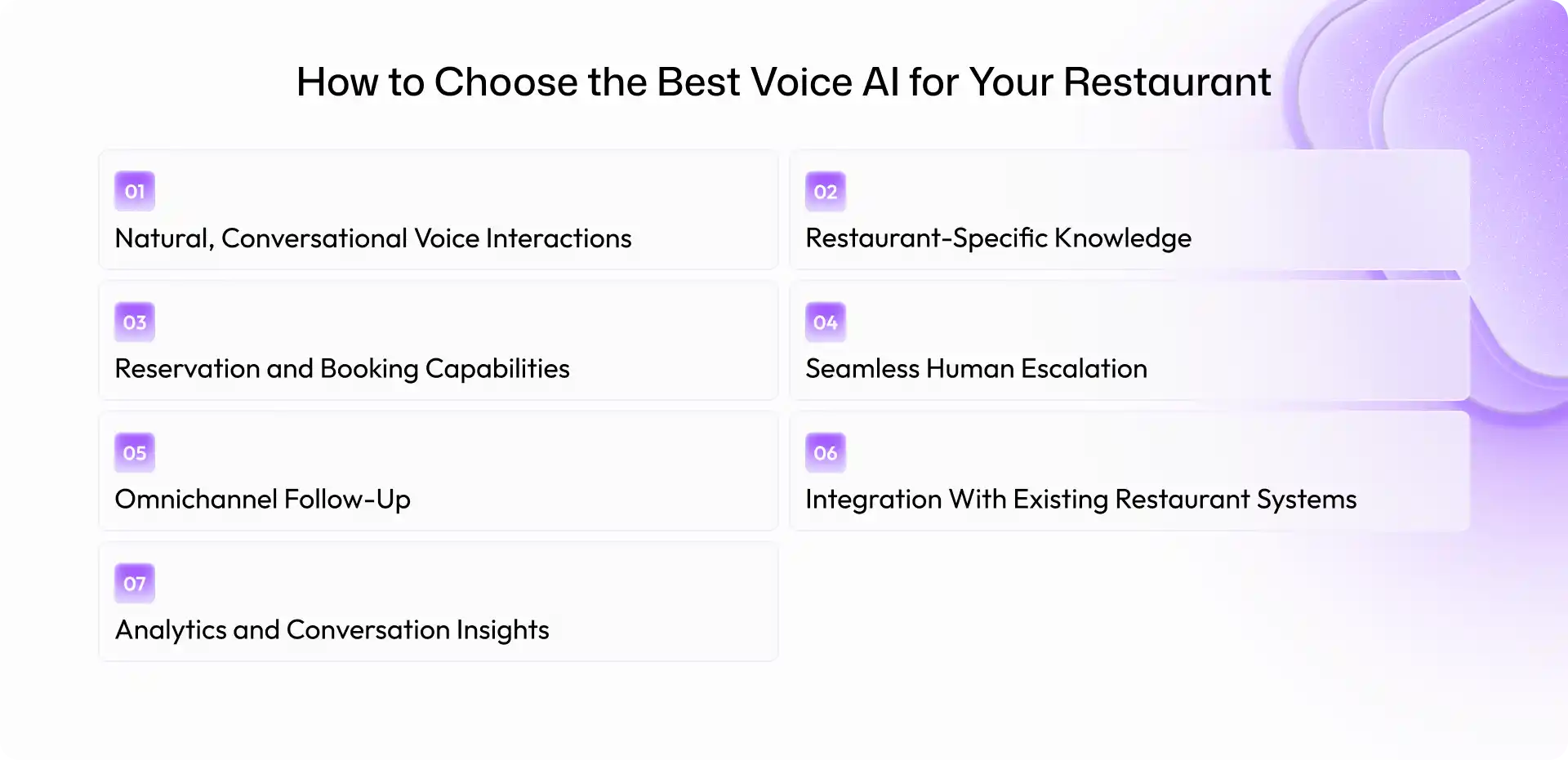
Natural Conversations That Don't Feel Like Phone Trees
Guests should be able to speak naturally instead of memorizing commands or navigating a rigid phone tree. The conversation should be clear, quick, and easy to follow.
Accurate Knowledge of Your Restaurant
The AI should understand information relevant to the restaurant, including:
Hours
Menu information
Reservation policies
Location
Parking
Events
Frequently asked questions
That information should also be easy to update.
Reservation and Booking Capabilities
If reservations are important to the business, the AI should support the restaurant's actual booking workflow. Depending on integrations, that may include checking availability, collecting booking information, confirming details, or escalating requests.
Easy Escalation to Your Team
Guests should have a clear path to a person when needed. This is especially important for complaints, unusual requests, and situations outside the AI's defined capabilities.
Voice, SMS, and Email Working Together
Phone support should not have to exist on its own. A stronger customer communication strategy can connect voice with:
SMS
Email
Reservation communication
Other guest messaging channels
Integration With Existing Restaurant Systems
The value of Voice AI increases when it can work with the systems a restaurant already uses. Depending on the setup, that might include reservation platforms, POS systems, CRM tools, or other restaurant software.
Analytics and Conversation Insights
The AI should also help the restaurant understand what guests are asking. Useful insights include:
Common questions
Call volume
Frequently requested information
Human escalation points
Areas where guests experience friction
That information can help restaurants improve both their AI workflows and their broader customer-service process.
How to Implement Voice AI Without Disrupting the Guest Experience
Restaurants don't need to automate everything at once. Starting small is often the smarter approach.
Start With Repetitive Customer Interactions
Identify the questions staff answer repeatedly. Operating hours, reservations, parking, and common policies are often good starting points.
Set Clear Boundaries for What AI Handles
Set clear boundaries before deployment. Decide what the AI can answer, what it can book, and when it should transfer the conversation to staff.
Train the System on Accurate Restaurant Information
The AI needs current information about:
Hours
Menu details
Reservation policies
Cancellation rules
Events
Holiday schedules
If something changes, the AI needs to reflect that change.
Monitor Conversations and Keep Improving
The first version will not be perfect. Guests will ask unexpected questions. Some workflows will need adjustment. That is normal. Reviewing conversations and analytics can show where the system needs improvement.
The Future of Restaurant Customer Service Is Connected
The future of restaurant customer service is not simply about using AI to answer more calls. It is about creating a connected experience across:
Voice → SMS → Email → Reservation → Visit → Follow-Up
A guest should not have to repeat the same information at every step. This is where AI voice agents for restaurants can become part of a broader customer communication strategy.
The technology handles certain repetitive interactions while people remain at the center of hospitality. That balance matters. The best restaurant technology should make service easier, not make it feel less human.
Conclusion: Better Restaurant Service Starts With Better Conversations
Voice AI is not valuable simply because it can answer a phone. Its real value comes from making the guest journey easier.
A guest can get an answer when they have a question, receive help with a reservation, get useful information before arriving, and continue the conversation after the visit. Meanwhile, restaurant employees can spend less time handling repetitive calls and more time taking care of the people in front of them.
That is the opportunity with Voice AI for restaurants. Not replacing hospitality. Reducing the friction around it.
For restaurants considering AI voice agents, a practical starting point is to identify repetitive conversations, define clear automation boundaries, keep information accurate, and make human escalation easy. The best restaurant technology should give your team more time to do what they do best: take care of guests.

Frequently Asked Questions About Restaurant Voice AI
1. How does Voice AI improve customer service in restaurants?
Voice AI can answer calls quickly, handle common questions, support reservations, provide information 24/7, and reduce routine interruptions for restaurant staff. This can create a faster and more consistent guest experience.
2. What can a Voice AI agent do for a restaurant?
It can answer FAQs, provide restaurant information, assist with reservations, collect guest details, confirm information, and transfer conversations to staff when human assistance is needed.
3. Can Voice AI answer restaurant calls 24/7?
Yes. Voice AI can provide approved information and handle supported requests outside normal business hours.
4. Does Voice AI replace restaurant employees?
It doesn't have to. Voice AI is best suited to repetitive, predictable interactions, while employees continue handling hospitality, complex requests, complaints, and situations requiring human judgment.
5. What should restaurants look for in the best AI voice agent?
Restaurants should evaluate conversational quality, restaurant-specific knowledge, reservation capabilities, human escalation, integrations, omnichannel support, and analytics.
6. Can Voice AI handle complex customer requests?
It can handle defined workflows, but complex or sensitive situations should have a clear path to human staff. A good system should know when to escalate rather than guess.
Shravan Rajpurohit
CEO & Co-Founder
Shravan Rajpurohit is the Co-Founder & CEO of The Intellify, a leading Custom Software Development company that empowers startups, product development teams, and Fortune 500 companies. With over 10 years of experience in marketing, sales, and customer success, Shravan has been driving digital innovation since 2018, leading a team of 50+ creative professionals. His mission is to bridge the gap between business ideas and reality through advanced tech solutions, aiming to make The Intellify a global leader. He focuses on delivering excellence, solving real-world problems, and pushing the limits of digital transformation.

Stay Updated
with AI Insights
Get the latest articles on AI, automation, and enterprise technology delivered to your inbox weekly.

500+ people have already subsribed!
No spam. Unsubscribe anytime.