
Why Dental Practices Are Losing Patients to After-Hours Competitors


Summary: Every missed after-hours call is a missed opportunity to gain a new patient. This blog explores why dental practices lose patients to competitors outside business hours, the impact of unanswered calls on revenue and growth, and how an AI-powered dental answering service helps answer every call, book appointments in real time, and handle emergencies. Discover how 24/7 AI voice agents help practices improve patient acquisition without increasing front desk workload.
It is 6:50 p.m. in Houston, and a patient with a cracked molar is scrolling through search results, calling one dental office after another. The first three calls go to voicemail. The fourth one, a practice twenty minutes further away, picks up on the second ring. That practice books the appointment, and the three offices that never answered never even know a new patient walked past them tonight.
This scene explains why so many practices are rethinking their after-hours dental answering service in 2026. Patients no longer wait for business hours to search for care, and the practice that answers first usually wins the patient for life, not just for one visit.
This article looks at why after-hours call gaps are costing practices real growth, what an always-on answering solution actually involves, and how practices in Austin, Dallas, San Antonio, and beyond are closing the gap without hiring a night shift.
The After-Hours Gap Is Bigger Than Most Practices Realize
Most dental offices close their phone lines at 5 p.m., yet patient demand does not follow that schedule. Evenings, weekends, and lunch hours are exactly when people finally have time to call around, compare options, and book care for themselves or their kids.
According to a 2026 Becker's Dental Review analysis, the average dental practice misses about 30% of its inbound calls. Every one of those missed calls during off-hours is a patient actively looking for a dentist right now, and a meaningful share of them will simply call the next name on the list instead of waiting for a callback.
Moreover, speed matters more than practices tend to assume. A landmark Harvard Business Review study of 2,241 companies found that businesses that responded to a new inquiry within an hour were nearly seven times more likely to qualify that lead than those that waited longer. The same study found only 37% of companies responded within an hour, and 23% never responded at all. Dentistry is not a B2B sales pipeline, but the underlying behavior is identical: a caller in pain or urgent need does not wait around.
Practices miss close to a third of incoming calls on average (Becker's Dental Review, 2026)
Callers reached within an hour are nearly 7x more likely to convert than those reached later (Harvard Business Review)
An average general dentistry patient is worth roughly $514 a year, meaning a handful of missed after-hours calls adds up fast (Dental Economics, citing ADA data)
As a result, the practices losing patients after hours are not necessarily providing worse care. They are simply losing the race to answer the phone.
What an After-Hours Dental Answering Solution Actually Does
An after-hours answering solution is a system that picks up every call a practice receives outside normal business hours, whether that is 7 p.m. on a Tuesday, a Saturday afternoon, or a holiday. The strongest versions are not answering services in the traditional sense, staffed by a call center reading from a script. They are AI voice agents built specifically for dental practices, capable of understanding what a caller needs and taking real action.
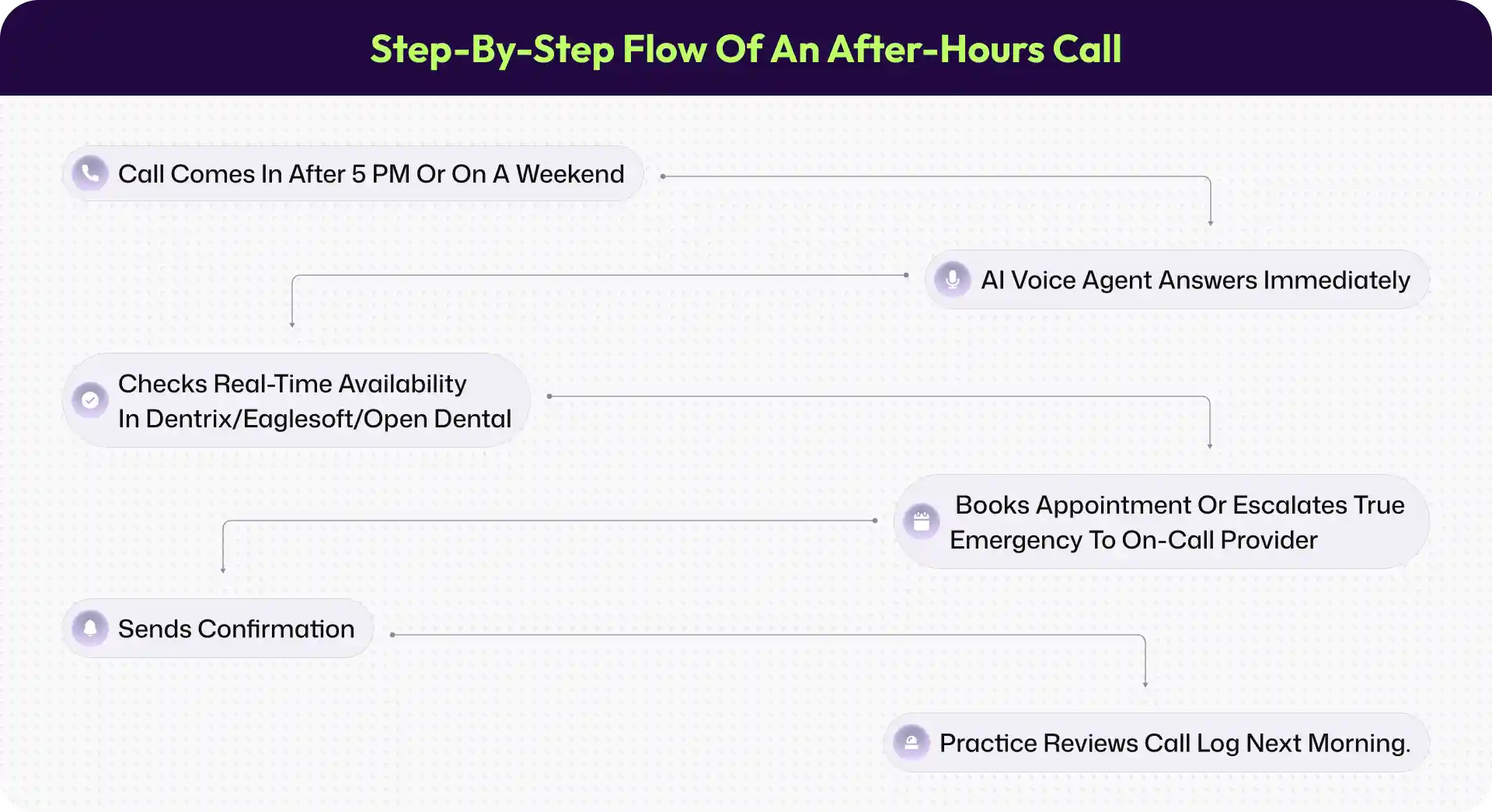
For a dentist or office manager without a technical background, think of it as a front desk that never actually closes. When a call comes in after hours, the AI voice agent checks real-time availability inside the practice's scheduling system, whether that is Dentrix, Eaglesoft, Open Dental, or Curve Dental, and books the next available appointment directly. No message gets left in a queue for a human to call back the next morning.
Furthermore, a well-built system distinguishes between a routine booking request and a true dental emergency. Routine calls get scheduled immediately. Emergency calls, such as a patient in severe pain or with facial swelling, get escalated to an on-call provider right away, so the practice never has to choose between being always-on and being safe.
Consequently, the gap tends to be worst for exactly the practices that can least afford it. Solo dentists and small group practices already run lean front desk teams, and asking one or two staff members to also monitor calls after 5 p.m. is neither sustainable nor fair. Meanwhile, larger DSOs with more resources are increasingly investing in always-on coverage, widening the responsiveness gap between well-funded groups and independent practices even further.
The Business Impact of Closing the After-Hours Gap
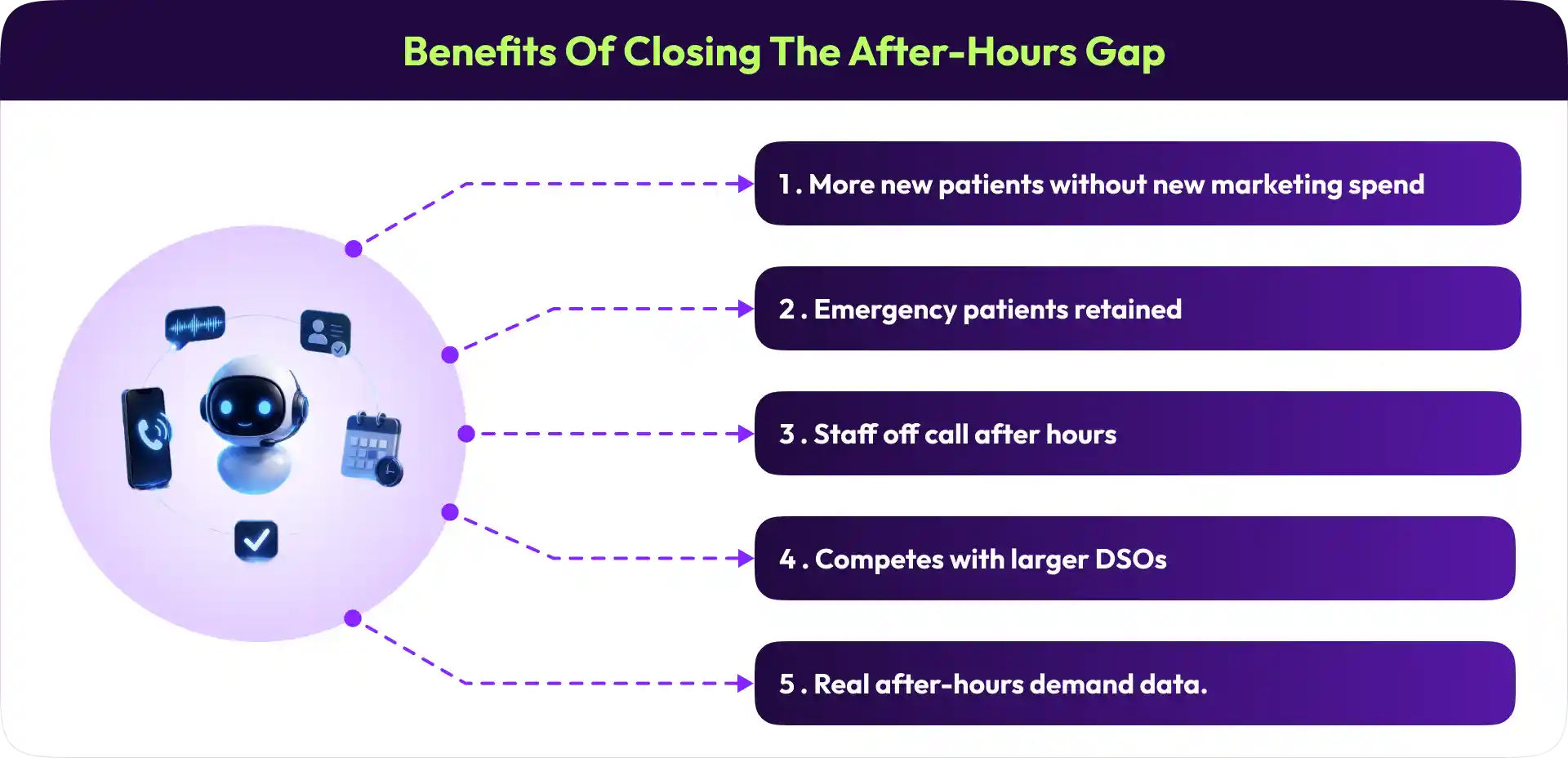
Practices that fix their after-hours coverage see the impact show up quickly, and in several different parts of the business at once.
1. New patient acquisition increases without new marketing spend. The same search traffic and referrals a practice already generates convert at a higher rate simply because someone answers the phone when the patient calls.
2. Emergency patients no longer default to urgent care or a competitor. A caller with sudden pain rarely waits until 8 a.m. A practice that answers at 9 p.m. keeps that patient, and often books a same-day or next-day visit.
3. Staff are not asked to be on call around the clock. Front desk teams get their evenings and weekends back instead of monitoring a forwarded practice line from home.
4. The practice competes with larger groups on responsiveness, not just marketing budget. A solo practice that answers every call at any hour competes directly with a well-funded DSO down the street.
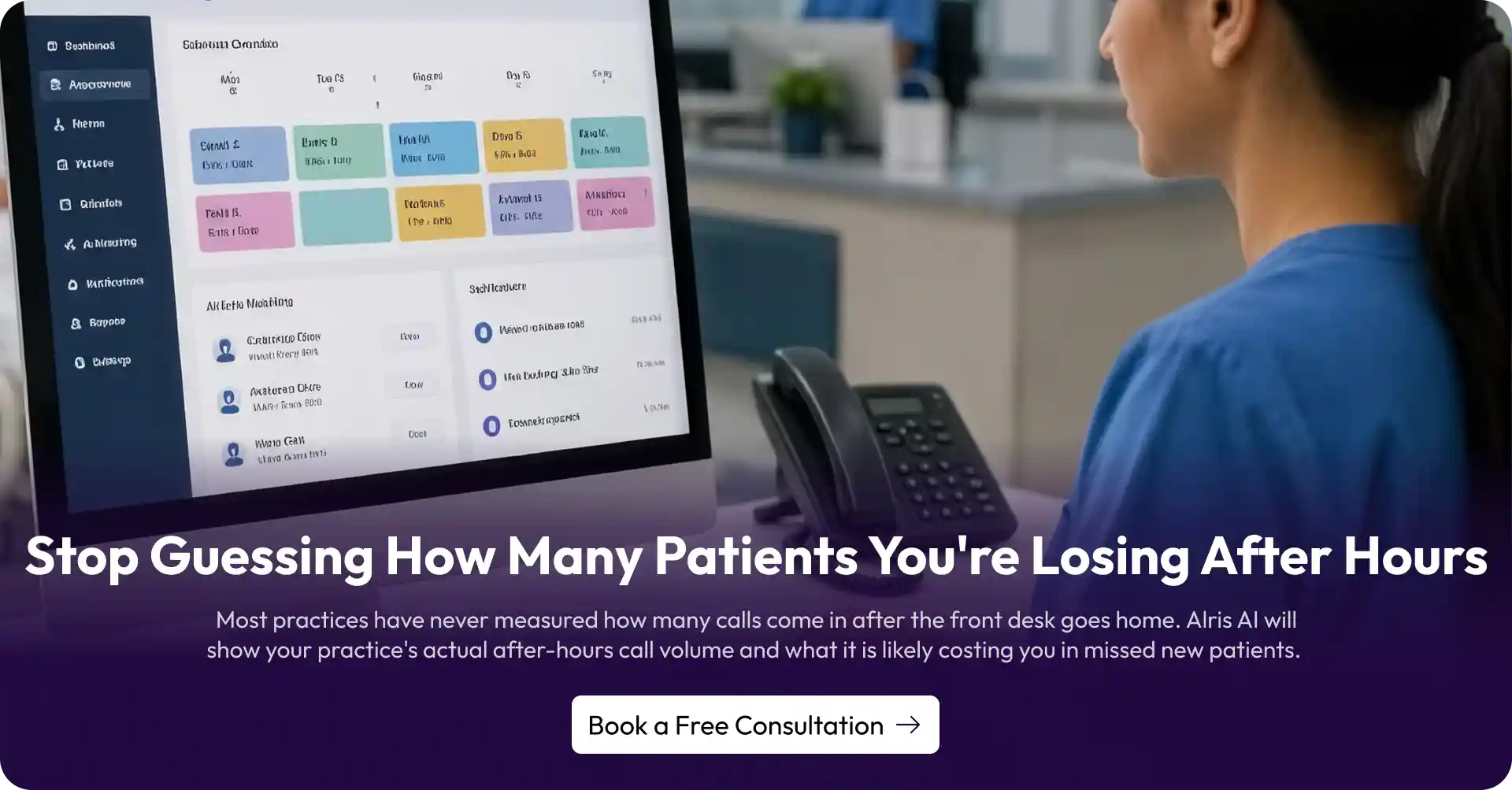
5. Reporting shows exactly what after-hours demand looks like. Instead of guessing how many patients call outside business hours, the practice gets real call volume and conversion data to inform staffing and scheduling decisions.
How After-Hours Coverage Plays Out Across Different Practices
A solo practice in Austin with one dentist and a two-person front desk previously let every call after 5 p.m. roll to voicemail. After adding an AI voice agent, the practice now books appointments overnight and on weekends without asking staff to carry a work phone home.
A group practice with locations in Dallas and Plano centralized after-hours coverage across all sites through a single AI voice agent, so a call to any location gets answered the same way, at any hour, regardless of which office's staff happen to be off that day.
A DSO managing practices across San Antonio and El Paso uses after-hours coverage as a standard part of onboarding every new acquisition, closing a gap that varied wildly from office to office under the previous owners and giving regional leadership one consistent after-hours experience across the whole network.
What to Look for When Evaluating After-Hours Coverage
Not every after-hours solution is built the same way, and the difference matters for both patient experience and practice safety.
1. Ask whether the system actually books appointments in real time, or simply takes a message for staff to follow up on the next business day. A message is only marginally better than voicemail, since the patient still has to wait for a callback.
2. Ask how the system identifies and escalates true emergencies after hours. A dentist should know exactly how a call about severe pain or facial swelling gets routed, and how quickly a live provider is reached.
3. Ask whether the system integrates directly with the practice's existing scheduling software. A system that requires manual double-entry the next morning creates more work, not less.
4. Finally, ask about HIPAA-compliant AI, since after-hours calls still involve protected health information. Confirm the vendor signs a Business Associate Agreement before any patient data touches the system.
5. In addition, ask for a trial period or a pilot window before committing to a full contract. A practice should be able to see real after-hours call data, actual bookings, and escalation performance for a few weeks before deciding whether the system fits its patient population and call volume.
Where After-Hours Dental Coverage Is Headed
Three shifts are likely over the next 12 to 18 months.
1. More practices will treat after-hours coverage as table stakes rather than a premium add-on, the same way online scheduling became standard a decade ago.
2. AI voice agents will get better at handling more complex after-hours requests, such as insurance questions and treatment plan follow-ups, not just basic booking.
3. Patient expectations will keep shifting toward around-the-clock access, meaning practices that wait to address the gap will find it harder to catch up as competitors normalize 24/7 responsiveness.
Conclusion
The practices winning new patients in 2026 are not necessarily the ones with the best marketing. They are the ones that answer the phone. An after-hours dental answering service built on a real AI voice agent turns evenings, weekends, and holidays from a revenue gap into a competitive advantage, without asking staff to give up their personal time. Practices in Austin, Dallas, Houston, San Antonio, El Paso, and Plano that close this gap now are the ones still getting the call when a patient searches at 6:50 p.m. on a Tuesday.
Frequently Asked Questions (FAQs)
1. What counts as an after-hours dental answering service?
It is any system that answers and handles patient calls outside a practice's normal business hours, including evenings, weekends, and holidays. The strongest versions are AI voice agents that book real appointments rather than simply taking a message.
2. Do patients actually call dental offices after hours?
Yes. Evenings and weekends are common times for patients to search for a new dentist or handle an urgent issue, since that is when they finally have time to make the call. Practices that only answer during business hours miss this demand entirely.
3. Will an AI voice agent handle a real dental emergency correctly?
A properly built system is trained to recognize signs of a true emergency, such as severe pain or swelling, and escalates the caller to an on-call provider immediately rather than booking a routine appointment.
4. Is after-hours coverage expensive to add?
It is typically far less expensive than hiring after-hours staff or paying overtime, since an AI voice agent handles unlimited call volume for a flat monthly cost rather than an hourly wage.
5. Does after-hours coverage replace my regular front desk team?
No. It extends coverage into the hours your team is not working, so patients calling at 8 a.m. still reach your regular staff, while patients calling at 8 p.m. still get answered instead of sent to voicemail.
6. How quickly can a practice add after-hours coverage?
Most dental-specific AI voice agents can be configured and live within a few weeks, including integration with the practice's existing scheduling software and testing of the emergency escalation process.
7. Is patient data safe during an after-hours call?
It should be, provided the vendor signs a Business Associate Agreement and encrypts call data in transit and at rest. Confirm this before any after-hours system goes live with real patient calls.
Sources & References:
1. Becker's Dental Review. "AI in dental operations" 2026.
2. "The Short Life of Online Sales Leads." Harvard Business Review.
3. "Phone calls: Are you losing patients at 'Hello'?" Dental Economics.
4. U.S. Bureau of Labor Statistics. "Receptionists: Occupational Outlook Handbook." 2025.
5. American Dental Association Health Policy Institute. "Dental Hygienist Shortage." 2026.
Shravan Rajpurohit
CEO & Co-Founder
Shravan Rajpurohit is the Co-Founder & CEO of The Intellify, a leading Custom Software Development company that empowers startups, product development teams, and Fortune 500 companies. With over 10 years of experience in marketing, sales, and customer success, Shravan has been driving digital innovation since 2018, leading a team of 50+ creative professionals. His mission is to bridge the gap between business ideas and reality through advanced tech solutions, aiming to make The Intellify a global leader. He focuses on delivering excellence, solving real-world problems, and pushing the limits of digital transformation.

Stay Updated
with AI Insights
Get the latest articles on AI, automation, and enterprise technology delivered to your inbox weekly.

500+ people have already subsribed!
No spam. Unsubscribe anytime.