
AI Host That Answers Your Restaurant Guests 24/7



Summary: An AI host answers your restaurant’s phone, books reservations, and handles guest questions around the clock, so your human host can stay with guests at the door. This guide covers what it does, how a call works, the US business case, and what independent restaurants should check before choosing one in 2026.
Saturday, 7:15. A party of four is standing at the door, the waitlist is up to six names, and the phone has rung three times in two minutes. The host can't be in two places. Something gives, and it's usually the phone.
A restaurant host really does three jobs at once: the door, the phone, and the waitlist. The door needs a person. The other two mostly don't.
That's where an AI host for restaurants comes in. It picks up the calls, books the tables, and keeps the waitlist moving, so your human host can stay with the guests in front of them. This guide explains what it does, where it stops, and what to check before you buy. It's written for US restaurant owners and operators.
What Is an AI Host for Restaurants?
An AI host is software that answers your restaurant's phone, understands what the caller wants, and handles it in normal conversation. It books and changes reservations, answers common questions, and passes anything tricky to your staff.
It isn't an IVR, which makes callers press buttons. It isn't an online booking widget, which only helps people already on your website. And it isn't a human answering service that takes a message and leaves you to call back. The AI host finishes the job during the call.
What it doesn't do matters just as much. It can't seat a guest, read a room, or calm down someone who's upset at the table. The welcome stays human, and that's the part guests remember.
What a Restaurant Host or Hostess Does, and Where AI Solutions Help
The host or hostess greets guests, seats them, answers the phone, manages reservations and the waitlist, and fields questions about everything from parking to allergens. That's a lot for one stand.
The trouble is timing. Calls and walk-ins peak together, right at the rush. The BLS puts the mean host wage at $15.72 an hour, and accommodation and food services has one of the highest quit rates of any US sector (BLS JOLTS). Roles like this turn over a lot, and every new hire has to learn the phone all over again.
AI solutions for the restaurant host or hostess role target exactly that overlap. They take the phone and waitlist work off the stand. Honestly, the phone is the part of the job that never fits. It interrupts everything else.
How an AI Host Answers Guests 24/7
Coverage is the main reason to look at this. An AI host answers during the rush, after closing, on weekends, and on holidays, with nobody scheduled to do it.
Reservations: books, changes, and cancels, then texts a confirmation.
Waitlist: adds callers and texts them when a table opens. Ask any provider exactly how its waitlist works before you rely on it.
FAQs: hours, parking, allergens, specials.
Takeout orders: where it's connected to your POS.
Large parties and events: captures the details and hands them to a manager.
Reminders matter too. OpenTable found 28% of Americans missed a reservation in the past year. Deposits cut no-shows by 57% on average, but that figure is for deposits, not reminders, so don't expect the same result from texts alone. Reminders still help, and they go out without anyone having to remember.
Peak hours are where this pays off most. During a Friday rush, calls arrive faster than anyone can pick up. The AI answers all of them at once, so no caller sits on hold or gets sent to voicemail, and you host stays at the stand.
What Happens at 11pm?
Here's one call. A guest rings at 11:05 on a Friday and asks for a table for four on Saturday at 7. The AI checks availability, offers 7:15, books it, and texts a confirmation. The guest also asks whether the pasta can be made gluten-free, and the AI answers from the menu you loaded.
Then a second guest calls about a 30-person private event. The AI doesn't try to quote it. It captures the date, headcount, and contact details, and flags it for the manager.
In the morning, you open a list of bookings and a summary of the calls, not a pile of voicemails. I'd still read those summaries closely for the first couple of weeks. You learn fast where the setup needs tweaking.
AI Host vs Human Host: Who Does What
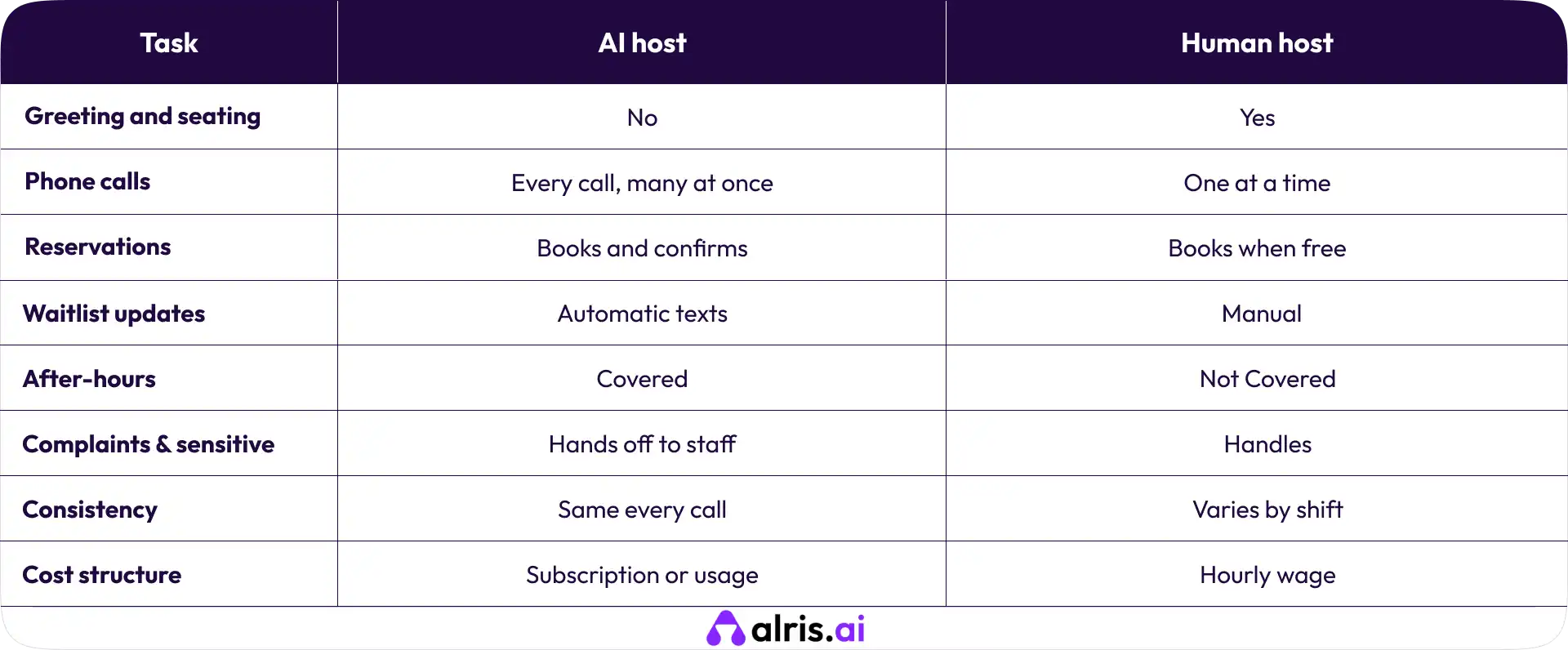
Read the table as a split of work, not a contest. The AI covers the phone and the waitlist. The human covers the room.
How an AI Host Works: A Call From Start to Finish
Call comes in
↓
AI answers on the first ring
↓
Understands the request
↓
Books, adds to the waitlist, or answers
↓
Confirms back to the caller
↓
Reservation system or POS updates
↓
SMS confirmation goes out
↓
Reminder or follow-up triggers
Several calls can run at once, so a rush doesn't create a queue. If the AI can't resolve something, it transfers to staff with the context attached, so the guest doesn't repeat themselves. Alris AI runs voice, SMS, WhatsApp, and email from one platform, so the confirmation and reminder come from the same system that took the call.
The Business Case for an AI Host in US Restaurants
The numbers explain why operators are looking. The NRA's 2026 State of the Restaurant Industry report found 42% of operators were unprofitable in 2025. Full-service labor runs a median 36.5% of sales, and net margin is 2.8% (NRA 2025). There isn't much room to add headcount for the phone.
Operators are open to the idea. Toast's 2025 survey of 712 decision-makers (operations with 16 or fewer locations) found 86% are comfortable using AI and 81% plan to use more. The NRA found 74% say technology augments labor rather than replaces it. Only about 6% use AI for customer orders, so there's still room to move early.
Run your own math: weekly hours your host spends on the phone × $19.65, which is the $15.72 BLS wage plus payroll costs. Say it's 10 hours a week. That's roughly $10,200 a year. The 10 hours is an assumption, so use your real number.
For takeout, direct orders also skip the 15-30% commission on delivery apps (DoorDash, Uber Eats, and Grubhub rate cards).
Best AI Host for Independent Restaurants: What to Look For
Independents have no IT team and little patience for long setups. If you run one location, start there. A single-site trial tells you more than any demo will. Check these:
Menu and modifier handling built for restaurants
Native POS integration (Toast, Square, Clover) and reservation sync
Real 24/7 coverage, not extended hours
SMS confirmations and outbound reminders
English and Spanish, tested with real calls
Setup you can finish without an IT team
State rules: call-recording consent and AI disclosure vary by state
Clear pricing. Published vendor pricing runs roughly $199 to $600 per location per month (mid-2026).
Questions to ask any provider:
Can I test it with my real menu?
Which POS integrations are native?
What happens at 11pm?
How does the waitlist work?
What's the full monthly cost at my call volume?
How to Set Up an AI Host
Map your busiest call and waitlist windows.
Load your menu, hours, and party-size rules.
Connect your POS and reservation system.
Test a rush scenario and an after-hours call.
Run it alongside your current setup for one to two weeks, then adjust.
Don't skip step 5. Seeing it work next to your real calls is what builds your team's trust in it. Hosts who see the AI catch the calls they couldn’t reach tend to stop worrying about being replaced. Tell your team early what it will and won’t take over, and ask them what the first week got wrong.
Common Mistakes
Treating it as a replacement for hospitality. It handles the phone, not the welcome.
Skipping integration. Without POS or reservation sync, someone re-enters everything by hand.
Not testing after-hours. The title promises 24/7, so check that it delivers at 11pm.
No handoff rules. Decide in advance what goes to a manager: large parties, complaints, events.
Choosing on price alone. The cheap option often leaves out the features you need.
Conclusion
An AI host handles the part of the host stand that never fit: the phone and the waitlist. Your human host stays with the guests, where the job is actually about hospitality.
Keep a person for the welcome, the complaints, and the judgment calls. Let software take the 11pm reservations and the Saturday rush calls. Run your own numbers first, because your call volume and wages are the only ones that matter here.
If you want to see how that works with voice, SMS, and email on one platform, Alris AI is worth a demo.
Frequently Asked Questions (FAQs)
1. What is an AI host for restaurants?
Software that answers your restaurant's calls, books reservations, answers questions, and hands tricky calls to staff.
2. Does an AI host replace my human host?
No. It covers the phone and waitlist work. Your host still greets and seats guests and handles complaints.
3. Can an AI host manage my waitlist?
Many can add callers and text them when a table opens. Ask each provider exactly how theirs works.
4. Can it take reservations over the phone?
Yes, when it's connected to your reservation system. Without that connection, it can only take a message.
5. Does it work with my reservation system and POS?
Often, but confirm your exact systems and versions. Ask for a live test before you sign.
6. Is it suitable for independent restaurants?
Yes. Small teams have the least spare hands during a rush, so they often gain the most.
7. Will guests know it's AI?
Many won't notice, but some states have AI-disclosure rules. Plenty of restaurants simply say so in the greeting.
Shravan Rajpurohit
CEO & Co-Founder
Shravan Rajpurohit is the Co-Founder & CEO of The Intellify, a leading Custom Software Development company that empowers startups, product development teams, and Fortune 500 companies. With over 10 years of experience in marketing, sales, and customer success, Shravan has been driving digital innovation since 2018, leading a team of 50+ creative professionals. His mission is to bridge the gap between business ideas and reality through advanced tech solutions, aiming to make The Intellify a global leader. He focuses on delivering excellence, solving real-world problems, and pushing the limits of digital transformation.

Stay Updated
with AI Insights
Get the latest articles on AI, automation, and enterprise technology delivered to your inbox weekly.

500+ people have already subsribed!
No spam. Unsubscribe anytime.